
 100% FREE ACCESS
12th Standard CBSE Syllabus & Materials
12th Standard CBSE
CBSE 12th Economics Government Budget and the Economy Previous year Question Papers Study Material - QB365 Set A
NEW12th Standard CBSE
CBSE 12th Computer Science Interface Python with MySQL - New Previous year Question Papers Study Material - QB365 Set A
NEW12th Standard CBSE
CBSE 12th Computer Science Database Concept - New Previous year Question Papers Study Material - QB365 Set A
NEW12th Standard CBSE
CBSE 12th Computer Science Data Communication - New Previous year Question Papers Study Material - QB365 Set A
NEW12th Standard CBSE
CBSE 12th Computer Science Data Structures - New Previous year Question Papers Study Material - QB365 Set A
NEW12th Standard CBSE
CBSE 12th Computer Science Functions - New Previous year Question Papers Study Material - QB365 Set A

Published on: 18/07/2019
Download CBSE Class 12th Standard CBSE Maths question papers, sample papers, important questions, and previous year solved papers in PDF format. Get free study materials, NCERT solutions, and exam preparation resources for Class 12th Standard CBSE Maths
Questions + Answers key
Take MCQ Maths Test
1.
Given an example of a relation which is
(i) Reflexive, Symmetric and transitive
(ii) Reflexive, Symmetric and not transitive.
2.
Let f:\(X\rightarrow Y\) be a function Define a relation R on X given be R=[(a,b) ; (f(b)] Show that R is an equivalence relation ?
3.
Define Transitive Relation. Give one example.
4.
Define symmetric Relation. Give one example
5.
Define Reflexive. Give one example.
6.
If f:\(R\to R\) be defined by \(f(X)=(3-X^3)^{1\over3}\) then find fof(X).
7.
If the binary operation * defined on Q is defined as a*b=2a+b-ab, for all \(a,b\in Q,\) find the value of 3*4.
8.
Let * be a binary operation on N given by a*b=HCF(a,b), \(a,b\in N\). Write the value of 22*4.
9.
If the binary operation * on the set of integers Z is defined by a*b=a+3b2 then find the value of 2 * 4.
10.
If f(x) = x + 7 and g(x) = x - 7, \(X\in R,\) find fog(7)?
11.
Show that the binary operation * on A = R-{-1} defined as a*b = a + b for all a, b, c A is commutative and associative on A. Also find the identity element of * in A and prove that every element of A is invertible
12.
Let * be a binary operation on Q defined by a*b = \(3ab\over5\). Show that * is commutative as well as associative. Also find its identify if it exists.
13.
(Diet Problem) A dietician wishes to mix two types of food in such a way that the vitamin contents of the mixture contain at least 8 units of vitamin A and 10 units of vitamin C. Food I contains 2 unit/ kg of vitamin A and 1 unit/kg of vitamin C while food II contains 1 unit/kg of vitamin A and 2 units/kg of vitamin C. It costs Rs.50 per kg to purchase Food I and Rs.70 per kg to purchase food II.
Formulate the problem as a linear programming problem to minimise the cost of such a mixture.
14.
Minimize Z = 3x + 2y subject to the constraints:
\(x+y\ge 8,3x+5y\le 15,x\ge 0,y\ge 0.\)
15.
If a*b \(=\frac { a }{ 2 } +\frac { b }{ 3 } \)then value of 2*3 is.......
16.
If a*b = 3a + 4b, then value 3*4 is...........
1.
(i) Let
A = (1,2,3)
A x A = (1, 1) (2, 2) (3, 3) (1, 2) (2, 1) (3, 2) (2, 3) (1, 3), (3, 1)
\(\therefore\) R = {(1, 1) (1, 2) (2, 1) (2, 2) (2, 3) (1,3) (3, 3) (3,2) (3, 1)}.
(ii) R = {(1, 1) (1,2) (2,1) (2,2) (2,3), (3, 3) (3,2)}
2.
The given function is f: X → Y and relation on X is R={(a, b): f(a) = f (b)}
Reflexive Since, for every x ∈ X, we have
f'(x) = f(x)
⇒ (xx) ∈ R, ∀ ∈ X Therefore, R is reflexive.
Symmetric Let (x, y) ∈ R
Then, f(x)=f(y)
⇒ f(y)=f(x)
⇒ (y, x) ∈ R
Thus, (x, y) ∈ R ⇒ (y, x)∈ R, ∀x, y∈ X
Therefore, R is symmetric.
Transitive Let x, y, z∈ X such that
(x, y) ∈ R and (y, z) ∈ R
Given a relation 5 in \(N \times N\), defined as
(a, b) S(c, d), if a+d=b+c.
Reflexive Let (a, b) be any arbitrary element of \(N \times N\)
i.e. \((a, b) \in N \times N\), where \(a, b \in N\)
Now, as a+b=b+a
[∴ addition is commutative ]
Therefore \quad(a, b) S(a, b)
So, S is reflexive.
Symmetric \(\operatorname{Let}(a, b),(c, d) \in N \times N\), such that (a, b)
S(c, d). Then, a+d=b+c
\( \Rightarrow b+c=a+d \Rightarrow c+b=d+a \)
\(\Rightarrow (c, d) S(a, b)\)
So, S is symmetric.
Transitive Let \((a, b),(c, d),(e, f) \in N \times N\) such that (a, b) S(c, d) and (c, d) S(e, f).
Then, a+d=b+c and c+f=d+e
On adding the above equations, we get
a+d+c+f=b+c+d+e
\( \Rightarrow a+f=b+e \Rightarrow(a, b) S(e, f)\)
So, S is transitive.
Thus, S is reflexive, symmetric and transitive. Hence, S is an equivalence
3.
A relation R on a non-empty set A is called a transitive relation if (a, b), (b, c) \(\in R\) then (a, c) \(\in R\) , i.e., aRb, bRc implies aRc.
Thus a relation R on a non empty set A is said to be transitive if there exist a, b, c \(\in A\) such that (a, b)(b, c) \(\in R\) implies (a, c) . \(\in R\)
Example
Let A = (1, 2, 3, 6)
R = (3, 6) (6, 1) (3, 1)
3 R 6 and 6 R 1 \(\Rightarrow \)(3, 1) \(\in R\)
\(\therefore\) A is transitive.
4.
Symmetric Relation : A relation R on a set A is called symmetric relation if aRb implies bRa, for every a,b \(\in a\) i.,e if (a,b) \(\in R\) \(\Rightarrow \) (b,a) \(\in R\)For every a,b \(\in A\)
Example
A = (1,2,3)
A x A =(1,2) (2,1) (1,1) (2,2) (3,3) (1,3) (2,3) (3,1) (3,2 ) \(\in R\)
since (a,b) \(\in R\) (b,a) \(\in R\) for every a, b \(\in A\)
Relation is said to be symmetric
5.
Reflexive Relation : A relation R on a set A is called reflexive relation if aRa for every \(a\in A\) ; if (a, a) \(\in \) R, for every \(a\in A\)
Example let
A = [1, 2, 3]
A x A =(1, 1) (1, 2)(1, 3) (2, 1) (2, 2) (2, 3) (3, 1)(3, 2) (3, 3) \(\in R\)
Since (a, a) \(\in R\) for every \(a\in A\)
6.
\(f o f(x)=f(f(x))=F\left\{\left(3-x^3\right)^{1 / 3}\right\}=\left[3-\left\{\left(3-x^3\right)^{1 / 3}\right\}^3\right]^{1 / 3}=\left(x^3\right)^{1 / 3}=x\)
7.
\( a * b=2 a+b-a b \\ 3 * 4=2 \times 3+4-3 \times 4 \\ 3 * 4=-2 \)
8.
22 * 4 = HCF (22,4) = 2
9.
\( a * b=a+3 b^2 \\ 2 * 4=2+3(4)^2 \\ =2+3 \times 16=50 \)
10.
...................[ Since, ]
..................[ Since, ]
11.
Let a, b \(\in A\), a " b = a + b + ab
Commutatively : for all a, b \(\in A\)
.a * b = a + b + ab
= b + a + ba
= b * a
Associatively: Let a, b, c \(\in A\)
(a * b) " c = (a + b + ab) " c
= (a + b + ab) + c + (a + b + ab)c
(a * b) " c = a + b + c + ab + bc + ac + abc
a * (b * c) = a * (b + c + bc)
= a + b + c + ab + bc + ac + abc
Clearly
(a * b) * c = a * (b "c) \(\forall \) a, b, c \(\in A\)}
* is associative.
Identity: Let e \(\in A\)}such that
a * c = a
c + a + ea = a
c = 0
Identity element of A is e = O.
Inverse: Let b \(\in A\)such that
a*b = b*a = e
\(\Rightarrow \) a + b + ab = 0 and b + a + ba = 0
\(\Rightarrow \) a = -b-ab
\(\Rightarrow \) a = -b(l + a)
\(\Rightarrow \) b = \(\frac { -a }{ 1+a } \) \([\because \quad a\in A\therefore a\neq -1]\)
Invertible element of A is \(\frac { -a }{ 1+a } \) for all \(a\in A\)
12.
Here \(a*b=\frac { 3ab }{ 5 } ;a,b,\in Q\) is a binary operation:
(I) Commutativity.
For \(a,b,\in Q\),
\(a*b=\frac { 3ab }{ 5 } =\frac { 3ba }{ 5 } .\)
[\(\because \) Rational numbers are commutative under multiplication]
= b * a
Hence,'* is commutative on Q.
(II) Associativity.
For \(a,b,c\in Q,\)
\((a*b)*c=\frac { 3ab }{ 5 } *c\)
\(=\frac { 3\frac { 3ab }{ 5 } c }{ 5 } =\frac { 9abc }{ 25 } \)
And \(=\frac { 3a\frac { 3bc }{ 5 } }{ 5 } =\frac { 9abc }{ 25 } \)
Thus \(a*(b*c)=a*(b*c)\).
Hence, ' * ' is associative on Q.
(III) Let 'e' be the identity element.
Then \(a*e=a\Rightarrow e*a\Rightarrow \frac { 3ae }{ 5 } \)
\(\Rightarrow \) \(e=\frac { 5 }{ 3 } \).
Hence, the identity element = \(\frac { 5 }{ 3 } \).
13.
Let 'x' kg of food I and 'y' kg of food II be mixed. We have the table:
| Food | Amount | Unit of Vitamin A | Unit of Vitamin C | Cost (in Rs) |
| I | x kg | 2x | x | 50x |
| II | y kg | y | 2y | 70y |
| Total | 2x+y | x+2y | 50x + 70y |
Thus LLP problem is as below:
Minimize: Z=50x+70y ....(1)
Subject to:\(2x+y\ge 8\) ...(2)
\(x+2y\ge 10\) ...(3)
and \(x,y\ge 0\) ....(4)
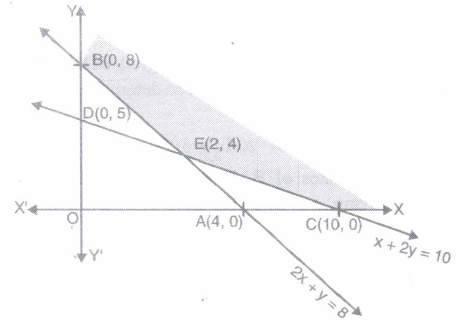
First of all, we locate the region represented by (2)-(4).
The shaded region, as shown above, is feasible region.
Applying Corner Point Method, we have:
| Corner Point | Z = 50x + 70y |
| C : (10,0) | 500 |
| E : (2,4) | 380 (Minimum) |
| B : (0,8) | 560 |
Hence, the minimum cost = Rs. 380 when 2 kg of food I and 4kg of food II are mixed.
14.
The system of constraints is:
\(x+y\ge 8\) ....(1)
\(3x+5y\le 15\)....(2)
and \(x,y\ge 0\)......(3)
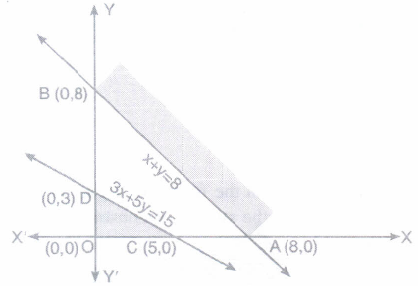
It is observed that there is no point, which satisfies all (1)-(3) simultaneously.
Thus there is no feasible region.
Hence, there is no feasible solution.
15.
\(2*3=\frac { 2 }{ 2 } +\frac { 3 }{ 2 } =1+1=2\)
16.
3*4 = 3(3) + 4(4) = 9 + 16 = 25

12th Standard CBSE Syllabus & Materials
12th Standard CBSE
CBSE 12th Computer Science Python Revision Tour I - New Previous year Question Papers Study Material - QB365 Set A
NEW12th Standard CBSE
CBSE 12th Business Studies Planning Important Questions And Answers Study Material - QB365 Set A
NEW12th Standard CBSE
CBSE 12th Business Studies Business Environment Important Questions And Answers Study Material - QB365 Set A
NEW12th Standard CBSE
CBSE 12th Business Studies Principles of Management Important Questions And Answers Study Material - QB365 Set A



CBSE 12th Standard CBSE Subjects
CBSE Standards










