
 100% FREE ACCESS
12th Standard CBSE Syllabus & Materials
12th Standard CBSE
CBSE 12th Economics Government Budget and the Economy Previous year Question Papers Study Material - QB365 Set A
NEW12th Standard CBSE
CBSE 12th Computer Science Interface Python with MySQL - New Previous year Question Papers Study Material - QB365 Set A
NEW12th Standard CBSE
CBSE 12th Computer Science Database Concept - New Previous year Question Papers Study Material - QB365 Set A
NEW12th Standard CBSE
CBSE 12th Computer Science Data Communication - New Previous year Question Papers Study Material - QB365 Set A
NEW12th Standard CBSE
CBSE 12th Computer Science Data Structures - New Previous year Question Papers Study Material - QB365 Set A
NEW12th Standard CBSE
CBSE 12th Computer Science Functions - New Previous year Question Papers Study Material - QB365 Set A

Published on: 21/05/2021
QB365 Provides the updated CASE Study Questions for Class 12 Maths, and also provide the detail solution for each and every case study questions . Case study questions are latest updated question pattern from NCERT, QB365 will helps to get more marks in Exams
Download CBSE Class 12th Standard CBSE Maths question papers, sample papers, important questions, and previous year solved papers in PDF format. Get free study materials, NCERT solutions, and exam preparation resources for Class 12th Standard CBSE Maths
Questions + Answers key
Take MCQ Maths Test
1.
Consider the following equations of curves y = cos x, y = x + 1 and y = 0. On the basis of above information, answer the following questions.
(i) The curves y = cos x and y = x + 1 meet at
| (a) (1, 0) | (b) (0, 1) | (c) (1, 1) | (d) (0,0) |
(ii) y = cos x meet the x-axis at
| (a) \(\left(\frac{-\pi}{2}, 0\right)\) | (b) \(\left(\frac{\pi}{2}, 0\right)\) | (c) both (a) and (b) | (d) None of these |
(iii) Value of the integral \(\int_{-1}^{0}(x+1) d x\) is
| (a) \(\frac{1}{2}\) | (b) \(\frac{2}{3}\) | (c) \(\frac{3}{4}\) | (d) \(\frac{1}{3}\) |
(iv) Value of the integral \(\int_{0}^{\pi / 2} \cos x d x\) is
| (a) 0 | (b) -1 | (c) 2 | (d) 1 |
(v) Area bounded by the given curves is
| (a) \(\frac{1}{2} \mathrm{sq} . \text { unit }\) | (b) \(\frac{3}{2} \text { sq. units }\) | (c) \(\frac{3}{4} \text { sq. unit }\) | (d) \(\frac{1}{4} \text { sq. unit }\) |
2.
Ajay cut two circular pieces of cardboard and placed one upon other as shown in figure. One of the circle represents the equation (x - 1)2 +1 = 1, while other circle represents the equation x2 +1 = 1.
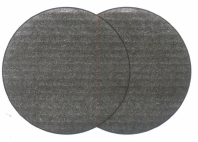
Based on the above information, answer the following questions.
(i) Both the circular pieces of cardboard meet each other at
| (a) x = 1 | (b) \(x=\frac{1}{2}\) | (c) \(x=\frac{1}{3}\) | (d) \(x=\frac{1}{4}\) |
(ii) Graph of given two curves can be drawn as

(iii) Value of \(\int_{0}^{1 / 2} \sqrt{1-(x-1)^{2}} d x\) is
| (a) \(\frac{\pi}{6}-\frac{\sqrt{3}}{8}\) | (b) \(\frac{\pi}{6}+\frac{\sqrt{3}}{8}\) | (c) \(\frac{\pi}{6}-\frac{\sqrt{3}}{8}\) | (d) \(\frac{\pi}{2}-\frac{\sqrt{3}}{4}\) |
(iv) Value of \(\int_{1 / 2}^{1} \sqrt{1-x^{2}} d x\) is
| (a) \(\frac{\pi}{6}-\frac{\sqrt{3}}{8}\) | (b) \(\frac{\pi}{6}+\frac{\sqrt{3}}{8}\) | (c) \(\frac{\pi}{6}-\frac{\sqrt{3}}{8}\) | (d) \(\frac{\pi}{2}-\frac{\sqrt{3}}{4}\) |
(v) Area of hidden portion of lower circle is
| (a) \(\left(\frac{2 \pi}{3}+\frac{\sqrt{3}}{2}\right) \text { sq. units }\) | (b) \(\left(\frac{\pi}{3}-\frac{\sqrt{3}}{8}\right) \text { sq. units }\) | (c) \(\left(\frac{\pi}{3}+\frac{\sqrt{3}}{8}\right) \text { sq. units }\) | (d) \(\left(\frac{2 \pi}{3}-\frac{\sqrt{3}}{2}\right) \text { sq. units }\) |
3.
Location of three houses of a society is represented by the points A(-1, 0), B(1, 3) and C(3, 2) as shown in figure. Based on the above information, answer the following questions
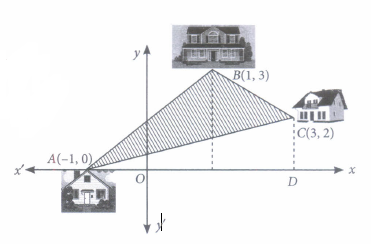
(i) Equation of line AB is
| (a) \(y=\frac{3}{2}(x+1)\) | (b) \(y=\frac{3}{2}(x-1)\) | (c) \(y=\frac{1}{2}(x+1)\) | (d) \(y=\frac{1}{2}(x-1)\) |
(ii) Equation of line BC is
| (a) \(y=\frac{1}{2} x-\frac{7}{2}\) | (b) \(y=\frac{3}{2} x-\frac{7}{2}\) | (c) \(y=\frac{-1}{2} x+\frac{7}{2}\) | (d) \(y=\frac{3}{2} x+\frac{7}{2}\) |
(iii) Area of region ABCD is
| (a) 2 sq. units | (b) 4 sq. units | (c) 6 sq. units | (d) 8 sq. units |
(iv) Area of \(\Delta A D C\) is
| (a) 4 sq. units | (b) 8 sq. units | (c) 16 sq. units | (d) 32 sq. units |
(iv) Area of \(\Delta A B C\) is
| (a) 3 sq. units | (b) 4 sq. units | (c) 5 sq. units | (d) 6 sq. units |
4.
Consider the following equation of curve I' = 4x and straight line x + y = 3.
Based on the above information, answer the following questions.
(i) The line x + y = 3 cuts the x-axis and y-axis respectively at
| (a) (0, 2), (2, 0) | (b) (3, 3), (0, 0) | (c) (0, 3), (3, 0) | (d) (3, 0), (0, 3) |
(ii) Point(s) of intersection of two given curves is (are)
| (a) (1, -2), (-9, 6) | (b) (2, 1), (-6, 9) | (c) (1, 2), (9, -6) | (d) None of these |
(iii) Which of the following shaded portion represent the area bounded by given curves?

(iv) Value of the integral \(\int_{-6}^{2}(3-y) d y\) is
| (a) 10 | (b) 20 | (c) 30 | (d) 40 |
(v) Value of area bounded by given curves is
| (a) 56 sq. units | (b) \(\frac{63}{5} \text { sq; units }\) | (c) \(\frac{64}{3} \text { sq. units }\) | (d) 31 sq. units |
5.
Consider the curve x2 +y2 = 16 and line y = x in the first quadrant. Based on the above information, answer the following questions.
(i) Point of intersection of both the given curves is
| (a) (0, 4) | (b) \((0,2 \sqrt{2})\) | (c) \((2 \sqrt{2}, 2 \sqrt{2})\) | (d) \((2 \sqrt{2}, 4)\) |
(ii) Which of the following shaded portion represent the area bounded by given two curves?

(iii) The value of the integral \(\int_{0}^{2 \sqrt{2}} x d x\) is
| (a) 0 | (b) 1 | (c) 2 | (d).4 |
(iv) The value of the integral \(\int_{2 \sqrt{2}}^{4} \sqrt{16-x^{2}} d x\) is
| (a) \(2(\pi-2)\) | (b) \(2(\pi-8)\) | (c) \(4(\pi-2)\) | (d) \(4(\pi+2)\) |
(v) Area bounded by the two given curves is
| (a) \(3 \pi \text { sq. units }\) | (b) \(\frac{\pi}{2} \text { sq. units }\) | (c) \(\pi \text { sq. units }\) | (d) \(2 \pi \text { sq. units }\) |
1.
(i) b : Curves y = cos x and y = x + 1 meet at point C(O, 1).
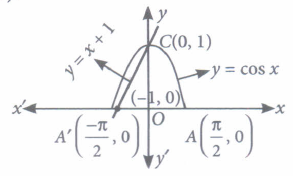
(ii) C : curve y=cosx meet the x axis at \(A^{\prime}\left(\frac{-\pi}{2}, 0\right)\) and \(A\left(\frac{\pi}{2}, 0\right)\) .
(iii) (a) : \(\int_{-1}^{0}(x+1) d x=\left[\frac{x^{2}}{2}+x\right]_{-1}^{0}=0-\left(\frac{1}{2}-1\right)=\frac{1}{2}\)
(iv) (d) : \(\int_{0}^{\pi / 2} \cos x d x=[\sin x]_{0}^{\pi / 2}=\sin \frac{\pi}{2}-\sin 0=1\)
(v) (b) : Required area \(\int_{-1}^{0}(x+1) d x+\int_{0}^{\pi / 2} \cos x d x\)
\(=\frac{1}{2}+1=\frac{3}{2} \text { sq. units }\)
2.
(i) (b) : We have, (x - 1)2+y2 = 1
\(\Rightarrow y=\sqrt{1-(x-1)^{2}}\) ...(i)
Also, \(x^{2}+y^{2}=1 \Rightarrow y=\sqrt{1-x^{2}}\) ...(ii)
From (i) and (ii), we get
\(\sqrt{1-(x-1)^{2}}=\sqrt{1-x^{2}}\)
\(\Rightarrow(x-1)^{2}=x^{2} \Rightarrow 2 x=1 \Rightarrow x=\frac{1}{2}\)
(ii) (c):
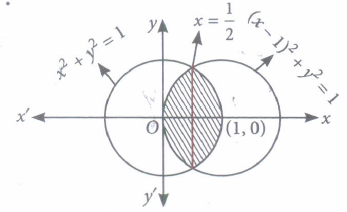
(iii) (a) : \(\int_{0}^{1 / 2} \sqrt{1-(x-1)^{2}} d x\)
\(=\left[\frac{x-1}{2} \sqrt{1-(x-1)^{2}}+\frac{1}{2} \sin ^{-1}\left(\frac{x-1}{1}\right)\right]_{0}^{1 / 2}\)
\(\begin{array}{r} =\frac{1}{2}\left(\frac{1}{2}-1\right) \sqrt{1-\frac{1}{4}}+\frac{1}{2} \sin ^{-1}\left(-\frac{1}{2}\right)-\left(-\frac{1}{2}\right)(0) -\frac{1}{2} \sin ^{-1}(-1) \end{array}\)
\(=\left[\frac{-1}{4} \cdot \frac{\sqrt{3}}{2}-\frac{1}{2} \cdot \frac{\pi}{6}+0+\frac{1}{2} \cdot \frac{\pi}{2}\right]=\frac{-\sqrt{3}}{8}-\frac{\pi}{12}+\frac{\pi}{4}\)
\(=\frac{\pi}{6}-\frac{\sqrt{3}}{8}\)
(iv) (c : \(\int_{1 / 2}^{1} \sqrt{1-x^{2}} d x=\left[\frac{x}{2} \sqrt{1-x^{2}}+\frac{1}{2} \sin ^{-1} x\right]_{1 / 2}^{1}\)
\(=0+\frac{1}{2} \sin ^{-1}(1)-\frac{1}{4} \sqrt{1-\frac{1}{4}}-\frac{1}{2} \sin ^{-1}\left(\frac{1}{2}\right)\)
\(=\frac{\pi}{4}-\frac{\sqrt{3}}{8}-\frac{\pi}{12}=\frac{\pi}{6}-\frac{\sqrt{3}}{8}\)
(v) (d) : Required area
\(=2\left[\int_{0}^{1 / 2} \sqrt{1-(x-1)^{2}} d x+\int_{1 / 2}^{1} \sqrt{1-x^{2}} d x\right]\)
\(=2\left[\frac{\pi}{6}-\frac{\sqrt{3}}{8}+\frac{\pi}{6}-\frac{\sqrt{3}}{8}\right]\)
\(=2\left[\frac{\pi}{3}-\frac{\sqrt{3}}{4}\right]=\left(\frac{2 \pi}{3}-\frac{\sqrt{3}}{2}\right) \text { sq. units }\)
3.
(i) (a) : Equation of line AB is
\(y-0=\frac{3-0}{1+1}(x+1) \Rightarrow y=\frac{3}{2}(x+1)\)
(ii) (c) : Equation of line BC is \(y-3=\frac{2-3}{3-1}(x-1)\)
\(\Rightarrow y=-\frac{1}{2} x+\frac{1}{2}+3 \Rightarrow y=\frac{-1}{2} x+\frac{7}{2}\)
(iii) (d) : Area of region ABCD
= Area of \(\triangle A B E\) + Area of region BCDE
\(=\int_{-1}^{1} \frac{3}{2}(x+1) d x+\int_{1}^{3}\left(\frac{-1}{2} x+\frac{7}{2}\right) d x\)
\(=\frac{3}{2}\left[\frac{x^{2}}{2}+x\right]_{-1}^{1}+\left[\frac{-x^{2}}{4}+\frac{7}{2} x\right]_{1}^{3}\)
\(=\frac{3}{2}\left[\frac{1}{2}+1-\frac{1}{2}+1\right]+\left[\frac{-9}{4}+\frac{21}{2}+\frac{1}{4}-\frac{7}{2}\right]\)
= 3 + 5 = 8 sq. units
(iv) (a) : Equation of line AC is \(y-0=\frac{2-0}{3+1}(x+1)\)
\(\Rightarrow y=\frac{1}{2}(x+1)\)
\(\therefore \text { Area of } \Delta A D C=\int_{-1}^{3} \frac{1}{2}(x+1) d x=\left[\frac{x^{2}}{4}+\frac{1}{2} x\right]_{-1}^{3}\)
\(=\frac{9}{4}+\frac{3}{2}-\frac{1}{4}+\frac{1}{2}=4 \text { sq. units }\)
(v) (b) : Area of \(\Delta A B C\)= Area of region ABCD - Area of \(\Delta A C D=8-4=4 \mathrm{sq} . \text { units }\)
4.
(i) (d) : Line x + y = 3 cuts the x-axis and y-axis at (3, 0) and (0, 3) respectively
[Since, at x-axis, y = 0 and at y-axis, x = 0]
(ii) (c) : We have, y2 = 4x and x + y = 3
From (i) and (ii), we have y2 = 4(3 - y)
\(\Rightarrow y^{2}+4 y-12=0 \Rightarrow y^{2}+6 y-2 y-12=0\)
\(\Rightarrow y(y+6)-2(y+6)=0\)
\(\Rightarrow (y+6)(y-2)=0 \Rightarrow y=2, y=-6\)
From (ii), x = 3 - 2 = 1 or x = 3 + 6 = 9
\(\therefore\) Required points of intersection are (1, 2), (9, - 6)
(iii) (b) :
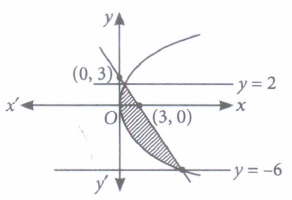
(iv) (d): \(\int_{-6}^{2}(3-y) d y=\left[3 y-\frac{y^{2}}{2}\right]_{-6}^{2}\)
\(=\left[6-\frac{4}{2}-\left[3(-6)-\frac{(-6)^{2}}{2}\right]\right]=4+36=40\)
(v) (c): Required area = \(\int_{-6}^{2}(3-y) d y-\int_{-6}^{2} \frac{y^{2}}{4} d y\)
\(=40-\frac{1}{4}\left[\frac{y^{3}}{3}\right]_{-6}^{2}=40-\frac{1}{4}\left[\frac{8}{3}-\frac{(-6)^{3}}{3}\right]\)
\(=40-\frac{2}{3}-\frac{216}{12}=\frac{480-8-216}{12}=\frac{256}{12}=\frac{64}{3} \mathrm{sq} . \text { units }\)
5.
(i) (c) : We have, x2 +y2= 16 ..(i)
and y = x ...(ii)
From (i) and (ii), \(2 x^{2}=16 \Rightarrow x^{2}=8 \Rightarrow x=2 \sqrt{2}\) (\(\therefore\) x lies in first quadrant)
\(\therefore\) Point of intersection of (i) and (ii) in first quadrant is \((2 \sqrt{2}, 2 \sqrt{2})\) .
(ii) (b) : The shaded region which represent the areabounded by two given curves in first quadrant is shown below.
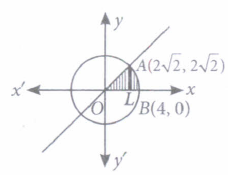
(iii)( d) : \(\int_{0}^{2 \sqrt{2}} x d x=\left[\frac{x^{2}}{2}\right]_{0}^{2 \sqrt{2}}=\frac{(2 \sqrt{2})^{2}}{2}=\frac{8}{2}=4\)
(iv) (a) : \(\int_{2 \sqrt{2}}^{4} \sqrt{16-x^{2}} d x=\left[\frac{x}{2} \sqrt{16-x^{2}}+\frac{16}{2} \cdot \sin ^{-1}\left(\frac{x}{4}\right)\right]_{2 \sqrt{2}}^{4}\)
\(=8 \sin ^{-1}(1)-4-8 \sin ^{-1}\left(\frac{1}{\sqrt{2}}\right)\)
\(=8\left(\frac{\pi}{2}\right)-4-8\left(\frac{\pi}{4}\right)=4 \pi-4-2 \pi=2 \pi-4=2(\pi-2)\)
(v) (d) : Required area = Area (OLA) + Area (BAL)
\(=\int_{0}^{2 \sqrt{2}} x d x+\int_{2 \sqrt{2}}^{4} \sqrt{16-x^{2}} d x\)
\(=4+2(\pi-2)=2 \pi \text { sq. units. }\)

12th Standard CBSE Syllabus & Materials
12th Standard CBSE
CBSE 12th Computer Science Python Revision Tour I - New Previous year Question Papers Study Material - QB365 Set A
NEW12th Standard CBSE
CBSE 12th Business Studies Planning Important Questions And Answers Study Material - QB365 Set A
NEW12th Standard CBSE
CBSE 12th Business Studies Business Environment Important Questions And Answers Study Material - QB365 Set A
NEW12th Standard CBSE
CBSE 12th Business Studies Principles of Management Important Questions And Answers Study Material - QB365 Set A



NCERT Books

Syllabus

Exam Pattern

Sample Question Papers

Previous year Question Papers

Important Notes

MCQ Practice test

NCERT Exemplers

Case study Questions

Image Based Questions

Passage based Questions

HOT Questions

Value Based Questions

Model Questions Papers
NCERT ( Book Back ) Questions

Assertion and Reason
Important Questions And Answers

CBSE 12th Standard CBSE Subjects
CBSE Standards








