
 100% FREE ACCESS
12th Standard CBSE Syllabus & Materials
12th Standard CBSE
CBSE 12th Economics Government Budget and the Economy Previous year Question Papers Study Material - QB365 Set A
NEW12th Standard CBSE
CBSE 12th Computer Science Interface Python with MySQL - New Previous year Question Papers Study Material - QB365 Set A
NEW12th Standard CBSE
CBSE 12th Computer Science Database Concept - New Previous year Question Papers Study Material - QB365 Set A
NEW12th Standard CBSE
CBSE 12th Computer Science Data Communication - New Previous year Question Papers Study Material - QB365 Set A
NEW12th Standard CBSE
CBSE 12th Computer Science Data Structures - New Previous year Question Papers Study Material - QB365 Set A
NEW12th Standard CBSE
CBSE 12th Computer Science Functions - New Previous year Question Papers Study Material - QB365 Set A

Published on: 21/05/2021
QB365 Provides the updated CASE Study Questions for Class 12 Maths, and also provide the detail solution for each and every case study questions . Case study questions are latest updated question pattern from NCERT, QB365 will helps to get more marks in Exams
Download CBSE Class 12th Standard CBSE Maths question papers, sample papers, important questions, and previous year solved papers in PDF format. Get free study materials, NCERT solutions, and exam preparation resources for Class 12th Standard CBSE Maths
Questions + Answers key
Take MCQ Maths Test
1.
If a relation between x and y is such that y cannot be expressed in terms of x, then y is called an implicit function of x.
When a given relation expresses y as an implicit function of x and we want to find \(\begin{equation} \frac{d y}{d x} \end{equation}\).then
we differentiate every term of the given relation w.r.t. x. remembering that a term in y is first differentiated w.r.t. y and then multiplied by \(\begin{equation} \frac{d y}{d x} \end{equation}\).
Based on the above information, find the value of \(\begin{equation} \frac{d y}{d x} \end{equation}\) in each of the following questions
(i) x3+x2y+xy2+y3=81
| (a) \(\begin{equation} \frac{\left(3 x^{2}+2 x y+y^{2}\right)}{x^{2}+2 x y+3 y^{2}} \end{equation}\) | (b) \(\begin{equation} \frac{-\left(3 x^{2}+2 x y+y^{2}\right)}{x^{2}+2 x y+3 y^{2}} \end{equation}\) | (c) \(\begin{equation} \frac{\left(3 x^{2}+2 x y-y^{2}\right)}{x^{2}-2 x y+3 y^{2}} \end{equation}\) | (d) \(\begin{equation} \frac{3 x^{2}+x y+y^{2}}{x^{2}+x y+3 y^{2}} \end{equation}\) |
(ii) xy = c- y
| (a) \(\begin{equation} \frac{x-y}{(1+\log x)} \end{equation}\) | (b) \(\begin{equation} \frac{x+y}{(1+\log x)} \end{equation}\) | (c) \(\begin{equation} \frac{x-y}{x(1+\log x)} \end{equation}\) | (d) \(\begin{equation} \frac{x+y}{x(1+\log x)} \end{equation}\) |
(iii) esiny = xy
| (a) \(\begin{equation} \frac{-y}{x(y \cos y-1)} \end{equation}\) | (b) \(\begin{equation} \frac{y}{y \cos y-1} \end{equation}\) | (c) \(\begin{equation} \frac{y}{y \cos y+1} \end{equation}\) | (d) \(\begin{equation} \frac{y}{x(y \cos y-1)} \end{equation}\) |
(iv) sin2 x + cos2y = 1
| (a) \(\begin{equation} \frac{\sin 2 y}{\sin 2 x} \end{equation}\) | (b) \(\begin{equation} -\frac{\sin 2 x}{\sin 2 y} \end{equation}\) | (c) \(\begin{equation} -\frac{\sin 2 y}{\sin 2 x} \end{equation}\) | (d) \(\begin{equation} \frac{\sin 2 x}{\sin 2 y} \end{equation}\) |
(v) \(\begin{equation} y=(\sqrt{x})^{\sqrt{x}} \end{equation}\)
| (a) \(\begin{equation} \frac{-y^{2}}{x(2-y \log x)} \end{equation}\) | (b) \(\begin{equation} \frac{y^{2}}{2+y \log x} \end{equation}\) | (c) \(\begin{equation} \frac{y^{2}}{x(2+y \log x)} \end{equation}\) | (d) \(\begin{equation} \frac{y^{2}}{x(2-y \log x)} \end{equation}\) |
2.
Logarithmic differentiation is a powerful technique to differentiate functions of the form \(\begin{equation} f(x)=[u(x)]^{\nu(x)} \end{equation}\) ,where both u(x) and vex) are differentiable functions and f and u need to be positive functions.
Let function \(\begin{equation} y=f(x)=(u(x))^{v(x)} \end{equation}\),then \(\begin{equation} y^{\prime}=y\left[\frac{v(x)}{u(x)} u^{\prime}(x)+v^{\prime}(x) \cdot \log [u(x)]\right] \end{equation}\)
On the basis of above information, answer the following questions.
(i) Differentiate xx w.r.t. x
| (a) xx(l + log x) | (b) xx(l -log x) | (c) -xx(1 + log x) | (d) xxlogx |
(ii) Differentiate xx+ ax+aa w.r.t. x
| (a) (1 + log x) + (axlog a + axa-1 | (b) xx(1 + log x) + log a + axa-1 |
| (c) xx(1 + log x) + xa(log x + axa-1) | (d) ~(1 + log x) + aXlog a + axa-1 |
(iii) If x = ex/y,then find \(\begin{equation} \frac{d y}{d x} \end{equation}\)
| (a) \(\begin{equation} -\frac{(x+y)}{x \log x} \end{equation}\) | (b) \(\begin{equation} -\frac{(x-y)}{x \log x} \end{equation}\) | (c) \(\begin{equation} \frac{(x+y)}{x \log x} \end{equation}\) | (d) \(\begin{equation} \frac{x-y}{x \log x} \end{equation}\) |
(iv) If = (2 - x)3 + 2x)5, then find \(\begin{equation} \frac{d y}{d x} \end{equation}\)
| (a) \(\begin{equation} (2-x)^{3}(3+2 x)^{5}\left[\frac{15}{3+2 x}-\frac{8}{2-x}\right] \end{equation}\) | (b) \(\begin{equation} (2-x)^{3}(3+2 x)^{5}\left[\frac{15}{3+2 x}+\frac{3}{2-x}\right] \end{equation}\) |
| (c) \(\begin{equation} (2-x)^{3}(3+2 x)^{5}\left[\frac{10}{3+2 x}-\frac{3}{2-x}\right] \end{equation}\) | (d) \(\begin{equation} (2-x)^{3}(3+2 x)^{5} \cdot\left[\frac{10}{3+2 x}+\frac{3}{2-x}\right] \end{equation}\) |
(v) If \(\begin{equation} y=x^{x} \cdot e^{(2 x+5)} \end{equation}\) then find \(\begin{equation} \frac{d y}{d x} \end{equation}\)
| (a) xxe2x+5 | (b) xxe2x+5(3-logx) | (c) xxe2x+5(1-logx) | (d) xxe2x+5 (3+logx) |
3.
(a) A function f(x) is said to be continuous in an open interval (a, b), if it is continuous at every point in this interval.
(b) A function f(x) is said to be continuous in the closed interval [a, b], if f(x) is continuous in (a, b) and \(\begin{equation} \lim _{h \rightarrow 0} f(a+h)=f(a) \text { and } \lim _{h \rightarrow 0} f(b-h)=f(b) \end{equation}\)
If function \(\begin{equation} f(x)=\left\{\begin{array}{ll} \frac{\sin (a+1) x+\sin x}{x} & , x<0 \\ c & , x=0 \\ \frac{\sqrt{x+b x^{2}}-\sqrt{x}}{b x^{3 / 2}} & , x>0 \end{array}\right. \end{equation}\) is continuous at x = 0, then answer the following questions.
(i) The value of a is
| (a) -3/2 | (b) 0 | (c) 1/2 | (d) -1/2 |
(ii) The value of b is
| (a) 1 | (b) -1 | (c) 0 | (d) any real number |
(iii) The value of c is
| (a) 1 | (b) 1/2 | (c) -1 | (d) -1/2 |
(iv) The value of a + c is
| (a) 1 | (b) 0 | (c) -1 | (d) -2 |
(v) The value oi c - a is
| (a) 1 | (b) 0 | (c) -1 | (d) 2 |
4.
If a real valued function f(x) is finitely derivable at any point of its domain, it is necessarily continuous at that point. But its converse need not be true.
For example, every polynomial. constant function are both continuous as well as differentiable and inverse trigonometric functions are continuous and differentiable in its domains etc.
Based on the above information, answer the following questions.
(i) If \(\begin{equation} f(x)=\left\{\begin{array}{l} x, \text { for } x \leq 0 \\ 0, \text { for } x>0 \end{array}\right. \end{equation}\) , then at x = 0
| (a) f(x) is differentiable and continuous | (b) j(x) is neither continuous nor differentiable |
| (c) f(x) is continuous but not differentiable | (d) none of these |
(ii) If \(\begin{equation} f(x)=|x-1|, x \in R \end{equation}\) ,then at x= 1
| (a) f(x) is not continuous | (b) f(x) is continuous but not differentiable |
| (c) f(x) is continuous and differentiable | (d) none of these |
(iii) f(x) = x3 is
| (a) continuous but not differentiable at x = 3 | (b) continuous and differentiable at x = 3 |
| (c) neither continuous nor differentiable at x = 3 | (d) none of these |
(iv) f(x) = [sin x], then which of the following is true?
| (a) j(x) is continuous and differentiable at x = o. | (b) j(x) is discontinuous at x = o. |
| (c) j(x) is continuous at x = 0 but not differentiable | (d) fix) is differentiable but not continuous at \(\begin{equation} x=\pi / 2 \end{equation}\) |
(v) If f(x) = sin-1x, \(\begin{equation} -1 \leq x \leq 1 \end{equation}\), then
| (a) f(x) is both continuous and differentiable | (b) f(x) is neither continuous nor differentiable. |
| (c) f(x) is continuous but not differentiable | (d) None of these |
5.
Let \(\begin{equation} f: A \rightarrow B \end{equation}\) and \(\begin{equation} g: B \rightarrow C \end{equation}\) be two functions defined on non-empty sets A, B, C,
then \(\begin{equation} \text { gof }: A \rightarrow C \end{equation}\) be is called the composition off and g defined as, \(\begin{equation} g o f(x)=g\{f(x)\} \forall x \in A \end{equation}\) .
Consider the functions \(\begin{equation} f(x)=\left\{\begin{array}{ll} \sin x, & x \geq 0 \\ 1-\cos x, & x \leq 0 \end{array}, g(x)=e^{x}\right. \end{equation}\) and
then answer the following questions.
(i) The function gof(x) is defined as
| (a) \(\begin{equation} g o f(x)=\left\{\begin{array}{ll} e^{x} & , x \geq 0 \\ 1-e^{\cos x} & , x \leq 0 \end{array}\right. \end{equation}\) | (b) \(\begin{equation} \operatorname{gof}(x)=\left\{\begin{array}{ll} e^{\sin x} & , x \leq 0 \\ e^{1-\cos x} & , x \geq 0 \end{array}\right. \end{equation}\) |
| (c) \(\begin{equation} g o f(x)=\left\{\begin{array}{ll} e^{\sin x} & , x \leq 0 \\ 1-e^{\cos x} & , x \geq 0 \end{array}\right. \end{equation}\) | (d) \(\begin{equation} g o f(x)=\left\{\begin{array}{ll} e^{\sin x} & , x \geq 0 \\ e^{1-\cos x} & , x \leq 0 \end{array}\right. \end{equation}\) |
(ii) \(\begin{equation} \frac{d}{d x}\{\operatorname{gof}(x)\}= \end{equation}\)
| (a) \(\begin{equation} [g o f(x)]^{\prime}=\left\{\begin{array}{ll} \cos x \cdot e^{\sin x} & , x \geq 0 \\ e^{1-\cos x} \cdot \sin x & , x \leq 0 \end{array}\right. \end{equation}\) | (b) \(\begin{equation} [g o f(x)]^{\prime}=\left\{\begin{array}{ll} \cos x \cdot e^{\sin x} & , x \geq 0 \\ -\sin x \cdot e^{1-\cos x} & , x \leq 0 \end{array}\right. \end{equation}\) |
| (c) \(\begin{equation} [g o f(x)]^{\prime}=\left\{\begin{array}{ll} \cos x \cdot e^{\sin x} & , x \geq 0 \\ \sin x \cdot(1-\cos x) & , x \leq 0 \end{array}\right. \end{equation}\) | (d) \(\begin{equation} [g o f(x)]^{\prime}=\left\{\begin{array}{ll} \cos x \cdot e^{\sin x} & , x \geq 0 \\ (1-\sin x) \cdot e^{1-\cos x} & , x \leq 0 \end{array}\right. \end{equation}\) |
(iii) R.H.D. of gof(x) at x = 0 is
| (a) 0 | (b) 1 | (c) -1 | (d) 2 |
(iv) L.H.D. of gof(x) at x = 0 is
| (a) 0 | (b) 1 | (c) -1 | (d) 2 |
(v) The value of \(\begin{equation} f^{\prime}(x) \text { at } x=\frac{\pi}{4} \end{equation}\) is
| (a) 1/9 | (b) \(\begin{equation} 1 / \sqrt{2} \end{equation}\) | (c) 1/2 | (d) not defined |
6.
Let f(x) be a real valued function, then its
Left Hand Derivative (L.H.D.) : \(\begin{equation} \mathrm{L} f^{\prime}(a)=\lim _{h \rightarrow 0} \frac{f(a-h)-f(a)}{-h} \end{equation}\)
Right Hand Derivative (R.H.D.) : \(\begin{equation} \mathrm{Rf}^{\prime}(a)=\lim _{h \rightarrow 0} \frac{f(a+h)-f(a)}{h} \end{equation}\)
Also, a function jfx) is said to be differentiable at x = a if its L.H.D. and R.H.D. at x = a exist and are equal
For the function \(\begin{equation} f(x)=\left\{\begin{array}{l} |x-3|, x \geq 1 \\ \frac{x^{2}}{4}-\frac{3 x}{2}+\frac{13}{4}, x<1 \end{array}\right. \end{equation}\) answer the following questions
(i) R.H.D. of f(x) at x = 1is
| (a) 1 | (b) -1 | (c) 0 | (d) 2 |
(ii) L.H.D. of f(x) at x = 1 is
| (a) 1 | (b) -1 | (c) 0 | (d) 2 |
(iii) f(x) is non-differentiable at
| (a) x = 1 | (b) x = 2 | (c) x = 3 | (d) x = 4 |
(iv) Find the value of f'(2).
| (a) 1 | (b) 2 | (c) 3 | (d) -1 |
(v) The value of f'( -1) is
| (a) 2 | (b) 1 | (c) -2 | (d) -1 |
7.
Three shopkeepers Salim, Vijay and Venket are using polythene bags, handmade bags (prepared by prisoners) and newspaper's envelope as carry bags. It is found that the shopkeepers Salim, Vijay and Venket are using (20, 30, 40), (30, 40, 20) and (40, 20, 30) polythene bags, handmade bags and newspaper's envelopes respectively. The shopkeepers Salim, Vijay and Venket spent Rs. 250, Rs. 270 and Rs. 200 on these carry bags respectively.
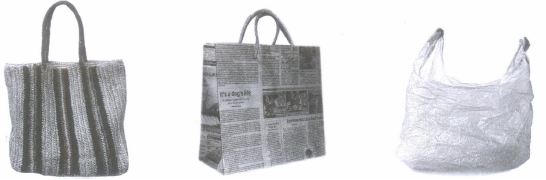
Using the concept of matrices and determinants, answer the following questions.
(i) What is the cost of one polythene bag?
| (a) Rs. 1 | (b) Rs. 2 | (c) Rs. 3 | (d) Rs. 5 |
(ii) What is the cost of one handmade bag?
| (a) Rs. 1 | (b) Rs. 2 | (c) Rs. 3 | (d) Rs. 5 |
(iii) What is the cost of one newspaper envelope
| (a) Rs. 1 | (b) Rs. 2 | (c) Rs. 3 | (d) Rs. 5 |
(iv) Keeping in mind the social conditions, which shopkeeper is better?
| (a) Salim | (b) Vijay | (c) Venket | (d) None of these |
(v) Keeping in mind the environmental conditions, which shopkeeper is better?
| (a) Salim | (b) Vijay | (c) Venket | (d) None of these |
8.
Let \(\begin{equation} A=\left[\begin{array}{ll} 1 & 0 \\ 2 & 1 \end{array}\right] \end{equation}\) , and U1 U2 are first and second columns respectively of a 2 x 2 matrix U.
Also, let the column matrices UI and U2 satisfying \(\begin{equation} A U_{1}=\left[\begin{array}{l} 1 \\ 0 \end{array}\right] \end{equation}\) and \(\begin{equation} A U_{2}=\left[\begin{array}{l} 2 \\ 3 \end{array}\right] \end{equation}\)
Based on the above information, answer the following questions
(i) The matrix U1 + U2 is equal to
| (a) \(\begin{equation} \left[\begin{array}{c} 1 \\ -1 \end{array}\right] \end{equation}\) | (b) \(\begin{equation} \left[\begin{array}{c} 2 \\ -2 \end{array}\right] \end{equation}\) | (c) \(\begin{equation} \left[\begin{array}{c} 3 \\ -3 \end{array}\right] \end{equation}\) | (d) \(\begin{equation} \left[\begin{array}{c} 4 \\ -4 \end{array}\right] \end{equation}\) |
(ii) The value of IUI is
| (a) 2 | (b) -2 | (c) 3 | (d) -3 |
(iii) If \(\begin{equation} X=\left[\begin{array}{ll} 3 & 2 \end{array}\right] U\left[\begin{array}{l} 3 \\ 2 \end{array}\right] \end{equation}\),then the value of IXI =
| (a) 3 | (b) -3 | (c) -5 | (d) 5 |
(iv) The minor of element at the position a22 in U is
| (a) 1 | (b) 2 | (c) -2 | (d) -1 |
(v) If \(\begin{equation} U=\left[a_{i j}\right]_{2 \times 2} \end{equation}\) , then the value of a11A11 + a12Al2 where Aij denotes the cofactor of aij is
| (a) 1 | (b) 2 | (c) -3 | (d) 3 |
9.
A company produces three products every day. Their production on certain day is 45 tons. It is found that the production of third product exceeds the production of first product by 8 tons while the total production of first and third product is twice the production of second product.
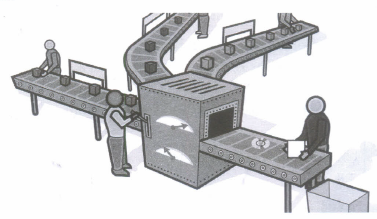
Using the concepts of matrices and determinants, answer the following questions.
(i) If x, y and z respectively denotes the quantity (in tons) of first, second and third product produced, then which of the following is true?
| (a) x + y + z = 45 | (b) x + 8 = z | (c) -2y+z=0 | (d) all of these |
(ii) If \(\left(\begin{array}{ccc} 1 & 1 & 1 \\ 1 & 0 & -2 \\ 1 & -1 & 1 \end{array}\right)^{-1}=\frac{1}{6}\left(\begin{array}{ccc} 2 & 2 & 2 \\ 3 & 0 & -3 \\ 1 & -2 & 1 \end{array}\right)\) , then the inverse of \(\left(\begin{array}{ccc} 1 & 1 & 1 \\ 1 & 0 & -1 \\ 1 & -2 & 1 \end{array}\right)\) is
| (a) \(\left(\begin{array}{lll} \frac{1}{3} & \frac{1}{3} & \frac{1}{3} \\ \frac{1}{2} & 0 & \frac{-1}{2} \\ \frac{1}{6} & \frac{-1}{3} & \frac{1}{6} \end{array}\right)\) | (b) \(\left(\begin{array}{ccc} \frac{1}{2} & 0 & -\frac{1}{2} \\ \frac{1}{3} & \frac{1}{3} & \frac{1}{3} \\ \frac{1}{6} & \frac{-1}{3} & \frac{1}{6} \end{array}\right)\) | (c) \(\left(\begin{array}{ccc} \frac{1}{3} & \frac{1}{2} & \frac{1}{6} \\ \frac{1}{3} & 0 & \frac{-1}{3} \\ \frac{1}{3} & \frac{-1}{2} & \frac{1}{6} \end{array}\right)\) | (d) none of these |
(iii) x :y : z is equal to
| (a) 12: 13: 20 | (b) 11:15:19 | (c) 15: 19: 11 | (d) 13: 12: 20 |
(iv) Which of the following is not true?
| (a) IAI = IA'I | (b) (A'rl = (A-I), | (c) A is skew symmetric-matrix of odd order, then IAI = 0 | (d) IABI = IAI + IBI |
10.
Consider 2 families A and B. Suppose there are 4 men, 4 women and 4 children in family A and 2 men, 2 womei and 2 children in family B. The recommend daily amount of calories is 2400 for a man, 1900 for a woman, 1801 for a children and 45 grams of proteins for a man, 55 grams for a woman and 33 grams for children.
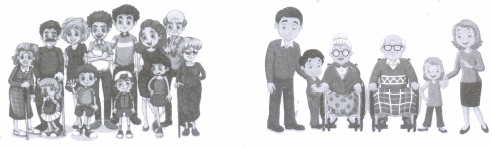
Based on the above information, answer the following questions
(i) The requirement of calories and proteins for each person in matrix form can be represented as

(ii) Requirement of calories of family A is
| (a) 24000 | (b) 24400 | (c) 15000 | (d) 15800 |
(iii) Requirement of proteins for family B is
| (a) 560 grams | (b) 332 grams | (c) 266 grams | (d) 300 grams |
(iv) If A and B are two matrices such that AB = Band BA = A, then A 2 + B2 equals
| (a) 560 grams | (b) 332 grams | (c) 266 grams | (d) 300 grams |
(v) If \(A=\left(a_{i j}\right)_{m \times n}, B=\left(b_{i j}\right)_{n \times p} \text { and } C=\left(c_{i j}\right)_{p \times q^{2}}\) and \(C=\left(c_{i j}\right)_{p \times q},\) then the product (BC)A is possible only when
| (a) m=q | (b) n=q | (c) p=q | (d) m=p |
11.
A manufacturer produces three types of bolts, x, y and z which he sells in two markets. Annual sales (in Rs) are indicated below:
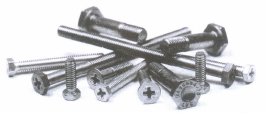
| Markets | Products | ||
| x | y | z | |
| I | 10000 | 2000 | 18000 |
| II | 6000 | 20000 | 8000 |
If unit sales prices of x, y and z are Rs.2.50, Rs.1.50 and Rs.1.00 respectively, then answer the following questions using the concept of matrices.
(i) Find the total revenue collected from the Market-I.
| (a) Rs. 44000 | (b) Rs. 48000 | (c) Rs. 46000 | (d) Rs. 53000 |
(ii) Find the total revenue collected from the Market-II.
| (a) Rs. 5100 | (b) Rs. 5300 | (c ) Rs. 46000 | (d) Rs. 49000 |
(iii) If the unit costs of the above three commodities are Rs.2.00, Rs.1.00 and 50 paise respectively, then find the gross profit from both the markets.
| (a) Rs. 53000 | (b) Rs. 46000 | (c) Rs. 34000 | (d) Rs. 32000 |
(iv) If matrix \(4=\left[a_{i j}\right]_{2 \times 2}\) , where \(a_{i j}=1, \text { if } i \neq j\) , and \(a_{i j}=0 \text { if } i=j\) , then A2 is equal to
| (a) I | (b) A | (c) 0 | (d) none of these |
(v) If A and B are matrices of same order, then (AB' - BA') is a
| (a) skew-symmetric matrix | (b) null matrix | (c) symmetric matrix | (d) unit matrix |
12.
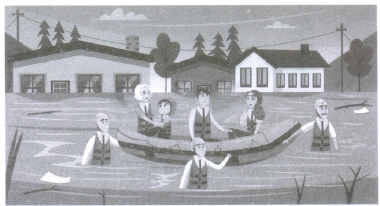
Three schools A, Band C organized a mela for collecting funds for helping the rehabilitation of flood victims. They sold hand made fans, mats and plates from recycled material at a cost of Rs. 25, Rs.100 and Rs.50 each. The number of articles sold by school A, B, C are given below.
| Artilcle\School | A | B | C |
| Fans | 40 | 25 | 35 |
| Mats | 50 | 40 | 50 |
| Plates | 20 | 30 | 40 |
Based on above information, answer the following questions.
(i) If P be a 3 x 3 matrix represent the sale of handmade fans, mats and plates by three schools A, Band C, then

(ii) If Q be a 3 x 1 matrix represent the sale prices (in Rs) of given products per unit, then

(iii) The funds collected by school A by selling the given articles is
| (a) Rs. 7000 | (b) Rs. 6125 | (c) Rs. 7875 | (d) Rs. 8000 |
(iv) The funds collected by school B by selling the given articles is
| (a) Rs. 5125 | (b) Rs. 6125 | (c) Rs. 7125 | (d) Rs. 8125 |
(v) The total funds collected for the required purpose is
| (a) Rs. 20000 | (b) Rs. 21000 | (c) Rs. 30000 | (d) Rs. 35000 |
13.
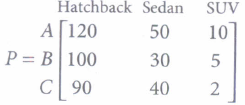
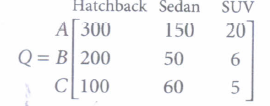
Three car dealers, say A, Band C, deals in three types of cars, namely Hatchback cars, Sedan cars, SUV cars. The sales figure of 2019 and 2020 showed that dealer A sold 120 Hatchback, 50 Sedan, 10 SUV cars in 2019 and 300 Hatchback, 150 Sedan, 20 SUV cars in 2020; dealer B sold 100 Hatchback, 30 Sedan,S SUV cars in 2019 and 200 Hatchback, 50 Sedan, 6 SUV cars in 2020; dealer C sold 90 Hatchback, 40 Sedan, 2 SUV cars in 2019 and 100 Hatchback, 60 Sedan,S SUV cars in 2020.

Based on the above information, answer the following questions.
(i) The matrix summarizing sales data of 2019 is

(ii) The matrix summarizing sales data of 2020 is

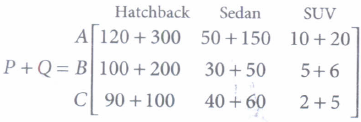
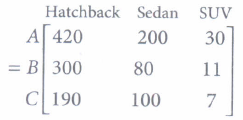
(iii) The total number of cars sold in two given years, by each dealer, is given by the matrix

(iv) The increase in sales from 2019 to 2020 is given by the matrix

(v) If each dealer receive profit of Rs. 50000 on sale of a Hatchback, Rs. 100000 on sale of a Sedan and Rs. 200000 on sale of a SUV (v) then amount of profit received in the year 2020 by each dealer is given by the matrix.

14.
To promote the making of toilets for women, an organisation tried to generate awareness through (i) house calls (ii) emails and (iii) announcements. The cost for each mode per attempt is given below:
(i) Rs.50 (ii) Rs.20 (iii) Rs.40
The number of attempts made in the villages X, Y and Z are given below:
\(\begin{array}{llll} & (\mathrm{i}) & (\mathrm{ii}) & (\mathrm{iii}) \\ X & 400 & 300 & 100 \\ Y & 300 & 250 & 75 \\ Z & 500 & 400 & 150 \end{array}\)
Also, the chance of making of toilets corresponding to one attempt of given modes is
(i) 2% (ii) 4% (iii) 20%
Based on the above information, answer the following questions.
(i) The cost incurred by the organisation on village X is
| (a) 10000 | (b) Rs.15000 | (c) 30000 | (d) Rs.20000 |
(ii) The cost incurred by the organisation on village Y is
| (a) Rs.25000 | (b) Rs.18000 | (c) Rs.23000 | (d) Rs.28000 |
(iii) The cost incurred by the organisation on village Z is
| (a) Rs.19000 | (b) Rs.39000 | (c) Rs.4500 | (d) Rs.5000 |
(iv) The total number of toilets that can be expected after the promotion in village X, is
| (a) 20 | (b) 30 | (c) 40 | (d) 50 |
(v) The total number of toilets that can be expected after the promotion in village Z, is
| (a) 26 | (b) 36 | (c) 46 | (d) 56 |
15.
Consider the mapping \(f: A \rightarrow B\) is defined by \(f(x)=\frac{x-1}{x-2}\) such that f is a bijection.
Based on the above information, answer the following questions.
(i) Domain of f is
| (a) R - {2} | (b) R | (C) R-{1,2} | (d) R-{0} |
(ii) Range of f is
| (a) R | (b) R -{1} | (C) R-{0} | (d) R-{1,2} |
(iii) If g: \(R-\{2\} \rightarrow R-\{1\}\) is defined by g(x) = 2f(x) - I, then g(x) in terms of x is
| (a) \(\frac{x+2}{x}\) | (b) \(\frac{x+1}{x-2}\) | (c) \(\frac{x-2}{x}\) | (d) \(\frac{x}{x-2}\) |
(iv) The function g defined above, is
| (a) | One-one | (b) Many-one | (c) into | (d) None of these |
(v) A function J(x) is said to be one-one iff
| (a) \(f\left(x_{1}\right)=f\left(x_{2}\right) \Rightarrow-x_{1}=x_{2}\) | (b) \(f\left(-x_{1}\right)=f\left(-x_{2}\right) \Rightarrow-x_{1}=x_{2}\) | (c) \(f\left(x_{1}\right)=f\left(x_{2}\right) \Rightarrow x_{1}=x_{2}\) | (d) None of these |
1.
(i) (b) : x3 + x2y+ xy2+y3= 81
\(\begin{equation} \Rightarrow 3 x^{2}+x^{2} \frac{d y}{d x}+2 x y+2 x y \frac{d y}{d x}+y^{2}+3 y^{2} \frac{d y}{d x}=0 \end{equation}\)
\(\begin{equation} \Rightarrow \left(x^{2}+2 x y+3 y^{2}\right) \frac{d y}{d x}=-3 x^{2}-2 x y-y^{2} \end{equation}\)
\(\begin{equation} \Rightarrow \frac{d y}{d x}=\frac{-\left(3 x^{2}+2 x y+y^{2}\right)}{x^{2}+2 x y+3 y^{2}} \end{equation}\)
(ii) (c) : xy = ex-y⇒y log x = x - y
\(\begin{equation} \Rightarrow y \times \frac{1}{x}+\log x \cdot \frac{d y}{d x}=1-\frac{d y}{d x} \end{equation}\)
\(\begin{equation} \Rightarrow \frac{d y}{d x}[\log x+1]=1-\frac{y}{x} \Rightarrow \frac{d y}{d x}=\frac{x-y}{x[1+\log x]} \end{equation}\)
(iii) (d) : \(\begin{equation} e^{\sin y}=x y \Rightarrow \sin y=\log x+\log y \end{equation}\)
\(\begin{equation} \Rightarrow \cos y \frac{d y}{d x}=\frac{1}{x}+\frac{1}{y} \frac{d y}{d x} \Rightarrow \frac{d y}{d x}\left[\cos y-\frac{1}{y}\right]=\frac{1}{x} \end{equation}\)
\(\begin{equation} \Rightarrow \frac{d y}{d x}=\frac{y}{x(y \cos y-1)} \end{equation}\)
(iv) (d) : sin2x + cos2y = 1
\(\begin{equation} \Rightarrow \quad 2 \sin x \cos x+2 \cos y\left(-\sin y \frac{d y}{d x}\right)=0 \end{equation}\)
\(\begin{equation} \Rightarrow \frac{d y}{d x}=\frac{-\sin 2 x}{-\sin 2 y}=\frac{\sin 2 x}{\sin 2 y} \end{equation}\)
(v) (d) : \(\begin{equation} y=(\sqrt{x})^{\sqrt{x}} \quad \Rightarrow y=(\sqrt{x})^{y} \end{equation}\)
\(\begin{equation} \Rightarrow \log y=y(\log \sqrt{x}) \Rightarrow \log y=\frac{1}{2}(y \log x) \end{equation}\)
\(\begin{equation} \Rightarrow \frac{1}{y} \frac{d y}{d x}=\frac{1}{2}\left[y \times \frac{1}{x}+\log x\left(\frac{d y}{d x}\right)\right] \end{equation}\)
\(\begin{equation} \Rightarrow \frac{d y}{d x}\left\{\frac{1}{y}-\frac{1}{2} \log x\right\}=\frac{1}{2} \frac{y}{x} \end{equation}\)
\(\begin{equation} \Rightarrow \frac{d y}{d x}=\frac{y}{2 x} \times \frac{2 y}{(2-y \log x)}=\frac{y^{2}}{x(2-y \log x)} \end{equation}\)
2.
(i) (a) : Let \(\begin{equation} y=x^{x} \Rightarrow \log y=x \log x \end{equation}\)
\(\begin{equation} \Rightarrow \frac{1}{y} \frac{d y}{d x}=\frac{d}{d x}(x \log x) \Rightarrow \frac{d y}{d x}=x^{x}\left[1 \times \log x+x \times \frac{1}{x}\right] \end{equation}\)
(ii) (d)
(iii) (d) : Given \(\begin{equation} x=e^{x / y} \Rightarrow \log x=\frac{x}{v} \log e \Rightarrow y \log x=x \end{equation}\)
\(\begin{equation} \Rightarrow y \frac{1}{x}+(\log x) \frac{d y}{d x}=1 \end{equation}\)
\(\begin{equation} \Rightarrow \frac{d y}{d x}=\left(1-\frac{y}{x}\right) \frac{1}{\log x} \Rightarrow \frac{1}{x \log x}(x-y) \end{equation}\)
(iv) (c) : y = (2 - x)3 (3 + 2x)5 '
\(\begin{equation} \Rightarrow \log y=\log (2-x)^{3}+\log (3+2 x)^{5} \end{equation}\)
= 3 log (2 - x) + 5log (3 + 2x)
\(\begin{equation} \Rightarrow \frac{1}{y} \frac{d y}{d x}=\frac{3 \times(-1)}{2-x}+\frac{5}{3+2 x} \times(2) \end{equation}\)
\(\begin{equation} \Rightarrow \frac{d y}{d x}=(2-x)^{3}(3+2 x)^{5}\left[\frac{10}{3+2 x}-\frac{3}{2-x}\right] \end{equation}\)
(v) (d) : y = xx.e(2x + 5)
\(\begin{equation} \Rightarrow \log y=x \log x+(2 x+5) \end{equation}\)
\(\begin{equation} \Rightarrow \frac{1}{y} \cdot \frac{d y}{d x}=\left(x \cdot \frac{1}{x}+\log x\right)+2 \end{equation}\)
\(\begin{equation} \Rightarrow \frac{d y}{d x}=x^{x} \cdot e^{2 x+5} \cdot(3+\log x) \end{equation}\)
3.
L.H.L (at x = 0) = \(\begin{equation} \lim _{x \rightarrow 0} \frac{\sin (a+1) x+\sin x}{x}\left(\frac{0}{0} \text { form }\right) \end{equation}\)
Using L' Hospital rule, we get
L.H.L.(at x = 0)
\(\begin{equation} =\lim _{x \rightarrow 0}(a+1) \cos (a+1) x+\cos x=a+2 \end{equation}\)
R.H.L \(\begin{equation} \text { (at } x=0)=\lim _{x \rightarrow 0} \frac{\sqrt{x+b x^{2}}-\sqrt{x}}{b x^{3 / 2}}=\lim _{x \rightarrow 0} \frac{\sqrt{1+b x}-1}{b x} \end{equation}\)
\(\begin{equation} =\lim _{x \rightarrow 0} \frac{1}{\sqrt{1+b x}+1}=\frac{1}{2} \end{equation}\)
Since,f(x) is continuous at x = 0.
\(\therefore\) From (i) and (ii), we get
\(\begin{equation} a+2=c=\frac{1}{2} \Rightarrow a=-\frac{3}{2}, c=\frac{1}{2} \end{equation}\)
Also, value of b does not affect the continuity of f(x), so b can be any real number.
(i) (a)
(ii) (d)
(iii) (b)
(iv) (c) : \(\begin{equation} a+c=-\frac{3}{2}+\frac{1}{2}=-1 \end{equation}\)
(v) (d) : \(\begin{equation} c-a=\frac{1}{2}+\frac{3}{2}=2 \end{equation}\)
4.
(i) (c)
(ii) (b)
(iii) (b)
(iv) (b)
(v) (a)
5.
(i) (d)
(ii) (a)
(iii) (b) ,
(iv) (a)
(v) (b)
6.
we have,\(\begin{equation} f(x)=\left\{\begin{array}{ll} x-3 & , x \geq 3 \\ 3-x & , 1 \leq x<3 \\ \frac{x^{2}}{4}-\frac{3 x}{2}+\frac{13}{4} & , x<1 \end{array}\right. \end{equation}\)
(i) (b) : \(\begin{equation} \mathrm{R} f^{\prime}(1)=\lim _{h \rightarrow 0} \frac{f(1+h)-f(1)}{h} \end{equation}\)
\(\begin{equation} =\lim _{h \rightarrow 0} \frac{3-(1+h)-2}{h}=\lim _{h \rightarrow 0}-\frac{h}{h}=-1 \end{equation}\)
(ii) (b) : \(\begin{equation} \mathrm{L}_{\mathrm{s}}^{\prime}(1)=\lim _{h \rightarrow 0} \frac{f(1-h)-f(1)}{-h} \end{equation}\)
\(\begin{equation} =\lim _{h \rightarrow 0} \frac{-1}{h}\left[\frac{(1-h)^{2}}{4}-\frac{3(1-h)}{2}+\frac{13}{4}-2\right] \end{equation}\)
\(\begin{equation} =\lim _{h \rightarrow 0}\left(\frac{1+h^{2}-2 h-6+6 h+13-8}{-4 h}\right) \end{equation}\)
\(\begin{equation} =\lim _{h \rightarrow 0}\left(\frac{h^{2}+4 h}{-4 h}\right)=-1 \end{equation}\)
(iii) (c) : Since, R.H.D. at x = 3 is 1 and L.H.D. at x = 3 is-1
\(\therefore\) f(x) is non-differentiable at x = 3.
(iv) (d)
(v) (c) : From above, we have
\(\begin{equation} f^{\prime}(x)=\frac{x}{2}-\frac{3}{2}, x<1 \end{equation}\)
\(\begin{equation} \therefore f^{\prime}(-1)=\frac{-1}{2}-\frac{3}{2}=-2 \end{equation}\)
7.
Let the cost of a polythene bag = Rs. x,
the cost of a handmade bag = Rs. y
and the cost of a newspaper bag = Rs. z
According to question,
20x + 30y + 40z = 250, 30x + 40y + 20z = 270
40x + 20y + 30z .=. 200 This system can be written as AX = B, where
\(\begin{equation} A=\left[\begin{array}{ccc} 20 & 30 & 40 \\ 30 & 40 & 20 \\ 40 & 20 & 30 \end{array}\right], X=\left[\begin{array}{l} x \\ y \\ \frac{1}{4} \end{array}\right] \end{equation}\) and \(\begin{equation} B=\left[\begin{array}{c} 250 \\ 270 \\ 200 \end{array}\right] \end{equation}\)
\(\begin{equation} |A|=\left|\begin{array}{ccc} 20 & 30 & 40 \\ 30 & 40 & 20 \\ 40 & 20 & 30 \end{array}\right| \end{equation}\)
= 20(1200 - 400) - 30(900 - 800) + 40(600 - 1600)
= 20(800) - 30(100) + 40(-1000)
= 16000 - 3000 - 40000 = -27000≠ 0
So, A-1 exists and system has a solution given by
X = A-1B.
Now, \(\begin{equation} \operatorname{adj} A=\left[\begin{array}{ccc} 800 & -100 & -1000 \\ -100 & -1000 & 800 \\ -1000 & 800 & -100 \end{array}\right] \end{equation}\)
\(\begin{equation} =\left[\begin{array}{ccc} 800 & -100 & -1000 \\ -100 & -1000 & 800 \\ -1000 & 800 & -100 \end{array}\right] \end{equation}\)
\(\begin{equation} \therefore A^{-1}=\frac{1}{|A|}(\operatorname{adj} A)=\frac{1}{-27000}\left[\begin{array}{ccc} 800 & -100 & -1000 \\ -100 & -1000 & 800 \\ -1000 & 800 & -100 \end{array}\right] \end{equation}\)
Now \(\begin{equation} X=\left[\begin{array}{l} x \\ y \\ z \end{array}\right]=\frac{1}{27000}\left[\begin{array}{ccc} -800 & 100 & 1000 \\ 100 & 1000 & -800 \\ 1000 & -800 & 100 \end{array}\right]\left[\begin{array}{c} 250 \\ 270 \\ 200 \end{array}\right] \end{equation}\)
\(\begin{equation} X=\left[\begin{array}{l} x \\ y \\ z \end{array}\right]=\frac{1}{27000}\left[\begin{array}{ccc} -800 & 100 & 1000 \\ 100 & 1000 & -800 \\ 1000 & -800 & 100 \end{array}\right]\left[\begin{array}{c} 250 \\ 270 \\ 200 \end{array}\right] \end{equation}\)
Hence, cost of a polythene bag, a handmade bag and a newspaper envelope is Rs. 1, Rs. 5 and Rs. 2 respectively.
(i) (a)
(ii) (d)
(iii) (b)
(iv) (b) : Vijay investing most of the money on hand-rnade bags.
(v) (a) : Salim investing less amount of money on polythene bags.
8.
(i) (c) : we have \(\begin{equation} A=\left[\begin{array}{ll} 1 & 0 \\ 2 & 1 \end{array}\right] \end{equation}\)
Let \(\begin{equation} U_{1}=\left[\begin{array}{l} a \\ b \end{array}\right] \end{equation}\) then \(\begin{equation} A U_{1}=\left[\begin{array}{l} 1 \\ 0 \end{array}\right] \end{equation}\)
\(\begin{equation} \Rightarrow\left[\begin{array}{ll} 1 & 0 \\ 2 & 1 \end{array}\right]\left[\begin{array}{l} a \\ b \end{array}\right]=\left[\begin{array}{l} 1 \\ 0 \end{array}\right] \Rightarrow\left[\begin{array}{c} a \\ 2 a+b \end{array}\right]=\left[\begin{array}{l} 1 \\ 0 \end{array}\right] \end{equation}\)
\(\begin{equation} \Rightarrow \end{equation}\) a = 1 and 2a + b = 0 \(\begin{equation} \Rightarrow \end{equation}\) a = 1 and b = -2
Let \(\begin{equation} U_{2}=\left[\begin{array}{l} c \\ d \end{array}\right] \end{equation}\) then \(\begin{equation} A U_{2}=\left[\begin{array}{l} 2 \\ 3 \end{array}\right] \end{equation}\)
\(\begin{equation} \Rightarrow\left[\begin{array}{ll} 1 & 0 \\ 2 & 1 \end{array}\right]\left[\begin{array}{l} c \\ d \end{array}\right]=\left[\begin{array}{l} 2 \\ 3 \end{array}\right] \Rightarrow\left[\begin{array}{c} c \\ 2 c+d \end{array}\right]=\left[\begin{array}{l} 2 \\ 3 \end{array}\right] \end{equation}\)
\(\begin{equation} \Rightarrow \end{equation}\) c = 2 and 2c + d = 3
\(\begin{equation} \Rightarrow \end{equation}\) c = 2 and d = 3 - 4 = -1
Thus,\(\begin{equation} U_{1}+U_{2}=\left[\begin{array}{c} 1 \\ -2 \end{array}\right]+\left[\begin{array}{c} 2 \\ -1 \end{array}\right]=\left[\begin{array}{c} 3 \\ -3 \end{array}\right] \end{equation}\)
(ii) (c) : Clearly \(\begin{equation} U=\left[\begin{array}{cc} 1 & 2 \\ -2 & -1 \end{array}\right] \end{equation}\)
\(\begin{equation} \therefore|U|=\left|\begin{array}{cc} 1 & 2 \\ -2 & -1 \end{array}\right|=-1+4=3 \end{equation}\)
(iii) (d) : We have \(\begin{equation} X=\left[\begin{array}{ll} 3 & 2 \end{array}\right]\left[\begin{array}{cc} 1 & 2 \\ -2 & -1 \end{array}\right]\left[\begin{array}{l} 3 \\ 2 \end{array}\right] \end{equation}\)
\(\begin{equation} =\left[\begin{array}{ll} 3 & 2 \end{array}\right]\left[\begin{array}{c} 7 \\ -8 \end{array}\right]=[21-16]=[5] \end{equation}\)
\(\therefore\) IX|=5.
(iv) (a) : a22 in U is -1 and its minor is 1.
(v) (d) : Since, the sum of products of elements of any row (or column) with their corresponding cofactors is equal to the value of determinant
\(\begin{equation} \therefore \quad a_{11} A_{11}+a_{12} A_{12}=|U|=3 \end{equation}\)
9.
(i) (d) : According to given condition, we have the following system of linear equations.
x + y + z = 45
x + 8 = z or x + 0·y - z = -8
and x + z = 2y or x - 2y + z = 0
(ii) (c): Let \(A=\left(\begin{array}{ccc} 1 & 1 & 1 \\ 1 & 0 & -2 \\ 1 & -1 & 1 \end{array}\right)\) then we have,
\(A^{-1}=\frac{1}{6}\left(\begin{array}{ccc} 2 & 2 & 2 \\ 3 & 0 & -3 \\ 1 & -2 & 1 \end{array}\right)\)
Now, (A')-1 = (A-1)'
\(=\frac{1}{6}\left(\begin{array}{ccc} 2 & 3 & 1 \\ 2 & 0 & -2 \\ 2 & -3 & 1 \end{array}\right)=\left(\begin{array}{ccc} \frac{1}{3} & \frac{1}{2} & \frac{1}{6} \\ \frac{1}{3} & 0 & \frac{-1}{3} \\ \frac{1}{3} & \frac{-1}{2} & \frac{1}{6} \end{array}\right)\)
(iii) (b) : The above system of equations can be written in matrix form as
A'X = B, where
\(A^{\prime}=\left(\begin{array}{ccc} 1 & 1 & 1 \\ 1 & 0 & -1 \\ 1 & -2 & 1 \end{array}\right), X=\left[\begin{array}{c} x \\ y \\ z \end{array}\right] \text { and } B=\left[\begin{array}{c} 45 \\ -8 \\ 0 \end{array}\right]\)
\(\Rightarrow X=\left(A^{\prime}\right)^{-1} B=\frac{1}{6}\left[\begin{array}{ccc} 2 & 3 & 1 \\ 2 & 0 & -2 \\ 2 & -3 & 1 \end{array}\right]\left[\begin{array}{c} 45 \\ -8 \\ 0 \end{array}\right]\)
\(=\frac{1}{6}\left[\begin{array}{c} 90-24 \\ 90 \\ 90+24 \end{array}\right]=\frac{1}{6}\left[\begin{array}{c} 66 \\ 90 \\ 114 \end{array}\right]=\left[\begin{array}{c} 11 \\ 15 \\ 19 \end{array}\right]\)
Thus, x:y:z = 11: 15: 19
(iv) (d) : Clearly, IABI = IAI ·IBI
(v) (b)
10.
(i) (a) : Let F be the matrix representing the number of family members and R be the matrix representing the requirement of calories and proteins for each person. Then
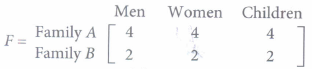
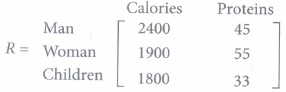
(ii) (b) : The requirement of calories and proteins for each of the two- families is given by the product matrix FR.
\(F R=\left[\begin{array}{lll} 4 & 4 & 4 \\ 2 & 2 & 2 \end{array}\right]\left[\begin{array}{ll} 2400 & 45 \\ 1900 & 55 \\ 1800 & 33 \end{array}\right]\)
\(=\left[\begin{array}{ll} 4(2400+1900+1800) & 4(45+55+33) \\ 2(2400+1900+1800) & 2(45+55+33) \end{array}\right]\)
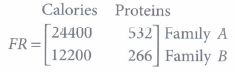
(iii) (c)
(iv) (c) : Since, AB = B ...(i) and BA = A ...(ii)
\(\therefore\) A2 + B2 = A·A + B·B
= A(BA) + B(AB) [using (i) and (ii)]
= (AB)A + (BA)B [Associative law]
= BA +AB [using (i) and (ii]
= A+B
11.
Let A be the 2 x 3 matrix representing the annual sales of products in two markets.
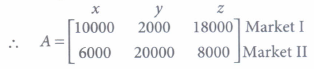
Let B be the column matrix representing the sale price of each unit of products x, y, z.
\(\therefore \quad B=\left[\begin{array}{c} 2.5 \\ 1.5 \\ 1 \end{array}\right]\)
Now, revenue = sale price x number of items sold
\(=\left[\begin{array}{ccc} 10000 & 2000 & 18000 \\ 6000 & 20000 & 8000 \end{array}\right]\left[\begin{array}{c} 2.5 \\ 1.5 \\ 1 \end{array}\right]\)
\(=\left[\begin{array}{l} 25000+3000+18000 \\ 15000+30000+8000 \end{array}\right]=\left[\begin{array}{l} 46000 \\ 53000 \end{array}\right]\)
Therefore, the revenue collected from Market I = Rs.46000 and the revenue collected from Market II = Rs. 53000.
(i) (c)
(ii) (b)
(iii) (d) : Let C be the column matrix representing cost price of each unit of products x, y, z.
Then, \(C=\left[\begin{array}{c} 2 \\ 1 \\ 0.5 \end{array}\right]\)
\(\therefore\) Total cost in each market is given by
\(A C=\left[\begin{array}{ccc} 10000 & 2000 & 18000 \\ 6000 & 20000 & 8000 \end{array}\right]\left[\begin{array}{c} 2 \\ 1 \\ 0.5 \end{array}\right]\)
\(=\left[\begin{array}{c} 20000+2000+9000 \\ 12000+20000+4000 \end{array}\right]=\left[\begin{array}{l} 31000 \\ 36000 \end{array}\right]\)
Now, Profit matrix = Revenue matrix, Cost matrix
\(=\left[\begin{array}{l} 46000 \\ 53000 \end{array}\right]-\left[\begin{array}{l} 31000 \\ 36000 \end{array}\right]=\left[\begin{array}{l} 15000 \\ 17000 \end{array}\right]\)
Therefore, the gross profit from both the markets
= Rs.15000+ Rs.17000= Rs.32000
(iv) (a) : We have \(A=\left[\begin{array}{ll} 0 & 1 \\ 1 & 0 \end{array}\right]\)
\(\therefore \quad A^{2}=\left[\begin{array}{ll} 0 & 1 \\ 1 & 0 \end{array}\right]\left[\begin{array}{ll} 0 & 1 \\ 1 & 0 \end{array}\right]=\left[\begin{array}{ll} 1 & 0 \\ 0 & 1 \end{array}\right]=I\)
(v) (a) : We have, (AB' -BA')' = (B')'A' - (A')'B'
= BA' - AB' = -(AB' - BA')
Thus, AB' - BA' is a skew-symmetric matrix.
12.
(i) (a) : Clearly,
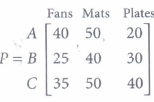
(ii) (d) : Since Q is a 3 x 1 matrix, therefore
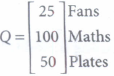
(iii) (a) : Clearly, total funds collected by each school is given by the matrix.
\(P Q=\left[\begin{array}{ccc} 40 & 50 & 20 \\ 25 & 40 & 30 \\ 35 & 50 & 40 \end{array}\right]\left[\begin{array}{c} 25 \\ 100 \\ 50 \end{array}\right]\)
\(=\left[\begin{array}{c} 1000+5000+1000 \\ 625+4000+1500 \\ 875+5000+2000 \end{array}\right]=\left[\begin{array}{l} 7000 \\ 6125 \\ 7875 \end{array}\right]\)
\(\therefore\) Funds collected by school A is Rs. 7000
Funds collected by school B is Rs. 6125
Pimds collected by school C is Rs. 7875
(iv) (b)
(v) (b) : Total funds collected for the required purpose
= Rs. (7000 + 6125 + 7875) = Rs. 21000
13.
(i) (b) : In 2019,dealer A sold 120 Hatchback, 50 Sedan and 10 SUV; dealer B sold 100 Hatchback, 30 Sedan and 5 SUV and dealer C sold 90 Hatchback, 40 Sedan and 2 SUV
\(\therefore\) Required matrix, say P, is given by
(ii) (a) : In 2020,
dealer A sold 300 Hatchback, 150 Sedan, 20 SUV
dealer B sold 200 Hatchback, 50 sedan, 6 SUV
dealer C sold 100 Hatchback, 60 sedan,S SUV
\(\therefore\) Required matrix, say Q, is given by
(iii) (c) : Total number of cars sold in two given years, by each dealer, is given by
(iv) (c): The increase in sales from 2019 to 2020 is given by
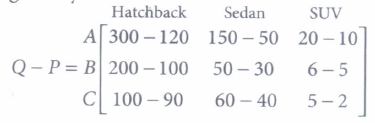
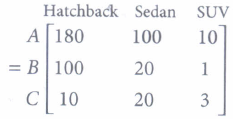
(v) (c) : The amount of profit in 2020 received by each dealer is given by the matrix
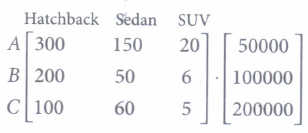
\(\begin{array}{c} A \\ B \\ C \end{array}\left[\begin{array}{c} 15000000+15000000+4000000 \\ 10000000+5000000+1200000 \\ 5000000+6000000+1000000 \end{array}\right]\)
\(\begin{array}{r} A \\ =B \\ C \end{array}\left[\begin{array}{l} 34000000 \\ 16200000 \\ 12000000 \end{array}\right]\)
14.
(i) (c) : Let Rs. A, Rs. B and Rs.C be the cost incurred by the organisation for villages X, Y and Z respectively. Then A, B, C will be given by the following matrix equation.
\(\left[\begin{array}{ccc} 400 & 300 & 100 \\ 300 & 250 & 75 \\ 500 & 400 & 150 \end{array}\right]\left[\begin{array}{l} 50 \\ 20 \\ 40 \end{array}\right]=\left[\begin{array}{c} A \\ B \\ C \end{array}\right]\)
\(\Rightarrow\left[\begin{array}{l} A \\ B \\ C \end{array}\right]=\left[\begin{array}{c} 400 \times 50+300 \times 20+100 \times 40 \\ 300 \times 50+250 \times 20+75 \times 40 \\ 500 \times 50+400 \times 20+150 \times 40 \end{array}\right]\)
(ii) (c)
(iii) (b)
(iv) (c) : Total number of toilets that can be expected in each village is given by the following matrix.
\(\begin{array}{l} X \\ Y \\ Z \end{array}\left[\begin{array}{ccc} 400 & 300 & 100 \\ 300 & 250 & 75 \\ 500 & 400 & 150 \end{array}\right]\)\(\left[\begin{array}{c} 2 / 100 \\ 4 / 100 \\ 20 / 100 \end{array}\right]\)
\(\begin{array}{l} X \\ Y \\ Z \end{array}\)\(\left[\begin{array}{c} 8+12+20 \\ 6+10+15 \\ 10+16+30 \end{array}\right]\)=\(\begin{array}{l} X \\ Y \\ Z \end{array}\)\(\left[\begin{array}{c} 40 \\ 31 \\ 56 \end{array}\right]\)
(v) (d)
15.
(i) (a) : For f(x) to be defined \(x-2 \neq 0\) i.e.,\(x \neq 2\)
\(\therefore\) Domain of f = R - {2}
(ii) (b) : Let y =J(x), then \(y=\frac{x-1}{x-2}\)
\(\Rightarrow x y-2 y=x-1 \Rightarrow x y-x=2 y-1 \Rightarrow x=\frac{2 y-1}{y-1}\)
Since, \(x \in R-\{2\}\),therefore \(y \neq 1\)
Hence, range of f = R-{1}
(iii) (d): We have,g(x) = 2f(x) - 1
\(=2\left(\frac{x-1}{x-2}\right)-1=\frac{2 x-2-x+2}{x-2}=\frac{x}{x-2}\)
(iv) (a) : We have, \(g(x)=\frac{x}{x-2}\) ,
Let \(g\left(x_{1}\right)=g\left(x_{2}\right) \Rightarrow \frac{x_{1}}{x_{1}-2}=\frac{x_{2}}{x_{2}-2}\)
\(\Rightarrow x_{1} x_{2}-2 x_{1}=x_{1} x_{2}-2 x_{2} \Rightarrow 2 x_{1}=2 x_{2} \Rightarrow x_{1}=x_{2}\)
Thus, \(g\left(x_{1}\right)=g\left(x_{2}\right) \Rightarrow x_{1}=x_{2}\)
Hence, g(x) is one-one.
(v) (c)

12th Standard CBSE Syllabus & Materials
12th Standard CBSE
CBSE 12th Computer Science Python Revision Tour I - New Previous year Question Papers Study Material - QB365 Set A
NEW12th Standard CBSE
CBSE 12th Business Studies Planning Important Questions And Answers Study Material - QB365 Set A
NEW12th Standard CBSE
CBSE 12th Business Studies Business Environment Important Questions And Answers Study Material - QB365 Set A
NEW12th Standard CBSE
CBSE 12th Business Studies Principles of Management Important Questions And Answers Study Material - QB365 Set A



NCERT Books

Syllabus

Exam Pattern

Sample Question Papers

Previous year Question Papers

Important Notes

MCQ Practice test

NCERT Exemplers

Case study Questions

Image Based Questions

Passage based Questions

HOT Questions

Value Based Questions

Model Questions Papers
NCERT ( Book Back ) Questions

Assertion and Reason
Important Questions And Answers

CBSE 12th Standard CBSE Subjects
CBSE Standards








