
 100% FREE ACCESS
12th Standard CBSE Syllabus & Materials
12th Standard CBSE
CBSE 12th Economics Government Budget and the Economy Previous year Question Papers Study Material - QB365 Set A
NEW12th Standard CBSE
CBSE 12th Computer Science Interface Python with MySQL - New Previous year Question Papers Study Material - QB365 Set A
NEW12th Standard CBSE
CBSE 12th Computer Science Database Concept - New Previous year Question Papers Study Material - QB365 Set A
NEW12th Standard CBSE
CBSE 12th Computer Science Data Communication - New Previous year Question Papers Study Material - QB365 Set A
NEW12th Standard CBSE
CBSE 12th Computer Science Data Structures - New Previous year Question Papers Study Material - QB365 Set A
NEW12th Standard CBSE
CBSE 12th Computer Science Functions - New Previous year Question Papers Study Material - QB365 Set A

Published on: 21/05/2021
QB365 Provides the updated CASE Study Questions for Class 12 Maths, and also provide the detail solution for each and every case study questions . Case study questions are latest updated question pattern from NCERT, QB365 will helps to get more marks in Exams
Download CBSE Class 12th Standard CBSE Maths question papers, sample papers, important questions, and previous year solved papers in PDF format. Get free study materials, NCERT solutions, and exam preparation resources for Class 12th Standard CBSE Maths
Questions + Answers key
Take MCQ Maths Test
1.
If an equation is of the form \(\frac{d y}{d x}+P y=Q\) ,where P, Q are functions of x, then such equation is known as linear differential equation. Its solu~:n is given by \(y \cdot(\mathrm{I} . \mathrm{F} .)=\int \mathrm{Q} \cdot(\mathrm{I} . \mathrm{F} .) d x+c\) where \(\text { I.F. }=e^{\int P d x}\) .
Now, suppose the given equation is \((1+\sin x) \frac{d y}{d x}+y \cos x+x=0\)
Based on the above information, answer the following questions
(i) The value of P and Q respectively are
| (a) \(\frac{\sin x}{1+\cos x}, \frac{x}{1+\sin x}\) | (b) \(\frac{\cos x}{1+\sin x}, \frac{-x}{1+\sin x}\) | (c) \(\frac{-\cos x}{1+\sin x}, \frac{x}{1+\sin x}\) | (d) \(\frac{\cos x}{1+\sin x}, \frac{x}{1+\sin x}\) |
(ii) The value of I.F. is
| (a) 1 - sin x | (b) cos x | (c) 1 + sin x | (d) 1- cosx |
(iii) Solution of given equation is
| (a) y{1-sinx)=x+c | (b) y(l + sin x) = x2+c | (c) \(y(1-\sin x)=\frac{-x^{2}}{2}+c\) | (d) \(y(1+\sin x)=\frac{-x^{2}}{2}+c\) |
(iv) If y(0) = 1, then y,equals
| (a) \(\frac{2-x^{2}}{2(1+\sin x)}\) | (b) \(\frac{2+x^{2}}{2(1+\sin x)}\) | (c) \(\frac{2-x^{2}}{2(1-\sin x)}\) | (d) \(\frac{2+x^{2}}{2(1-\sin x)}\) |
(v) Value of \(y\left(\frac{\pi}{2}\right)\) is
| (a) \(\frac{4-\pi^{2}}{2}\) | (b) \(\frac{8-\pi^{2}}{16}\) | (c) \(\frac{8-\pi^{2}}{4}\) | (d) \(\frac{4+\pi^{2}}{2}\) |
2.
A differential equation is said to be in the variable separable form if it is expressible in the form j(x) dx = g(y) dy. The solution of this equation is given by \(\int f(x) d x=\int g(y) d y+c\) where c is the constant of integration.
Based on the above information, answer the following questions.
(i) If the solunon of the differential equation \(\frac{d y}{d x}=\frac{a x+3}{2 y+f}\) represents a circle, then the value of' a 'is
| (a) 2 | (b) - 2 | (c) 3 | (d) - 4 |
(ii) The diiftfterential equation \(\frac{d y}{d x}=\frac{\sqrt{1-y^{2}}}{y}\) deterrnines a family of circle with
| (a) variable radii and fixed centre (0,1) | (b) variable radii and fixed centre (0,-1) |
| (c) fixed radius 1 and variable centre on x-axis | (d) fixed radius 1 and variable centre on y-axis |
(iii) If y' = y + 1, y (0) = 1, theny (In 2) =
| (a) 1 | (b) 2 | (c) 3 | (d) 4 |
(iv) The solution of the differential equation \(\frac{d y}{d x}=e^{x-y}+x^{2} e^{-y}\) is
| (a) \(e^{x}=\frac{y^{3}}{3}+e^{y}+c\) | (b) \(e^{y}=\frac{x^{2}}{3}+e^{x}+c\) | (c) \(e^{y}=\frac{x^{3}}{3}+e^{x}+c\) | (d) none of these |
(v) If \(\frac{d y}{d x}=y \sin 2 x, y(0)=1\) then its solution is
| (a) y = esin2x | (b) y = sin2 | (c) y = cos2x | (d) y = cos2x |
3.
Order: The order of a differential equation is the order of the highest order derivative appearing in the differential equation.
Degree : The degree of differential equation is the power of the highest order derivative, when differential coefficients are made free from radicals and fractions. Also, differential equation must be a polynomial equation
in derivatives for the degree to be defined.
Based on the above information, answer the following questions.
(i) Find the degree of the differential equation \(2 \frac{d^{2} y}{d x^{2}}+3 \sqrt{1-\left(\frac{d y}{d x}\right)^{2}-y}=0\)
| (a) 3 | (b) 4 | (c) 2 | (d) 1 |
(ii) Order and degree of the differential equation \(y \frac{d y}{d x}=\frac{x}{\frac{d y}{d x}+\left(\frac{d y}{d x}\right)^{3}}\) are respectively
| (a) 1,1 | (b) 1,2 | (c) 1,3 | (d) 1,4 |
(iii) Find order and degree of the equation \(y^{\prime \prime \prime}+y^{2}+e^{y^{\prime}}=0\)
| (a) order = 3, degree = undefined | (b) order = 1, degree = 3 | (c) order = 2, degree = undefined | (d) order = 1, degree = 2 |
(iv) Determine degree of the differential equation \((\sqrt{a+x}) \cdot\left(\frac{d y}{d x}\right)+x=0\)
| (a) 3 | (b) not defined | (c) 1 | (d) 2 |
(v) Order and degree of the differential equation \(\left(1+\left(\frac{d y}{d x}\right)^{3}\right)^{\frac{7}{3}}=7 \frac{d^{2} y}{d x^{2}}\) are respectively
| (a) 2, 1 | (b) 2,3 | (c) 1,3 | (d) \(1, \frac{7}{3}\) |
4.
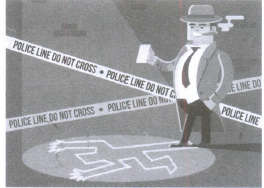
In a murder investigation, a corpse was found by a detective at exactly 8 p.m. Being alert, the detective measured the body temperature and found it to be 70°F. Two hours later, the detective measured the body temperature again and found it to be 60°F, where the room temperature is 50°F. Also, it is given the body temperature at the time of death was normal, i.e., 98.6°F.
Let T be the temperature of the body at any time t and initial time is taken to be 8 p.m.
Based on the above information, answer the following questions.
(i) By Newton's law of cooling,\(\frac{d T}{d t}\) is proportional to
| (a) T - 60 | (b) T - 50 | (c) T - 70 | (d) T - 98.6 |
(ii) When t = 0, then body temperature is equal to
| (a) 50°F | (b) 60°F | (c) 70oF | (d) 98.6°F |
(iii) When t = 2, then body temperature is equal to
| (a) 50°F | (b) 60°F | (c) 70oF | (d) 98.6°F |
(iv) The value of T at any time tis
| (a) \(50+20\left(\frac{1}{2}\right)^{t}\) | (b) \(50+20\left(\frac{1}{2}\right)^{t-1}\) | (c) \(50+20\left(\frac{1}{2}\right)^{t / 2}\) | (d) None of these |
(v) If it is given that loge(2.43) = 0.88789 and loge(0.5) = -0.69315, then the time at which the murder occur is
| (a) 7:30 p.m. | (b) 5:30 p.m. | (c) 6:00 p.m. | (d) 5:00 p.m. |
5.
A thermometer reading 800P is taken outside. Five minutes later the thermometer reads 60°F. After another 5 minutes the thermometer reads 50of At any time t the thermometer reading be TOP and the outside temperature be SoF.
Based on the above information, answer the following questions.
(i) If \(\lambda\) is positive constant of proportionality, then \(\frac{d T}{d t}\) is
| (a) \(\lambda(T-S)\) | (b) \(\lambda(T+S)\) | (c) \(\lambda T S\) | (d) \(-\lambda(T-S)\) |
(ii) The value of T(S) is
| (a) 300F | (b) 40oF | (c) 50oF | (d) 60oF |
(iii) The value of T(10) is
| (a) 50oF | (b) 40oF | (c) 50oF | (d) 60oF |
(iv) Find the general solution of differential equation formed in given situation.
| (a) logT=St+c | (b) \(\log (T-S)=-\lambda t+c\) | (c) log S = tT + c | (d) \(\log (T+S)=\lambda t+c\) |
(v) Find the valiie of constant of integration c in the solution of differential equation formed in given situation.
| (a) log (60 -S) | (b) log (80 + S) | (c) log (80 - S) | (d) log (60 + S) |
1.
(i) (b) : The given differential equation can be written as \(\frac{d y}{d x}+\frac{\cos x}{1+\sin x} y=\frac{-x}{1+\sin x}\)
Compare it with \(\frac{d y}{d x}+P y=Q\) ,we get
\(P=\frac{\cos x}{1+\sin x}\) and \(Q=\frac{-x}{1+\sin x}\)
(ii) (c) : \(\text { I.F. }=e^{\int P d x}=e^{\int \frac{\cos x}{1+\sin x} d x}\)
Put \(1+\sin x=t \Rightarrow \cos x d x=d t\)
\(\therefore \quad \text { I.F. }=e^{\int \frac{1}{t} d t}=e^{\log t}=t=1+\sin x\)
(iii) (d) : Solution of given differential equation is given by \(y \cdot(\mathrm{I} . \mathrm{F} .)=\int Q(\mathrm{I.F.}) d x+c\)
\(\Rightarrow y(1+\sin x)=\int \frac{-x}{1+\sin x} \cdot(1+\sin x) d x+c\)
\(\Rightarrow \quad y(1+\sin x)=\frac{-x^{2}}{2}+c\)
(iv) (a) : We have, y(0) = 1 i.e., x = 0, y = 1
\(\therefore \quad 1(1+\sin 0)=c \Rightarrow c=1\)
\(\therefore \quad y(1+\sin x)=\frac{-x^{2}}{2}+1=\frac{2-x^{2}}{2}\)
\(\therefore \quad y=\frac{2-x^{2}}{2(1+\sin x)}\)
(v) (b) : We have, \(y=\frac{2-x^{2}}{2(1+\sin x)}\)
\(\therefore \quad y\left(\frac{\pi}{2}\right)=\frac{2-\left(\frac{\pi}{2}\right)^{2}}{2\left(1+\sin \frac{\pi}{2}\right)}=\frac{2-\frac{\pi^{2}}{4}}{4}=\frac{8-\pi^{2}}{16}\)
2.
(i) (b) : We have,\(\frac{d y}{d x}=\frac{a x+3}{2 y+f}\)
\(\Rightarrow \quad(a x+3) d x=(2 y+f) d y\)
\(\Rightarrow \quad a \frac{x^{2}}{2}+3 x=y^{2}+f y+c\) (Integrating)
\(\Rightarrow-\frac{a}{2} x^{2}+y^{2}-3 x+f y+C=0\)
This will represent a circle, if \(\frac{-a}{2}=1 \Rightarrow a=-2\)
[\(\therefore\) In circle, coefficient of x2 = coefficient of y2]
(ii) (c) : We have,\(\frac{y d y}{\sqrt{1-y^{2}}}=d x\)
On integration, we get \(-\sqrt{1-y^{2}}=x+c\)
\(\Rightarrow \quad 1-y^{2}=(x+c)^{2} \Rightarrow(x+c)^{2}+y^{2}=1\) ,which represents a circle with radius 1 and centre on the x-axis.
(iii) (c) : \(y^{\prime}=y+1 \Rightarrow \frac{d y}{y+1}=d x\)
\(\Rightarrow \ln (y+1)=x+c\)
Now, \(y(0)=1 \Rightarrow c=\ln 2\)
\(\therefore \quad \ln \left(\frac{y+1}{2}\right)=x \Rightarrow y+1=2 e^{x}\)
So, y (In 2) = -1 + 2e1n 2 = -1 + 4 = 3
(iv) (c) : From the given differential equation, we have
\(\frac{d y}{d x}=\frac{e^{x}+x^{2}}{e^{y}} \Rightarrow e^{y} d y=\left(e^{x}+x^{2}\right) d x\)
Integrating, we get \(y=e^{x}+\frac{x^{3}}{3}+c\)
(v) (a) : We have, \(\frac{d y}{d x}=y \sin 2 x\)
\(\Rightarrow \quad \frac{d y}{y}=\sin 2 x d x \Rightarrow \log y=-\frac{\cos 2 x}{2}+c\)
Since x = 0, y = 1 therefore c = 1/2
Now, \(\log y=\frac{1}{2}(1-\cos 2 x)\)
\(\Rightarrow \log y=\sin ^{2} x \Rightarrow y=e^{\sin ^{2} x}\)
3.
(i) (c) : We have, \(2 \frac{d^{2} y}{d x^{2}}+3 \sqrt{1-\left(\frac{d y}{d x}\right)^{2}-y}=0\)
\(\therefore \quad 2 \frac{d^{2} y}{d x^{2}}=-3 \sqrt{1-\left(\frac{d y}{d x}\right)^{2}-y}\)
Squaring both sides, we get
\(4\left(\frac{d^{2} y}{d x^{2}}\right)^{2}=9\left[1-\left(\frac{d y}{d x}\right)^{2}-y\right]\)
Here, highest order derivative is \(\frac{d^{2} y}{d x^{2}}\) and its power is 2. So, its degree is 2.
(ii) (d) : We have, \(y \frac{d y}{d x}=\frac{x}{\frac{d y}{d x}+\left(\frac{d y}{d x}\right)^{3}}\)
\(\Rightarrow y\left(\frac{d y}{d x}\right)^{2}+y\left(\frac{d y}{d x}\right)^{4}=x\)
\(\Rightarrow\) Here, highest order derivative is \(\frac{d y}{d x}\) is So , its order is 1 and degree is 4.
(iii) (a) : We have,\(y^{\prime \prime \prime}+y^{2}+e^{y^{\prime}}=0\)
\(\frac{d^{3} y}{d x^{3}}+y^{2}+e^{(d y / d x)}=0\)
Highest order derivative is \(\frac{d^{3} y}{d x^{3}}\) .So, its order is 3.
Also, the given differential cannot be expressed as a polynomial. So, its degree is not defined.
(iv) (c) : The given differential equation is,
\(\sqrt{a+x} \cdot\left(\frac{d y}{d x}\right)+x=0 \Rightarrow \frac{d y}{d x}=\frac{-x}{\sqrt{a+x}}\)
Clearly, degree = 1
(v) (b) : We have \(y \frac{d y}{d x}=\frac{x}{\frac{d y}{d x}+\left(\frac{d y}{d x}\right)^{3}}\)
\(\Rightarrow y\left(\frac{d y}{d x}\right)^{2}+y\left(\frac{d y}{d x}\right)^{4}=x\)
\(\Rightarrow\) Here, highest order derivative is \(\frac{d y}{d x}\) ,So , its order is 1 and degree is 4.
(iii) (a) : We have, y'" +y2 + ey = 0
\(\frac{d^{3} y}{d x^{3}}+y^{2}+e^{(d y / d x)}=0\)
Highest order derivative is \(\frac{d^{3} y}{d x^{3}}\) So, its order is 3.
Also, the given differential cannot be expressed as a polynomial. So, its degree is not defined
(iv) (c) :The given differential equation is,
\(\sqrt{a+x} \cdot\left(\frac{d y}{d x}\right)+x=0 \Rightarrow \frac{d y}{d x}=\frac{-x}{\sqrt{a+x}}\)
Clearly, degree = 1.
(v) (b) : We have \(\left(1+\left(\frac{d y}{d x} \mid\right)^{3}\right)^{\frac{1}{3}}=7 \frac{d^{2} y}{d x^{2}}\)
\(\therefore\) Order is 2 and degree is 3.
4.
(i) (b) : Given, T is the temperature of the body at any time t. Then, by Newton's law of cooling, we get \(\frac{d T}{d t}=k(T-50)\), where k is the constant of proportionality
(ii) (c) : From given information, we have
At 8 p.m. temperature is 70°F
\(\therefore\) At t = 0, T = 70°F
(iii) (b) : From given information, we have
At 10 p.m., temperature is 60°F.
\(\therefore\) At t = 2, T = 60° F
(iv) (c) : \(\frac{d T}{d t}=k(T-50) \Rightarrow \frac{d T}{T-50}=k d t\)
On integrating both sides, we get
\(\log |T-50|=k t+\log C \Rightarrow T-50=C e^{\wedge t}\)
Clearly, for t = 0, \(T=70^{\circ} \Rightarrow C=20\)
Thus, T - 50 = 20ekt
For \(t=2, T=60^{\circ} \Rightarrow 10=20 e^{2 k}\)
\(\Rightarrow 2 k=\log \left(\frac{1}{2}\right) \Rightarrow k=\frac{1}{2} \log \left(\frac{1}{2}\right)\)
Hence, \(T=50+20\left(\frac{1}{2}\right)^{\frac{t}{2}}\)
(v) (b) : We have, \(T=50+20\left(\frac{1}{2}\right)^{\frac{2}{2}}\)
5.
(i) (d) :Given, at any time t the thermometer reading be ToF and the outside temperature be sop.
Then, by Newton's law of cooling, we have
\(\frac{d T}{d t} \propto(T-S) \Rightarrow \frac{d T}{d t}=-\lambda(T-S)\)
(ii) (d) : Since, after 5 minutes, thermometer reads 600F.
\(\therefore\) Value of T(5) = 600F
(iii) (a) : Clearly from given information, value of T( 10) is 50°F.
(iv) (b) : We have,\(\frac{d T}{d t}=-\lambda(T-S)\)
\(\Rightarrow \frac{d T}{T-S}=-\lambda d t \Rightarrow \int \frac{1}{T-S} d T=-\lambda \int d t\)
\(\Rightarrow \log (T-S)=-\lambda t+c\)
(v) (c) : Since, at t = 0, T = 80°

12th Standard CBSE Syllabus & Materials
12th Standard CBSE
CBSE 12th Computer Science Python Revision Tour I - New Previous year Question Papers Study Material - QB365 Set A
NEW12th Standard CBSE
CBSE 12th Business Studies Planning Important Questions And Answers Study Material - QB365 Set A
NEW12th Standard CBSE
CBSE 12th Business Studies Business Environment Important Questions And Answers Study Material - QB365 Set A
NEW12th Standard CBSE
CBSE 12th Business Studies Principles of Management Important Questions And Answers Study Material - QB365 Set A



NCERT Books

Syllabus

Exam Pattern

Sample Question Papers

Previous year Question Papers

Important Notes

MCQ Practice test

NCERT Exemplers

Case study Questions

Image Based Questions

Passage based Questions

HOT Questions

Value Based Questions

Model Questions Papers
NCERT ( Book Back ) Questions

Assertion and Reason
Important Questions And Answers

CBSE 12th Standard CBSE Subjects
CBSE Standards








