
 100% FREE ACCESS
12th Standard CBSE Syllabus & Materials
12th Standard CBSE
CBSE 12th Economics Government Budget and the Economy Previous year Question Papers Study Material - QB365 Set A
NEW12th Standard CBSE
CBSE 12th Computer Science Interface Python with MySQL - New Previous year Question Papers Study Material - QB365 Set A
NEW12th Standard CBSE
CBSE 12th Computer Science Database Concept - New Previous year Question Papers Study Material - QB365 Set A
NEW12th Standard CBSE
CBSE 12th Computer Science Data Communication - New Previous year Question Papers Study Material - QB365 Set A
NEW12th Standard CBSE
CBSE 12th Computer Science Data Structures - New Previous year Question Papers Study Material - QB365 Set A
NEW12th Standard CBSE
CBSE 12th Computer Science Functions - New Previous year Question Papers Study Material - QB365 Set A

Published on: 21/05/2021
QB365 Provides the updated CASE Study Questions for Class 12 Maths, and also provide the detail solution for each and every case study questions . Case study questions are latest updated question pattern from NCERT, QB365 will helps to get more marks in Exams
Download CBSE Class 12th Standard CBSE Maths question papers, sample papers, important questions, and previous year solved papers in PDF format. Get free study materials, NCERT solutions, and exam preparation resources for Class 12th Standard CBSE Maths
Questions + Answers key
Take MCQ Maths Test
1.
A trust fund has Rs. 35000 that must be invested in two different types of bonds, say X and Y. The first bond pays 10% interest p.a. which will be given to an old age home and second one pays 8% interest p.a. which will be given to WWA (Women Welfare Association). Let A be a 1 x 2 matrix and B be a 2 x 1 matrix, representing the investment and interest rate on each bond respectively.

Based on the above information, answer the following questions.
(i) . If Rs.15000 is invested in bond X, then

(ii) If Rs.15000 is invested in bond X, then total amount.of interest received on both bonds is
| (a) Rs.2000 | (b) Rs.2100 | (c) Rs. 3100 | (d) Rs.4000 |
(iii) If the trust fund obtains an annual total interest of Rs.3200, then the investment in two bonds is
| (a) Rs. 15000 in X, Rs. 20000 in Y | (b) Rs. 17000 in X, Rs. 18000 in Y | (c) Rs. 20000 in X, Rs. 15000 in Y | (d) Rs. 18000 in X, Rs. 17000 in Y |
(iv) The total amount of interest received on both bonds is given by
| (a) AB | (b) A'B | (c) B'A | (d) none of these |
(v) If the amount of interest given to old age home is Rs.500, then the amount of investment in bond Y is
| (a) Rs. 20000 | (b) Rs. 30000 | (c) Rs. 15000 | (d) Rs. 25000 |
2.
If \(A=\left[a_{i j}\right]_{m \times n} \text { and } B=\left[b_{i j}\right]_{m \times n}\) are two matrices, then \(A \pm B\) is of order m x n and is defined as \((A \pm B)_{i j}=a_{i j} \pm b_{i j}\), where i = 1,2, , m and j = 1,2, ..., n
If \(A=\left[a_{i j}\right]_{m \times n} \text { and } B=\left[b_{j k}\right]_{n \times p}\) are two matrices, then AB is of order m x p and is defined as \((A B)_{i k}=\sum_{r=1}^{n} a_{i r} b_{r k}=a_{i 1} b_{1 k}+a_{i 2} b_{2 k}+\ldots . .+a_{i n} b_{n k}\)
Consider \(A=\left[\begin{array}{cc} 2 & -1 \\ 3 & 4 \end{array}\right], B=\left[\begin{array}{ll} 5 & 2 \\ 7 & 4 \end{array}\right], C=\left[\begin{array}{ll} 2 & 5 \\ 3 & 8 \end{array}\right] \text { and } D=\left[\begin{array}{ll} a & b \\ c & d \end{array}\right]\)
Using the concept of matrices answer the following questions.
(i) Find the product AB.
| (a) \(\left[\begin{array}{cc} 3 & 0 \\ 43 & 22 \end{array}\right]\) | (b) \(\left[\begin{array}{cc} 0 & 3 \\ 22 & 43 \end{array}\right]\) | (c) \(\left[\begin{array}{cc} 43 & 22 \\ 0 & 3 \end{array}\right]\) | (d) \(\left[\begin{array}{cc} 22 & 43 \\ 3 & 0 \end{array}\right]\) |
(ii) If A and B are any other two matrices such that AB exists, then
| (a) BA does not exist | (b) BA will be equal to AB | (c) BA mayor may not exist | (d) None of these |
(iii) Find the values of a and c in the matrix D such than CD - AB = 0.
| (a) a = 77, c=-191 | (b) a = -191, c=77 | (c) a = 191, c=77 | (d) a = 91, c = 70 |
(iv) Find the values of band d in the matrix D such that CD - AB = 0.
| (a) b = 44, d = -110 | (b) b = 110, d = 44 | (c) b = -110, d = 44 | (d) b = -44, d = 110 |
(v) Find B + D.
| (a) \(\left[\begin{array}{cc} 80 & 200 \\ 115 & 105 \end{array}\right]\) | (b) \(\left[\begin{array}{cc} 84 & 48 \\ 180 & 181 \end{array}\right]\) | (c) \(\left[\begin{array}{ll} 186 & 108 \\ -84 & -48 \end{array}\right]\) | (d) \(\left[\begin{array}{cc} -186 & -108 \\ 84 & 48 \end{array}\right]\) |
3.
Two farmers Shyam and Balwan Singh cultivate only three varieties of pulses namely Urad, Masoor and Mung. The sale (in Rs.) of these varieties of pulses by both the farmers in the month of September and October are given by the following matrices A and B.

Using algebra of matrices, answer the following questions.
(i) The combined sales of Masoor in September and October, for farmer Balwan Singh, is
| (a) Rs. 80000 | (b) Rs. 90000 | (c) Rs. 40000 | (d) Rs. 135000 |
(ii) The combined sales of Urad in September and October, for farmer Shyam is
| (a) Rs. 20000 | (b) Rs. 30000 | (c) Rs. 36000 | (d) Rs. 15000 |
(iii) Find the decrease in sales of Mung from September to October, for the farmer Shyam.
| (a) Rs. 24000 | (b) Rs. 10000 | (c) Rs. 30000 | (d) No change |
(iv) If both farmers receive 2% profit on gross sales, compute the profit for each farmer and for each variety sold in October.

(v) Which variety of pulse has the highest selling value in the month of September for the farmer Balwan Singh?
| (a) Urad | (b) Masoor | (c) Mung | (d) All of these have the same price |
4.
To promote the making of toilets for women, an organisation tried to generate awareness through (i) house calls (ii) emails and (iii) announcements. The cost for each mode per attempt is given below:
(i) Rs.50 (ii) Rs.20 (iii) Rs.40
The number of attempts made in the villages X, Y and Z are given below:
\(\begin{array}{llll} & (\mathrm{i}) & (\mathrm{ii}) & (\mathrm{iii}) \\ X & 400 & 300 & 100 \\ Y & 300 & 250 & 75 \\ Z & 500 & 400 & 150 \end{array}\)
Also, the chance of making of toilets corresponding to one attempt of given modes is
(i) 2% (ii) 4% (iii) 20%
Based on the above information, answer the following questions.
(i) The cost incurred by the organisation on village X is
| (a) 10000 | (b) Rs.15000 | (c) 30000 | (d) Rs.20000 |
(ii) The cost incurred by the organisation on village Y is
| (a) Rs.25000 | (b) Rs.18000 | (c) Rs.23000 | (d) Rs.28000 |
(iii) The cost incurred by the organisation on village Z is
| (a) Rs.19000 | (b) Rs.39000 | (c) Rs.4500 | (d) Rs.5000 |
(iv) The total number of toilets that can be expected after the promotion in village X, is
| (a) 20 | (b) 30 | (c) 40 | (d) 50 |
(v) The total number of toilets that can be expected after the promotion in village Z, is
| (a) 26 | (b) 36 | (c) 46 | (d) 56 |
5.
In a city there are two factories A and B. Each factory produces sports clothes for boys and girls. There are three types of clothes produced in both the factories, type I, II and III. For boys the number of units of types I, II and III respectively are 80, 70'and 65 in factory A and 85, 65 and 72 are in factory B. For girls the number of units of types I, II and III respectively are 80, 75, 90 in factory A and 50, 55, 80 are in factory B.
Based on the above information, answer the following questions.
(i) If P represents the matrix of number of units of each type produced by factory A for both boys and girls, then P is given by

(ii) If Q represents the matrix of number of units of each type produced by factory B for both boys and girls, then Q is given by
(iii) The total- production of sports clothes of each type for boys is given by the matrix

(iv) The total production of sports clothes of each type for girls is given by the matrix

(v) Let R be a 3 x 2 matrix that represent the total production of sports clothes of each type for boys and girls, then transpose of R is(iv) The total production of sports clothes of each type for girls is given by the matrix

1.
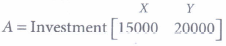
(i) (b) : If Rs. 15000 is invested in bond X, then the amount invested in bond Y = Rs. (35000 - 15000) = Rs. 20000.
and
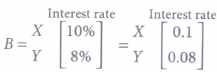
(ii) (c) : The amount of interest received on each bond is given by
\(A B=\left[\begin{array}{ll} 15000 & 20000 \end{array}\right] \times\left[\begin{array}{c} 0.1 \\ 0.08 \end{array}\right]\)
= [15000 x 0.1 + 20000 x 0.08] = [1500 + 1600] = 3100
(iii) (c) : Let Rs. x be invested in bond X and then Rs. (35000 - x) will be invested in bond Y.
Now, total amount of interest is given by
\(\left[\begin{array}{ll} x & 35000-x \end{array}\right]\left[\begin{array}{c} 0.1 \\ 0.08 \end{array}\right]=[0.1 x+(35000-x) 0.08]\)
But, it is given that total amount of interest = Rs. 3200
\(\therefore\) 0.1x + 2800 - 0.08x = 3200
\(\Rightarrow 0.02 x=400 \Rightarrow x=20000\)
Thus, Rs. 20000 invested in bond X and Rs. 35000 - Rs. 20000
= Rs. 15000 invested in bond Y.
(iv) (a) : AB will give the total amount of interest received on both bonds.
(v) (b) : Let Rs x invested in bond X, then we have
\(x \times \frac{10}{100}=500 \Rightarrow x=5000\)
Thus, amount invested in bond X is Rs.5000 and so investment in bond Y be Rs. (35000 - 5000) = Rs. 30000
2.
(i) (a) : \(A B=\left[\begin{array}{cc} 2 & -1 \\ 3 & 4 \end{array}\right]\left[\begin{array}{ll} 5 & 2 \\ 7 & 4 \end{array}\right]\)
\(=\left[\begin{array}{cc} 10-7 & 4-4 \\ 15+28 & 6+16 \end{array}\right]=\left[\begin{array}{cc} 3 & 0 \\ 43 & 22 \end{array}\right]\)
(ii) (c)
(iii) (b) : We have, CD - AB = 0
\(\Rightarrow\left[\begin{array}{ll} 2 & 5 \\ 3 & 8 \end{array}\right]\left[\begin{array}{ll} a & b \\ c & d \end{array}\right]-\left[\begin{array}{cc} 3 & 0 \\ 43 & 22 \end{array}\right]=\left[\begin{array}{ll} 0 & 0 \\ 0 & 0 \end{array}\right]\)
\(\Rightarrow\left[\begin{array}{ll} 2 a+5 c & 2 b+5 d \\ 3 a+8 c & 3 b+8 d \end{array}\right]-\left[\begin{array}{cc} 3 & 0 \\ 43 & 22 \end{array}\right]=\left[\begin{array}{ll} 0 & 0 \\ 0 & 0 \end{array}\right]\)
\(\Rightarrow\left[\begin{array}{cc} 2 a+5 c-3 & 2 b+5 d \\ 3 a+8 c-43 & 3 b+8 d-22 \end{array}\right]=\left[\begin{array}{ll} 0 & 0 \\ 0 & 0 \end{array}\right]\)
By equality of matrices, we get 2a + 5c - 3 = 0 ...(i)
3a + 8c - 43 = 0 ...(ii)
2b + 5d = 0 ...(iii)
3b + 8d - 22 = 0 ...(iv)
Solving (i) and (ii), we get a = -191, e = 77
(iv) (c) : Solving (iii) and (iv), we get b = -110, d = 44
(v) (d) : Wehave, \(B+D=\left[\begin{array}{ll} 5 & 2 \\ 7 & 4 \end{array}\right]+\left[\begin{array}{cc} -191 & -110 \\ 77 & 44 \end{array}\right]\)
\(=\left[\begin{array}{cc} -186 & -108 \\ 84 & 48 \end{array}\right]\)
3.
Combined sales in September and October for each farmer in each variety is given by
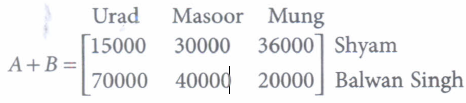
(i) (c) : Combined sales of Masoor in September and October for farmer Balwan Singh = Rs. 40000
(ii) (d) : Combined sales of Urad in September and October for farmer Shyam = Rs. 15000
(iii) (a) : Change in sales from September to October is given by
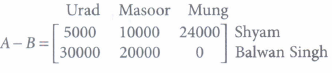
\(\therefore\) Decrease in sales of Mung from September to October for farmer Shyam = Rs. 24000.
(iv) (b) : Required profit is given by
\(2 \% \text { of } B=\frac{2}{100} \times B=0.02 \times B\)
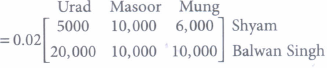
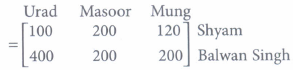
thus,in October Shyam receives Rs. 100, Rs. 200 and Rs. 120 as profit in the sale of each variety of pulses, respectively and Balwan Singh receives a profit of Rs. 400, Rs. 200 and Rs. 200 in the sale of each variety of pulses respectively.
4.
(i) (c) : Let Rs. A, Rs. B and Rs.C be the cost incurred by the organisation for villages X, Y and Z respectively. Then A, B, C will be given by the following matrix equation.
\(\left[\begin{array}{ccc} 400 & 300 & 100 \\ 300 & 250 & 75 \\ 500 & 400 & 150 \end{array}\right]\left[\begin{array}{l} 50 \\ 20 \\ 40 \end{array}\right]=\left[\begin{array}{c} A \\ B \\ C \end{array}\right]\)
\(\Rightarrow\left[\begin{array}{l} A \\ B \\ C \end{array}\right]=\left[\begin{array}{c} 400 \times 50+300 \times 20+100 \times 40 \\ 300 \times 50+250 \times 20+75 \times 40 \\ 500 \times 50+400 \times 20+150 \times 40 \end{array}\right]\)
(ii) (c)
(iii) (b)
(iv) (c) : Total number of toilets that can be expected in each village is given by the following matrix.
\(\begin{array}{l} X \\ Y \\ Z \end{array}\left[\begin{array}{ccc} 400 & 300 & 100 \\ 300 & 250 & 75 \\ 500 & 400 & 150 \end{array}\right]\)\(\left[\begin{array}{c} 2 / 100 \\ 4 / 100 \\ 20 / 100 \end{array}\right]\)
\(\begin{array}{l} X \\ Y \\ Z \end{array}\)\(\left[\begin{array}{c} 8+12+20 \\ 6+10+15 \\ 10+16+30 \end{array}\right]\)=\(\begin{array}{l} X \\ Y \\ Z \end{array}\)\(\left[\begin{array}{c} 40 \\ 31 \\ 56 \end{array}\right]\)
(v) (d)
5.
(I) (d) : In factory A, number of units of types I, II and III for boys are 80, 70, 65 respectively and for girls number of units of types I, II and III are 80, 75, 90 respectively.
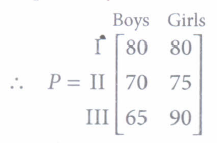
(ii) (a) : In factory B, number of units of types I, II and III for boys are 85, 65, 72 respectively and for girls number of units of types I, II and III are 50, 55, 80 respectively.
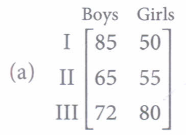
(iii) (c) : Let X be the matrix that represent the number of units of each type produced by factory A for boys, and Y be the matrix that represent the number of units of each type produced by factory B for boys.
Then, X = \(\begin{array}{ccc} \text { I } & \text { II } & \text { III } \\ {[170} & 130 & 130] \end{array}\) and Y = \(\begin{array}{ccc} \text { I } & \text { II } & \text { III } \\ {[85} & 65 & 72] \end{array}\)
Now, required matrix = X + Y = [80 70 65] + [85 65 72]
= [165 135 137]
(iv) (a): Required matrix = [80 75 90] + [50 55 80]
= [130 130 170]
(v) (a) : Clearly,R = P+Q
\(=\left[\begin{array}{ll} 80 & 80 \\ 70 & 75 \\ 65 & 90 \end{array}\right]+\left[\begin{array}{ll} 85 & 50 \\ 65 & 55 \\ 72 & 80 \end{array}\right]=\left[\begin{array}{ll} 165 & 130 \\ 135 & 130 \\ 137 & 170 \end{array}\right]\)
\(\therefore \quad R^{\prime}=\left[\begin{array}{lll} 165 & 135 & 137 \\ 130 & 130 & 170 \end{array}\right]\)

12th Standard CBSE Syllabus & Materials
12th Standard CBSE
CBSE 12th Computer Science Python Revision Tour I - New Previous year Question Papers Study Material - QB365 Set A
NEW12th Standard CBSE
CBSE 12th Business Studies Planning Important Questions And Answers Study Material - QB365 Set A
NEW12th Standard CBSE
CBSE 12th Business Studies Business Environment Important Questions And Answers Study Material - QB365 Set A
NEW12th Standard CBSE
CBSE 12th Business Studies Principles of Management Important Questions And Answers Study Material - QB365 Set A



NCERT Books

Syllabus

Exam Pattern

Sample Question Papers

Previous year Question Papers

Important Notes

MCQ Practice test

NCERT Exemplers

Case study Questions

Image Based Questions

Passage based Questions

HOT Questions

Value Based Questions

Model Questions Papers
NCERT ( Book Back ) Questions

Assertion and Reason
Important Questions And Answers

CBSE 12th Standard CBSE Subjects
CBSE Standards








