
 100% FREE ACCESS
12th Standard CBSE Syllabus & Materials
12th Standard CBSE
CBSE 12th Economics Government Budget and the Economy Previous year Question Papers Study Material - QB365 Set A
NEW12th Standard CBSE
CBSE 12th Computer Science Interface Python with MySQL - New Previous year Question Papers Study Material - QB365 Set A
NEW12th Standard CBSE
CBSE 12th Computer Science Database Concept - New Previous year Question Papers Study Material - QB365 Set A
NEW12th Standard CBSE
CBSE 12th Computer Science Data Communication - New Previous year Question Papers Study Material - QB365 Set A
NEW12th Standard CBSE
CBSE 12th Computer Science Data Structures - New Previous year Question Papers Study Material - QB365 Set A
NEW12th Standard CBSE
CBSE 12th Computer Science Functions - New Previous year Question Papers Study Material - QB365 Set A

Published on: 22/05/2021
QB365 Provides the updated NCERT Examplar Questions for Class 12 Maths, and also provide the detail solution for each and every ncert examplar questions , QB365 will give all kind of study materials will help to get more marks
Download CBSE Class 12th Standard CBSE Maths question papers, sample papers, important questions, and previous year solved papers in PDF format. Get free study materials, NCERT solutions, and exam preparation resources for Class 12th Standard CBSE Maths
Questions + Answers key
Take MCQ Maths Test1.
Sketch the region \(\left\{(x, y): y=\sqrt{4-x^{2}}\right\}\) and X-axis. Find the area of the region using integration.
2.
Evaluate \(\int \tan ^{2} x \sec ^{4} x d x\)
3.
Evaluate the integral \(\int { \frac { \sin ^{ -1 }{ x } }{ { \left( 1-{ x }^{ 2 } \right) }^{ 3/2 } } } dx.\)
4.
Evaluate the integral \(\int { \frac { \sqrt { 1+{ x }^{ 2 } } }{ { x }^{ 4 } } } dx.\)
5.
Evaluate:\(\int { \frac { { x }^{ 3 }+x }{ { x }^{ 4 }-9 } } dx.\)
6.
Evaluate :\(\int { \tan ^{ 8 }{ x } } \sec ^{ 4 }{ x } dx.\)
7.
Evaluate : \(\int { \frac { dx }{ \sqrt { (x-a)(\beta -x) } } } ,\beta >a.\)
8.
Verify the following, using the concept of integration as an antiderivative: \(\int { \frac { { x }^{ 3 } }{ x+1 } } dx=x-\frac { 1 }{ 2 } { x }^{ 2 }+\frac { 1 }{ 3 } { x }^{ 3 }-\log { \left| x+1 \right| } +C.\)
9.
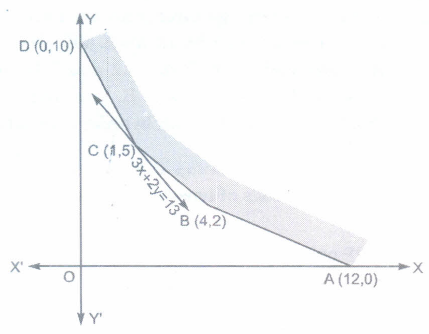
Determine the minimum value of Z = 3x + 2y (if any), if the feasible region for an LLP is shown in the figure:
10.
Show that the vector \(\overset { \rightarrow }{ a } \), \(\overset { \rightarrow }{ b } \) and \(\overset { \rightarrow }{ c } \) are coplanar if \(\overset { \rightarrow }{ a } +\overset { \rightarrow }{ b } ,\overset { \rightarrow }{ b } +\overset { \rightarrow }{ c } \ and \ \overset { \rightarrow }{ c } +\overset { \rightarrow }{ a } \) are coplanar.
11.
Prove that:\(\left[ \overset { \rightarrow }{ a } +\overset { \rightarrow }{ b } ,\overset { \rightarrow }{ b } +\overset { \rightarrow }{ c } ,\overset { \rightarrow }{ c } +\overset { \rightarrow }{ a } ]=2[\overset { \rightarrow }{ a } \overset { \rightarrow }{ b } \overset { \rightarrow }{ c } \right] \)
12.
Lagrange's identify prove that : \({( }{ \overrightarrow { a } *\overrightarrow { b) } }^{ 2 }=\overset { \rightarrow }{ { |a| }^{ 2 } } \overset { \rightarrow }{ { |b| }^{ 2 } } -{ ( }{ \overrightarrow { a } .\overrightarrow { b) } }^{ 2 }\)
13.
If \(\overrightarrow { r } =x\hat { i } +y\hat { j } +z\hat { k } \) ,then find \((\vec{r} \times \hat{i}) \cdot(\vec{r} \times \hat{j})+x y\)
14.
If A and B are two points vectors and respectively. write the position vectors of a point of a P, which divides the line segment AB internally in the ratio 1 : 2
15.
Find the value of 'p' for which the vectors:\(3\overset { \wedge }{ i } -2\overset { \wedge }{ j } +9\overset { \wedge }{ k } \) and \(\overset { \wedge }{ i } -2p\overset { \wedge }{ j } +3\overset { \wedge }{ k } \) are paralell.
16.
Using vector, find the value of 'k' such that the point: (k, -10, 3), (1, -1, 3) and (3, 5, 3) are collinear.
17.
Find all vectors of magnitude 10\(\sqrt { 3 }\) that are perpendicular to the plane of:
\(\overset { \wedge }{ i } +2\overset { \wedge }{ j } +\overset { \wedge }{ k } \ and\ -\overset { \wedge }{ i } +3\overset { \wedge }{ j } +4\overset { \wedge }{ k } \)
18.
Find the equation of a curve passing through the origin, given that the slope of the tangent to the curve at any point (x, y) is the equal to the sum of the co-ordinates of the point.
19.
Show that for \(a\ge 1\) \(f(x)=\sqrt { 3 } sinx-cosx-2ax+4\) is increasing in R.
20.
Find the area of the region bounded by the curves:
x = at2 and y = 2at between the ordinates corresponding to t = 1 and t = 2.
21.
Find the area of the region bounded by the parabola y2 = 2x and the straight line x - y = 4.
22.
Is the binary operation '*' defined on Z (set of integers) by:
\(m*n=m-n+mn\quad for\quad all\quad m,n\in Z\) commutative?
23.
If the mappings f and g are given by:
f = {(1, 2), (3, 5) (4, 1) and g = {(2, 3), (5, 1), (1, 3)}, write fog.
24.
If \(\Delta =\left| \begin{matrix} 1 & x & x^{ 2 } \\ 1 & y & { y }^{ 2 } \\ 1 & z & { z }^{ 2 } \end{matrix} \right| ,{ \Delta }_{ 1 }=\left| \begin{matrix} 1 & 1 & 1 \\ yz & zx & xy \\ x & y & z \end{matrix} \right| \)then prove that \(\Delta+\Delta_1=0\)
1.
Given region is \(\left\{(x, y): y=\sqrt{4-x^{2}}\right\} \text { and } X \text { -axis. }\)
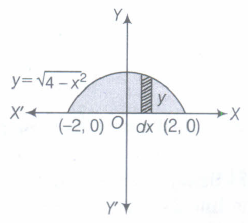
We have,\(y=\sqrt{4-x^{2}}\)
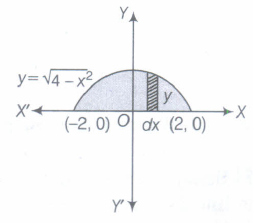
We have,\(y=\sqrt{4-x^{2}}\)
\(\Rightarrow y^{2}=4-x^{2} \Rightarrow x^{2}+y^{2}=4\)
This represent the equation of circle having centre (0, 0) and radius 2.
But original equation is \(y=\sqrt{4-x^{2}}\). So y is positive. It means that, we have to take a curve above the X-axis.
Thus, only semi-circle is formed above the X-axis
Since, the region is symmetrical about Y-axis
\(\therefore\) Area of shaded region,
\(A=2 \int_{0}^{2} y d x=2 \int_{0}^{2} \sqrt{4-x^{2}} d x=2 \int_{0}^{2} \sqrt{2^{2}-x^{2}} d x\)
\(=2\left[\frac{x}{2} \sqrt{2^{2}-x^{2}}+\frac{2^{2}}{2} \cdot \sin ^{-1} \frac{x}{2}\right]_{0}^{2} \)
\(=2\left[\frac{2}{2} \cdot 0+2 \cdot \frac{\pi}{2}-\frac{0}{2} \cdot 2-2 \sin ^{-1}(0)\right] \)
\(=2\left[2 \cdot \frac{\pi}{2}+0\right]=2 \pi \text { sq units } \)
2.
Let \(I=\int \tan ^{2} x \sec ^{4} x d x=\int \tan ^{2} x \sec ^{2} x \sec ^{2} x d x\)
\(=\int \tan ^{2} x\left(1+\tan ^{2} x\right) \sec ^{2} x d x \quad\left[\because \sec ^{2} x=1+\tan ^{2} x\right]\)
Now, put \(\tan x=t \Rightarrow \sec ^{2} x d x=d t\)
\( \therefore I =\int\left(t^{2}-1\right) \cdot t^{2} d t=\int\left(t^{4}-t^{2}\right) d t=\frac{t^{3}}{5}-\frac{t^{3}}{3}+C\)
\( =\frac{1}{5} \sec ^{5} x-\frac{1}{3} \sec ^{3} x+C \quad[\because t=\sec x] \)
3.
\(Put\ \sin ^{ -1 }{ x } =t\) i.e.x = sin t
so that \(\frac { 1 }{ \sqrt { 1-{ x }^{ 2 } } } dx=dt.\)
\(\therefore I=\int { \frac { t }{ (1-\sin ^{ 2 }{ t) } } } dt=\int { \frac { t }{ \cos ^{ 2 }{ t } } } dt\)
\(=\int { t\sec ^{ 2 }{ t } dt } \)
\(=t\tan { t } -\int { (1) } \tan { t } dt\)
[Integration by Parts]
\(=t\tan { t } +\log { \left| \cos { t } \right| } +c\)
\(=\sin ^{ -1 }{ x } .\frac { x }{ \sqrt { 1-{ x }^{ 2 } } } +\log { \left| \sqrt { 1-{ x }^{ 2 } } \right| } +c\)
4.
\(I=\int { \sqrt { \left( \frac { 1 }{ { x }^{ 2 } } +1 \right) } } \frac { 1 }{ { x }^{ 3 } } dx.\)
\(Put\ \frac { 1 }{ { x }^{ 2 } } +1=t\)so that \(-\frac { 2 }{ { x }^{ 3 } } dx=dt\quad i.e.\frac { dx }{ { x }^{ 3 } } =-\frac { dt }{ 2 } .\)
\(\therefore I=\int { \sqrt { t } } \left( -\frac { dt }{ 2 } \right) =-\frac { 1 }{ 2 } \int { { t }^{ 3/2 } } dt\)
\(=-\frac { 1 }{ 2 } .\frac { { t }^{ 3/2 } }{ 3/2 } +c=-\frac { 1 }{ 3 } { \left( 1+\frac { 1 }{ { x }^{ 2 } } \right) }^{ 3/2 }+c.\)
5.
\(I= \int { \frac { { x }^{ 3 }+x }{ { x }^{ 4 }-9 } } dx.\)
\(=\frac { { x }^{ 3 } }{ { x }^{ 4 }-9 } dx+\int { \frac { xdx }{ { x }^{ 4 }-9 } } ..(1)\)
Now, \({ I }_{ 1 }=\frac { { x }^{ 3 } }{ { x }^{ 4 }-9 } dx.\)
\(Put\ { x }^{ 4 }=t\)so that \(4{ x }^{ 3 }dx=dt\ i.e. { x }^{ 3 }dx=\frac { 1 }{ 4 } dt.\)
\(\therefore { I }_{ 1 }=\int { \frac { \frac { 1 }{ 4 } dt }{ t-9 } } =\frac { 1 }{ 4 } \int { \frac { dt }{ t-9 } } \)
\(=\frac { 1 }{ 4 } \log { \left| t-9 \right| } +{ c }_{ 1 }=\frac { 1 }{ 4 } \log { \left| { x }^{ 4 }-9 \right| } +{ c }_{ 1 }.\)
And \({ I }_{ 2 }=\int { \frac { x }{ { x }^{ 4 }-9 } } dx.\)
\(Put\ { x }^{ 2 }=u\)so that \(2xdx=du\ i.e. xdx=\frac { 1 }{ 2 } du.\)
\(\therefore { I }_{ 2 }=\int { \frac { \frac { 1 }{ 2 } du }{ { u }^{ 2 }-9 } } =\frac { 1 }{ 2 } \int { \frac { du }{ { u }^{ 2 }-3^{ 2 } } } \)
\(=\frac { 1 }{ 2 } .\frac { 1 }{ 2(3) } \log { \left| \frac { u-3 }{ u+3 } \right| } +{ c }_{ 2 }= \frac { 1 }{ 12 } \log { \left| \frac { { x }^{ 2 }-3 }{ { x }^{ 2 }+3 } \right| } +{ c }_{ 2 }.\)
\(\therefore \ From(1), I=\ \frac { 1 }{ 4 } \log { \left| { x }^{ 2 }-9 \right| } +\frac { 1 }{ 12 } \log { \left| \frac { { x }^{ 2 }-3 }{ { x }^{ 2 }+3 } \right| } +{ c }.\)
Where \({ c }_{ 1 }+{ c }_{ 2 }=c\)
6.
\(I=\int { \tan ^{ 8 }{ x } } (\sec ^{ 2 }{ x } )\)
\(=\int { \tan ^{ 8 }{ x } } (\sec ^{ 2 }{ x } )\sec ^{ 2 }{ x } dx\)
\(=\int { \tan ^{ 8 }{ x } } (1+\tan ^{ 2 }{ x } )\sec ^{ 2 }{ x } dx\)
\(=\int { \tan ^{ 8 }{ x } } \sec ^{ 4 }{ x } dx+ \int { \tan ^{ 10 }{ x } \sec ^{ 2 }{ x } } dx.\)
\(Put\ \tan { x } =t\) so that \(\sec ^{ 2 }{ x } dx=dt\)
\(\therefore I= \int { { t }^{ 8 } } dt+\int { { t }^{ 10 } } dt=\frac { { t }^{ 9 } }{ 9 } +\frac { { t }^{ 11 } }{ 11 } +c\)
\(I= \frac { \tan ^{ 11 }{ x } }{ 11 } +\frac { \tan ^{ 9 }{ x } }{ 9 } +C.\)
7.
Let \(I=\int { \frac { dx }{ \sqrt { (x-a)(\beta -x) } } } \)
\(Put\ x-a={ t }^{ 2 }\) so that \(dx=2t\ dt\)
Also \(\beta -x=\beta -({ t }^{ 2 }+(\beta -a)=(\beta -a)-{ t }^{ 2 }\)
\(\therefore I= \int { \frac { 2t\quad dt }{ { t }^{ 2 }({ \beta -a-t }^{ 2 }) } } =\int { \frac { 2\quad dt }{ ({ \beta -a)-t }^{ 2 } } } \)
\(=2\int { \frac { dt }{ \sqrt { { (\sqrt { \beta -a } ) }^{ 2 }-{ t }^{ 2 } } } } =2\sin ^{ -1 }{ \frac { t }{ \sqrt { \beta -a } } } +c\)
\(=2\sin ^{ -1 }{ \sqrt { \frac { x-a }{ \beta -a } } } +C\)
8.
\( \frac { d }{ dx } \left( x-\frac { { x }^{ 2 } }{ 2 } +\frac { { x }^{ 3 } }{ 3 } -\log { \left| x+1 \right| } +C \right) \)
\(=1-\frac { 1 }{ 2 } (2x)+\frac { 1 }{ 3 } (3{ x }^{ 2 })-\frac { 1 }{ x+1 } +0\)
\(=1-x+{ x }^{ 2 }-\frac { 1 }{ 1+x } =\frac { 1-x+{ x }^{ 2 }(1+x)-1 }{ 1+x } \)
\(=\frac { 1+{ x }^{ 3 }-1 }{ 1+x } =\frac { { x }^{ 3 } }{ x+1 } .\)
\(\left( x-\frac { 1 }{ 2 } { x }^{ 2 }+\frac { 1 }{ 3 } { x }^{ 3 }-\log { \left| x+1 \right| } +C \right) \)
\(=\int { \frac { { x }^{ 3 } }{ x+1 } } dx.\)
9.
The feasible region is unbounded.
∴ Minimum value of Z may or may not exist.
Applying Corner Point Method, we have:
| Corner Point | Value of Z |
| A : (12,0) | 36 |
| B : (4,2) | 16 |
| C : (1,5) | 13 (Minimum) |
| D : (0,10) | 20 |
We graph 3x + 2y < 13.
It is observed that the open half plane determined by 3x + 2y < 13 and R do not have a common point.
Hence, Minimum value of Z = 13.
10.
Since \(\overset { \rightarrow }{ a } +\overset { \rightarrow }{ b } ,\overset { \rightarrow }{ b } +\overset { \rightarrow }{ c } \ and\ \overset { \rightarrow }{ c } +\overset { \rightarrow }{ a } \) are complannar.
\(\therefore\) \(\overset { \rightarrow }{ a } +\overset { \rightarrow }{ b } ).\left[ (\overset { \rightarrow }{ b } +\overset { \rightarrow }{ c } )\times (\overset { \rightarrow }{ c } +\overset { \rightarrow }{ a } ) \right] =0\)
\(\Rightarrow (\overset { \rightarrow }{ a } +\overset { \rightarrow }{ b } ).\left[ \overset { \rightarrow }{ b } +\overset { \rightarrow }{ c } \times \overset { \rightarrow }{ b } \times \overset { \rightarrow }{ a } \times \overset { \rightarrow }{ c } \times \overset { \rightarrow }{ c } +\overset { \rightarrow }{ c } +\overset { \rightarrow }{ a } \right] =0\)
\(\Rightarrow (\overset { \rightarrow }{ a } +\overset { \rightarrow }{ b } ).(\overset { \rightarrow }{ b } \times \overset { \rightarrow }{ c } +\overset { \rightarrow }{ b } \times \overset { \rightarrow }{ a } +\overset { \rightarrow }{ c } \times \overset { \rightarrow }{ a } )=0 \left[ \because \overset { \rightarrow }{ c } \times \overset { \rightarrow }{ c } =\overset { \rightarrow }{ 0 } \right] \)
\(\Rightarrow \overset { \rightarrow }{ a } .(\overset { \rightarrow }{ b } \times \overset { \rightarrow }{ c } )+\overset { \rightarrow }{ a } .(\overset { \rightarrow }{ b } \times \overset { \rightarrow }{ a } )+\overset { \rightarrow }{ a } .(\overset { \rightarrow }{ c } \times \overset { \rightarrow }{ a } )+\overset { \rightarrow }{ b } .(\overset { \rightarrow }{ b } \times \overset { \rightarrow }{ c } )+\overset { \rightarrow }{ b } .(\overset { \rightarrow }{ b } \times \overset { \rightarrow }{ a } )+\overset { \rightarrow }{ b } .(\overset { \rightarrow }{ c } \times \overset { \rightarrow }{ a } )=0\)
\(\Rightarrow 2\left[ \overset { \rightarrow }{ a } \overset { \rightarrow }{ b } \overset { \rightarrow }{ c } \right] +\overset { \rightarrow }{ 0 } +\overset { \rightarrow }{ 0 } +\overset { \rightarrow }{ 0 } +\overset { \rightarrow }{ 0 } +\left[ \overset { \rightarrow }{ a } \overset { \rightarrow }{ b } \overset { \rightarrow }{ c } \right] =0\)
\(\Rightarrow 2\left[ \overset { \rightarrow }{ a } \overset { \rightarrow }{ b } \overset { \rightarrow }{ c } \right] =0\Rightarrow \left[ \overset { \rightarrow }{ a } \overset { \rightarrow }{ b } \overset { \rightarrow }{ c } \right] =0\)
\(\Rightarrow \) \(\overset { \rightarrow }{ a } ,\overset { \rightarrow }{ b } \ and\ \overset { \rightarrow }{ c } \) are coplanar.
11.
LHS\(=\left[ \overset { \rightarrow }{ a } +\overset { \rightarrow }{ b } ,\overset { \rightarrow }{ b } +\overset { \rightarrow }{ c } ,\overset { \rightarrow }{ c } +\overset { \rightarrow }{ a } \right] \)
\(=\left[ \left( \overset { \rightarrow }{ a } +\overset { \rightarrow }{ b } \right) *\left( \overset { \rightarrow }{ b } +\overset { \rightarrow }{ c } \right) \right] .\left( \overset { \rightarrow }{ c } +\overset { \rightarrow }{ a } \right) \)
\(=\left[ \overset { \rightarrow }{ a } \times \overset { \rightarrow }{ b } +\overset { \rightarrow }{ a } \times \overset { \rightarrow }{ c } +\overset { \rightarrow }{ b } \times \overset { \rightarrow }{ b } \right] .\left( \overset { \rightarrow }{ c } +\overset { \rightarrow }{ a } \right) \)
\(=\left[ \overset { \rightarrow }{ a } \times \overset { \rightarrow }{ b } +\overset { \rightarrow }{ a } \times \overset { \rightarrow }{ c } +\overset { \rightarrow }{ b } \times \overset { \rightarrow }{ c } \right] .\left( \overset { \rightarrow }{ c } +\overset { \rightarrow }{ a } \right) \)
\(=\left( \overset { \rightarrow }{ a } \times \overset { \rightarrow }{ b } \right) .\overset { \rightarrow }{ c } +\left( \overset { \rightarrow }{ a } \times \overset { \rightarrow }{ b } \right) .\overset { \rightarrow }{ a } +\left( \overset { \rightarrow }{ a } \times \overset { \rightarrow }{ c } \right) .\overset { \rightarrow }{ c } +\left( \overset { \rightarrow }{ a } \times \overset { \rightarrow }{ c } \right) .\overset { \rightarrow }{ a } +\left( \overset { \rightarrow }{ b } \times \overset { \rightarrow }{ c } \right) .\overset { \rightarrow }{ c } +\left( \overset { \rightarrow }{ b } \times \overset { \rightarrow }{ c } \right) .\overset { \rightarrow }{ a } \\ \)
\(=\left[ \overset { \rightarrow }{ a } \overset { \rightarrow }{ b } \overset { \rightarrow }{ c } \right] +\left[ \overset { \rightarrow }{ a } \overset { \rightarrow }{ b } \overset { \rightarrow }{ a } \right] +\left[ \overset { \rightarrow }{ a } \overset { \rightarrow }{ c } \overset { \rightarrow }{ c } \right] +\left[ \overset { \rightarrow }{ a } \overset { \rightarrow }{ c } \overset { \rightarrow }{ a } \right] +\left[ \overset { \rightarrow }{ b } \overset { \rightarrow }{ c } \overset { \rightarrow }{ c } \right] +\left[ \overset { \rightarrow }{ b } \overset { \rightarrow }{ c } \overset { \rightarrow }{ a } \right] \)
\(=\left[ \overset { \rightarrow }{ a } \overset { \rightarrow }{ b } \overset { \rightarrow }{ c } \right] +\overset { \rightarrow }{ 0 } +\overset { \rightarrow }{ 0 } +\overset { \rightarrow }{ 0 } +\overset { \rightarrow }{ 0 } +\left[ \overset { \rightarrow }{ b } \overset { \rightarrow }{ c } \overset { \rightarrow }{ a } \right] \)
\(=\left[ \overset { \rightarrow }{ a } \overset { \rightarrow }{ b } \overset { \rightarrow }{ c } \right] +\left[ \overset { \rightarrow }{ a } \overset { \rightarrow }{ b } \overset { \rightarrow }{ c } \right] =2\left[ \overset { \rightarrow }{ a } \overset { \rightarrow }{ b } \overset { \rightarrow }{ c } \right] =RHS\\ \)
12.
\({ ( }{ \overrightarrow { a } *\overrightarrow { b) } }^{ 2 }={ \overset { \rightarrow }{ { (|a| }^{ 2 } } \overset { \rightarrow }{ { |b| }^{ 2 } } sin\theta { \overrightarrow { n } ) }^{ 2 } }\)
\(=\overset { \rightarrow }{ { |a| }^{ 2 } } \overset { \rightarrow }{ { |b| }^{ 2 } } sin\theta { \overrightarrow { n } }^{ 2 }=\overset { \rightarrow }{ { |a| }^{ 2 } } \overset { \rightarrow }{ { |b| }^{ 2 } } sin\theta { \overrightarrow { n } }^{ 2 }\) \([\because { \overrightarrow { n } }^{ 2 }=\overrightarrow { n } .\overrightarrow { n } =(1)cos0°=1]\)
\(=\overset { \rightarrow }{ { |a| }^{ 2 } } \overset { \rightarrow }{ { |b| }^{ 2 } } (1-{ cos }^{ 2 }°\theta )\)
\(=\overset { \rightarrow }{ { |a| }^{ 2 } } \overset { \rightarrow }{ { |b| }^{ 2 } } -\overset { \rightarrow }{ { |a| }^{ 2 } } \overset { \rightarrow }{ { |b| }^{ 2 } } { cos }^{ 2 }°\theta \)
\(=\overset { \rightarrow }{ { |a| }^{ 2 } } \overset { \rightarrow }{ { |{ b }| }^{ 2 } } -{ (\overrightarrow { a } .\overrightarrow { b } ) }^{ 2 }{ cos }^{ 2 }°\theta \)
\(=\overset { \rightarrow }{ { |a| }^{ 2 } } \overset { \rightarrow }{ { |{ b }^{ 2 }| }^{ 2 } } -{ (\overrightarrow { a } .\overrightarrow { b } ) }^{ 2 }\)
Other (I) \({ (\overrightarrow { a } .\overrightarrow { b } ) }^{ 2 }=\overset { \rightarrow }{ { |a| }^{ 2 } } \overset { \rightarrow }{ { |{ b }| }^{ 2 } } -{ (\overrightarrow { a } *\overrightarrow { b } ) }^{ 2 }\)
(II) \({ (\overrightarrow { a } *\overrightarrow { b } ) }^{ 2 }+{ (\overrightarrow { a } .\overrightarrow { b } ) }^{ 2 }=\overset { \rightarrow }{ { |a| } } \overset { \rightarrow }{ { |{ b }| }^{ 2 } } \)
13.
Here \(\overrightarrow { r } *\hat { i } \) \(=(x\hat { i } +y\hat { j } +z\hat { k } )*\hat { i } \)
\(=x(i*\hat { j } )+y(\hat { j } *i)+z(\hat { k } *i)\)
\(=x\overrightarrow { (0) } +y(-\hat { k } )+z(\hat { j } )\)
\(=-y\hat { k } +z\hat { j } \) ...(1)
and \(\overrightarrow { r } *\hat { j } =(x\hat { i } +y\hat { j } +z\hat { k } )*\hat { i } \)
\(=x(i*\hat { j } )+y(\hat { j } *\hat { j } )+z(\hat { k } *\hat { j } )\)
\(=x(\hat { k } )+y\overrightarrow { (0) } +z(-\hat { i } )\)
\(=-y\hat { k } -z\hat { i } \) ...(2)
\(\therefore (\overrightarrow { r } *\hat { i } ).(\overrightarrow { r } *\hat { j } )+xy\)
\(=(-y\hat { k } +z\hat { j } ).(x\hat { k } +z\hat { j } )+xy\)
\(=-yx(\hat { k } .\hat { k } )+yz(\hat { k } .\hat { i } )+zx(\hat { j } .\hat { k } )-{ z }^{ 2 }(\hat { j } .\hat { i } )+xy\)
\(=-yx(1)+yz(0)+zx(0)-{ z }^{ 2 }(0)+xy\)
\(=-xy+xy=0\)
14.
The position vector of P
\(=\frac { 1.(6\overset { \rightarrow }{ b } -\overset { \rightarrow }{ a } )+(2\overset { \rightarrow }{ a } -\overset { \rightarrow }{ b } ) }{ 1+2 } \)
\(=\frac { 6\overset { \rightarrow }{ b } -\overset { \rightarrow }{ a } +4\overset { \rightarrow }{ a } -\overset { \rightarrow }{ b } }{ 3 } =\frac { 3\overset { \rightarrow }{ a } }{ 3 } =\overset { \rightarrow }{ a } \)
15.
The given vectors \(3\overset { \wedge }{ i } -2\overset { \wedge }{ j } +9\overset { \wedge }{ k } \) and \(\overset { \wedge }{ i } -2p\overset { \wedge }{ j } +3\overset { \wedge }{ k } \) are parallel
if \(\frac { 3 }{ 1 } =\frac { 2 }{ -2p } =\frac { 9 }{ 3 } 3=\frac { 1 }{ -p } =3\)
if \(p=-\frac { 1 }{ 3 } \)
16.
Let \(\overset { \rightarrow }{ a } =k\overset { \wedge }{ i } -10\overset { \wedge }{ j } +3\overset { \wedge }{ k } ,\) and \(\overset { \rightarrow }{ b } =\overset { \wedge }{ i } -\overset { \wedge }{ j } +3\overset { \wedge }{ k } \) and \(\overset { \rightarrow }{ c } =3\overset { \wedge }{ i } +5\overset { \wedge }{ j } +3\overset { \wedge }{ k } \)
the given points are colinear if \(\left| \begin{matrix} k & -10 & 3 \\ 1 & -1 & 3 \\ 3 & 5 & 3 \end{matrix} \right| \)
If k(-3-15) +10(3-9) + 3(5+3) = 0
If -8k - 60 + 24 = 0
If 18k = -36
If k = -2
17.
Let \(\overset { \rightarrow }{ a } =\overset { \wedge }{ i } +2\overset { \wedge }{ j } +\overset { \wedge }{ k } \ and\ \overset { \rightarrow }{ b } =-\overset { \wedge }{ i } +3\overset { \wedge }{ j } +4\overset { \wedge }{ k } \)
Then \(\overset { \rightarrow }{ a } *\overset { \rightarrow }{ b } =\left| \begin{matrix} \overset { \wedge }{ i } & \overset { \wedge }{ j } & \overset { \wedge }{ k } \\ 1 & 2 & 1 \\ -1 & 3 & 4 \end{matrix} \right| \)
\(\therefore |\overset { \rightarrow }{ a } *\overset { \rightarrow }{ b } |=\sqrt { { (5) }^{ 2 }+{ (-5) }^{ 2 }+{ (5) }^{ 2 } } =\sqrt { { 3(5) }^{ 2 } } \)
\(\pm 10\sqrt { 3 } \left( \frac { 5\overset { \wedge }{ i } -5\overset { \wedge }{ j } +5\overset { \wedge }{ k } }{ 5\sqrt { 3 } } \right) i.e\pm 10(\overset { \wedge }{ i } -\overset { \wedge }{ j } +\overset { \wedge }{ k } )\)
\(\therefore\) The unit vector perpendicular to the plane \(\overset { \rightarrow }{ a } \) and \(\overset { \rightarrow }{ b } \) is given by:
Hence, the vector of magnitude 10\(\sqrt { 3 }\) that are perpendicular to the plane of \(\overset { \rightarrow }{ a } \) and \(\overset { \rightarrow }{ b } \) are
18.
We know that the slope of the tangent to the curve is \(\frac { dy }{ dx } .\)
By the question, \(\frac { dy }{ dx } =x+y\)
\(\Rightarrow\) \(\frac { dy }{ dx } -y=x\) .(1)
Here \('P'=-1\) and \('Q'=x.\)
\(\therefore\) I.F. \(={ e }^{ \int { Pdx } }={ e }^{ \int { -1.dx } }={ e }^{ -x }\)
Multiplying (1) by \({ e }^{ -x },\) we get:
\({ e }^{ -x }.\frac { dy }{ dx } -y.{ e }^{ -x }=x.{ e }^{ -x }.\)
\(\Rightarrow\) \(\frac { d }{ dx } \left( y.{ e }^{ -x } \right) =x{ e }^{ -x }.\)
Integrating,
\(y.{ e }^{ -x }=\int { x.{ e }^{ -x } } dx+C\)
\(=x.\frac { { e }^{ -x } }{ -1 } -\int { \left( 1 \right) } \frac { { e }^{ -x } }{ -1 } dx+C\)
[Integrating by Parts]
\(=-x{ e }^{ -x }+\int { { e }^{ -x } } dx+C\)
\(=-x{ e }^{ -x }+\frac { { e }^{ -x } }{ -1 } +C\)
\(\Rightarrow\) \(y=-x-1+C\quad { e }^{ x }\)
Since the curve passes through of the origin(0,0),
\(\therefore\) \(0=-0-1+C\quad { e }^{ 0 }\Rightarrow C=1.\)
Putting in (2),\(y=-x-1+{ e }^{ x }\)
\(\Rightarrow x+y+1={ e }^{ x },\)
Which is the requested equation of the curve.
19.
We have:
\(f(x)=\sqrt { 3 } sinx-cosx-2ax+b\)
\(\therefore f(x)=\sqrt { 3 } cosx-sinx-2a\)
\(=2\left( \frac { \sqrt { 3 } }{ 2 } cosx+\frac { 1 }{ 2 } sinx \right) -2a\)
\(=2cos\left( x-\frac { \pi }{ 6 } \right) -2a=2\left\lfloor cos\left( x-\frac { \pi }{ 6 } \right) -a \right\rfloor \)
\(= \ge 0.\)
20.
We have : x = at2 ..(1)
and y = 2at ...(2)
From (2) \(t=\frac { y }{ 2a } \)
Putting in (1), \(x=a\left( \frac { { y }^{ 2 } }{ { 4a }^{ 2 } } \right) \Rightarrow { y }^{ 2 }=4ax\)
When t = 1, then from (1), x = a.
When t = 2, then from (2), x = 4a
Therefore, Reqd. area = 2 (area ABCD)
\(=2\overset { 4a }{ \underset { a }{ \int { } } } ydx=2\overset { 4a }{ \underset { a }{ \int { } } } 2\sqrt { ax } dx\)
\(=4\sqrt { a } \left[ \frac { { x }^{ 3/2 } }{ 3/2 } \right] _{ a }^{ 4a }\)
\(=\frac { 8 }{ 3 } \sqrt { a } \left[ { (4a) }^{ 3/2 }-{ (a) }^{ 3/2 } \right] \)
\(=\frac { 8 }{ 3 } { a }^{ 2 }\left[ 8-1 \right] =\frac { 56 }{ 3 } { a }^{ 2 }sq.units\)
21.
The given parabola is y2 = 2x and the given st. line is x - y = 4
Solving (1) and (2):
From (2), x = 4 + y
Putting in (1), y2 = 8 + 2y \(\Rightarrow\) y2 - 2y - 8 = 0 \(\Rightarrow\) (y - 4) (y + 2) = 0 \(\Rightarrow\) y = 4, - 2
When y = 4, then from (3), x = 4 + 4 = 8
When y = -2, then from (3), x = 4 - 2 = 2
Thus the line (2) cuts parabola (2) in the points A (2, -2) and B(8, 4).
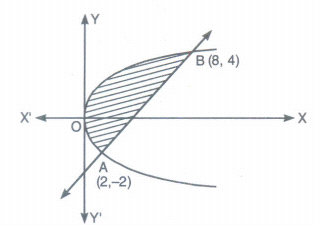
The region is shown as shaded in the above figure.
Therefore, Reqd.area
\(=\overset { 4 }{ \underset { -2 }{ \int { } } } \left( 4+y\frac { { y }^{ 2 } }{ 2 } \right) dy=\left[ 4y+\frac { { y }^{ 2 } }{ 2 } -\frac { { y }^{ 3 } }{ 6 } \right] _{ -2 }^{ 4 }\)
\(=\left( 4(4)+\frac { 16 }{ 2 } -\frac { 64 }{ 6 } \right) -\left( -8+\frac { 4 }{ 2 } +\frac { 8 }{ 6 } \right) \)
\(=\left( 16+8\frac { 64 }{ 6 } \right) -\left( -8+2+\frac { 8 }{ 6 } \right) \)
\(=\left( 24-\frac { 64 }{ 6 } \right) +\left( 6-\frac { 8 }{ 6 } \right) =30-\frac { 72 }{ 6 } =30-12=18sq.units\)
22.
No.
For \(1,2\in Z,\quad 1*2=1-2+1.2=1\)
while \(2*1=2-1+2.1=3\)
Hence \(1*2\neq 2*1\)
23.
\((fog)=f(g(x))\)
= {(2, 5), (5, 2), (1, 5)}.
\([\therefore Under\ g:2\rightarrow 3\Rightarrow (2,5);\ etc.\ Under\ f:3\rightarrow 2]\)
24.
\(\Delta_1=\begin{vmatrix} 1&1&1\\yz&zx&xy\\x&y&z\end{vmatrix}\)
\(=\begin{vmatrix}1&yz&x&\\1&zx&y\\1&xy&z \end{vmatrix}\) [Inter-changing rows and columns]
\(={1\over xyz}\begin{vmatrix} x&xyz&x^2\\y&xyz&y^2\\z&xyz&z^2\end{vmatrix}\)[Multiplying R1 by x, R2 by y and R3 by z and taking \(1\over xyz\) outside]
\(={xyz\over xyz}\begin{vmatrix} x&1&x^2\\y&1&y^2\\z&1&z^2\end{vmatrix}\)[Taking xyz common from C2]\
\(=(-1)\begin{vmatrix}1 &x&x^2\\1&y&y^2\\1&z&z^2 \end{vmatrix}\)[Operating C1↔C2]
\(=-\Delta\)
Hence, \(\Delta+\Delta_1\)

12th Standard CBSE Syllabus & Materials
12th Standard CBSE
CBSE 12th Computer Science Python Revision Tour I - New Previous year Question Papers Study Material - QB365 Set A
NEW12th Standard CBSE
CBSE 12th Business Studies Planning Important Questions And Answers Study Material - QB365 Set A
NEW12th Standard CBSE
CBSE 12th Business Studies Business Environment Important Questions And Answers Study Material - QB365 Set A
NEW12th Standard CBSE
CBSE 12th Business Studies Principles of Management Important Questions And Answers Study Material - QB365 Set A



NCERT Books

Syllabus

Exam Pattern

Sample Question Papers

Previous year Question Papers

Important Notes

MCQ Practice test

NCERT Exemplers

Case study Questions

Image Based Questions

Passage based Questions

HOT Questions

Value Based Questions

Model Questions Papers
NCERT ( Book Back ) Questions

Assertion and Reason
Important Questions And Answers

CBSE 12th Standard CBSE Subjects
CBSE Standards









