
 100% FREE ACCESS
12th Standard CBSE Syllabus & Materials
12th Standard CBSE
CBSE 12th Economics Government Budget and the Economy Previous year Question Papers Study Material - QB365 Set A
NEW12th Standard CBSE
CBSE 12th Computer Science Interface Python with MySQL - New Previous year Question Papers Study Material - QB365 Set A
NEW12th Standard CBSE
CBSE 12th Computer Science Database Concept - New Previous year Question Papers Study Material - QB365 Set A
NEW12th Standard CBSE
CBSE 12th Computer Science Data Communication - New Previous year Question Papers Study Material - QB365 Set A
NEW12th Standard CBSE
CBSE 12th Computer Science Data Structures - New Previous year Question Papers Study Material - QB365 Set A
NEW12th Standard CBSE
CBSE 12th Computer Science Functions - New Previous year Question Papers Study Material - QB365 Set A

Published on: 23/05/2021
QB365 Provides the updated NCERT Examplar Questions for Class 12 Maths, and also provide the detail solution for each and every ncert examplar questions , QB365 will give all kind of study materials will help to get more marks
Download CBSE Class 12th Standard CBSE Maths question papers, sample papers, important questions, and previous year solved papers in PDF format. Get free study materials, NCERT solutions, and exam preparation resources for Class 12th Standard CBSE Maths
Questions + Answers key
Take MCQ Maths Test1.
Differentiate w.r.t. x or find \(\frac { dy }{ dx } \) : \(x={ e }^{ \theta }\left( \theta +\frac { 1 }{ \theta } \right) ,y={ e }^{ -\theta }\left( \theta -\frac { 1 }{ \theta } \right) \)
2.
Differentiate w.r.t. x or find \(\frac { dy }{ dx } \) : \({ 2 }^{ cos^{ 2 }x }\)
3.
Verify MVT for the following functions:
f(x)= sin x-sin 2x in [0,\(\pi\)]
4.
If xpyq = (x + y)p+q, prove that \((i)\frac { dy }{ dx } =\frac { y }{ x } and\quad (ii)\frac { { d }^{ 2 }y }{ { d }x^{ 2 } } =0.\)
5.
If \(f(x)=\frac { \sqrt { 2 } cos\quad x-1 }{ cot\quad x-1 } ,\quad x\neq \frac { \pi }{ 4 } \), find the value of \(f\left( \frac { \pi }{ 4 } \right) \), so that f (x) becauses continuous at x =\(\frac { \pi }{ 4 } \).
6.
Find the value of \(\theta\) satisfying \(\begin{vmatrix} 1 & 1 & sin3\theta \\ -4 & 3 & cos2\theta \\ 7 & -7 & -2 \end{vmatrix}=0\)
7.
Let \(A=\begin{bmatrix} 2 & 3 \\ -1 & 2 \end{bmatrix}\), then show that \({ A }^{ 2 }-4A+7l=0\). Using this result, calculate \({ A }^{ 5 }\) also.
8.
Find the value of the expression \(sin\left( 2{ tan }^{ -1 }\frac { 1 }{ 3 } \right) +cos\left( { tan }^{ -1 }2\sqrt { 2 } \right) \)
9.
Which is greater tan 1 or tan-1 1?
10.
Show that the function f : R \(\rightarrow\)R defined by f(x) = \({x\over{x^2+1}}{\forall \ x\in R}\) is neither one-one nor onto.
11.
A biased die is such that \(P(4)=\frac{1}{10}\) and other scores-being equally likely. The die is tossed twice. If X is the 'number of four seen', then find the variance of the random variable X.
12.
A swimming pool is to be drained for cleaning. If L represents-the number of litres of water in the pool t seconds after the pool has been plugged off to drain and L = 200(10 - t)2. How fast is the water running out at the end of 5 s and what is the average rate at which the water flows out during the first 5 s?
13.
Integrate:\(\int^{1}_{0}{dx\over e^x+e^{-x}}\)
14.
If \(\overrightarrow { a } =\hat { i } -\hat { j } +7\hat { k } \) and \(\overrightarrow { b } =5\hat { i } -\hat { j } +\lambda \hat { k } \) then find the value of \(\lambda\) so that the vectors \(\overrightarrow { a } +\overrightarrow { b } \ and\ \overrightarrow { a } -\overrightarrow { b } \) are orthogonal.
15.
Evaluate the integral: \({\sqrt x\over \sqrt{a^3-x^3}}dx\)
16.
Evaluate the integral: \(\int{x^2\over x^4+x^2-2}dx\)
17.
Evaluate the integral: \(\int {x^3\over x^4+3x^2+2}dx.\)
18.
Evaluate the integral: \(\int tan^8\ x\ sec^4\ x\ dx\)
19.
Prove that the curves y2 = 4x and x2 = 4y divide the area of the square bounded by x = 0, x = 4, y = 4 and y = 0 into three equal parts.
1.
\(\frac { dy }{ dx } ={ e }^{ -2\theta }\left( \frac { { \theta }^{ 2 }+1-{ \theta }^{ 3 }+\theta }{ { \theta }^{ 2 }-1+{ \theta }^{ 3 }+\theta } \right) \)
2.
\(\frac { d }{ dx } \left( { 2 }^{ cos^{ 2 }x } \right) ={ 2 }^{ cos^{ 2 }x }.log_{ e }2.\left( -2sinx\quad cosx \right) =-{ 2 }^{ cos^{ 2 }x }log_{ e }2. sin2x.\)
3.
(i) sin x, sin 2x are continuous, so f (x) is continuous in [0,\(\pi\)]
(ii) c= cos-1 \(\left( \frac { 1\pm \sqrt { 33 } }{ 8 } \right) \)
4.
(i) Taking log on both sides, we get
p log x + q log y = (p + q) log (x + y)
Differentiating both sides w.r.t, x, we get
\(p \cdot \frac{1}{x}+q \cdot \frac{1}{y} \cdot \frac{d y}{d x}=(p+q) \cdot \frac{1}{x+y}\left(1+\frac{d y}{d x}\right)\)
\(\Rightarrow \frac{p}{x}-\frac{p+q}{x+y}=\frac{d y}{d x}\left[\frac{p+q}{x+y}-\frac{q}{y}\right]\)
\(\Rightarrow \frac{p x+p y-p x-q x}{x(x+y)}=\frac{d y}{d x}\left[\frac{p y+q y-q x-q y}{y(x+y)}\right]\)
\(\Rightarrow \frac{p y-q x}{x(x+y)}=\frac{p y-q x}{y(x+y)} \frac{d y}{d x} \Rightarrow \frac{d y}{d x}=\frac{y}{x}\)
\(\text { (ii) } x \frac{d y}{d x}=y \Rightarrow x \frac{d^{2} y}{d x^{2}}+\frac{d y}{d x}=\frac{d y}{d x} \Rightarrow \frac{d^{2} y}{d x^{2}}=0\)
5.
\(\therefore \ f\left( \frac { \pi }{ 4 } \right) =\frac { 1 }{ 2 } \)
6.
Performing R2 \(\rightarrow\) R2 + 4R1 and R3 \(\rightarrow\) R3 - 7R1 we get
\(\left|\begin{array}{ll} 1 & 1 & \sin 3 \theta \\ 0 & 7 & \cos 2 \theta+4 \sin 3 \theta \\ 0 & -14 & -2-7 \sin 3 \theta \end{array}\right|=0 \)
\(\Rightarrow-14-49 \sin 3 \theta+14 \cos 2 \theta+56 \sin 3 \theta=0 \)
\(\Rightarrow \sin 3 \theta+2 \cos 2 \theta-2=0 \)
\(\Rightarrow 3 \sin \theta-4 \sin ^{3} \theta-4 \sin ^{2} \theta=0 \)
\(\Rightarrow \sin \theta\left[3-4 \sin ^{2} \theta-4 \sin \theta\right]=0 \)
\(\Rightarrow \sin \theta=0 \text { or } 4 \sin ^{2} \theta+4 \sin \theta-3=0 \)
\(\Rightarrow \theta=n \pi ; n \in Z \text { or } 4 \sin ^{2} \theta+6 \sin \theta-2 \sin \theta-3=0 \)
\(\Rightarrow \theta=n \pi ; n \in Z \text { or }(2 \sin \theta-1)(2 \sin \theta+3)=0 \)
\(\Rightarrow \theta=n \pi ; n \in Z \text { or } \sin \theta=\frac{1}{2} \)
\(\text { or } \sin \theta=-\frac{3}{2}\)
\(\text { Hence, } \theta=n \pi ; n \in Z \text { or } \theta=n \pi+(-1)^{n} \frac{\pi}{6}, n \in Z\)
7.
\(A^{2}-4 A \left.+7 I=\left[\begin{array}{rr} 2 & 3 \\ -1 & 2 \end{array}\right]\left[\begin{array}{rr} 2 & 3 \\ -1 & 2 \end{array}\right]-4\left[\begin{array}{rr} 2 & 3 \\ -1 & 2 \end{array}\right]+7 \mid \begin{array}{rr} 1 & 0 \\ 0 & 1 \end{array}\right] \)
\(=\left[\begin{array}{rr} 4-3 & 6+6 \\ -2-2 & -3+4 \end{array}\right]-\left[\begin{array}{rr} 8 & 12 \\ -4 & 8 \end{array}\right]+\left[\begin{array}{ll} 7 & 0 \\ 0 & 7 \end{array}\right] \)
\(=\left[\begin{array}{rr} 1 & 12 \\ -4 & 1 \end{array}\right]-\left[\begin{array}{rr} 8 & 12 \\ -4 & 8 \end{array}\right]+\left[\begin{array}{ll} 7 & 0 \\ 0 & 7 \end{array}\right] \)
\(=\left[\begin{array}{rr} 1-8+7 & 12-12+0 \\ -4+4+0 & 1-8+7 \end{array}\right]=\left[\begin{array}{ll} 0 & 0 \\ 0 & 0 \end{array}\right]\)
\(\Rightarrow A^{2} =4 A-7 I \Rightarrow A^{5}=4 A^{4}-7 I A^{3} \)
\(A^{5} =4(4 A-7 I)(4 A-7 I)-7(4 A-7 I) A \)
\(=4\left(16 A^{2}-28 \mathrm{~A}-28 \mathrm{~A}+49 I^{2}\right)-28 A^{2}+49 A \)
\(=64 A^{2}-224 A+1961-28 A^{2}+49 A \)
\(=36 A^{2}-175 A+196 I \)
\(=36(4 A-7 I)-175 A+196 I \)
\(=144 A-252 I-175 A+196 I=-31 A-56 I \)
\(=-31\left[\begin{array}{rr} 2 & 3 \\ -1 & 2 \end{array}\right]-56\left[\begin{array}{ll} 1 & 0 \\ 0 & 1 \end{array}\right] \)
\(=\left[\begin{array}{rr} -62 & -93 \\ 31 & -62 \end{array}\right]-\left[\begin{array}{rr} 56 & 0 \\ 0 & 56 \end{array}\right] \)
\(=\left[\begin{array}{cr} -62-56 & -93-0 \\ 31-0 & -62-56 \end{array}\right]=\left[\begin{array}{rr} -118 & -93 \\ 31 & -118 \end{array}\right]\)
8.
\(\text { Let } E=\sin \left(2 \tan ^{-1} \frac{1}{3}\right)+\cos \left(\tan ^{-1} 2 \sqrt{2}\right.\)
\(\text { Now, } 2 \tan ^{-1}\left(\frac{1}{3}\right)=\tan ^{-1}\left(\frac{2 \times \frac{1}{3}}{1-\left(\frac{1}{3}\right)^{2}}\right) \)
\(\left[\because 2 \tan ^{-1} x=\tan ^{-1}\left(\frac{2 x}{1-x^{2}}\right)\right] \)
\(\Rightarrow \quad 2 \tan ^{-1}\left(\frac{1}{3}\right)=\tan ^{-1}\left(\frac{2 / 3}{8 / 9}\right)=\tan ^{-1}\left(\frac{3}{4}\right) \)
\(\text { Put } \tan ^{-1}\left(\frac{3}{4}\right)=\theta \Rightarrow \tan \theta=\frac{3}{4} \)
\(\text { Then, } \sin \theta=\frac{3}{5} \Rightarrow \theta=\sin ^{-1}\left(\frac{3}{5}\right) \)
\(\Rightarrow \tan ^{-1}\left(\frac{3}{4}\right)=\sin ^{-1}\left(\frac{3}{4}\right)\)
From Eqs. (i) and (ii), we get
2\( \tan ^{-1}\left(\frac{1}{3}\right)=\sin ^{-1}\left(\frac{3}{5}\right)\)
Now, put \(\tan ^{-1} 2 \sqrt{2}=\phi \Rightarrow \tan \phi=2 \sqrt{2}\)
Then, \(\cos \phi=\frac{1}{3} \Rightarrow \phi=\cos ^{-1}\left(\frac{1}{3}\right)\)
Now, \(\tan ^{-1} 2 \sqrt{2}=\cos ^{-1}\left(\frac{1}{3}\right)\)
\(\tan ^{-1}\left(\frac{3}{4}\right)=\sin ^{-1}\left(\frac{3}{5}\right)\)
\( \therefore E =\sin \left(2 \tan ^{-1} \frac{1}{3}\right)+\cos \left(\tan ^{-1} 2 \sqrt{2}\right) \)
\(=\sin \left(\sin ^{-1} \frac{3}{5}\right)+\cos \left(\cos ^{-1} \frac{1}{3}\right) \)
\(=\frac{3}{5}+\frac{1}{3}=\frac{9+5}{15}=\frac{14}{15} \)
9.
We know tan x is increasing for \(\left(-\frac{\pi}{2}, \frac{\pi}{2}\right)\)\(\left[y=\tan x \Rightarrow y^{\prime}=\sec ^{2} x>0\right]\)
\(\text {Also } 1>\frac{\pi}{4} \)
\(\Rightarrow \tan ^{-1}>\tan \frac{\pi}{4} \)
\(\Rightarrow \tan ^{-1} >1>\frac{\pi}{4} \)
\(\Rightarrow \tan ^{-1}>1>\tan ^{-1}(1) . \)
10.
For \(x_{ 1 },x_{ 2 }\in R,f(x_{ 1 })=f(x_{ 2 })\)
\(\Rightarrow \) \(\frac { x_{ 1 } }{ x_{ 1 }^{ 2 }+1 } =\frac { x_{ 2 } }{ x_{ 2 }^{ 2 }+1 } \)
\(\Rightarrow \) \(x_{ 1 }x_{ 2 }^{ 2 }+x_{ 1 }=x_{ 2 }x_{ 1 }^{ 2 }+x_{ 2 }\)
\(\Rightarrow \) \(x_{ 1 }x_{ 2 }(x_{ 1 }-x_{ 2 })=x_{ 2 }-x_{ 1 }\)
\(\Rightarrow \) \(x_{ 1 }=x_{ 2 }\quad or\quad x_{ 1 }x_{ 2 }=1.\)
Here there are points \(x_{ 1 }\) and \(x_{ 2 }\) with \(x_{ 1 }\neq x_{ 2 }\) and \(f(x_{ 1 })=f(x_{ 2 })\).
\(\left[ For\ Ex.\ Take\ x_{ 1 }=2,x_{ 2 }=\frac { 1 }{ 2 } \right] \)
then \(f(x_{ 1 })=\frac { 2 }{ 4+1 } =\frac { 2 }{ 5 } \) and \(f(x_{ 2 })=\frac { 1/2 }{ 1+1/4 } =\frac { 2 }{ 5 } \)
Thus \(f(x_{ 1 })=f(x_{ 2 })=\frac { 2 }{ 5 } \) but \(x_{ 1 }\neq x_{ 2 }\quad i.e.f(x)=\frac { 1 }{ 2 } ]\)
Hence 'f' is not one-one.
Also 'f' is not onto.
For if so, then for \(1\in R\) , there exists \(x\in R\) such that f(x) = 1,
Which gives \(\frac { x_{ 2 } }{ x_{ 2 }^{ 2 }+1 } =1\)
But there is no such x in the domain R.
[ ∵ x2 − x + 1 = 0 does not give any real value of x]
11.
Since, X = Number of four seen
On tossing two dice, X = 0, 1, 2
Also, \(P(4)=\frac{1}{10} \text { and } P(\operatorname{not} 4)=\frac{9}{10}\)
So, \(P(X=0)=P(\operatorname{not} 4) \cdot P(\operatorname{not} 4)=\frac{9}{10} \cdot \frac{9}{10}=\frac{81}{100}\)
\(P(X=1)=P(\operatorname{not} 4) \cdot P(4)+P(4) \cdot P(\operatorname{not} 4)\)
\(=\frac{9}{10} \cdot \frac{1}{10}+\frac{1}{10} \cdot \frac{9}{10}=\frac{18}{100}\)
\(P(X=2)=P(4) \cdot P(4)=\frac{1}{10} \cdot \frac{1}{10}=\frac{1}{100}\)
Thus, we get the following table
\(\begin{array}{|c|c|c|c|} \hline X & 0 & 1 & 2 \\ \hline P(X) & 81 / 100 & 18 / 100 & 1 / 100 \\ \hline \end{array}\)
\(\begin{array}{c|c|c|c} \hline X P(X) & 0 & 18 / 100 & 2 / 100 \\ \hline X^{2} P(X) & 0 & 18 / 100 & 4 / 100 \\ \hline \end{array}\)
\(\therefore \operatorname{Var}(X)=E\left(X^{2}\right)-[E(X)]^{2}=\Sigma X^{2} P(X)-\left[\sum X P(X)\right]^{2}\)
\(=\left(0+\frac{18}{100}+\frac{4}{100}\right)-\left(0+\frac{18}{100}+\frac{2}{100}\right)^{2}\)
\(=\frac{22}{100}-\left(\frac{20}{100}\right)^{2}=\frac{11}{50}-\frac{1}{25}\)
\(=\frac{11-2}{50}=\frac{9}{50}=\frac{18}{100}=0.18\)
12.
Given that L represents the number of litres of water in the pool, t seconds after the pool has been plugged off todrain, then
\(L=200(10-t)^{2}\)
ஃ Rate at which the water is running out
\(\frac{d L}{d t}=-200 \cdot 2(10-t) \cdot(-1)=400(10-t)\)
[here, we take negative sign, because the water is decreasing]
Rate at which the water is running out at the end of 5s
= 400(10 - 5)= 2000 L /s = Final rate
Initial rate \((\text { at } t=0)=\left(\frac{d L}{d t}\right)_{t=0}=4000 \mathrm{~L} / \mathrm{s}\)
\( \therefore \text { Average rate during } 5 \mathrm{~s} =\frac{\text { Initial rate }+\text { Final rate }}{2} \)
\(=\frac{4000+2000}{2}=3000 \mathrm{~L} / \mathrm{s} \)
Hence, the water flows out during the first 5s withaverage rate of 3000 L / s
13.
\(= tan^{-1}e-{\pi\over4}\)
14.
Given, \(\vec{a}=\hat{i}-\hat{j}+7 \hat{k} \text { and } \vec{b}=5 \hat{i}-\hat{j}+\lambda \hat{k}\)
Now, \(\vec{a}+\vec{b}=6 \hat{i}-2 \hat{j}+(7+\lambda) \hat{k}\)
and \(\vec{a}-\vec{b}=-4 \hat{i}+(7-\lambda) \hat{k}\)
\(\because(\vec{a}+\vec{b}) \text { and }(\vec{a}-\vec{b})\) are orthogonal.
\(\begin{aligned}
\therefore & (\vec{a}+\vec{b}) \cdot(\vec{a}-\vec{b}) =0
\end{aligned}\)
\(\begin{aligned}
\Rightarrow & {[6 \hat{i}-2 \hat{j}+(7+\lambda) \hat{k}] \cdot[-4 \hat{i}+(7-\lambda) \hat{k}] } =0
\end{aligned}\)
\(\begin{aligned}
\Rightarrow & -24+49-\lambda^2 =0
\end{aligned}\)
\(\begin{aligned}
\Rightarrow & \lambda^2 =25
\end{aligned}\)
\(\begin{aligned}
\Rightarrow & \lambda = \pm 5
\end{aligned}\)
15.
\({2\over3}sin^{-1}\sqrt{x^3\over a^3}+c\)
16.
\({2\over 3\sqrt2}tan^{-1}{x\over\sqrt2}+{1\over 6}log|{x-1\over x+1}|+c\)
17.
\(log\ |{x^2+2\over\sqrt{x^2+1}}|+c\)
18.
\({tan^{11}\ x\over 11}+{tan^9\ x\over 9}+c\)
19.
Given curve, \(y^{2}=4 x\) ..(i)
is a parabola having vertex (0, 0) and open right sides and the curve x2 = 4y ...(ii)
is a parabola having vertex (0, 0) and open upward.
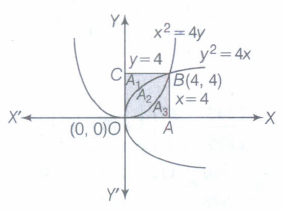
Also, draw the square bounded by the lines x = 0,x = 4
y = 4 and y = 0.To prove, Area A1 = Area A2 = Area A 3
Now, the point of intersection of curves y2 = 4x and
\(x^{2}=4 y \text { is given by }\left(\frac{y^{2}}{4}\right)^{2}=4 y\)
\(\Rightarrow y^{4}=64 y \Rightarrow y\left(y^{3}-64\right)=0\)
\(\Rightarrow y=0, y^{3}=64 \Rightarrow y=0, y=4\)
When \(y=0, \text { then } 0^{2}=4 x \Rightarrow x=0\)
When \(y=4, \text { then } 4^{2}=4 x \Rightarrow x=4\)
So, the points of intersection are 0(0, 0) and B(4, 4).
Now, the area of the region bounded by curves y2 = 4x and x2 = 4y is
\(A_{2}=\int_{0}^{4}[y\{\text { parabola }(\mathrm{i})\}-y\{\text { parabola }(\mathrm{ii})\}] d x\)
\(=\int_{0}^{4}\left(\sqrt{4 x}-\frac{x^{2}}{4}\right) d x=\int_{0}^{4}\left(2 \sqrt{x}-\frac{x^{2}}{4}\right) d x\)
\( =\left[2 \times \frac{x^{3 / 2}}{3 / 2}-\frac{x^{3}}{12}\right]_{0}^{4}=\left[\frac{4}{3}(4)^{3 / 2}-\frac{4^{3}}{12}-(0-0)\right. \)
\(=\left[\frac{4}{3}(2)^{3}-\frac{64}{12}\right] \)
\(=\frac{32}{3}-\frac{16}{3}=\frac{16}{3} \mathrm{sq} \text { units } \)
Now, the area of the region bounded by the curves
\(x^{2}=4 y, x=4 \text { and } X \text { -axis is } A_{3}=\int_{0}^{4} y d x=\int_{0}^{4}\left(\frac{x^{2}}{4}\right) d x\)
\( =\left[\frac{x^{3}}{12}\right]_{0}^{4}=\frac{(4)^{3}}{12}-0 \)
\(=\frac{16}{3} \text { sq units } \)
Similarly, the area of the region bounded by the curve
\(y^{2}=4 x, Y \text { -axis and } y=4 \text { is }\)
\(A_{1}=\int_{0}^{4} x d y=\int_{0}^{4} \frac{y^{2}}{4} d y=\left[\frac{y^{3}}{12}\right]_{0}^{4}=\frac{1}{12}\left[4^{3}-0\right]\)
\(=\frac{1}{12}(64)=\frac{16}{3} \text { sq units }\)
Here, we see that
\(A_{1}=A_{2}=A_{3}=\frac{16}{3} \mathrm{sq} \text { units }\)
Hence proved.

12th Standard CBSE Syllabus & Materials
12th Standard CBSE
CBSE 12th Computer Science Python Revision Tour I - New Previous year Question Papers Study Material - QB365 Set A
NEW12th Standard CBSE
CBSE 12th Business Studies Planning Important Questions And Answers Study Material - QB365 Set A
NEW12th Standard CBSE
CBSE 12th Business Studies Business Environment Important Questions And Answers Study Material - QB365 Set A
NEW12th Standard CBSE
CBSE 12th Business Studies Principles of Management Important Questions And Answers Study Material - QB365 Set A



NCERT Books

Syllabus

Exam Pattern

Sample Question Papers

Previous year Question Papers

Important Notes

MCQ Practice test

NCERT Exemplers

Case study Questions

Image Based Questions

Passage based Questions

HOT Questions

Value Based Questions

Model Questions Papers
NCERT ( Book Back ) Questions

Assertion and Reason
Important Questions And Answers

CBSE 12th Standard CBSE Subjects
CBSE Standards









