
 100% FREE ACCESS
12th Standard CBSE Syllabus & Materials
12th Standard CBSE
CBSE 12th Economics Government Budget and the Economy Previous year Question Papers Study Material - QB365 Set A
NEW12th Standard CBSE
CBSE 12th Computer Science Interface Python with MySQL - New Previous year Question Papers Study Material - QB365 Set A
NEW12th Standard CBSE
CBSE 12th Computer Science Database Concept - New Previous year Question Papers Study Material - QB365 Set A
NEW12th Standard CBSE
CBSE 12th Computer Science Data Communication - New Previous year Question Papers Study Material - QB365 Set A
NEW12th Standard CBSE
CBSE 12th Computer Science Data Structures - New Previous year Question Papers Study Material - QB365 Set A
NEW12th Standard CBSE
CBSE 12th Computer Science Functions - New Previous year Question Papers Study Material - QB365 Set A

Published on: 23/05/2021
QB365 Provides the updated NCERT Examplar Questions for Class 12 Maths, and also provide the detail solution for each and every ncert examplar questions , QB365 will give all kind of study materials will help to get more marks
Download CBSE Class 12th Standard CBSE Maths question papers, sample papers, important questions, and previous year solved papers in PDF format. Get free study materials, NCERT solutions, and exam preparation resources for Class 12th Standard CBSE Maths
Questions + Answers key
Take MCQ Maths Test1.
Find the matrix A satisfying the matrix equation
\(\left[\begin{array}{ll}2 & 1 \\ 3 & 2\end{array}\right] A\left[\begin{array}{rr}-3 & 2 \\ 5 & -3\end{array}\right]=\left[\begin{array}{ll}1 & 0 \\ 0 & 1\end{array}\right] \).
2.
Express the matrix \(A=\left[\begin{array}{rrr}2 & 4 & -6 \\ 7 & 3 & 5 \\ 1 & -2 & 4\end{array}\right]\) as the sum of a symmetric and a skew-symmetric matrices.
3.
Examine the differentiability of the function f(x)=\(\begin{cases} x\left[ x \right] \quad \ \ \ \ \ ,\quad if\quad 0\le x< \\ \left( x-1 \right) x \ \ , \quad if\quad 2\le x<3 \end{cases}\quad \)at x=2
4.
Verify MVT for the following functions:
f(x)= sin x-sin 2x in [0,\(\pi\)]
5.
If A is a square matrix such that A2 = A, show that (l + A)3 = 7A + l
6.
If X and Y are \(2\times 2\) matrices, then solve the following matrix equation of X and Y.
\(2X+3Y=\begin{bmatrix} 2 & 3 \\ 4 & 0 \end{bmatrix},3X+2Y=\begin{bmatrix} -2 & 2 \\ 1 & -5 \end{bmatrix}\)
7.
Find the value of the expression \(sin\left( 2{ tan }^{ -1 }\frac { 1 }{ 3 } \right) +cos\left( { tan }^{ -1 }2\sqrt { 2 } \right) \)
8.
Which is greater tan 1 or tan-1 1?
9.
Suppose 10000 tickets are sold in a lottery each for Rs. 1. First prize is of Rs. 3000 and the second prize is of Rs. 2000. There are three third prizes of Rs. 500 each. If you buy one ticket, then what is your expectation?
10.
A biased die is such that \(P(4)=\frac{1}{10}\) and other scores-being equally likely. The die is tossed twice. If X is the 'number of four seen', then find the variance of the random variable X.
11.
Evaluate the following integral.
\(\int \frac{(2 x-1)}{(x-1)(x+2)(x-3)} d x\)
12.
(a) Find the image of the point (1,6,3) in the line \(\frac { x }{ 1 } =\frac { y-1 }{ 2 } =\frac { z-2 }{ 3 } .\)
(b) Also write the equation of the line joining the: given point and its image and find the length of the: segment joining the given point and its image
13.
If a variable line in two adjacent positions has direction cosines l,m,n,\(l+\delta l,m+\delta m,n+\delta n\) and show that the small angle \(\delta \theta \) between two positions is given by \({ (\delta \theta ) }^{ 2 }={ (\delta l) }^{ 2 }+(\delta m)^{ 2 }+{ (\delta n) }^{ 2 }\).
14.
Solve the differential equation: (x + y) (dx - dy) = dx + dy
15.
Find f′(x) if f (x) = (sin x)sin x for all 0 < x < π.
16.
Prove that the curves xy=4 and x2+y2=8 touch each other.
17.
Evaluate the integral: \({\sqrt x\over \sqrt{a^3-x^3}}dx\)
18.
Show that \({x\over a}+{y\over b}=1\) touches the curve \(y=be^{-{x\over a}}\) at the point where curve crosses the Y-axis.
19.
Show that \(f(x)=2x+{cot^-1}x+\log { \left( \sqrt { { 1+x }^{ 2 } } -x \right) } \)Is increasing in R.
20.
An open box,with a square base,is to be made out of a given quantity of metal sheet of area c2.Show that the maximum volume of box is \(c^3\over6\sqrt{3}\)
1.
\(\left[\begin{array}{ll}1 & 1 \\ 1 & 0\end{array}\right]\)
2.
We have,
\(A=\left[\begin{array}{rrr} 2 & 4 & -6 \\ 7 & 3 & 5 \\ 1 & -2 & 4 \end{array}\right]\)
\(\begin{array}{l} \Rightarrow A^{\prime}=\left[\begin{array}{rrr} 2 & 7 & 1 \\ 4 & 3 & -2 \\ -6 & 5 & 4 \end{array}\right] \end{array}\)
\(\text { Let } P=\frac{1}{2}\left(A+A^{\prime}\right)=\frac{1}{2}\left\{\left[\begin{array}{rrr} 2 & 4 & -6 \\ 7 & 3 & 5 \\ 1 & -2 & 4 \end{array}\right]+\left[\begin{array}{ccc} 2 & 7 & 1 \\ 4 & 3 & -2 \\ -6 & 5 & 4 \end{array}\right]\right\}\)
\(=\frac{1}{2}\left[\begin{array}{ccc} 4 & 11 & -5 \\ 11 & 6 & 3 \\ -5 & 3 & 8 \end{array}\right]=\left[\begin{array}{ccc} 2 & \frac{11}{2} & -\frac{5}{2} \\ \frac{11}{2} & 3 & \frac{3}{2} \\ -\frac{5}{2} & \frac{3}{2} & 4 \end{array}\right]\)
which is symmetric matrix and
\(Q =\frac{1}{2}\left(A-A^{\prime}\right)=\frac{1}{2}\left\{\left[\begin{array}{rrr} 2 & 4 & -6 \\ 7 & 3 & 5 \\ 1 & -2 & 4 \end{array}\right]-\left[\begin{array}{rrr} 2 & 7 & 1 \\ 4 & 3 & -2 \\ -6 & 5 & 4 \end{array}\right]\right\} \)
\(=\frac{1}{2}\left[\begin{array}{rrr} 0 & -3 & -7 \\ 3 & 0 & 7 \\ 7 & -7 & 0 \end{array}\right]=\left[\begin{array}{rrr} 0 & -\frac{3}{2} & -\frac{7}{2} \\ \frac{3}{2} & 0 & \frac{7}{2} \\ \frac{7}{2} & -\frac{7}{2} & 0 \end{array}\right] \)
which is skew-symmetric matrix
Now,\(P+Q=\frac{1}{2}\left(A+A^{\prime}\right)+\frac{1}{2}\left(A-A^{\prime}\right)\)
\(=\left[\begin{array}{rrr} 2 & \frac{11}{2} & -\frac{5}{2} \\ \frac{11}{2} & 3 & \frac{3}{2} \\ -\frac{5}{2} & \frac{3}{2} & 4 \end{array}\right]+\left[\begin{array}{rrr} 0 & -\frac{3}{2} & -\frac{7}{2} \\ \frac{3}{2} & 0 & \frac{7}{2} \\ \frac{7}{2} & -\frac{7}{2} & 0 \end{array}\right]=\left[\begin{array}{rrr} 2 & 4 & -6 \\ 7 & 3 & 5 \\ 1 & -2 & 4 \end{array}\right]=A\)
Hence, A is represented as sum of symmetric and skew-symmetric matrix.
3.
Hence, the given function is not differentiable at x=2.
4.
(i) sin x, sin 2x are continuous, so f (x) is continuous in [0,\(\pi\)]
(ii) c= cos-1 \(\left( \frac { 1\pm \sqrt { 33 } }{ 8 } \right) \)
5.
\((I+A)^{3}=(I+A)(I+A)(I+A)\\
=\left(I^{2}+I A+A I+A^{2}\right)(I+A)=(I+A+A+A)(I+A)\\
=(I+3 A)(I+A) \quad\left[\because A^{2}=A\right]\)
\(=I^{2}+I A+3 A I+3 A^{2}\\=I+A+3 A+3 A\\=I+7 A\)
6.
Consider 3(2X + 3 Y) - 2(3X + 2 Y)
\(=3\left[\begin{array}{ll} 2 & 3 \\ 4 & 0 \end{array}\right]-2\left[\begin{array}{rr} -2 & 2 \\ 1 & -5 \end{array}\right]\)
\(\Rightarrow 6 X+9 Y-6 X-4 Y=\left[\begin{array}{cc} 6 & 9 \\ 12 & 0 \end{array}\right]-\left[\begin{array}{rr} -4 & 4 \\ 2 & -10 \end{array}\right]\)
\(=\left[\begin{array}{cc} 6+4 & 9-4 \\ 12-2 & 0+10 \end{array}\right]=\left[\begin{array}{cc} 10 & 5 \\ 10 & 10 \end{array}\right]\)
\(\Rightarrow 5 Y=\left[\begin{array}{rr} 10 & 5 \\ 10 & 10 \end{array}\right] \)
\(\Rightarrow \ Y=\frac{1}{5}\left[\begin{array}{rr} 10 & 5 \\ 10 & 10 \end{array}\right]=\left[\begin{array}{ll} 2 & 1 \\ 2 & 2 \end{array}\right]\)
\(\text { Now } \ 2 X =\left[\begin{array}{ll} 2 & 3 \\ 4 & 0 \end{array}\right]-3 Y=\left[\begin{array}{ll} 2 & 3 \\ 4 & 0 \end{array}\right]-3\left[\begin{array}{ll} 2 & 1 \\ 2 & 2 \end{array}\right] \)
\(=\left[\begin{array}{ll} 2 & 3 \\ 4 & 0 \end{array}\right]-\left[\begin{array}{ll} 6 & 3 \\ 6 & 6 \end{array}\right]=\left[\begin{array}{lr} 2-6 & 3-3 \\ 4-6 & 0-6 \end{array}\right] \)
\(=\left[\begin{array}{ll} -4 & 0 \\ -2 & -6 \end{array}\right] \)
\(\Rightarrow \ X=\frac{1}{2}\left[\begin{array}{rr} -4 & 0 \\ -2 & -6 \end{array}\right]=\left[\begin{array}{lr} -2 & 0 \\ -1 & -3 \end{array}\right]\)
\(\text {Hence, } \quad X=\left[\begin{array}{rr} -2 & 0 \\ -1 & -3 \end{array}\right] \text { ; }Y=\left[\begin{array}{ll} 2 & 1 \\ 2 & 2 \end{array}\right]\)
7.
\(\text { Let } E=\sin \left(2 \tan ^{-1} \frac{1}{3}\right)+\cos \left(\tan ^{-1} 2 \sqrt{2}\right.\)
\(\text { Now, } 2 \tan ^{-1}\left(\frac{1}{3}\right)=\tan ^{-1}\left(\frac{2 \times \frac{1}{3}}{1-\left(\frac{1}{3}\right)^{2}}\right) \)
\(\left[\because 2 \tan ^{-1} x=\tan ^{-1}\left(\frac{2 x}{1-x^{2}}\right)\right] \)
\(\Rightarrow \quad 2 \tan ^{-1}\left(\frac{1}{3}\right)=\tan ^{-1}\left(\frac{2 / 3}{8 / 9}\right)=\tan ^{-1}\left(\frac{3}{4}\right) \)
\(\text { Put } \tan ^{-1}\left(\frac{3}{4}\right)=\theta \Rightarrow \tan \theta=\frac{3}{4} \)
\(\text { Then, } \sin \theta=\frac{3}{5} \Rightarrow \theta=\sin ^{-1}\left(\frac{3}{5}\right) \)
\(\Rightarrow \tan ^{-1}\left(\frac{3}{4}\right)=\sin ^{-1}\left(\frac{3}{4}\right)\)
From Eqs. (i) and (ii), we get
2\( \tan ^{-1}\left(\frac{1}{3}\right)=\sin ^{-1}\left(\frac{3}{5}\right)\)
Now, put \(\tan ^{-1} 2 \sqrt{2}=\phi \Rightarrow \tan \phi=2 \sqrt{2}\)
Then, \(\cos \phi=\frac{1}{3} \Rightarrow \phi=\cos ^{-1}\left(\frac{1}{3}\right)\)
Now, \(\tan ^{-1} 2 \sqrt{2}=\cos ^{-1}\left(\frac{1}{3}\right)\)
\(\tan ^{-1}\left(\frac{3}{4}\right)=\sin ^{-1}\left(\frac{3}{5}\right)\)
\( \therefore E =\sin \left(2 \tan ^{-1} \frac{1}{3}\right)+\cos \left(\tan ^{-1} 2 \sqrt{2}\right) \)
\(=\sin \left(\sin ^{-1} \frac{3}{5}\right)+\cos \left(\cos ^{-1} \frac{1}{3}\right) \)
\(=\frac{3}{5}+\frac{1}{3}=\frac{9+5}{15}=\frac{14}{15} \)
8.
We know tan x is increasing for \(\left(-\frac{\pi}{2}, \frac{\pi}{2}\right)\)\(\left[y=\tan x \Rightarrow y^{\prime}=\sec ^{2} x>0\right]\)
\(\text {Also } 1>\frac{\pi}{4} \)
\(\Rightarrow \tan ^{-1}>\tan \frac{\pi}{4} \)
\(\Rightarrow \tan ^{-1} >1>\frac{\pi}{4} \)
\(\Rightarrow \tan ^{-1}>1>\tan ^{-1}(1) . \)
9.
\(\begin{array}{c|l|l|l|l} \hline x & 0 & 500 & 2000 & 3000 \\ \hline P(X) & \frac{9995}{10000} & \frac{3}{10000} & \frac{1}{10000} & \frac{1}{10000} \\ \hline P_{i} X_{1} & 0 & \frac{1500}{10000} & \frac{2000}{10000} & \frac{3000}{10000} \\ \hline \end{array}\)
\(\because E(X)=\Sigma X P(X)\)
= 0.65
10.
Since, X = Number of four seen
On tossing two dice, X = 0, 1, 2
Also, \(P(4)=\frac{1}{10} \text { and } P(\operatorname{not} 4)=\frac{9}{10}\)
So, \(P(X=0)=P(\operatorname{not} 4) \cdot P(\operatorname{not} 4)=\frac{9}{10} \cdot \frac{9}{10}=\frac{81}{100}\)
\(P(X=1)=P(\operatorname{not} 4) \cdot P(4)+P(4) \cdot P(\operatorname{not} 4)\)
\(=\frac{9}{10} \cdot \frac{1}{10}+\frac{1}{10} \cdot \frac{9}{10}=\frac{18}{100}\)
\(P(X=2)=P(4) \cdot P(4)=\frac{1}{10} \cdot \frac{1}{10}=\frac{1}{100}\)
Thus, we get the following table
\(\begin{array}{|c|c|c|c|} \hline X & 0 & 1 & 2 \\ \hline P(X) & 81 / 100 & 18 / 100 & 1 / 100 \\ \hline \end{array}\)
\(\begin{array}{c|c|c|c} \hline X P(X) & 0 & 18 / 100 & 2 / 100 \\ \hline X^{2} P(X) & 0 & 18 / 100 & 4 / 100 \\ \hline \end{array}\)
\(\therefore \operatorname{Var}(X)=E\left(X^{2}\right)-[E(X)]^{2}=\Sigma X^{2} P(X)-\left[\sum X P(X)\right]^{2}\)
\(=\left(0+\frac{18}{100}+\frac{4}{100}\right)-\left(0+\frac{18}{100}+\frac{2}{100}\right)^{2}\)
\(=\frac{22}{100}-\left(\frac{20}{100}\right)^{2}=\frac{11}{50}-\frac{1}{25}\)
\(=\frac{11-2}{50}=\frac{9}{50}=\frac{18}{100}=0.18\)
11.
\(\frac{2 x-1}{(x-1)(x+2)(x-3)}=\frac{A}{x-1}+\frac{B}{x+2}+\frac{C}{x-3}\)
\(\log \left|\frac{\sqrt{x-3}}{(x-1)^{1 / 6}(x+2)^{1 / 3}}\right|+C\)
12.
(a) Let P be the given point (1, 6, 3) and M, the foot of perpendicular from P on the given line AB
\(i.e.\quad \frac { x }{ 1 } =\frac { y-1 }{ 2 } =\frac { z-2 }{ 3 } (=k(say))\)
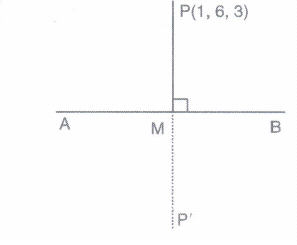
Any point on the given line is:
(k , 1+ 2k , 2 + 3k).
For some value of k, let the point be M.
:. Direction-ratios of PM are:
< k - 1 , 1 + 2k - 6, 2 + 3k - 3 >
i.e. < k - 1, 2k - 5, 3k - 1 > .
Since \(PM\bot AB\) ,
:. (1) (k-l) + (2) (2k- 5) + (3) (3k-l) = 0
\(\Rightarrow\)k - 1 + 4k - 10 + 9k - 3 = 0
\(\Rightarrow\) 14k = 14 \(\Rightarrow\) k = 1.
:. Foot of perpendicular Mis (1,1+2,2+3) i.e. (1,3,5).
Let \(P'(\alpha ,\beta ,\gamma )\) be the image of P in the given line.
Then M is the mid-point of [PP']
\(\frac { \alpha +1 }{ 2 } =1\frac { \beta +6 }{ 2 } =3,\frac { \gamma +3 }{ 2 } =5\)
\(\alpha +1=2,\beta +6=6,\gamma +3=10\)
\(\Rightarrow \alpha =1,\beta =0,\gamma =7\)
Hence the reqd image is(1,0,7).
(b) (i) The equations of PP' are:
\(\frac { x-1 }{ 1-1 } =\frac { y-6 }{ 0-6 } =\frac { z-3 }{ 7-3 } \)
\(i.e.\quad \frac { x-1 }{ 0 } =\frac { y-6 }{ -6 } =\frac { z-3 }{ 4 } \)
\(\Rightarrow \frac { x-1 }{ 1-1 } =\frac { y-6 }{ -3 } =\frac { z-3 }{ 2 } \)
(ii) Length od segment [PP']
\(\sqrt { { \left( 1-1 \right) }^{ 2 }+{ \left( 0-6 \right) }^{ 2 }+{ \left( 7-3 \right) }^{ 2 } } \)
\(=\sqrt { 0+36+16 } =\sqrt { 52 } =2\sqrt { 13 } units.\)
13.
Since \(l, m, n \text { and } l+\delta l, m+\delta m, n+\delta n\) are direction cosines of a variable line in two different positions,therefore,
\(l^{2}+m^{2}+n^{2}=1\)
\(\text { and }(l+\delta l)^{2}+(m+\delta m)^{2}+(n+\delta n)^{2}=1\)
\(\text { Now, }(l+\delta l)^{2}+(m+\delta m)^{2}+(n+\delta n)^{2}=1\)
\(\Rightarrow\left(l^{2}+m^{2}+n^{2}\right)+2(l \cdot \delta l+m \cdot \delta m+n \cdot \delta n) \)
\(+(\delta l)^{2}+(\delta m)^{2}+(\delta n)^{2}=1[\text { from }(i i)] \)
\(\Rightarrow 1+2(l \delta l+m \delta m+n \delta n)+(\delta l)^{2} \)
\(+(\delta m)^{2}+(\delta n)^{2}=1[\text { using }(i)] \)
\(\Rightarrow 2(l \delta l+m \delta m+n \delta n)=-\left[(\delta l)^{2}+(\delta m)^{2}+(\delta n)^{2}\right] \)
\(\Rightarrow(l \delta l+m \delta m+n \delta n)=-\frac{1}{2}\left[(\delta l)^{2}+(\delta m)^{2}+(\delta n)^{2}\right]
\)
\(\text { Also } \cos (\delta \theta)=l(l+\delta l)+m(m+\delta m)+n(n+\delta) \)
\(=\left(l^{2}+m^{2}+n^{2}\right)+(l \delta l+m \delta m+n \delta n)
\)
\(=1-\frac{1}{2}\left[(\delta l)^{2}+(\delta m)^{2}+(\delta n)^{2}\right] \quad[\text { using }(i) \text { and (iii)] }\)
\(\Rightarrow 2(1-\cos \delta \theta)=(\delta I)^{2}+(\delta m)^{2}+(\delta n)^{2}\)
\(\Rightarrow 2 \times 2 \sin ^{2} \frac{\delta \theta}{2}=(\delta l)^{2}+(\delta m)^{2}+(\delta n)^{2}\)
\(\left[\because 1-\cos 2 \theta=2 \sin ^{2} \theta\right]\)
\(\Rightarrow 4\left[\frac{\delta \theta}{2}\right]^{2}=(\delta l)^{2}+(\delta m)^{2}+(\delta n)^{2}\)
\(\text { [if } \theta \text { is small, then } \sin \theta \rightarrow \theta]\)
\(\Rightarrow(\delta \theta)^{2}=(\delta l)^{2}+(\delta m)^{2}+(\delta n)^{2}
\)
which is true.
14.
\(\Rightarrow \) y - x + log |x + y| = c is the required solution.
15.
The function y = (sin x)sin x is defined for all positive real numbers. Taking logarithms, we have
log y = log (sin x)sin x = sin x log (sin x)
Then \(\frac{1}{y} \frac{d y}{d x}=\frac{d}{d x}(\sin x \log (\sin x))\)
\( =\cos x \log (\sin x)+\sin x \cdot \frac{1}{\sin x} \cdot \frac{d}{d x}(\sin x) \)
\(=\cos x \log (\sin x)+\cos x \)
\(=(1+\log (\sin x)) \cos x\)
Thus, \(\frac{d y}{d x}=y((1+\log (\sin x)) \cos x)=(1+\log (\sin x))(\sin x)^{\sin x} \cos x\)
16.
Find point of intersection on two curves and show that slopes of tangents to the two curves at point of intersection is same.
17.
\({2\over3}sin^{-1}\sqrt{x^3\over a^3}+c\)
18.
\({x\over a}+{y\over b}=1\)
19.
\(2-\left[ \frac { 1+\sqrt { { 1+x }^{ 2 } } }{ 1+{ x }^{ 2 } } \right] >0\ as \ \frac { 1+\sqrt { { 1+x }^{ 2 } } }{ 1+{ x }^{ 2 } } <\quad 2\).
20.
\(c^3\over6\sqrt{3}\) cu units

12th Standard CBSE Syllabus & Materials
12th Standard CBSE
CBSE 12th Computer Science Python Revision Tour I - New Previous year Question Papers Study Material - QB365 Set A
NEW12th Standard CBSE
CBSE 12th Business Studies Planning Important Questions And Answers Study Material - QB365 Set A
NEW12th Standard CBSE
CBSE 12th Business Studies Business Environment Important Questions And Answers Study Material - QB365 Set A
NEW12th Standard CBSE
CBSE 12th Business Studies Principles of Management Important Questions And Answers Study Material - QB365 Set A



NCERT Books

Syllabus

Exam Pattern

Sample Question Papers

Previous year Question Papers

Important Notes

MCQ Practice test

NCERT Exemplers

Case study Questions

Image Based Questions

Passage based Questions

HOT Questions

Value Based Questions

Model Questions Papers
NCERT ( Book Back ) Questions

Assertion and Reason
Important Questions And Answers

CBSE 12th Standard CBSE Subjects
CBSE Standards









