
 100% FREE ACCESS
12th Standard CBSE Syllabus & Materials
12th Standard CBSE
CBSE 12th Economics Government Budget and the Economy Previous year Question Papers Study Material - QB365 Set A
NEW12th Standard CBSE
CBSE 12th Computer Science Interface Python with MySQL - New Previous year Question Papers Study Material - QB365 Set A
NEW12th Standard CBSE
CBSE 12th Computer Science Database Concept - New Previous year Question Papers Study Material - QB365 Set A
NEW12th Standard CBSE
CBSE 12th Computer Science Data Communication - New Previous year Question Papers Study Material - QB365 Set A
NEW12th Standard CBSE
CBSE 12th Computer Science Data Structures - New Previous year Question Papers Study Material - QB365 Set A
NEW12th Standard CBSE
CBSE 12th Computer Science Functions - New Previous year Question Papers Study Material - QB365 Set A

Published on: 23/05/2021
QB365 Provides the updated NCERT Examplar Questions for Class 12 Maths, and also provide the detail solution for each and every ncert examplar questions , QB365 will give all kind of study materials will help to get more marks
Download CBSE Class 12th Standard CBSE Maths question papers, sample papers, important questions, and previous year solved papers in PDF format. Get free study materials, NCERT solutions, and exam preparation resources for Class 12th Standard CBSE Maths
Questions + Answers key
Take MCQ Maths Test1.
A shopkeeper sells three types of flower seeds A1, A2 and A3. They are sold as a mixture, where the proportions are 4 : 4 : 2, respectively. The germination rates of the three types of seedsare 45%, 60% and 35%. Calculate the probability.
(i) of a randomly chosen seed to germinate
(ii) that it willhot germinate given that the seed is of type A3.
(iii) that it is of the type A2 given that a randomly chosen seed does not germinate.
2.
Find the equation of the plane through the intersection of the planes \(\vec{r} \cdot(\hat{i}+3 \hat{j})-6=0\) and \(a\vec{r} \cdot(3 \hat{i}-\hat{j}-4 \hat{k})=0\) whose perpendicular distance from origin is unity.
3.
Find the area bounded by the lines y = 4x + 5, y = 5 - x and 4y = x + 5.
4.
Draw a rough sketch of the region \(\left\{(x, y): y^{2} \leq 6 \text { ax and } x^{2}+y^{2} \leq 16 a^{2}\right\}\). Also, find the area of the region sketched using method of integration.
5.
Evaluate the following integral.
\(\int_{0}^{\pi} x \log |\sin x| d x\)
6.
Evaluate the following integral
\(\int e^{-3 x} \cos ^{3} x d x\)
7.
Evaluate the following integral
\(\int \frac{(\cos 5 x+\cos 4 x)}{1-2 \cos 3 x} d x\)
8.
Two men A and B start with velocities v at the same time from the junction of two roads inclined at 45° to each other. If they travel by different roads, then find the rate at which they are being separated.
9.
If \(A=\left[\begin{array}{rrr} 1 & 2 & 0 \\ -2 & -1 & -2 \\ 0 & -1 & 1 \end{array}\right]\) then findA-1.using A-1,equations x - 2y = 10,,2x - y- z = 8 and - 2y +z = 7.
10.
Using the properties of determinants, prove that
\(\left|\begin{array}{ccc} (b+c)^{2} & a^{2} & a^{2} \\ b^{2} & (c+a)^{2} & b^{2} \\ c^{2} & c^{2} & (a+b)^{2} \end{array}\right|=2 a b c(a+b+c)^{3}\)
11.
If a + b + c \(\neq \) 0 and \(\left|\begin{array}{lll} a & b & c \\ b & c & a \\ c & a & b \end{array}\right|=0\) then prove that a = b = c.
12.
If A = \(\left[ \begin{matrix} 1 & -1 & 0 \\ 2 & 3 & 4 \\ 0 & 1 & 2 \end{matrix} \right] \) and B = \(\left[ \begin{matrix} 2 & 2 & -4 \\ -4 & 2 & -4 \\ 2 & -1 & 5 \end{matrix} \right] \) are square matrices, find A, B and hence solve the system of equation:
x - y = 3, 2x + 3y + 4z = 17 and y + 2z = 7
13.
Using integration, find the area of the region bounded by the two parabolas y2 = 4x and x2 = 4y
14.
A company manufactures two types of sweaters, type A and B. It costs Rs. 360 to make one unit of type A and Rs. 120 to make a unit of type B. The company can make at most 300 sweaters and can spend Rs. 72,000 a day. The number of sweaters of type A cannot exceed the number of type B by more than 100. The company makes a profit of Rs 200 on each unit of type A. The company charging a nominal profit of Rs. 20 on a unit of type B. Using LPP, solve for max. profit.
15.
Show that triangle ABC is an isosceles triangle, if the determinant
\( \triangle =\left| \begin{matrix} 1 & 1 & 1 \\ 1+cosA & 1+cosB & 1+cosC \\ \cos ^{ 2 }{ A } +cosA & \cos ^{ 2 }{ B } +cosB & \cos ^{ 2 }{ C } +cosC \end{matrix} \right| \)
16.
Using properties of determinants, show that triangle ABC is isosceles if:
\(\left| \begin{matrix} 1 & 1 & 1 \\ 1+cosA & 1+cosB & 1+cosC \\ \cos ^{ 2 }{ A } +cosA & \cos ^{ 2 }{ B } +cosB & \cos ^{ 2 }{ B } +cosC \end{matrix} \right| =0\)
17.
AB is a diameter of a circle and C is any point on the circle. Show that the area of ΔABC is maximum when it is isosceles.
18.
A metal box with a square base and vertical sides is to contain 1024 cm3. The material for the top and bottom costs Rs. 5 per cm2 and the material for the sides cost Rs. 2.50/cm2. Find the least cost of the box.
1.
We have, A1: A2 :A3 = 4: 4: 2
\(\therefore P\left(A_{1}\right)=\frac{4}{10}, P\left(A_{2}\right)=\frac{4}{10} \text { and } P\left(A_{3}\right)=\frac{2}{10}\)
where AI',A2 and A3 denote the event of choosing flower seeds A1, A2 and A3 respectively,
Let E be the event that a seed germinates and E be the event that a seed does not germinate.
Then,\(P\left(\frac{E}{A_{1}}\right)=\frac{45}{100}, P\left(\frac{E}{A_{2}}\right)=\frac{60}{100}, P\left(\frac{E}{A_{3}}\right)=\frac{35}{100}\)
and \(P\left(\frac{\bar{E}}{A_{1}}\right)=\frac{55}{100}, P\left(\frac{\bar{E}}{A_{2}}\right)=\frac{40}{100}, P\left(\frac{\bar{E}}{A_{3}}\right)=\frac{65}{100}\)
(i) Probability that a randomly chosen seed to germinate,
\(P(E)=P\left(A_{1}\right) \cdot\left(\frac{E}{A_{1}}\right)+P\left(A_{2}\right) \cdot P\left(\frac{E}{A_{2}}\right)+P\left(A_{3}\right) \cdot P\left(\frac{E}{A_{3}}\right)\)
\(=\frac{4}{10} \times \frac{45}{100}+\frac{4}{10} \times \frac{60}{100}+\frac{2}{10} \times \frac{35}{100}\)
\(=\frac{180}{1000}+\frac{240}{1000}+\frac{70}{1000}=\frac{490}{1000}=0.49\)
\(\text { (ii) } P\left(\frac{\bar{E}}{A_{3}}\right)=1-P\left(\frac{E}{A_{3}}\right)=1-\frac{35}{100}=\frac{65}{100}\)
\(\text { (iii) } P\left(\frac{A_{2}}{\bar{E}}\right)\)
\(=\frac{P\left(A_{2}\right) \cdot P\left(\frac{\bar{E}}{A_{2}}\right)}{P\left(A_{1}\right) \cdot P\left(\frac{\bar{E}}{A_{1}}\right)+P\left(A_{2}\right) \cdot P\left(\frac{\bar{E}}{A_{2}}\right)+P\left(A_{3}\right) \cdot P\left(\frac{\bar{E}}{A_{3}}\right)}\)
\(=\frac{\frac{4}{10} \times \frac{40}{100}}{\frac{4}{10} \times \frac{55}{100}+\frac{4}{10} \times \frac{40}{100}+\frac{2}{10} \times \frac{65}{100}}\)
\(=\frac{\frac{160}{1000}}{\frac{220}{1000}+\frac{160}{1000}+\frac{130}{1000}}=\frac{\frac{160}{1000}}{\frac{510}{1000}}=\frac{16}{51}\)
= 0.313725 = 0.314
2.
Equation of plane passing through the intersection of given planes is
\(\vec{r} \cdot[(\hat{i}+3 \hat{j})+\lambda(3 \hat{i}-\hat{j}-4 \hat{k})]=6+0 \cdot \lambda\)
\(\Rightarrow \vec{r} \cdot[(1+3 \lambda) \hat{i}+(3-\lambda) \hat{j}+\hat{k}(-4 \lambda)]=6\) ...(i)
On dividing both sides by
\(\sqrt{(1+3 \lambda)^{2}+(3-\lambda)^{2}+(-4 \lambda)^{2}}\) ,We get
\(\frac{\vec{r} \cdot[(1+3 \lambda) \hat{i}+(3-\lambda) \hat{j}+\hat{k}(-4 \lambda)]}{\sqrt{(1+3 \lambda)^{2}+(3-\lambda)^{2}+(-4 \lambda)^{2}}}\)
\(=\frac{6}{\sqrt{(1+3 \lambda)^{2}+(3-\lambda)^{2}+(-4 \lambda)^{2}}}\)
Given the perpendicular distance from origin is unity.
\(\therefore \frac{6}{\sqrt{(1+3 \lambda)^{2}+(3-\lambda)^{2}+(-4 \lambda)^{2}}}=1\)
\(\Rightarrow (1+3 \lambda)^{2}+(3-\lambda)^{2}+(-4 \lambda)^{2}=36\)
\(\Rightarrow 1+9 \lambda^{2}+6 \lambda+9+\lambda^{2}-6 \lambda+16 \lambda^{2}=36\)
\(\Rightarrow 26 \lambda^{2}+10=36 \Rightarrow \lambda^{2}=1\)
\(\Rightarrow \lambda=\pm 1\)
On putting the value of \(\lambda\) in Eq. (i), the required equation of plane are
\(\vec{r} \cdot[(1 \pm 3) \hat{i}+(3 \mp 1) \hat{j}+(\mp 4) \hat{k}]=6\)
\(\Rightarrow \vec{r} \cdot[(1+3) \hat{i}+(3-1) \hat{j}+(-4) \hat{k}]=6\)
and \(\vec{r} \cdot[(1-3) \hat{i}+(3+1) \hat{j}+4 \hat{k}]=6\)
\(\Rightarrow \vec{r} \cdot(4 \hat{i}+2 \hat{j}-4 \hat{k})=6\)
and \(\vec{r} \cdot(-2 \hat{i}+4 \hat{j}+4 \hat{k})=6\)
and \(-2 x+4 y+4 z-6=0\)
3.
\(\frac{15}{2} \text { sq units }\)
4.
\(\text {Required area }=2\left[\int_{0}^{2 a} \sqrt{6 a x} d x+\int_{2 a}^{4 a} \sqrt{16 a^{2}-x^{2}} d x\right]\)
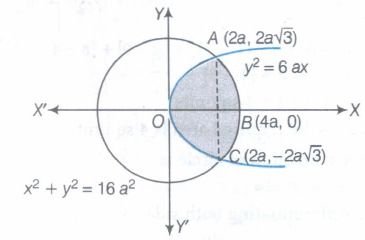
\(\frac{4}{3}(\sqrt{3}+4 \pi) a^{2} \text { sq units }\)
5.
Let \(I=\int_{0}^{\pi} x \log |\sin x| d x\) ...(i)
\(\Rightarrow I=\int_{0}^{\pi}(\pi-x) \log |\sin (\pi-x)| d x\)
\(=\int_{0}^{\pi}(\pi-x) \log |\sin x| d x\) ..(ii)
On adding Eqs. (i) and (ii), we get
\(2 I=\pi \int_{0}^{\pi} \log |\sin x| d x\)
\(\Rightarrow 2 I=2 \pi \int_{0}^{\pi / 2} \log |\sin x| d x\) ...(iii)
\(\left[\because \int_{0}^{2 a} f(x) d x=2 \int_{0}^{a} f(x) d x, \text { if } f(2 a-x)=f(x)\right]\)
\(\Rightarrow I=\pi \int_{0}^{\pi / 2} \log |\sin x| d x\) ...(iv)
\(\Rightarrow I=\pi \int_{0}^{\pi / 2} \log |\sin (\pi / 2-x)| d x\)
\(\left[\because \int_{0}^{a} f(x) d x=\int_{0}^{a} f(a-x) d x\right]\)
\(=\pi \int_{0}^{\pi / 2} \log |\cos x| d x\) ...(v)
On adding Eqs. (iv) and (v), we get
\(2 I=\pi \int_{0}^{\pi / 2}(\log |\sin x|+\log |\cos x|) d x\)
\(\Rightarrow 2 I I=\pi \int_{0}^{\pi / 2} \log |\sin x \cos x| d x\)
\(\Rightarrow 2 I=\pi \int_{0}^{\pi / 2} \log \left|\frac{2 \sin x \cos x}{2}\right| d x\)
[multiply by 2 from numerator and denominator]
\(\Rightarrow 2 I=\pi \int_{0}^{\pi / 2}(\log |\sin 2 x|-\log 2) d x\)
\(2 I=\pi \int_{0}^{\pi / 2} \log |\sin 2 x| d x-\pi \int_{0}^{\pi / 2} \log 2 d x\)
\(\Rightarrow 2 I=\pi \int_{0}^{\pi / 2} \log |\sin 2 x| d x-\pi \log 2[x]_{0}^{\pi / 2}\)
Now, put \(2 x=t \Rightarrow d x=\frac{1}{2} d t\)
Lower limit When \(x=0, \text { then } t=0\)
Upper limit When \(x=\frac{\pi}{2}, \text { then } t=\pi\)
\(\therefore \ 2 I=\frac{\pi}{2} \int_{0}^{\pi} \log |\sin t| d t-\frac{\pi^{2}}{2} \log 2\)
\(\Rightarrow 2 I=\frac{\pi}{2} \int_{0}^{\pi} \log |\sin x| d x-\frac{\pi^{2}}{2} \log 2\)
\(\Rightarrow 2 I=I-\frac{\pi^{2}}{2} \log 2\) [from ii]
\(\therefore I=-\frac{\pi^{2}}{2} \log 2=\frac{\pi^{2}}{2} \log \left(\frac{1}{2}\right)\)
6.
\(I=\int e^{-3 x} \cos ^{3} x d x\)
\(I=\int e^{-3 x}\left[\frac{\cos 3 x+3 \cos x}{4}\right] d x\)
\(=\frac{1}{4}\left[\int e^{-3 x} \cos 3 x d x+3 \int e^{-3 x} \cos x d x\right]\)
\(\begin{aligned} I=\frac{e^{-3 x}}{24}[\sin 3 x-\cos 3 x] -\frac{9}{40} e^{-3 x} & \cos x+\frac{3}{40} e^{-3 x} \sin x+C \end{aligned}\)
7.
Let \(I=\int \frac{\cos 5 x+\cos 4 x}{1-2 \cos 3 x} d x=\int \frac{2 \cos \frac{9 x}{2} \cdot \cos \frac{x}{2}}{1-2\left(2 \cos ^{2} \frac{3 x}{2}-1\right)} d x\)
\(\left[\begin{array}{l} \because \cos C+\cos D=2 \cos \frac{C+D}{2} \cdot \cos \frac{C-D}{2} \\ \text { and } \cos x=2 \cos ^{2}\left(\frac{x}{2}\right)-1 \end{array}\right]\)
\( \Rightarrow I=\int \frac{2 \cos \frac{9 x}{2} \cdot \cos \frac{x}{2}}{3-4 \cos ^{2} \frac{3 x}{2}} d x=-\int \frac{2 \cos \frac{9 x}{2} \cdot \cos \frac{x}{2}}{4 \cos ^{2} \frac{3 x}{2}-3} d x \)
\(=-\int \frac{2 \cos \frac{9 x}{2} \cdot \cos \frac{x}{2} \cdot \cos \frac{3 x}{2}}{4 \cos ^{3} \frac{3 x}{2}-3 \cos \frac{3 x}{2}} d x \)
\(\left[\text { multiply and divide by } \cos \frac{3 x}{2}\right]\)
\( =-\int \frac{2 \cos \frac{9 x}{2} \cdot \cos \frac{x}{2} \cdot \cos \frac{3 x}{2}}{\cos 3 \cdot\left(\frac{3 x}{2}\right)} d x \)
\(=\left[\because \cos 3 \theta=4 \cos ^{3} \theta-3 \cos \theta\right] \)
\( =-\int 2 \cos \frac{3 x}{2} \cdot \cos \frac{x}{2} d x \)
\(=-\int\left\{\cos \left(\frac{3 x}{2}+\frac{x}{2}\right)+\cos \left(\frac{3 x}{2}-\frac{x}{2}\right)\right\} d x \)
\(=-\int_{0}[(\cos 2 x+\cos x) d x \)
\(=-\left[\frac{\sin 2 x}{2}+\sin x\right]+C=-\frac{1}{2} \sin 2 x-\sin x+C \)
8.
Let two men start from the point C with velocity veach at the same time.
Also, \(\angle B C A=45^{\circ}\)
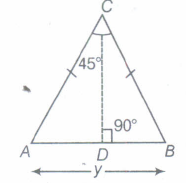
Since, A and B are moving with same velocity v, so they will cover same distance in same time
Therefore, \(\Delta A B C\) is an isosceles triangle with AC = BC
Now, draw \(C D \perp A B\)
Let at any instant t, the distance between them is AB
Let \(A C=B C=x \text { and } A B=y\)
In \(\Delta A C D \text { and } \Delta D C B\) we get
\( \angle C A D=\angle C B D \)
\( \angle C D A=\angle C D B=90^{\circ} \)
\(\therefore \ \angle A C D=\angle D C B \text { or } \angle A C D=\frac{1}{2} \times \angle A C B\)
\(\Rightarrow \angle A C D=\frac{1}{2} \times 45^{\circ} \Rightarrow \angle A C D=22.5^{\circ} \)
\(\therefore \sin 22.5^{\circ}=\frac{A D}{A C} \)
\(\Rightarrow \sin 22.5^{\circ}=\frac{y / 2}{x} \)
\(\Rightarrow \frac{y}{2}=x \sin 22.5^{\circ} \)
\(\Rightarrow y=2 x \cdot \sin 22.5^{\circ} \)
On differentiating both sides w. r. t. t, we get
\( \frac{d y}{d t} =2 \cdot \sin 22.5^{\circ} \frac{d x}{d t}=2 \cdot \sin 22.5^{\circ} v \left[\because v=\frac{d x}{d t}\right][1] \)
\(=2 v \cdot \frac{\sqrt{2-\sqrt{2}}}{2}=v \sqrt{2-\sqrt{2}}\left[\because \sin 22.5^{\circ}=\frac{\sqrt{2-\sqrt{2}}}{2}\right] \)
which is the required rate at which A and B are being separated.
9.
We have, \(A=\left[\begin{array}{rrr}1 & 2 & 0 \\ -2 & -1 & -2 \\ 0 & -1 & 1\end{array}\right]\)
\(\therefore \quad|A|=1(-3)-2(-2)+0=1 \neq 0\)
Now, \(A_{11}=-3, A_{12}=2, A_{13}=2\),
\(A_{21}=-2, A_{22}=1, A_{23}=1, A_{31}=-4, A_{32}=2\)
and \(A_{33}=3\)
Also, we have the system of linear equations as
x-2 y =10
2 x-y-z =8 and -2 y+z=7
\( \therefore \quad \operatorname{adj}(A)=\left[\begin{array}{lll} -3 & 2 & 2 \\ -2 & 1 & 1 \\ -4 & 2 & 3 \end{array}\right]^T=\left[\begin{array}{rrr} -3 & -2 & -4 \\ 2 & 1 & 2 \\ 2 & 1 & 3 \end{array}\right]\)
\(\therefore \quad A^{-1}=\frac{\operatorname{adj} A}{|A|} \)
\(=\frac{1}{1}\left[\begin{array}{rrr} -3 & -2 & -4 \\ 2 & 1 & 2 \\ 2 & 1 & 3 \end{array}\right]\)
\(\Rightarrow \quad A^{-1}=\left[\begin{array}{rrr} -3 & -2 & -4 \\ 2 & 1 & 2 \\ 2 & 1 & 3 \end{array}\right]\)
Also, we have the system of linear equations as x - 2y = 10,,2x - y- z = 8 and - 2y +z = 7
In the form of CX = D
\(\left[\begin{array}{rrr} 1 & -2 & 0 \\ 2 & -1 & -1 \\ 0 & -2 & 1 \end{array}\right]\left[\begin{array}{c} x \\ y \\ z \end{array}\right]=\left[\begin{array}{r} 10 \\ 8 \\ 7 \end{array}\right]\)
where, \(C=\left[\begin{array}{rrr}1 & -2 & 0 \\ 2 & -1 & -1 \\ 0 & -2 & 1\end{array}\right], X=\left[\begin{array}{l}x \\ y \\ z\end{array}\right]\) and \(D=\left[\begin{array}{c}10 \\ 8 \\ 7\end{array}\right]\)
We know that \(\left(A^T\right)^{-1}=\left(A^{-1}\right)^T\)
\( \therefore \quad C^T=\left|\begin{array}{rrr} 1 & 2 & 0 \\ -2 & -1 & -2 \\ 0 & -1 & 1 \end{array}\right|=A\)
\(\therefore \quad X=C^{-1} D\) [using Eq. (i)]
\(\Rightarrow\left[\begin{array}{l}
x \\
y \\
z
\end{array}\right] =\left[\begin{array}{lll}
-3 & 2 & 2 \\
-2 & 1 & 1 \\
-4 & 2 & 3
\end{array}\right]\left[\begin{array}{c}
10 \\
8 \\
7
\end{array}\right] \)
\( =\left[\begin{array}{c}
-30+16+14 \\
-20+8+7 \\
-40+16+21
\end{array}\right]=\left[\begin{array}{r}
0 \\
-5 \\
-3
\end{array}\right]\)
\(\therefore x=0, y=-5 \text { and } z=-3\)
10.
To prove,\(\left|\begin{array}{ccc} (b+c)^{2} & a^{2} & a^{2} \\ b^{2} & (c+a)^{2} & b^{2} \\ c^{2} & c^{2} & (a+b)^{2} \end{array}\right|=2 a b c(a+b+c)^{3}\)
\(\mathrm{LHS}=\left|\begin{array}{ccc} (b+c)^{2} & a^{2} & a^{2} \\ b^{2} & (c+a)^{2} & b^{2} \\ c^{2} & c^{2} & (a+b)^{2} \end{array}\right|\)
\(\text { Applying } C_{2} \rightarrow C_{2}-C_{1} \text { and } C_{3} \rightarrow C_{3}-C_{1}, \text { we get }\)
\(=\left|\begin{array}{ccc} (b+c)^{2} & a^{2}-(b+c)^{2} & a^{2}-(b+c)^{2} \\ b^{2} & (c+a)^{2}-b^{2} & 0 \\ c^{2} & 0 & (a+b)^{2}-c^{2} \end{array}\right|\)
\(=\left|\begin{array}{ccc} (b+c)^{2} & (a+b+c)(a-b-c) & (a+b+c)(a-b-c) \\ b^{2} & (c+a+b)(c+a-b) & 0 \\ c^{2} & \mathbf{O} \quad 0 & (a+b+c)(a+b-c) \end{array}\right|\)
Taking (a + b + c) common from C2 and C3, we get
\(=(a+b+c)^{2}\left|\begin{array}{ccc} b^{2}+c^{2}+2 b c & a-b-c & a-b-c \\ b^{2} & c+a-b & 0 \\ c^{2} & 0 & a+b-c \end{array}\right|\)
\(\text { Applying } R_{1} \rightarrow R_{1}-\left(R_{2}+R_{3}\right) \text { , we get }\)
\(=(a+b+c)^{2}\left|\begin{array}{ccc} 2 b c & -2 c & -2 b \\ b^{2} & c+a-b & 0 \\ c^{2} & 0 & a+b-c \end{array}\right|\)
\(\text { Applying } C_{2} \rightarrow C_{2}+\frac{1}{b} C_{1} \text { and } C_{3} \rightarrow C_{3}+\frac{1}{c} C_{1}, \text { we get }\)
\(\mathrm{LHS}=(a+b+c)^{2}\left|\begin{array}{ccc} 2 b c & 0 & 0 \\ b^{2} & c+a & \frac{b^{2}}{c} \\ c^{2} & \frac{c^{2}}{b} & a+b \end{array}\right|\)
Expanding along R1 we get
\( \mathrm{LHS} =(a+b+c)^{2}[2 b c\{(c+a)(a+b)-b c\}-0+0] \)
\(=2 b c(a+b+c)^{2}\left[a c+a^{2}+a b+b c-b c\right] \)
\( =2 a b c(a+b+c)^{3}=\mathrm{RHS} \)
11.
Let \(\Delta=\left|\begin{array}{ccc} a & b & c \\ b & c & a \\ c & a & b \end{array}\right|=\left|\begin{array}{ccc} a+b+c & a+b+c & a+b+c \\ b & c & a \\ c & a & b \end{array}\right|\)
[applying R1➝ R1 + R2 + R3]
\(=(a+b+c)\left|\begin{array}{lll} 1 & 1 & 1 \\ b & c & a \\ c & a & b \end{array}\right|\)
\(=(a+b+c)\left|\begin{array}{ccc} 0 & 0 & 1 \\ b-a & c-a & a \\ c-b & a-b & b \end{array}\right|\)
\(\left[\text { using } C_{1} \rightarrow C_{1}-C_{3} \text { and } C_{2} \rightarrow C_{2}-C_{3}\right]\)
Expanding along R1 we get
\((a+b+c)[1\{(b-a)(a-b)-(c-a)(c-b)\}] \)
\( =(a+b+c)\left(b a-b^{2}-a^{2}+a b-c^{2}+c b+a c-a b\right) \)
\(=\frac{-1}{2}(a+b+c) \times(-2)\left(-a^{2}-b^{2}-c^{2}+a b+b c+c a\right) \)
[multiply and divide by (-2)]
\(=\frac{-1}{2}(a+b+c)\left[a^{2}+b^{2}+c^{2}-2 a b-2 b c\right. \left.-2 c a+a^{2}+b^{2}+c^{2}\right] \)
\(=-\frac{1}{2}(a+b+c)\left[a^{2}+b^{2}-2 a b+b^{2}+c^{2}\right. \)
\(=\frac{-1}{2}(a+b+c)\left[(a-b)^{2}+(b-c)^{2}+(c-a)^{2}\right] \)
Also, \(\Delta=0\)
\(\Rightarrow \frac{-1}{2}(a+b+c)\left[(a-b)^{2}+(b-c)^{2}+(c-a)^{2}\right]=0\)
\(\Rightarrow(a-b)^{2}+(b-c)^{2}+(c-a)^{2}=0[\because a+b+c \neq 0, \text { given }]\)
\(\Rightarrow a-b=b-c=c-a=0\)
\(\Rightarrow a=b=c \)
12.
Given A = \(\left[ \begin{matrix} 1 & -1 & 0 \\ 2 & 3 & 4 \\ 0 & 1 & 2 \end{matrix} \right] \)
and B = \(\left[ \begin{matrix} 2 & 2 & -4 \\ -4 & 2 & -4 \\ 2 & -1 & 5 \end{matrix} \right] \)
\(\therefore AB=\left[ \begin{matrix} 2+4 & 2-2 & -4+4 \\ 4-12+8 & 4+6-4 & -8-12+20 \\ -4+4 & 2-2 & -4+10 \end{matrix} \right] \)
=\(\left[ \begin{matrix} 6 & 0 & 0 \\ 0 & 6 & 0 \\ 0 & 0 & 6 \end{matrix} \right] \)
\(\therefore \) AB = 6I
Premultiplying by A-1
A-1AB = 6A-1I
=> IB = 6A-1I (\(\therefore \) A-1A = I)
=> B = 6A-1 (\(\therefore \) IX = X)
=> A-1 = 1/6B
Given equations are:
x - y = 3
2x + 3y + 4z = 17
y + 2z = 7
=> \(\left[ \begin{matrix} 1 & -1 & 0 \\ 2 & 3 & 4 \\ 0 & 1 & 2 \end{matrix} \right] \left[ \begin{matrix} x \\ y \\ z \end{matrix} \right] =\left[ \begin{matrix} 3 \\ 17 \\ 7 \end{matrix} \right] \)
AX = C, where
C = \(\left[ \begin{matrix} 3 \\ 17 \\ 7 \end{matrix} \right] \)
X = \(\left[ \begin{matrix} x \\ y \\ z \end{matrix} \right] \)
=> A-1AX = A-1C
=> X = A-1C
=> X = \(\frac { 1 }{ 6 } \left[ \begin{matrix} 2 & 2 & -4 \\ -4 & 2 & -4 \\ 2 & -1 & 5 \end{matrix} \right] \left[ \begin{matrix} 3 \\ 17 \\ 7 \end{matrix} \right] =\frac { 1 }{ 6 } \left[ \begin{matrix} 12 \\ -6 \\ 24 \end{matrix} \right] =\left[ \begin{matrix} 2 \\ -1 \\ 4 \end{matrix} \right] \)
\(\therefore \) x = 2, y = -1 and z = 4
13.
For intersection points, substitute
y2 = 4x ⇒ y = 2√x
x2 = 4y
x2 = 4x 2√x
x4 = 64x
⇒ x(x3-64) = 0
⇒ x = 0
and x = 士 4
when x = 0, y2 = 4 x 0⇒ y = 0
when x = 4, y2 = 4 x 4 ⇒ y = 4
Points of intersection are (0, 0) and (4, 4).
Given, y2 = 4x or y = 2√x = f(x)
and y = \(\frac{1}{4}x^{2}=g(x)\)
14.
Let the company manufactures sweaters of type A = x, type B = y, daily.
\(\therefore\) LPP is maximize. P = 200x + 20y s.t.
360x + 120y \(\le \) 72000
\(\Rightarrow\) 3x + y \(\le \) 300
x + y \(\le \) 300
x - y \(\le \) 100
\(3x+y=600,\begin{cases} x=0,y=600 \\ y=0,x=200 \end{cases}\)
\(x+y=300,\begin{cases} x=0,y=300 \\ y=0,x=300 \end{cases}\)
\(x-y=100,\begin{cases} x=100,\quad y=0 \\ y=100,\quad x=200 \end{cases}\)
\(\\ x\ge 0\)
\(y\ge 0\)
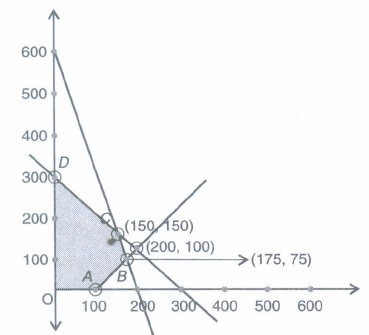
Getting vertices of feasible region as, O(0, 0), A(100, 0), B(175, 75), C(150, 150) and D(0, 300)
Maximum profit is P = 200(175) + 20(75)
= 35000 + 1500 = Rs. 36500
15.
Applying \({ C }_{ 2 }\rightarrow { C }_{ 2 }-{ C }_{ 1 }\quad and\quad { C }_{ 3 }\rightarrow { C }_{ 3 }-{ C }_{ 1 }\)
\(\left| \begin{matrix} 1 & 0 & 0 \\ 1+cosA & cosB-cosA\cos ^{ 2 }{ B } +cosB & cosC-cosA\cos ^{ 2 }{ C } -cosC \\ \cos ^{ 2 }{ A } +cosA & \cos ^{ 2 }{ A } -cosA & -\cos ^{ 2 }{ A } -cosA \end{matrix} \right| =0\)
\({ R }_{ 3 }\rightarrow { R }_{ 3 }-{ R }_{ 2 }\)
\(\left| \begin{matrix} 1 & 0 & 0 \\ 1+cosA & cosB-cosA & cosC-cosA \\ \cos ^{ 2 }{ A } -1 & \cos ^{ 2 }{ B } -\cos ^{ 2 }{ A } & \cos ^{ 2 }{ C } -cosA \end{matrix} \right| =0\)
\({ C }_{ 3 }\rightarrow { C }_{ 3 }-{ C }_{ 2 }\)
(cos B - cos A ) x ( cos C -cos B)
\(\left| \begin{matrix} 1 & 0 & 0 \\ 1+cosA & 1 & 0 \\ \cos ^{ 2 }{ A } -1 & cosB+cosA & cosC-cosA \end{matrix} \right| =0\)
\(\therefore \quad (cosB-cosA)\times (cosC-cosA)\times (cosC-cosB)\)
[1-0]=0 (Expanding along C3)
\(\therefore \quad -cosB=cosA\quad or\quad cosC=cosAorcosC=cosB\)
\(\Rightarrow cosB=cosAorcosC=cosAorcosC=cosB\)
\(\Rightarrow \angle B=\angle Aor\angle C=\angle Aor\angle C=\angle B\)
\(\Rightarrow \triangle ABC\) is an isosceles triangle.
16.
Applying \({ C }_{ 2 }\rightarrow { C }_{ 2 }-{ C }_{ 1 }\quad and\quad { C }_{ 3 }\rightarrow { C }_{ 3 }-{ C }_{ 1 }\)
\(\left| \begin{matrix} 1 & 0 & 0 \\ 1+cosA & cosB-cosA\cos ^{ 2 }{ B } +cosB & cosC-cosA\cos ^{ 2 }{ C } -cosC \\ \cos ^{ 2 }{ A } +cosA & \cos ^{ 2 }{ A } -cosA & -\cos ^{ 2 }{ A } -cosA \end{matrix} \right| =0\)
\({ R }_{ 3 }\rightarrow { R }_{ 3 }-{ R }_{ 2 }\)
\(\left| \begin{matrix} 1 & 0 & 0 \\ 1+cosA & cosB-cosA & cosC-cosA \\ \cos ^{ 2 }{ A } -1 & \cos ^{ 2 }{ B } -\cos ^{ 2 }{ A } & \cos ^{ 2 }{ C } -cosA \end{matrix} \right| =0\)
\({ C }_{ 3 }\rightarrow { C }_{ 3 }-{ C }_{ 2 }\)
(cos B - cos A ) x ( cos C -cos B)
\(\left| \begin{matrix} 1 & 0 & 0 \\ 1+cosA & 1 & 0 \\ \cos ^{ 2 }{ A } -1 & cosB+cosA & cosC-cosA \end{matrix} \right| =0\)
\(\therefore \quad (cosB-cosA)\times (cosC-cosA)\times (cosC-cosB)\)
[1-0]=0 (Expanding along C3)
\(\therefore \ -cosB=cosA\quad or\quad cosC=cosAorcosC=cosB\)
\(\Rightarrow cosB=cosAorcosC=cosAorcosC=cosB\)
\(\Rightarrow \angle B=\angle Aor\angle C=\angle Aor\angle C=\angle B\)
\(\Rightarrow \triangle ABC\) is an isosceles triangle.
17.
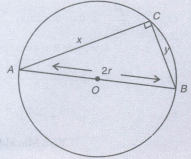
Let the sides of rt. ΔABC be x and y.
\(\therefore\ x^2+y^2=4r^2\)
and A = area of \(\Delta=\frac{1}{2}xy\)
Let, \(S=A^2 =\frac{1}{4}x^2y^2\)
\(=\frac{1}{4}x^2(4r^2-x^2)\)
\(=\frac{1}{4}(4r^2x^2-x^4)\)
\(\therefore\ \frac{dS}{dx}=\frac{1}{4}[8r^2x-4x^3]\)
\(\Rightarrow \ \frac{dS}{dx}=0\Rightarrow x^2=2r^2 \ or\ x=\sqrt{2r}\)
\(y^2=4r^2-2r^2=2r^2\Rightarrow y=\sqrt2r\)
i.e. x = y and \(\frac{d^2S}{dx^2}=(2r^2-3x^2)=2r^2-6r^2<0\)
⇒ Area is maximum when Δ is isosceles
18.
Given, volume of the box = 1024 cm3.Let length of the side ofsquare base be x cm and height ofthe box be y cm.
= x cm,
height of box = h cm.
Volume of box = 1024 cm3
\(\Rightarrow x.x.h=1024\)
\(\therefore h=\frac{1024}{x^2}\)
C (cost of box) = 5(2x2) + 2.5(4xh)
= 10x2 + 10hx
\(=10x^2+\frac{10,240}{x}\)
\(\Rightarrow \frac{dC}{dx}=20x-\frac{10,240}{x^2}\)
Solving \(\frac{dC}{dx}=0,\) we get x3 = 512 ஃ x = 8
\(=20+\frac{1(10240)}{x^3}>0\)
Thus, cost of box is least at x = 8 and least cost of
box is:
\(C(8)=10(8)^2+\frac{10240}{8}\)
= Rs. 1,920

12th Standard CBSE Syllabus & Materials
12th Standard CBSE
CBSE 12th Computer Science Python Revision Tour I - New Previous year Question Papers Study Material - QB365 Set A
NEW12th Standard CBSE
CBSE 12th Business Studies Planning Important Questions And Answers Study Material - QB365 Set A
NEW12th Standard CBSE
CBSE 12th Business Studies Business Environment Important Questions And Answers Study Material - QB365 Set A
NEW12th Standard CBSE
CBSE 12th Business Studies Principles of Management Important Questions And Answers Study Material - QB365 Set A



NCERT Books

Syllabus

Exam Pattern

Sample Question Papers

Previous year Question Papers

Important Notes

MCQ Practice test

NCERT Exemplers

Case study Questions

Image Based Questions

Passage based Questions

HOT Questions

Value Based Questions

Model Questions Papers
NCERT ( Book Back ) Questions

Assertion and Reason
Important Questions And Answers

CBSE 12th Standard CBSE Subjects
CBSE Standards









