
 100% FREE ACCESS
12th Standard CBSE Syllabus & Materials
12th Standard CBSE
CBSE 12th Economics Government Budget and the Economy Previous year Question Papers Study Material - QB365 Set A
NEW12th Standard CBSE
CBSE 12th Computer Science Interface Python with MySQL - New Previous year Question Papers Study Material - QB365 Set A
NEW12th Standard CBSE
CBSE 12th Computer Science Database Concept - New Previous year Question Papers Study Material - QB365 Set A
NEW12th Standard CBSE
CBSE 12th Computer Science Data Communication - New Previous year Question Papers Study Material - QB365 Set A
NEW12th Standard CBSE
CBSE 12th Computer Science Data Structures - New Previous year Question Papers Study Material - QB365 Set A
NEW12th Standard CBSE
CBSE 12th Computer Science Functions - New Previous year Question Papers Study Material - QB365 Set A

Published on: 27/05/2021
QB365 Provides the HOT Question Papers for Class 12 Physics, and also provide the detail solution for each and every HOT Questions. HOT Questions will help to get more idea about question pattern in every exams and also will help to get more marks in Exams
Download CBSE Class 12th Standard CBSE Physics question papers, sample papers, important questions, and previous year solved papers in PDF format. Get free study materials, NCERT solutions, and exam preparation resources for Class 12th Standard CBSE Physics
Questions + Answers key
Take MCQ Physics Test1.
Study the circuits (a) and (b) shown in the figure answer the following question:

(i) Under which conditions would the rms currents in the two circuits be the same?
(ii) Can the rms current in circuit (b) be larger than that in (a)?
2.
(i) Determine the value of phase difference between the current and the voltage in the given series L-C-R circuit.
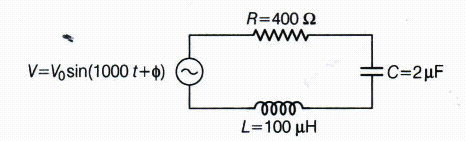
(ii) Calculate the Value of additional capacitor which may be joined suitably to the capacitor C that would make the power factor of the circuit unity.
3.
An AC voltage \(V={ V }_{ m }sin \ \omega t\) is applied across an inducer of inductance L.Find the instantaneous power Pi supplied to the inductor. Show graphically the variation of Pi with \(\omega t\) .
4.
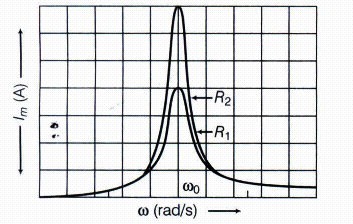
In a series L-C-R circuit connected to an AC source of variable frequency and voltage \(V\ =\ { V }_{ m }\ sin\ \omega t\), draw a plot showing the variation of current I with angular frequency \(\omega \), for two different values of resistance R1and R2(R1>R2). Write the condition under which the phenomenon of resistance occurs. For which value of the resistance out of the two curves, a sharper resonance is produced? Define Q-factor of the circuit and give its significance.
5.
A 12 V resistance and an inductance of \(\frac { 0.05 }{ \pi } H\) are connected in series.Across the end of this ciuit an alternating voltage of 130 V and frequency 50 Hz is connected. Calculate the current in the circuit and the potential difference across the inductance.
1.
Let (Irms)a = rms current in circuit (a)
(Irms)b = rms current in circuit (b)
\({ \left( I_{ rms } \right) }_{ a }=\frac { { V }_{ rms } }{ Z } =\frac { V }{ R } \)
\({ \left( I_{ rms } \right) }_{ b }=\frac { { V }_{ rms } }{ Z } b\)
\(=\frac { V }{ \sqrt { { R }^{ 2 }+\left( { X }_{ L }-{ X }_{ C } \right) ^{ 2 } } } \)
When \(({ I }_{ rms })_{ a } =({ I }_{ rms })_{ b }\)
\(R=\sqrt { { R }^{ 2 }+\left( { X }_{ L }-{ X }_{ C } \right) ^{ 2 } } \)
\(\Rightarrow \ { X }_{ L }={ X }_{ C }\) in resonance condition
(ii) As, \( Z\ge R\)
\(\Rightarrow \frac { ({ I }_{ rms })_{ a } }{ ({ I }_{ rms })_{ a } } =\frac { \sqrt { R=\sqrt { { R }^{ 2 }+\left( { X }_{ L }-{ X }_{ C } \right) ^{ 2 } } } }{ R } \)
\(=\frac { Z }{ R } \ \ge 1\)
\(({ I }_{ rms })_{ a }\ge ({ I }_{ rms })_{ b }\)
No, the rms current in circuit (b) cannot be larger than that in (a)
2.
(i) Consider the given figure,
Since, the alternating emf in the above L-C-R series circuit would be represented by
\(V={ V }_{ 0 }sin(1000t+\phi )\)
\(\Rightarrow \omega =1000Hz \)
Given, \(R=400\Omega ,C=2\mu F,L=100mH\)
Capacitive reactance, \({ X }_{ C }=\frac { 1 }{ \omega C } \)
\(\Rightarrow \ \ { X }_{ C }=\frac { 1 }{ 1000\times 2\times { 10 }^{ -6 } } \Rightarrow \quad { X }_{ C }=\frac { { 10 }^{ 3 } }{ 2 } \)
\(\Rightarrow \ \ { X }_{ L }=1000\times 100\times { 10 }^{ -3 }=100\Omega \)
So, we can see that \(\Rightarrow \ \ { X }_{ C }=\omega L\)
\(\Rightarrow \ tan\phi \) is negative.
Hence, the Voltage lags behind the current by a phase angle \( \phi \).The AC circuit is capacitance-dominated circuit.
Phase difference \(tan\ \phi \ =\frac { { X }_{ L }-{ X }_{ C } }{ R } \)
\(tan \ \phi \ =\frac { 100-500 }{ 400 } \Rightarrow tan \ \phi =\frac { -400 }{ 400 } \)
\(tan \ \phi \ =-1 \ \ \Rightarrow tan \ \phi =-tan\left( \frac { \pi }{ 4 } \right) \)
\(\Rightarrow \ \ \phi =-\frac { \pi }{ 4 } \)
This is the required value of the phase difference between the current and the voltage in the given series L-C-R circuit.
As, \(cos\phi <1\)
(ii) Suppose new capacitance of the circuit is C'.
\(cos\phi '=1=\frac { 1 }{ \sqrt { { R }^{ 2 }+\left( { X }_{ L }-{ X }_{ C }^{ ' } \right) ^{ 2 } } } \)
\(\Rightarrow \ { R }^{ 2 }={ R }^{ 2 }+{ R }^{ 2 }+\left( { X }_{ L }-{ X }_{ C }^{ ' } \right) ^{ 2 }\)
\(\Rightarrow \ { X }_{ L }={ X }_{ C }^{ , }=\frac { 1 }{ \omega C' } or\quad \omega L=\frac { 1 }{ \omega C' } \)
\(\Rightarrow \quad { \omega }^{ 2 }=\frac { 1 }{ LC' } \)
or \(\Rightarrow \ (1000)^{ 2 }=\frac { 1 }{ LC' } \quad [\omega =1000]\)
\(\Rightarrow \ C^{ ' }=\frac { 1 }{ L\times { 10 }^{ 6 } } =\frac { 1 }{ 100\times { 10 }^{ -3 }\times { 10 }^{ 6 } } \)
\(\Rightarrow \ \frac { 10 }{ { 10 }^{ 6 } } =\frac { 1 }{ { 10 }^{ 5 } } ={ 10 }^{ -5 }\)
\(\Rightarrow \ C'={ 10 }^{ -5 }F\ =10\times { 10 }^{ -6 }F=10\mu F\)
As, C' > C. Hence, we have to add an additional capacitor \(10\mu F(10\mu F-2\mu F)\) in parallel with previous capacitor.
3.
In an inductor, the current lags the voltage by 900 . If the source voltage is sinusoidal, then the current is also sinusoidal but shifted in phase. The instantaneous power defined as the product of the instantaneous voltage and current can also be seen to be sinusoidal in time. However, in contrast to the resistive load, the instantaneous power in the inductor goes negative for part of the cycle of the source driving it.
As, \(V(t)={ V }_{ m }\sin { \omega t } \)
\(I(t)=-{ I }_{ m }cos\omega t\)
instantaneous power Pi = V(t).I(t)
\(={ V }_{ m }sinn\omega t\times (-{ I }_{ m }cos\omega t)\)
\(=-\frac { { V }_{ m }{ I }_{ m } }{ 2 } \times 2sin\omega tcos\omega t\)
\(=-\frac { { V }_{ m }{ I }_{ m } }{ 2 } [sin\omega t+sin\ 0]\)
\(=-\frac { { V }_{ m }{ I }_{ m } }{ 2 } sin2\omega t\)
The variation of Pi with \(\omega t\) is as given in the figure.

The instantaneous power altertes positive and negative at twice the ferquency of source supplying it.
4.
Figure shows the variation of Im with \(\omega \) in a L-C-R series circuit for two values of resistance R1 and R2(R1>R2).
The condition for resources in the L-C-R circuit is,
XL = XC
\({ \omega }_{ 0 }L\ =\ \frac { 1 }{ { \omega }_{ 0 }C } \Rightarrow { \omega }_{ 0 }^{ 2 }=\frac { I }{ LC } \Rightarrow { \omega }_{ 0 }=\frac { 1 }{ \sqrt { LC } } \)
We see that, the current amplitude is maximum at the resonance frequency \({ \omega }_{ 0 }\) .
Since, \({ I }_{ m }=\frac { { V }_{ m } }{ R } \) ar resonance, the current amplitude for case R2
is sharper to that for case R1.
Quality factor or simply the Q-factor of a resonant L-C-R circuit is defined as the ratio of voltage drop across the capacitor (or inductor) to that of applied voltage.
It is given by \(Q=\frac { 1 }{ R } \sqrt { \frac { L }{ C } } \)
The Q-factor determines the sharpness of the resonance curve and if the resonance is less sharp, not only the maximum current becomes less, but also the circuit will be closed to the resonance for a larger range \(\triangle \omega \) frequencies and the tuning of the circuit will not be good. So, less sharp the resonance, less in the selectivity of the circuit while higher is the Q, sharper is the resonance curve and lesser will be loss in energy of the circuit.
5.
\( { I }_{ v }=\frac { { E }_{ v } }{ Z } =\frac { 130 }{ 2 } \ \ ...(i)\)
\(Since \ \ Z=\sqrt { { R }^{ 2 }+{ X }_{ L }^{ 2 } } =\sqrt { { \left( 12 \right) }^{ 2 }{ +\left( 2\pi vL \right) }^{ 2 } }\)
\(=\sqrt { { \left( 12 \right) }^{ 2 }+{ \left( 2\pi \times 50\times \frac { 0.05 }{ \pi } \right) }^{ 2 } } \)
\(or \ Z=\sqrt { 144+{ \left( 5 \right) }^{ 2 } } =13\Omega \)
\(So \ \ { I }_{ v } \ =\frac { 130 }{ 13 } =10 \ A\)
\(\\ And \ \ { E }_{ L }={ X }_{ L }I=5\times 10=50 \ V\)

12th Standard CBSE Syllabus & Materials
12th Standard CBSE
CBSE 12th Computer Science Python Revision Tour I - New Previous year Question Papers Study Material - QB365 Set A
NEW12th Standard CBSE
CBSE 12th Business Studies Planning Important Questions And Answers Study Material - QB365 Set A
NEW12th Standard CBSE
CBSE 12th Business Studies Business Environment Important Questions And Answers Study Material - QB365 Set A
NEW12th Standard CBSE
CBSE 12th Business Studies Principles of Management Important Questions And Answers Study Material - QB365 Set A



NCERT Books

Syllabus

Exam Pattern

Sample Question Papers

Previous year Question Papers

Important Notes

MCQ Practice test

NCERT Exemplers

Case study Questions

Image Based Questions

Passage based Questions

HOT Questions

Value Based Questions

Model Questions Papers
NCERT ( Book Back ) Questions

Assertion and Reason
Important Questions And Answers

CBSE 12th Standard CBSE Subjects
CBSE Standards









