
 100% FREE ACCESS
12th Standard CBSE Syllabus & Materials
12th Standard CBSE
CBSE 12th Economics Government Budget and the Economy Previous year Question Papers Study Material - QB365 Set A
NEW12th Standard CBSE
CBSE 12th Computer Science Interface Python with MySQL - New Previous year Question Papers Study Material - QB365 Set A
NEW12th Standard CBSE
CBSE 12th Computer Science Database Concept - New Previous year Question Papers Study Material - QB365 Set A
NEW12th Standard CBSE
CBSE 12th Computer Science Data Communication - New Previous year Question Papers Study Material - QB365 Set A
NEW12th Standard CBSE
CBSE 12th Computer Science Data Structures - New Previous year Question Papers Study Material - QB365 Set A
NEW12th Standard CBSE
CBSE 12th Computer Science Functions - New Previous year Question Papers Study Material - QB365 Set A

Published on: 24/05/2021
QB365 Provides the updated NCERT Exemplar Questions for Class 12, and also provide the detail solution for each and every case study questions. NCERT Exemplar questions are latest updated question pattern from NCERT, QB365 will helps to get more marks in Exams
Download CBSE Class 12th Standard CBSE Physics question papers, sample papers, important questions, and previous year solved papers in PDF format. Get free study materials, NCERT solutions, and exam preparation resources for Class 12th Standard CBSE Physics
Questions + Answers key
Take MCQ Physics Test1.
1 MW power is to be delivered from a power station to a town 10 km away. One uses a pair of Cu wires of radius 0.5 cm for this purpose. Calculate the fraction of ohmic losses to power transmitted, if
(i) power is ttansmitted at 220 V. Comment on the feasibility of doing this.
(ii) a step-up transformer is used to boost the. voltage at 11000 V, power transmitted, then a step-up transformer is used to bring voltage is 220 V.(Take, PCu = 1.7 x 10⁻⁸ SI unit)
2.
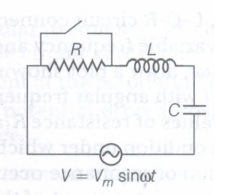
In the L-C-R circuit, shown in the figure, the AC driving voltage is V = Vm sin \(\omega\)t.
(i) Write down the equation of motion for q(t) .
(ii) At t = t0, the voltage source stops and R is short circuited. Now, write down how much energy is stored in each of L and C.
(iii) Describe subsequent motion of charges.
3.
A \(2㎌\) capacitor, \(100 \ \Omega \) resistor and 8 H inductor are connected in series with an AC source. What should be the frequency of source for which the current drawn in the circuit is maximum?
If peak value of emf of source is 200 V, find the maximum current, inductive reactance, capacitive reactance, total impedance, peak value of current in the circuit.
4.
Calculate the value of capacity in picofarad, which will make 101.4\(\mu H\) inductance to oscillate with the frequency of 1MHz.
5.
A magnetic field of flux density 10 T acts normally to the coil 50 turns having 100 cm2 area.Find emf induced if the coil is removed from the magnetic field in 0.15 s.
1.
(i) The town is 10 km away, length of pair of Cu wires
used, I = 20 km = 20000 m.
Resistance of Cu wires,
\(R=\rho \frac{l}{A}=\rho \frac{l}{\pi(r)^{2}}=\frac{1.7 \times 10^{-8} \times 20000}{3.14\left(0.5 \times 10^{-2}\right)^{2}} \approx 4 \Omega\)
\(I \text { at } 220 \mathrm{~V}, V I=10^{6} \mathrm{~W} ; I=\frac{10^{6}}{220}=0.45 \times 10^{4} \mathrm{~A}\)
RI2 = power loss = 4 x (0.45)2 x 10⁸> 106 W
Therefore, this method cannot be used for transmission.
(ii) When power, P = 106 W is transmitted at 11000 V.
V \('I'\)= 106 W = 11000 \(I'\)
Current drawn, \(I^{\prime}=\frac{1}{1.1} \times 10^{2}\)
Power loss \(=R I^{2}=\frac{1}{121} \times 4 \times 10^{6}=3.3 \times 10^{4} \mathrm{~W}\)
\(\therefore\) Fraction of power loss \(=\frac{3.3 \times 10^{4}}{10^{6}}=3.3 \%\)
2.
(i) Consider the R-L-C circuit as shown in the figure.
Given, V = Vmsin \(\omega\)t
Let current at any instant be i.
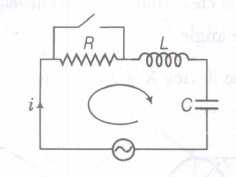
Note We have to apply KVL, write the equations in the form of current and charge, double differentiate the equation with respect to time and find the required relations.
Applying KVL in the given circuit,
\(i R+L \frac{d i}{d t}+\frac{q}{C}-V_{m} \sin \omega t=0\) ..........(i)
Now, we can write, \(i=\frac{d q}{d t} \Rightarrow \frac{d i}{d t}=\frac{d^{2} q}{d t^{2}}\)
From Eq. (i), we get
\(\frac{d q}{d t} R+L \frac{d^{2} q}{d t^{2}}+\frac{q}{C}=V_{m} \sin \omega t\)
\(\Rightarrow \quad L \frac{d^{2} q}{d t^{2}}+R \frac{d q}{d t}+\frac{q}{C}=V_{m} \sin \omega t\)
This is-the required equation of variation motion of charge.
(ii) Let \(q=q_{m} \sin (\omega t+\phi)=-q_{m} \cos (\omega t+\phi)\)
\(i=i_{m} \sin (\omega t+\phi)=q_{m} \omega \sin (\omega t+\phi)\)
\(i_{m}=\frac{V_{m}}{Z}=\frac{V_{m}}{\sqrt{R^{2}+\left(X_{C}-X_{L}\right)^{2}}}\)
and \(\phi=\tan ^{-1}\left(\frac{X_{C}-X_{L}}{R}\right)\)
When R is short circuited at t = to energy is stored in Land C.
\(U_{L}=\frac{1}{2} L i^{2}=\frac{1}{2} L\left[\frac{V_{m}}{\sqrt{R^{2}+\left(X_{C}-X_{L}\right)^{2}}}\right]^{2} \sin ^{2}(\omega t+\phi)\)
\(\text { and } U_{C}=\frac{1}{2} \times \frac{q^{2}}{C}=\frac{1}{2 C} \times\left(\frac{i_{m}}{\omega}\right)^{2} \cos ^{2}\left(\omega t_{0}+\phi\right)\)
\(=\frac{i_{m}^{2}}{2 C \omega^{2}} \cos ^{2}\left(\omega t_{0}+\phi\right) \quad\left[\because i_{m}=q_{m} \omega\right]\)
\(=\frac{1}{2 C}\left[\frac{V_{m}}{\sqrt{R^{2}+\left(X_{C}-X_{L}\right)^{2}}}\right]^{2} \frac{\cos ^{2}\left(\omega t_{0}+\phi\right)}{\omega^{2}}\)
\(=\frac{1}{2 C \omega^{2}}\left[\frac{V_{m}}{\sqrt{R^{2}+\left(X_{C}-X_{L}\right)^{2}}}\right]^{2} \cos ^{2}\left(\omega t_{0}+\phi\right)\)
(iii) When R is short circuited, it becomes an L - C oscillator. The capacitor will go on discharging and all energy will go to L.
Hence, there is an oscillation of energy from electrostatic to magnetic and again to electrostatic.
3.
Given, capacitance, \(C=2㎌=2\times { 10 }^{ -6 }F\)
Resistance, R = 100\(\Omega\)
Inductance, L = 8H
Peak value of voltage, E0 = 200V
When frequency of AC source is equal to resonant frequency, then current drawn in the circuit is maximum.
\(\begin{aligned} \therefore \quad v & =v,=\frac{1}{2 \pi \sqrt{L C}} \\ \end{aligned}\)
\(\begin{aligned} & =\frac{1}{2 \times 3.14 \times \sqrt{8 \times 2 \times 10^{-6}}} \\ \end{aligned}\)
\(\begin{aligned} =\frac{1000}{8 \times 3.14}=39.8 \mathrm{~Hz} \end{aligned}\)
Peak value of current,
\(\begin{aligned} I_0 & =\frac{E_0}{R}=\frac{200}{100}=2 \mathrm{~A} \\ \end{aligned}\)
\(\begin{aligned} \because \quad X_C & =X_L=\omega L=2 \pi v L \\ \end{aligned}\)
\(\begin{aligned} & =2 \times 3.14 \times 39.8 \times 8=2000 \mathrm{~W} \end{aligned}\)
\(\begin{aligned} \Rightarrow \quad Z & =R=100 \Omega \end{aligned}\)
The voltages across inductor and resistor differ in phase by 90° and the voltages across inductor and capacitor differ in phase by 180°.
4.
Given, inductance, L = 101.4\(\mu H\)
\(=101.4\times { 10 }^{ -6 }H\)
Frequency, v = 1MHz = 106Hz
Since, \(v=\frac { 1 }{ 2\pi \sqrt { LC } } \)
\(\Rightarrow \) \(C=\frac { 1 }{ 4{ \pi }^{ 2 }{ v }^{ 2 }L } \)
\(=\frac { 1\times 7\times 7 }{ 4\times 22\times 22\times { \left( { 10 }^{ 6 } \right) }^{ 2 }\times 101.4\times { 10 }^{ -6 } }\)
\(=2.496\times { 10 }^{ -10 }F\)
\(C=249.6 \ ㎊\)
5.
Given, B = 10 T, N = 50 turns
A = 100 cm2 = 10-2 m2 , dt = 0.15 s
Magnetic flux link with the coil initially,
\(\phi \) = NBA =50 x 10 x 10-2 = 5Wb
But magnetic flux linked with the coil finally,i.e.,
(when removed from the magnetic field), \({ \phi }_{ 2 }\) = 0
Emf infuced, e = \(\frac { -d\phi }{ dt } =-(\frac { { \phi }_{ 2 }-{ \phi }_{ 1 } }{ dt } )\)
\(=-(\frac { 0-5 }{ 0.15 } )=33.33 \ v\)

12th Standard CBSE Syllabus & Materials
12th Standard CBSE
CBSE 12th Computer Science Python Revision Tour I - New Previous year Question Papers Study Material - QB365 Set A
NEW12th Standard CBSE
CBSE 12th Business Studies Planning Important Questions And Answers Study Material - QB365 Set A
NEW12th Standard CBSE
CBSE 12th Business Studies Business Environment Important Questions And Answers Study Material - QB365 Set A
NEW12th Standard CBSE
CBSE 12th Business Studies Principles of Management Important Questions And Answers Study Material - QB365 Set A



NCERT Books

Syllabus

Exam Pattern

Sample Question Papers

Previous year Question Papers

Important Notes

MCQ Practice test

NCERT Exemplers

Case study Questions

Image Based Questions

Passage based Questions

HOT Questions

Value Based Questions

Model Questions Papers
NCERT ( Book Back ) Questions

Assertion and Reason
Important Questions And Answers

CBSE 12th Standard CBSE Subjects
CBSE Standards









