
 100% FREE ACCESS
12th Standard CBSE Syllabus & Materials
12th Standard CBSE
CBSE 12th Economics Government Budget and the Economy Previous year Question Papers Study Material - QB365 Set A
NEW12th Standard CBSE
CBSE 12th Computer Science Interface Python with MySQL - New Previous year Question Papers Study Material - QB365 Set A
NEW12th Standard CBSE
CBSE 12th Computer Science Database Concept - New Previous year Question Papers Study Material - QB365 Set A
NEW12th Standard CBSE
CBSE 12th Computer Science Data Communication - New Previous year Question Papers Study Material - QB365 Set A
NEW12th Standard CBSE
CBSE 12th Computer Science Data Structures - New Previous year Question Papers Study Material - QB365 Set A
NEW12th Standard CBSE
CBSE 12th Computer Science Functions - New Previous year Question Papers Study Material - QB365 Set A

Published on: 21/05/2021
QB365 Provides the updated CASE Study Questions for Class 12 , and also provide the detail solution for each and every case study questions . Case study questions are latest updated question pattern from NCERT, QB365 will helps to get more marks in Exams
Download CBSE Class 12th Standard CBSE Physics question papers, sample papers, important questions, and previous year solved papers in PDF format. Get free study materials, NCERT solutions, and exam preparation resources for Class 12th Standard CBSE Physics
Questions + Answers key
Take MCQ Physics Test
1.
Whenever an electric current is passed through a conductor, it becomes hot after some time. The phenomenon of the production of heat in a resistor by the flow of an electric current through it is called heating effect of current or Joule heating. Thus, the electrical energy supplied by the source of emf is converted into heat. In purely resistive circuit, the energy expended by the source entirely appears as heat. But if the circuit has an active element like a motor, then a part of the energy supplied by the source goes to do useful work and the rest appears as heat. Joule's law of heating form the basis of various electrical appliances such as electric bulb, electric furnace,
electric press etc.
(i) Which of the following is a correct statement?
| (a) Heat produced in a conductor is independent of the current flowing |
| (b) Heat produced in a conductor varies inversely as the current flowing |
| (c) Heat produced in a conductor varies directly as the square of the current flowing |
| (d) Heat produced in a conductor varies inversely as the square of the current flowing |
(ii) If the coil of a heater is cut to half, what would happen to heat produced?
| (a) Doubled | (b) Halved | (c) Remains same | (d) Becomes four times |
(iii) A 25 Wand 100 Ware joined in series and connected to the mains. Which bulbs will glow brighter?
| (a) 100W | (b) 25 W |
| (c) both bulbs will glow brighter | (d) none will glow brighter |
(iv) A rigid container with thermally insulated wall contains a coil of resistance \(100 \Omega\) carrying current 1A. Change in its internal' energy after 5 min will be
| (a) 0 kJ | (b) 10 kJ | (c) 20 kJ | (d) 30 kJ |
(v) The heat emitted by a bulb of 1.90W in 1 min is
| (a) 100 J | (b) 1000 J | (c) 600 J | (d) 6000 J |
2.
Wheatstone bridge is an arrangement of four resistances P, Q, Rand S connected as shown in the figure. Their values are so adjusted that the galvanometer G shows no deflection. The bridge is then said to be balanced when this condition is achieved happens. In the setup shown here, the points Band D are at the same potential and it can be shown that \(\frac{P}{Q}=\frac{R}{S}\)
This is called the balancing condition. If any three resistances are known, the fourth can be found.
The practical form of Wheatstone bridge is slide wire bridge or Meter bridge. Using this the unknown resistance can be determined as \(S=\left(\frac{100-l}{l}\right) \times R\) ,where I is the balancing length of the Meter bridge.
(i) In a Wheatstone bridge circuit, \(P=5 \Omega, Q=6 \Omega, R=10 \Omega\) and \(S=5 \Omega\) What is the value of additional resistance to be used in series with S, so that the bridge is balanced?
| \(\text { (a) } 9 \Omega\) | \(\text { (b) } 7 \Omega\) | \(\text { (c) } 10 \Omega\) | \(\text { (d) } 5 \Omega\) |
(ii) A Wheatstone bridge consisting of four arms of resistances P, Q, R, S is most sensitive when
| (a) all the resistances are equal |
| (b) all the resistances are unequal |
| (c) the resistances P and Q are equal but R > > P and S > > Q |
| (d) the resistances P and Q are equal but R < < P and S < < Q |
(iii) When a metal conductor connected to left gap of a meter bridge is heated, the balancing point
| (a) shifts towards right | (b) shifts towards left | (c) remains unchanged | (d) remains at zero |
(iv) The percentage error in measuring resistance with a meter bridge can be minimized by adjusting the balancing point close to
| (a) 0 | (b)·20cm | (c) 50cm | (d) 80cm |
(v) In a meter bridge experiment, the ratio ofleft gap resistance to right gap resistance is 2 : 3. The balance point from left is
| (a) 20 cm | (b) 50 cm | (c) 40 cm | (d) 60 cm |
3.
A single cell provides a feeble current. In order to get a higher current in a circuit, we often use a combination of cells A combination of cells is called a battery, Cells can be joined in series, parallel or in a mixed way.
Two cells are said to be connected in series when negative terminal of one cell is connected to positive terminal of the other cell and so on. Two cells are said to be connected in parallel if positive terminal of each cell is connected to one point and negative terminal of each cell connected to the other point. In mixed grouping of cells, a certains number of identical cells are joined in series, and all such rows are then connected in parallel with each other.
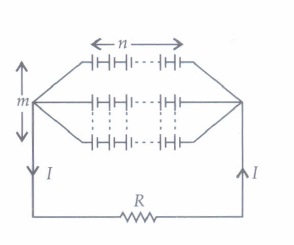
(i) To draw the maximum current from a combination of cells, how should the cells be grouped?
| (a) Parallel | (b) Series | (c) Mixed grouping | (d) Depends upon the relative values of internal and external resistances |
(ii) The total emf of the cells when n identical cells each of emf e are connected in parallel is
| \(\text { (a) } n \varepsilon\) | \(\text { (b) } n^{2} \varepsilon\) | (c) E | \(\text { d) } \frac{\varepsilon}{n}\) |
(iii) 4 cells each of emf 2 V and internal resistance of \(1 \Omega\) are connected in parallel to a load resistor of \(2 \Omega\). Then the current through the load resistor is
| (a) 2 A | (b) 1.5 A | (c) 1 A | (d) 0.888 A |
(iv) If two cells out of n number of cells each of internal resistance 'r' are wrongly connected in series, then total resistance of the cell is
| (a) 2nr | (b) nr - 4r | (c) nr | (d) r |
(v) Two identical non-ideal batteries are connected in parallel. Consider the following statements.
(i). The equivalent emf is smaller than either of the two emfs.
(ii) The equivalent internal resistance is smaller than either of the two internal resistances
| (a) Both (i) and (ii) are correct. | (b) (i) is correct but (ii) is wrong |
| (c) (ii) is correct but (i) is wrong. | (d) Both (i) and (ii) are wrong. |
4.
The flow of charge in a particular direction constitutes the electric current. Current is measured in Ampere. Quantitatively, electric current in a conductor across an area held perpendicular to the direction of flow of charge is defined as the amount of charge is flowing across that area per unit time.
Current density at a point in a conductor is the ratio of the current at that point in the conductor to the area of cross section of the conductor of that point.
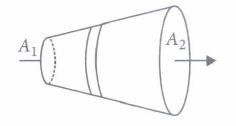
The given figure shows a steady current flows in a metallic conductor of non uniform cross section. Current density depends inversely on area, so, here \(J_{1}>J_{2}, \text { as } A_{1}
(i) What is the current flowing through a conductor, if one million electrons are crossing in one millisecond through a cross-section of it ?
| (a) 2.5 x 10⁻¹⁰ A | (b) 1.6 x 10⁻¹⁰ A |
| (c) 7.5 X 10⁻⁹ A | (d) 8.2 x 10⁻¹¹ A |
(ii) SI unit of electric current is
| (a) Cs | (b) Ns-2 | (c) Cs-1 | C-1s-1 |
(iii) A steady current flows in a metallic conductor of non-uniform cross-section. Which of these quantities is constant along the conductor?
| (a) Electric field | (b) Drift velocity | (c) Current | (d) Current density |
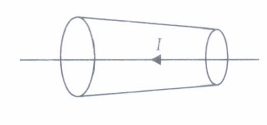
(iv) A constant current I is flowing along the length of a conductor of variable cross-section as shown in the figure. The quantity which does not depend upon the area of cross-section is
| (a) electron density | (b) current density |
| (c) drift velocity | (d) electric field |
(v) When a current of 40 A flows through a conductor of area 10 m2, then the current density is
| (a) 4 A/m2 | (b) 1 A/m2 | (c) 2 A/m2 | (d) 8 A/m2 |
1.
(i) (c): According to Joule's law of heating, Heat produced in a conductor, H= I2Rt
where, I = Current flowing through the conductor
R = Resistance of the conductor
t = Time for which current flows through the conductor.
\(\therefore \quad H \propto I^{2}\)
(ii) (a): If the coil is cut into half, its resistance is also halved.
As \(H=\frac{V^{2}}{R} t \quad \therefore \quad H^{\prime}=2\)
(iii) (b): \(P=\frac{V^{2}}{R} \text { or } R=\frac{V^{2}}{P}\)
The bulbs are joined in series. Current in both the bulbs will same
\(\therefore\) The heat produced in them is given by H = I2Rt
or \(H \propto R \Rightarrow H \propto \frac{1}{P}\)
Therefore the bulb with low wattage or high resistance will glow brighter or we can say the 25 W bulb will glow brighter than the 100 W bulb.
(iv) (d): \(R=100 \Omega ; I=1 \mathrm{~A} ; t=5 \mathrm{~min} .=5 \times 60=300 \mathrm{~s}\)
change in internal energy = heat generated in coil
\(=I^{2} R t=\left((1)^{2} \times 100 \times 300\right) \mathrm{J}\)
= 30000 J = 30 kJ
(v) (d): Here, P = 100 W, t = 1 min = 60 s
Heat developed in time t
H = P x t = (100 W)( 60 s) = 6000 J
2.
(I) (b): \((S+x)=\frac{Q}{P} R\)
\(x=\frac{Q}{P} R-S=\frac{6}{5} \times 10-5=7 \Omega\)
(ii) (a): A Wheatstone bridge consisting of four arms of resistance P, Q, R, S is most sensitive when all the resistances are equal.
(iii) (a) : When metal wire is heated, its resistance increases R1 increases,L1 increases.
The null point shift to the right.
(iv) (c): The percentage error in measuring resistance with a metre bridge can be minimized by adjusting the balancing point near the middle of the bridge i.e. close to 50 cm
(v) (c): \(\frac{P}{Q}=\frac{l_{1}}{100-l_{1}} \text { or } \frac{2}{3}=\frac{l_{1}}{100-l_{1}}\)
\(\text { or } \quad 5 l_{1}=200 \text { or } l_{1}=40 \mathrm{~cm}\)
3.
(i) (d)
(ii) (c): For parallel combination of n celis, \(\varepsilon_{e q}=\varepsilon\)
(iii) (d): \(I=\frac{m E}{m R+r}\) m= number of cells = 4
\(E=2 \mathrm{~V}, R=2 \Omega, r=1 \Omega\)
\(I=\frac{8}{8+1}=\frac{8}{9}=0.888 \mathrm{~A}\)
(iv) (b)
(v) (c): Let two cells of emf's E1 and E2 and of internal resistance r1 and r2 respectively are connected in parallel
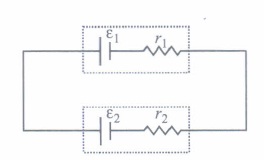
The equivalent emf is given by
\(\varepsilon_{\mathrm{eq}}=\frac{\varepsilon_{1} r_{2}+\varepsilon_{2} r_{1}}{r_{1}+r_{2}}\)...(I)
The equivalent internal resistance is given by
\(\frac{1}{r_{\mathrm{eq}}}=\frac{1}{r_{1}}+\frac{1}{r_{2}} \quad \text { or } \quad r_{\mathrm{eq}}=\frac{r_{1} r_{2}}{r_{1}+r_{2}}\)
Let us consider, two cells connected in parallel of same emf E and same internal resistance r.
From equatio. n (i), we get \(\varepsilon_{\mathrm{eq}}=\frac{\varepsilon r+\varepsilon r}{r+r}=\varepsilon\)
From equation (ii), we get
\(r_{\mathrm{eq}}=\frac{r^{2}}{r+r}=\frac{r}{2}\)
4.
(I) (b): \(q=10^{6} \times 1.6 \times 10^{-19} \mathrm{C}=1.6 \times 10^{-13} \mathrm{C}\)
t = 10-3 s
\(I=\frac{q}{t}=\frac{1.6 \times 10^{-13}}{10^{-3}}=1.6 \times 10^{-10} \mathrm{~A}\)
(ii) (C): C S-1
(iii) (C): The current flowing through a conductor of non-uniform cross-section remain same in the whole of the conductor.
(iv) (a): When a constant current is flowing through a conductor of non-uniform cross-section, electron density does not depend upon the area of cross section, while current density, drift velocity and electric field all vary inversely with area of cross-section.
(v) (a): Given, I = 40 A ;A = 10m2
\(\therefore\) Current density, \(J=\frac{I}{A} \text { or } J=\frac{40}{10}=4 \mathrm{~A} / \mathrm{m}^{2}\)

12th Standard CBSE Syllabus & Materials
12th Standard CBSE
CBSE 12th Computer Science Python Revision Tour I - New Previous year Question Papers Study Material - QB365 Set A
NEW12th Standard CBSE
CBSE 12th Business Studies Planning Important Questions And Answers Study Material - QB365 Set A
NEW12th Standard CBSE
CBSE 12th Business Studies Business Environment Important Questions And Answers Study Material - QB365 Set A
NEW12th Standard CBSE
CBSE 12th Business Studies Principles of Management Important Questions And Answers Study Material - QB365 Set A



NCERT Books

Syllabus

Exam Pattern

Sample Question Papers

Previous year Question Papers

Important Notes

MCQ Practice test

NCERT Exemplers

Case study Questions

Image Based Questions

Passage based Questions

HOT Questions

Value Based Questions

Model Questions Papers
NCERT ( Book Back ) Questions

Assertion and Reason
Important Questions And Answers

CBSE 12th Standard CBSE Subjects
CBSE Standards








