
 100% FREE ACCESS
12th Standard CBSE Syllabus & Materials
12th Standard CBSE
CBSE 12th Economics Government Budget and the Economy Previous year Question Papers Study Material - QB365 Set A
NEW12th Standard CBSE
CBSE 12th Computer Science Interface Python with MySQL - New Previous year Question Papers Study Material - QB365 Set A
NEW12th Standard CBSE
CBSE 12th Computer Science Database Concept - New Previous year Question Papers Study Material - QB365 Set A
NEW12th Standard CBSE
CBSE 12th Computer Science Data Communication - New Previous year Question Papers Study Material - QB365 Set A
NEW12th Standard CBSE
CBSE 12th Computer Science Data Structures - New Previous year Question Papers Study Material - QB365 Set A
NEW12th Standard CBSE
CBSE 12th Computer Science Functions - New Previous year Question Papers Study Material - QB365 Set A

Published on: 21/05/2021
QB365 Provides the updated CASE Study Questions for Class 12 , and also provide the detail solution for each and every case study questions . Case study questions are latest updated question pattern from NCERT, QB365 will helps to get more marks in Exams
Download CBSE Class 12th Standard CBSE Physics question papers, sample papers, important questions, and previous year solved papers in PDF format. Get free study materials, NCERT solutions, and exam preparation resources for Class 12th Standard CBSE Physics
Questions + Answers key
Take MCQ Physics Test
1.
When light of sufficiently high frequency is incident on a metallic surface, electrons are emitted from the metallic surface. This phenomenon is called photoelectric emission. Kinetic energy of the emitted photoelectrons depends on the wavelength of incident light and is independent of the intensity of light. Number of emitted photoelectrons depends on intensity. (hv - \(\phi\) is the maximum kinetic energy of emitted photoelectrons (where \(\phi\) is the work function of metallic surface). Reverse effect of photo emission produces X-ray. X-ray is not deflected by electric and magnetic fields. Wavelength of a continuous X-ray depends on potential difference across the tube. Wavelength of characteristic X-ray depends on the atomic number.
(i) Einstein's photoelectric equation is
| \(\text { (a) } E_{\max }=h v-\phi\) | \(\text { (b) } E=m c^{2}\) | \(\text { (c) } E^{2}=p^{2} c^{2}+m_{0}^{2} c^{4}\) | \(\text { (d) } E=\frac{1}{2} m v^{2}\) |
(ii) Light of wavelength \(\lambda\) which is less than threshold wavelength is incident on a photosensitive material. If incident wavelength is decreased so that emitted photoelectrons are moving with some velocity then stopping potential will
| (a) increase | (b) decrease | (c) be zero | (d) become exactly half |
(iii) When ultraviolet rays incident on metal plate then photoelectric effect does not occur, it occur by incident of
| (a) Infrared rays | (b) X-rays | (c) Radio wave | (d) Micro wave |
(iv) If frequency (v > v0) of incident light becomes n times the initial frequency (v), then K.E. of the emitted photoelectrons becomes (v0 threshold frequency).
| (a) n times of the initial kinetic energy |
| (b) More than n times of the initial kinetic energy |
| (c) Less than n times of the initial kinetic energy |
| (d) Kinetic energy of the emitted photoelectrons remains unchanged |
(v) A monochromatic light is used in a photoelectric experiment. The stopping potential
| (a) Is related to the mean wavelength | (b) Is related to the shortest wavelength |
| (c) Is not related to the minimum kinetic energy of emitted photoelectrons | (d) Intensity of incident light |
2.
According to Einstein, when a photon of light of frequency u or wavelength \(\lambda\) is incident on a photosensitive metal surface of work function \(\phi\)0w' here \(\phi\)0< hv (here, h is Planck's constant), then the emission of photoelectrons takes place. The maximum kinetic energy of the emitted photoelectrons is given by Kmax = hv - \(\phi\)0. If the frequency of the incident light is V0 called threshold frequency, the photoelectrons are emitted from metal without any kinetic energy. So hv0 = \(\phi\)
(i) A metal of work function 3·3 eV is illuminated by light of wavelength 300 nm. The maximum kinetic energy of photoelectrons emitted is (taking h = 6·6 x 10-34 Js)
| (a) 0.413 eV | (b) 0.825 eV | (c) 1.65 eV | (d) 1.32 eV |
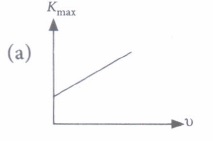
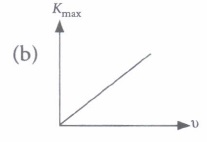
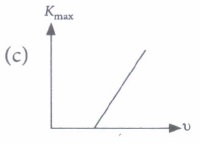
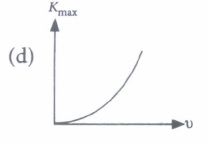
(ii) The variation of maximum kinetic energy (Kmax) of the emitted photoelectrons with frequency (v) of the incident radiations can be represented by
 |
 |
 |
 |
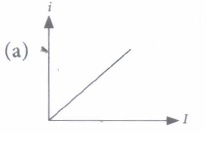
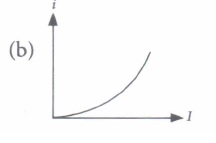
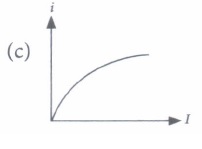
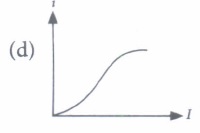
(iii) The variation of photoelectric current (i) with the intensity of the incident radiation (I) can be represented by
 |
 |
 |
 |
(iv) The graph between the stopping potential (V0) and \(\left(\frac{1}{\lambda}\right)\) is shown in the figure \(\phi_{1}, \phi_{2}, \phi_{3}\) 3 are work function. Which of the following options is correct?
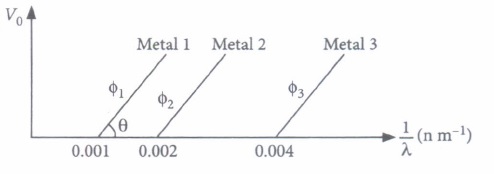
\(\text { (a) } \phi_{1}: \phi_{2}: \phi_{3}=1: 2: 3\) |
| \(\text { (b) } \phi_{1}: \phi_{2}: \phi_{3}=4: 2: 1\) |
| \(\text { (c) } \phi_{1}: \phi_{2}: \phi_{3}=1: 2: 4\) |
| (d) Ultraviolet light can be used to emit photoelectrons from metal 2 and metal 3 only |
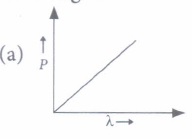
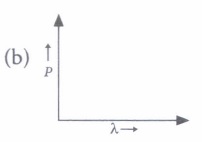
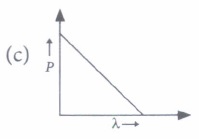
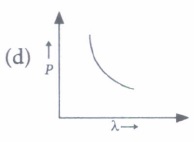
(v) Which of the following figures represent the variation of particle momentum and the associated de- Broglie wavelength?
 |
 |
 |
 |
3.
A point source S of power 6.4 x 10⁻³W emits mono energetic photons each of energy 6.0 eV. The source is located at a distance of 0·8 m from the centre of a stationary metallic sphere of work function 3·0 eV and of radius 1.6 x 10⁻³ m as shown in figure. The sphere is isolated and initially neutral and photoelectrons are instantly taken away from sphere after emission. The efficiency of photoelectric emission is one for very 105 incident photons.
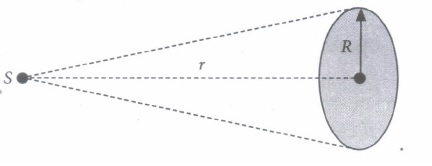
(i) The'power received by the sphere through radiations is
| \(\text { (a) } \frac{4 R^{2}}{P r}\) | \(\text { (b) } \frac{P R^{2}}{4 r^{2}}\) | \(\text { (c) } \frac{p^{2} R}{2 \pi r}\) | \(\text { (d) } \frac{P R}{4 r}\) |
(ii) Number of photons striking the metal sphere per second is
| (a) 6.7 x 10⁹ | (b) 3.3 x 10⁹ | (c) 6.7 x 10¹⁰ | (b) 3.3 x 10¹⁰ |
(iii) The number of photoelectrons emitted per second is about
| (a) 3.3 x 10⁴ | (b) 6.7 x 10⁴ | (c) 6.7 x 10¹⁵ | (d) 3.3 x 10¹⁵ |
(iv) The photoelectric emission stops when the sphere acquires a potential about
| (a) 2 V | (b) 3 V | (c) 4 V | (d) 6 V |
(v) If the distance of source becomes double from the centre of the metal sphere then the power received by the sphere
| \(\text { (a) } \frac{P R^{2}}{4 r^{2}}\) | \(\text { (b) } \frac{P R^{2}}{16 r^{2}}\) | \(\text { (c) } \frac{P R^{2}}{4 r}\) | \(\text { (d) } \frac{P^{2} R^{2}}{16 r^{2}}\) |
4.
When a monochromatic radiations of suitable frequency obtained from source S, after being filtered by a filter attached on the window W, fall on the photosensitive place C, the photo electrons are emitted from C, which get accelerated towards the plate A if it is kept at positive potential. These electrons flow in the outer circuit resulting in photoelectric current. Due to it, the micro ammeter shows a deflection. The reading of micrommeter measures the photoelectric current.
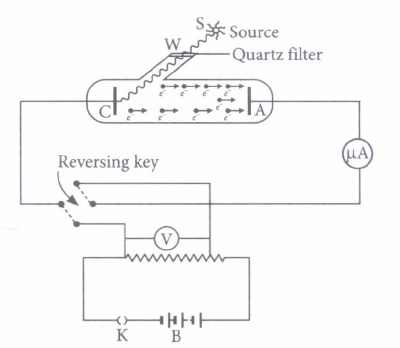
An experimental setup of verification of photoelectric effect is shown in figure. The voltage across the electrodes is measured with the help of an ideal voltmeter, and which can be varied by moving jockey J on the potentiometer wire. The battery used in potentiometer circuit is of 16 V and its internal resistance is 2 \(\Omega\) The resistance of 100 ern long po.t•e. ntiometer wire is 8 \(\Omega\).
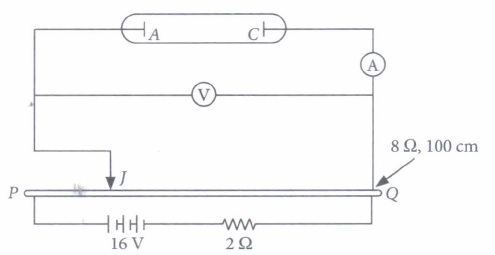
The photocurrent is measured with the help of an ideal ammeter. Two plates of potassium oxide of area 50 cm2 at separation 0.5 mm are used in the vacuum tube. Photocurrent in the circuit is very small, so we can treat the
potentiometer circuit as an independent circuit
| Light | Violet | blue | Green | Yellow | Orange | Red |
| \(\lambda\) in \(\dot A\) | 4000-5000 | 4500-5000 | 5000-5500 | 5500-6000 | 6000-6500 | 6500-7000 |
(i) When radiation falls on the cathode plate, a current of 2 \(\mu \)A is recorded in the ammeter. Assuming that the vacuum tube setup follows Ohm's law, the equivalent resistance of vacuum tube operating in the case when jockey is at end P is
| (a) 8 x 10⁸\(\Omega\) | (b) 16 x 106\(\Omega\) | (c) 8 x 10⁶\(\Omega\) | (d) 10 x 106\(\Omega\) |
(ii) It is found that ammeter current remains unchanged (2 \(\mu\)A) even when the jockey is moved from the end P to the middle point of the potentiometer wire. Assuming that all the incident photons eject electrons and the power of the light incident is 4 x 10⁻⁶\(\Omega\)Then, the color of the incident light is
| (a) Green | (b) Violet | (c) Red | (d) Orange |
(iii) Which of the following colors may not give photoelectric effect for this cathode?
| (a) Green | (b) Violet | (c) Red | (d) Orange |
(iv) When other light falls on the anode plate, the ammeter reading zero till jockey is moved from the end P to the middle point of the wire PQ. Therefore, the deflection is recorded in the ammeter. The maximum kinetic energy of the emitted electron is
| (a) 16 eV | (b) 8 eV | (c) 4 eV | (d) 10 eV |
(v) If the intensity of incident radiation is increased twice, the number of photoelectrons emitted per second will be
| (a) halves | (b) double | (c) remain same | (d) four times |
1.
(i) (a)
(ii) (a): According to Einstein's photoelectric equation,
\(e V_{0}=\frac{h c}{\lambda}-\frac{h c}{\lambda_{0}}\)
As \(\lambda\)0 is constant, so when \(\lambda\). is decreased, stopping potential (V0) increases.
(iii) (b): It indicates that threshold frequency is greater than that of ultraviolet light. As X-rays have greater frequency than ultraviolet rays, so they can cause photoelectric effect.
(iv) (b): \(\mathrm{K.E}_{\cdot 1}=h \mathrm{v}-\phi\)
\({K.E}_{\cdot 2}=n h v-\phi=n(h v-\phi)+(n-1) \phi\)
\({K.E.} 2=n \mathrm{KE}_{1}+(n-1) \phi \)
\(\text { K.E. }_{2}>n \mathrm{KE}_{1}\)
(v) (b): Stopping potential is the measurement of maximum kinetic energy of emitted photoelectrons and kinetic energy of emitted photoelectrons is linearly related with the frequency of incident light corresponding (i.e., corresponding to shortest wavelength, KE. is maximum). Stopping potential is independent of intensity.
2.
(i) (b): \(K_{\max }=h v-\phi_{0}=\frac{h c}{\lambda}-\phi_{0}\)
\(=\frac{\left(6 \cdot 6 \times 10^{-34}\right) \times\left(3 \times 10^{8}\right)}{\left(300 \times 10^{-9}\right) \times\left(1 \cdot 6 \times 10^{-19}\right)}-3 \cdot 3\)
\(=4 \cdot 125 \times 3 \cdot 3=0 \cdot 825 \mathrm{eV}\)
(ii) (c) : \(K_{\max }=h v-\phi_{0}, \text { When } v=v_{0}, K_{\max }=0\)
\(\therefore \quad 0=h v_{0}-\phi_{0} \text { or } \phi_{0}=h v_{0}\)
If v < v0 then Kmax is negative, i.e., no photoelectric emission takes place. Thus, graph (c) is possible.
(iii) (a): Photoelectric current (i) is proportional to the intensity of the emission light. Thus, graph (a) is possible.
(iv) (c): From Einstein's photoelectric equation,
\(K_{\max }=e V_{0}=\frac{h c}{\lambda}-\phi\)
or \(V_{0}=\frac{h c}{e} \cdot \frac{1}{\lambda}-\frac{\phi}{e}\)
Graph of V0 versus \(\frac{1}{\lambda}\) is a straight line Slope of straight line,\(\tan \theta=\frac{h c}{e}\)
\(\text { At } V_{0}=0, \text { we have }\)
\(\phi_{1}: \phi_{2}: \phi_{3}=\frac{h c}{\lambda_{01}}: \frac{h c}{\lambda_{02}}: \frac{h c}{\lambda_{03}}\)
\(0.001 h c: 0.002 h c: 0.004 h c\)
\(\therefore 1: 2: 4\)
(v) (d): de-Broglie wavelength
\(\lambda=\frac{h}{p} i . e ., \lambda \propto \frac{1}{p}\)
So the graph between \(\lambda\) and P is of the type shown is option (d).
3.
(i) (b): Let R be the radius of the metallic sphere and r be its distance from the source S0. The power received at the sphere is
\(P^{\prime}=\frac{P \times \pi R^{2}}{4 \pi r^{2}}=\frac{P R^{2}}{4 r^{2}}\)
(ii) (a): Number of photons striking the metal sphere per second is
\(n^{\prime}=\frac{P^{\prime}}{E}=\frac{6 \cdot 4 \times 10^{-9}}{6 \cdot 0 \times 1 \cdot 6 \times 10^{-19}}=6 \cdot 7 \times 10^{9} \mathrm{~s}^{-1}\)
(iii) (b): Number of photoelectrons emitted from metal sphere,\(\frac{n^{\prime}}{10^{5}}=\frac{6 \cdot 7 \times 10^{-9}}{10^{5}}=6 \cdot 7 \times 10^{4}\)
(iv) (b): Kinetic energy of the fastest photoelectrons is \(K_{\max }=6 \cdot 0-3 \cdot 0=3 \cdot 0 \mathrm{eV}\)
\(\therefore \text { Stopping potential, } V_{s}=\frac{K_{\max }}{e}=\frac{3 \cdot 0 \mathrm{eV}}{e}=3.0 \mathrm{~V}\)
(v) (b): When r = 2r, then power received by the sphere
\(P^{\prime \prime}=\frac{P \pi R^{2}}{4 \pi(2 r)^{2}}=\frac{1}{4}\left(\frac{P R^{2}}{4 r^{2}}\right)\)
4.
(i) (c) :Equivalent resistance
\(R=\frac{V}{I}=\frac{16 \mathrm{~V}}{2 \times 10^{-6} \mathrm{~A}}=8 \times 10^{6} \Omega\)
(ii) (d): \(P=\frac{I h C}{e \lambda}\)
\(\lambda=\frac{\left(2 \times 10^{-6}\right)\left(6.6 \times 10^{-34}\right)\left(3 \times 10^{8}\right)}{\left(4 \times 10^{-6}\right)\left(1.6 \times 10^{-19}\right)}\)
\(=\frac{9.9}{1.6} \times 10^{-7} \mathrm{~m}=\frac{9900}{1.6} \dot A=6187 \dot A\)
Which is in the range of orange light
(iii) (c) : The range of wavelength for red light is beyond the wavelength of incident light.
(iv) (b): Stopping potential, \(V_{s}=8 \mathrm{~V}\)
and \(\mathrm{K.E.}=e V_{\mathrm{s}}\)
\(\therefore \quad \mathrm{K} . \mathrm{E} .=8 \mathrm{eV}\)
(v) (b): Photoelectric current varies linearly with the intensity of the incident radiation.

12th Standard CBSE Syllabus & Materials
12th Standard CBSE
CBSE 12th Computer Science Python Revision Tour I - New Previous year Question Papers Study Material - QB365 Set A
NEW12th Standard CBSE
CBSE 12th Business Studies Planning Important Questions And Answers Study Material - QB365 Set A
NEW12th Standard CBSE
CBSE 12th Business Studies Business Environment Important Questions And Answers Study Material - QB365 Set A
NEW12th Standard CBSE
CBSE 12th Business Studies Principles of Management Important Questions And Answers Study Material - QB365 Set A



NCERT Books

Syllabus

Exam Pattern

Sample Question Papers

Previous year Question Papers

Important Notes

MCQ Practice test

NCERT Exemplers

Case study Questions

Image Based Questions

Passage based Questions

HOT Questions

Value Based Questions

Model Questions Papers
NCERT ( Book Back ) Questions

Assertion and Reason
Important Questions And Answers

CBSE 12th Standard CBSE Subjects
CBSE Standards








