
 100% FREE ACCESS
12th Standard CBSE Syllabus & Materials
12th Standard CBSE
CBSE 12th Economics Government Budget and the Economy Previous year Question Papers Study Material - QB365 Set A
NEW12th Standard CBSE
CBSE 12th Computer Science Interface Python with MySQL - New Previous year Question Papers Study Material - QB365 Set A
NEW12th Standard CBSE
CBSE 12th Computer Science Database Concept - New Previous year Question Papers Study Material - QB365 Set A
NEW12th Standard CBSE
CBSE 12th Computer Science Data Communication - New Previous year Question Papers Study Material - QB365 Set A
NEW12th Standard CBSE
CBSE 12th Computer Science Data Structures - New Previous year Question Papers Study Material - QB365 Set A
NEW12th Standard CBSE
CBSE 12th Computer Science Functions - New Previous year Question Papers Study Material - QB365 Set A

Published on: 21/05/2021
QB365 Provides the updated CASE Study Questions for Class 12 , and also provide the detail solution for each and every case study questions . Case study questions are latest updated question pattern from NCERT, QB365 will helps to get more marks in Exams
Download CBSE Class 12th Standard CBSE Physics question papers, sample papers, important questions, and previous year solved papers in PDF format. Get free study materials, NCERT solutions, and exam preparation resources for Class 12th Standard CBSE Physics
Questions + Answers key
Take MCQ Physics Test
1.
To study photoelectric effect, an emitting electrode C of a photosensitive material is kept at negative potential and collecting electrode A is kept at positive potential in an evacuated tube. When light of sufficiently high frequency falls on emitting electrode, photoelectrons are emitted which travel directly to collecting electrode and hence an electric cusrent called photoelectric current starts flowing in the circuit, which is directly proportional to the number of photoelectrons emitted by emitting electrode C.
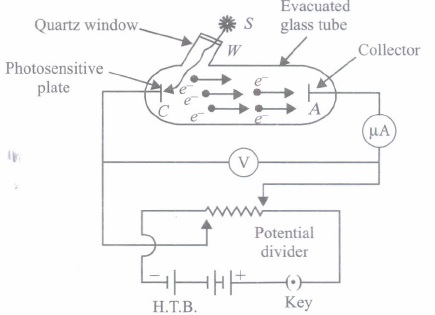
While demonstrating the existence of electromagnetic waves, Hertz found that high voltage sparks passed across the metal electrodes of the detector loop more easily when the cathode was illuminated by ultraviolet light from an arc lamp. The ultraviolet light falling on the metal surface caused the emission of negatively charged particles,which are now known to be electrons, into the surrounding space and hence enhanced the high voltage sparks.
(i) Cathode rays were discovered by
| (a) Maxwell Clerk James | (b) Heinrich Hertz |
| (c) William Crookes | (d) J. J. Thomson |
(ii) Cathode rays consists of
| (a) photons | (b) electrons | (c) pistons | (d) a-particles. |
(iii) Who discovered the charge on an electron for the frist time?
| (a) Millikan | (b) Thomson | (c) Kelvin | (d) Coulomb |
(iv) The dual nature of light is exhibited by
| (a) diffraction and photoelectric effect | (b) photoelectric effect |
| (c) refraction and interference | (d) diffraction and reflection |
(v) In the phenomenon of electric discharge through gases at low pressure, the coloured glow in the tube appears as a result of
| (a) collisions between the charged particles emitted from the cathode and the atoms of the gas |
| (b) collision between different electrons of the atoms of the gas |
| (c) excitation of electrons in the atoms |
| (d) collision between the atoms of the gas. |
2.
The photon picture of electromagnetic radiations and the characteristic properties of photons are as follows:In the interaction of radiation with matter, radiation behaves as if it is made of particles like photons. Each photon has energy \(E(=h v=h c / \lambda)\) and momentum \(p\left(=\frac{h v}{c}=\frac{h}{\lambda}\right)\) where h is Planck's constant, v and A are the frequency and wavelength of radiation and c is the velocity of light. The photon energy is independent of the intensity of radiations. All the photons emitted from a source of radiations travel through space with the same speed c. The frequency of photon gives the radiation, a definite energy (or colour) which does not change when photon travels through different media. Photons are not deflected by electric and magnetic fields. This shows that photons are electrically neutral.
(i) Which one among the following shows particle nature of light?
| (a) Photoelectric effect | (b) Interference | (c) Refraction | (d) Polarization |
(ii) Which of the following statements about photon is incorrect?
| (a) Photons exert no pressure | (b) Momentum of photon is \(\frac{h v}{c}\) |
| (c) Rest mass of photon is zero | (d) Energy of photon is hv |
(iii) The rest mass of photon is
| \(\text { (a) } \frac{h v}{c}\) | \(\text { (b) } \frac{h v}{c^{2}}\) | \(\text { (c) } \frac{h v}{\lambda}\) | (d) zero |
(iv) In a photon-particle collision (such as photon-electron collision), which of the following may not be conserved?
| (a) Total energy | (b) Number of photons | (c) Total momentum | (d) Both (a) and (b) |
(v) 'n' photons of wavelengt '\(\lambda\)' are absorbed by a black body of mass 'm'. The momentum gained by the body is
| \(\text { (a) } \frac{h}{m \lambda}\) | \(\text { (b) } \frac{m n h}{\lambda}\) | \(\text { (c) } \frac{n h}{m \lambda}\) | \(\text { (d) } \frac{n h}{\lambda}\) |
3.
According to wave theory, the light of any frequency can emit electrons from metallic surface provided the intensity of light be sufficient to provided necessary energy for emission of electrons, but according to experimental observations, the light of frequency less than threshold frequency can not emit electrons; whatever be the intensity of incident light. Einstein also proposed that electromagnetic radiation is quantised.If photoelectrons are ejected from a surface when light of wavelength \(\lambda\) 1= 550 nm is incident on it. The stopping potential for such electrons is Vs = 0.19 V. Suppose the radiation of wavelength \(\lambda\)2= 190 nm is incident on the surface.
(i) Photoelectric effect supports quantum nature oflight because
(A) there is a minimum frequency of light below which no photoelectrons are emitted.
(B) the maximum K.E. of photoelectric depends only on the frequency of light and not on its intensity.
(C) even when the metal surface is faintly illuminated, the photo electrons leave the surface immediately.
(D) electric charge of the photoelectrons is quantized.
| (a) A,B,C | (b) B,C | (c) C,D | (d) A,D,C |
(ii) In photoelectric effect, electrons are ejected from metals, if the incident light has a certain minimum
| (a) wavelength | (b) frequency | (c) amplitude | (d) angle of incidence |
(iii) Calculate the stopping potential VS2of surface.
| (a) 4.47 | (b) 3.16 | (c) 2.76 | (d) 5.28 |
(iv) Calculate the work function of the surface.
| (a) 3.75 | (b) 2.07 | (c) 4.20 | (d) 3.60 |
(v) Calculate the threshold frequency for the surface.
| (a) 500 x 1012 Hz | (b) 480 x 1013 Hz | (c) 520 x 1011Hz | (d) 460 x 1013 Hz |
4.
If we allow radiations of a fixed frequency to fall on plate and the accelerating potential difference between the two electrodes is kept fixed, then the photoelectric current is found to increase linearly with the intensity of incident radiation. Here, radiation pressure is P = \(\left(\frac{1+e}{C}\right) I\). As, atmosphere pressure at sea level is 105Pa. If the intensity of light of a given wavelength, is increased, there is an increase in the number of photons incident on a given area in a given time. But the energy of each photon remain the same.
(i) The number of photons hitting the cone second
| \(\text { (a) } \pi R^{2} I / 2 E\) | \(\text { (b) } 2 \pi R^{2} I / E\) | \(\text { (c) } \pi R^{2} I / 4 E\) | \(\text { (d) } \pi R^{2} I / E\) |
(ii) A radiation of energy E falls normally on a perfect reflecting surface. The momentum transferred to the surface is
| \(\text { (a) } \frac{E}{c}\) | \(\text { (b) } \frac{2 E}{c}\) | \(\text { (c) } E c\) | \(\text { (d) } \frac{E}{c^{2}}\) |
(iii) Which one is correct?
| \(\text { (a) } E^{2}=p^{2} c^{2}\) | \(\text { (b) } E^{2}=p^{2} c\) | \(\text { (c) } E^{2}=p^{2}\) | \(\text { (d) } E^{2}=\frac{p^{2}}{c^{2}}\) |
(iv) The incident intensity on a horizontal surface at sea level from the Sun is about 1 k W m-2. Assuming that 50% of this intensity is reflected and 50% is absorbed, determine the radiation pressure on this horizontal surface.
| (a) 8.2 x 10⁻² Pa | (b) 5 x 10⁻⁶ Pa | (c) 3 x 10⁻⁵ Pa | (d) 6 x 10⁻⁵ Pa |
(v) Find the ratio of radiation pressure to atmospheric pressure P0 about 1 x 10⁵ Pa at sea level.
| (a) 5 x 10-11 | (b) 4 x 10⁻⁸ | (c) 6 x 10-12 | (d) 8 x 10-11 |
1.
(i) (c)
(ii) (b)
(iii) (a)
(iv) (a)
(v) (c): In discharge tube, collision between charged particles emitted from cathode and atoms of the gas results to colorless glow in the tube.
2.
(i) (a): Particle nature of light was established by photoelectric effect.
(ii) (a): Photons move with velocity of light and have energy hv. Therefore, they also exert pressure.
(iii) (d): The rest mass of photon is zero.
(iv) (b): In a photon-particle collision, (such as photon electron collision), the total energy and total momentum are conserved. However, the number of photons may not be conserved in photon-particle collision. The photon may be absorbed or a new photon may be created.
(v) (d): Energy of n photons \(E=\frac{n h c}{\lambda}\)
Momentum gam. ed by the body, \(p=\frac{E}{c}=\frac{n h c}{\lambda c}=\frac{n h}{\lambda}\)
3.
(i) (a): The existence of the frequency and the instantaneous emission of photo electrons support the quantum nature of light.
(ii) (b): For photoelectric emission, the incident light must have a certain minimum frequency, called threshold frequency.
(iii) (a): From Einstein's relation
\(e V_{s}=h v-W\)
As work function is a constant for a surface
\(e\left(V_{s_{2}}-V_{s_{1}}\right)=h\left(v_{2}-v_{1}\right)\)
\(V_{s_{2}}=V_{s_{1}}+\frac{h}{e}\left(v_{2}-v_{1}\right)\)
\(=0.19+1240\left(\frac{1}{190}-\frac{1}{550}\right)=4.47 \mathrm{~V}\)
(iv) (b): \(W=\frac{h c}{\lambda_{1}}-e V_{s_{1}}=\frac{1240}{550}-0.19=2.07 \mathrm{eV}\)
(v) (a): hve = W
4.
(i) (d): Power of light received by the cone \(=I\left(\pi R^{2}\right)\)
Let number of photons hitting the cone per second is n.
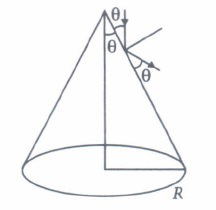
Then, \(n E=I \pi R^{2} \Rightarrow n=\pi R^{2} I / E\)
(ii) (b): Initial moment \(p_{i}=\frac{E}{c}\)
For a perfectly selecting surface
Final momentum \(p_{f}=\frac{-E}{c}\)
\(\Delta p=p_{f}-p_{i}=\frac{-E}{c}-\frac{E}{c}=\frac{-2 E}{c}\)
Hence a momentum \(\frac{2 E}{c}\) is transferred to the reflecting surface.
(iii) (a): According to the theory of relatively,
\(E=m c^{2}=m c . c=p c\)
\(\text { or } \quad E^{2}=p^{2} c^{2}\)
where p is the momentum of a photon.
(iv) (b): I = 1 kWm-2
As, 50% of light is reflected, thus e = 0.5
Radiation pressure \(P=\frac{(1+e) I}{c}\)
\(\therefore \quad P=\frac{(1+0.5) \times 1000}{3 \times 10^{8}}=5 \times 10^{-6} \mathrm{~Pa}\)
(v) (a) : \(\frac{P_{\mathrm{rad}}}{P_{0}}=\frac{5 \times 10^{-6}}{1 \times 10^{5}}=5 \times 10^{-11}\)

12th Standard CBSE Syllabus & Materials
12th Standard CBSE
CBSE 12th Computer Science Python Revision Tour I - New Previous year Question Papers Study Material - QB365 Set A
NEW12th Standard CBSE
CBSE 12th Business Studies Planning Important Questions And Answers Study Material - QB365 Set A
NEW12th Standard CBSE
CBSE 12th Business Studies Business Environment Important Questions And Answers Study Material - QB365 Set A
NEW12th Standard CBSE
CBSE 12th Business Studies Principles of Management Important Questions And Answers Study Material - QB365 Set A



NCERT Books

Syllabus

Exam Pattern

Sample Question Papers

Previous year Question Papers

Important Notes

MCQ Practice test

NCERT Exemplers

Case study Questions

Image Based Questions

Passage based Questions

HOT Questions

Value Based Questions

Model Questions Papers
NCERT ( Book Back ) Questions

Assertion and Reason
Important Questions And Answers

CBSE 12th Standard CBSE Subjects
CBSE Standards








