
 100% FREE ACCESS
12th Standard CBSE Syllabus & Materials
12th Standard CBSE
CBSE 12th Economics Government Budget and the Economy Previous year Question Papers Study Material - QB365 Set A
NEW12th Standard CBSE
CBSE 12th Computer Science Interface Python with MySQL - New Previous year Question Papers Study Material - QB365 Set A
NEW12th Standard CBSE
CBSE 12th Computer Science Database Concept - New Previous year Question Papers Study Material - QB365 Set A
NEW12th Standard CBSE
CBSE 12th Computer Science Data Communication - New Previous year Question Papers Study Material - QB365 Set A
NEW12th Standard CBSE
CBSE 12th Computer Science Data Structures - New Previous year Question Papers Study Material - QB365 Set A
NEW12th Standard CBSE
CBSE 12th Computer Science Functions - New Previous year Question Papers Study Material - QB365 Set A

Published on: 27/05/2021
QB365 Provides the HOT Question Papers for Class 12 Physics, and also provide the detail solution for each and every HOT Questions. HOT Questions will help to get more idea about question pattern in every exams and also will help to get more marks in Exams
Download CBSE Class 12th Standard CBSE Physics question papers, sample papers, important questions, and previous year solved papers in PDF format. Get free study materials, NCERT solutions, and exam preparation resources for Class 12th Standard CBSE Physics
Questions + Answers key
Take MCQ Physics Test1.
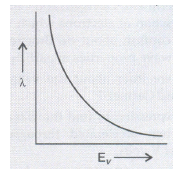
X-rays fall on a photosensitive surface to cause photoelectric emission. Assuming that the work function of the surface can be neglected, find the relation between the de-Broglie wavelength (\(\lambda \)) of the electrons emitted to the energy (Ev) of the incident photons. Draw the nature of the graph for Aas a function of Ev.
2.
What is the
(i) momentum
(ii) speed
(iii) de-Broglie wavelength of an electron with kinetic energy of 120 eV?
3.
Find the ratio of the de-Broglie wavelength associated with protons accelerated through a potential of 128 V and a particles accelerated through a potential of 64 V.
To calculate the ratio of de-Baroglie wavelength of two particle find the ratio in terms of symbols and then put the given numerical values.
4.
A proton and an \(\alpha \) particle are accelerated through the same potential. Which one of the two has
(i) greater value of de-Broglie wavelength associated with it and
(ii) less kinetic energy? Give reasons to justify your answer.
1.
\( { E }_{ v }={ \phi }_{ 0 }+{ K }_{ max }\)
\( \Rightarrow { \phi }_{ 0 }=0\)
\( \Rightarrow \ { E }_{ v }={ K }_{ max }\)
\(\Rightarrow { K }_{ max }=\frac { { p }^{ 2 } }{ 2m } ={ E }_{ v }\)
\( \Rightarrow \ p=\sqrt { 2m{ E }_{ v } } \)
Wavelength \(\left( \lambda \right) \) of emitted electrons,
\(\lambda =\frac { h }{ p } =\frac { h }{ \sqrt { 2m{ E }_{ v } } } \)
2.
Given, Kinetic energy = KE = 120 eV
p=\(\sqrt { 2eVm } =\sqrt {2KE.m }\) \([\because K E=e V]\)
\(P=\sqrt { 2\times 120\times 1.6\times 10^{ -19 }\times 9.1\times 10^{ -31 } } \)
\(=5.91\times 10^{ -24 }\ kg-m/s\)
(ii) We know that momentum, p = mv
or, \(v=\frac{p}{m}=\frac{5.91 \times 10^{-24}}{9.1 \times 10^{-31}}\)
\(=6.5 \times 10^{6} \mathrm{~m} / \mathrm{s}\)
(iii) de-Broglie wavelength associated with electron,
\(\lambda =\frac { 12.27 }{ \sqrt { V_{ } } } \mathring { A } =\frac { 12.27 }{ \sqrt { 120 } } \mathring { A=0.112\times 10^{ -9 } } \ m=0.112 \ nm\)
3.
de-Broglie wavelength is given by
\(\lambda =\frac { h }{ \sqrt { 2mK } } =\frac { h }{ \sqrt { 2mqV } }\)
\(\lambda \propto \frac { 1 }{ \sqrt { mqV } } \)
m = mass of charge particle, q = charge and V = potential difference
Raio of de-Broglie wavelengths of proton and a-particle is given by
\(\frac { \lambda _{ \alpha } }{ \lambda _{ p } } =\sqrt { \frac { m_{ \alpha }q_{ \alpha }V_{ \alpha } }{ m_{ p }q_{ p }V_{ p } } } =\sqrt { \left( \frac { m_{ \alpha } }{ m_{ p } } \right) \left( \frac { q_{ \alpha } }{ q_{ p } } \right) \left( \frac { V_{ \alpha } }{ V_{ p } } \right) } \)
\(\frac { m_{ \alpha } }{ m_{ p } } =4,\frac { q_{ \alpha } }{ q_{ p } } =2,\frac { V_{ \alpha } }{ V_{ p } } =\frac { 1 }{ 2 } \)
a-particle is 4 toimes heavier than proton and it has double the charge than that of proton
\(\frac { \lambda _{ p } }{ \lambda _{ \alpha } } =\sqrt { 4\times 2\times \frac { 1 }{ 2 } } =2\quad \Rightarrow \lambda _{ p }:\lambda _{ \alpha }=2:1\)
4.
(i) The de-Broglie wavelength of a particle is given as
\(\lambda=\frac{b}{\sqrt{2 m V_0 q}}\)
Since, \(\alpha\)-particle and proton both are accelerated through the same potential V0.
\(\begin{aligned}
\therefore \quad \lambda \propto \frac{1}{\sqrt{m q}}
\end{aligned}\)
\(\begin{aligned}
\text { or } \quad \frac{\lambda_a}{\lambda_p}=\sqrt{\frac{m_p q_p}{m_a q_a}}
\end{aligned}\)
As, charge on \(\alpha\)-particle = 2 \(\times\)charge on proton
\(q_{\mathrm{\alpha}}=2 q_{p} \Rightarrow \frac{q_{\mathrm{p}}}{q_{\mathrm{\alpha}}}=\frac{1}{2}\)
Mass of \(\alpha\)-particle = 4 \(\times\) Mass of proton
ma = 4 \(\times\) mp
\(\Rightarrow \quad \frac{m_p}{m_\alpha}=\frac{1}{4}\)
\(\begin{array}{ll}
\therefore & \frac{\lambda_{\mathrm{a}}}{\lambda_p}=\sqrt{\frac{1}{4} \cdot \frac{1}{2}}=\frac{1}{2 \sqrt{2}}\end{array}\)
\(\begin{array}{ll}
\Rightarrow & \lambda_p=2 \sqrt{2 \lambda_\alpha}
\end{array}\)
i.e. proton has greater de-Broglie wavelength than that \(\alpha\)-paricle.
(ii) \(\mathrm{KE} \propto q\) (for same accelerating potential)
Since, charge on an \(\alpha\)-paricle is more as compared to a proton, so it will have a greater value of KE. Hence, proton will have lesser KE.

12th Standard CBSE Syllabus & Materials
12th Standard CBSE
CBSE 12th Computer Science Python Revision Tour I - New Previous year Question Papers Study Material - QB365 Set A
NEW12th Standard CBSE
CBSE 12th Business Studies Planning Important Questions And Answers Study Material - QB365 Set A
NEW12th Standard CBSE
CBSE 12th Business Studies Business Environment Important Questions And Answers Study Material - QB365 Set A
NEW12th Standard CBSE
CBSE 12th Business Studies Principles of Management Important Questions And Answers Study Material - QB365 Set A



NCERT Books

Syllabus

Exam Pattern

Sample Question Papers

Previous year Question Papers

Important Notes

MCQ Practice test

NCERT Exemplers

Case study Questions

Image Based Questions

Passage based Questions

HOT Questions

Value Based Questions

Model Questions Papers
NCERT ( Book Back ) Questions

Assertion and Reason
Important Questions And Answers

CBSE 12th Standard CBSE Subjects
CBSE Standards









