
 100% FREE ACCESS
12th Standard CBSE Syllabus & Materials
12th Standard CBSE
CBSE 12th Economics Government Budget and the Economy Previous year Question Papers Study Material - QB365 Set A
NEW12th Standard CBSE
CBSE 12th Computer Science Interface Python with MySQL - New Previous year Question Papers Study Material - QB365 Set A
NEW12th Standard CBSE
CBSE 12th Computer Science Database Concept - New Previous year Question Papers Study Material - QB365 Set A
NEW12th Standard CBSE
CBSE 12th Computer Science Data Communication - New Previous year Question Papers Study Material - QB365 Set A
NEW12th Standard CBSE
CBSE 12th Computer Science Data Structures - New Previous year Question Papers Study Material - QB365 Set A
NEW12th Standard CBSE
CBSE 12th Computer Science Functions - New Previous year Question Papers Study Material - QB365 Set A

Published on: 27/05/2021
QB365 Provides the HOT Question Papers for Class 12 Physics, and also provide the detail solution for each and every HOT Questions. HOT Questions will help to get more idea about question pattern in every exams and also will help to get more marks in Exams
Download CBSE Class 12th Standard CBSE Physics question papers, sample papers, important questions, and previous year solved papers in PDF format. Get free study materials, NCERT solutions, and exam preparation resources for Class 12th Standard CBSE Physics
Questions + Answers key
Take MCQ Physics Test1.
Draw a plot showing the variation of potoelectric current with collector plate potential for two different frequencies, v1 > v2 of incident radiation having the same intensity. In which case will the stopping potential be hgiher ? Justify your answer.
2.
Plot a graph showing the variation of stopping potential with the frequency of incident radiation for two different photosensitive materials having work functions W01 and W02 (W01> W02). On what' factors does the
(i) slope and
(ii) intercept of the lines depend ?
3.
A student performs an experiment on photoelectric effect, using two materials A and B. A plot of Vstop versus v is given in the figure.
(i) Which material A or B has a higher work function?
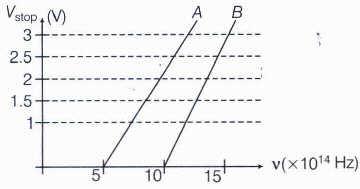
(ii) Given the electric charge of an electron =\(1.6\times { 10 }^{ -19 }C\), find the value of h obtained from the experiment for both A and B.
Comment on whether it is consistent with the Einstein's theory.
4.
An electron, \(\alpha \) -particle and a proton have the same de-Broglie wavelengths. Which of
theseparticle has
(i) minimum kinetic energy?
(ii) maximum kinetic energy and why?
In what way has the wave nature of electron beam exploited in an electron microscope?
5.
Find the de Broglie wavelength associated with an electron moving with velocity 0.6c. Given, rest mass of electron = \(9.1\times { 10 }^{ -31 }kg\) ,\(h=6.63\times { 10 }^{ -34 }Js\)
1.
Stopping potential is more for the curve corresponding to frequency V1
Stopping po ential is directly proportional to the frequency of incident radiation.
2.
(i) Slope is determined by h and e. (or slop is independent of the metal used)
(ii) Work function of the metal.
.png)
3.
Given, thershold frequency of A is
\({ v }_{ OA }=5\times { 1 }0^{ 14 }\quad Hz\)
and thershold frequency of B is \({ v }_{ OB }=10\times { 1 }0^{ 14 }\quad Hz\)
We know that work function,
\({ \phi }_{ 0 }=h{ v }_{ 0 } \ or \ { \phi }_{ 0 }\propto { v }_{ 0 }\)
\(So,\ \frac { { \phi }_{ OA } }{ { \phi }_{ OB } } =\frac { 5\times { 10 }^{ 14 } }{ 10\times { 10 }^{ 14 } } <1 \ \Rightarrow { \phi }_{ OA }<{ \phi }_{ OB }\)
Thus, work function of B is higher than A.
(ii) For metal A, slope
\(=\frac { h }{ e } =\frac { 2 }{ (10-5)\times { 10 }^{ 14 } } \)
\(or \ h=\ \frac { 2\times e }{ 5\times { 10 }^{ 14 } } =\frac { 2\times 1.6\times { 10 }^{ -19 } }{ 5\times { 10 }^{ 14 } } \)
\(=6.4\times { 10 }^{ -34 }\ J-s\)
For metal B, slope \(=\frac { h }{ e } =\frac { 2.5 }{ (15-10)\times { 10 }^{ 14 } } \)
\(\\ or\quad h=\frac { 2.5\times e }{ 5\times { 10 }^{ 14 } } =\frac { 2.5\times 1.6\times { 10 }^{ -19 } }{ 5\times { 10 }^{ 14 } } =8\times { 10 }^{ -34 }J-s\)
Since, the value of b from experiment for metals A and B is different. Hence, experiment is not consistent with theory.
4.
de-Broglie matter wave equation,
\(\lambda =\frac { h }{ p } =\frac { h }{ \sqrt { 2mK } } \ \left[ \because K=\frac { { P }^{ 2 } }{ 2m } \right] \)
where K is kinetic energy and m is a mass of the particle.
\(K=\frac { { h }^{ 2 } }{ 2m{ \lambda }^{ 2 } } \) [ for same wavelength \( \lambda] \)
\(K\propto \frac { 1 }{ m }\)
\(\Rightarrow \ { K }_{ e }:{ K }_{ \alpha }:{ K }_{ p }=\frac { 1 }{ { m }_{ e } } :\frac { 1 }{ { m }_{ \alpha } } :\frac { 1 }{ { m }_{ p } } \)
where \({ m }_{ e },{ m }_{ p } \ and \ { m }_{ \alpha }\) are masses of electron, proton and \(\alpha \) -particle, respectively.
Also, \({ K }_{ e },k_{ p } \ and \ K_{ \alpha }\) are their respective kinetic energies.
\(\because \ m_{ \alpha }>m_{ p }>m_{ e }\)
\(\\ \Rightarrow m_{ \alpha }m_{ p }>m_{ e }m_{ \alpha }>m_{ e }m_{ p }\)
\(\\ { K }_{ e }>k_{ p }>K_{ \alpha }\)
(i) \(\alpha \) particle possess minimum kinetic energy
(ii) The electron has maximum kinetic energy. The magnifying power of an electron microscope is inversely related to the wavelength of radiation used. The Smaller wavelength of the electron beam in comparison to visible light increases the magnifying power of the microscope.
5.
\(Here,{ m }_{ 0 }=9.1\times { 10 }^{ -31 }kg;h=6.63\times { 10 }^{ -34 }Js;v=0.6c \ or \ v/c=0.6\)
Since electron is moving with a speed comparable to the velocity of light, so
\(\lambda =\frac { h }{ mv } =\frac { h\sqrt { 1-{ v }^{ 2 }/{ c }^{ 2 } } }{ { m }_{ 0 }v } =\frac { 6.63\times { 10 }^{ -34 }\sqrt { 1-{ \left( 0.6 \right) }^{ 2 } } }{ 9.1\times { 10 }^{ -31 }\times \left( 0.6\times 3\times { 10 }^{ 8 } \right) } =3.24\times { 10 }^{ -12 }m\)

12th Standard CBSE Syllabus & Materials
12th Standard CBSE
CBSE 12th Computer Science Python Revision Tour I - New Previous year Question Papers Study Material - QB365 Set A
NEW12th Standard CBSE
CBSE 12th Business Studies Planning Important Questions And Answers Study Material - QB365 Set A
NEW12th Standard CBSE
CBSE 12th Business Studies Business Environment Important Questions And Answers Study Material - QB365 Set A
NEW12th Standard CBSE
CBSE 12th Business Studies Principles of Management Important Questions And Answers Study Material - QB365 Set A



NCERT Books

Syllabus

Exam Pattern

Sample Question Papers

Previous year Question Papers

Important Notes

MCQ Practice test

NCERT Exemplers

Case study Questions

Image Based Questions

Passage based Questions

HOT Questions

Value Based Questions

Model Questions Papers
NCERT ( Book Back ) Questions

Assertion and Reason
Important Questions And Answers

CBSE 12th Standard CBSE Subjects
CBSE Standards









