
 100% FREE ACCESS
12th Standard CBSE Syllabus & Materials
12th Standard CBSE
CBSE 12th Economics Government Budget and the Economy Previous year Question Papers Study Material - QB365 Set A
NEW12th Standard CBSE
CBSE 12th Computer Science Interface Python with MySQL - New Previous year Question Papers Study Material - QB365 Set A
NEW12th Standard CBSE
CBSE 12th Computer Science Database Concept - New Previous year Question Papers Study Material - QB365 Set A
NEW12th Standard CBSE
CBSE 12th Computer Science Data Communication - New Previous year Question Papers Study Material - QB365 Set A
NEW12th Standard CBSE
CBSE 12th Computer Science Data Structures - New Previous year Question Papers Study Material - QB365 Set A
NEW12th Standard CBSE
CBSE 12th Computer Science Functions - New Previous year Question Papers Study Material - QB365 Set A

Published on: 23/05/2021
QB365 Provides the updated NCERT Exemplar Questions for Class 12, and also provide the detail solution for each and every case study questions. NCERT Exemplar questions are latest updated question pattern from NCERT, QB365 will helps to get more marks in Exams
Download CBSE Class 12th Standard CBSE Physics question papers, sample papers, important questions, and previous year solved papers in PDF format. Get free study materials, NCERT solutions, and exam preparation resources for Class 12th Standard CBSE Physics
Questions + Answers key
Take MCQ Physics Test1.
Calculate
(i) momentum and
(ii) de-Broglie wavelength of the electron accelerated through a potential difference of 56 V
2.
Find the ratio of the de-Broglie wavelength associated with protons accelerated through a potential of 128 V and a particles accelerated through a potential of 64 V.
To calculate the ratio of de-Baroglie wavelength of two particle find the ratio in terms of symbols and then put the given numerical values.
3.
Draw a graph to show the variation of stopping potential with frequency of radiation incident on a metal plate. How can the value of Planck's constant be determined from this graph?
4.
Consider figure for photoemission. How would you reconcile with momentum conservation? Note light (photons) have momentum in a different direction than the emitted electrons.
5.
(i) In the explanation of photoelectric effect, we assume one photon of frequency v collides with an electron and transfer its energy.This leads to the equation for the maximum energy Emax of the emitted electron as \({ E }_{ max }=hv-{ \phi }_{ 0 }\)
Where \({ \phi }_{ 0 }\)is the work function of metal.If an electron absorbs two photons(each of frequency v) What will be the maximum energy for the emitted electron?
(ii) Why is this fact(two-photon absorption) not taken into consideration in our discussion of the stopping potential?
1.
Protential difference V = 56 V
(i)Use the kinetic energy
eV = 1/2mv2
= 2eV/m
= v2
v = \(\sqrt { \frac { 2eV }{ m } } \)
where m is mass v is velocity
p = mv = m\(\sqrt { \frac { 2eV }{ m } } \)
\(=\sqrt { 2\times 1.6\times 10^{ -19 }\times 56\times 9\times 10^{ -31 } }\)
\( =4.02\times 10^{ -24 }\ kg-m/s\)
2.
de-Broglie wavelength is given by
\(\lambda =\frac { h }{ \sqrt { 2mK } } =\frac { h }{ \sqrt { 2mqV } }\)
\(\lambda \propto \frac { 1 }{ \sqrt { mqV } } \)
m = mass of charge particle, q = charge and V = potential difference
Raio of de-Broglie wavelengths of proton and a-particle is given by
\(\frac { \lambda _{ \alpha } }{ \lambda _{ p } } =\sqrt { \frac { m_{ \alpha }q_{ \alpha }V_{ \alpha } }{ m_{ p }q_{ p }V_{ p } } } =\sqrt { \left( \frac { m_{ \alpha } }{ m_{ p } } \right) \left( \frac { q_{ \alpha } }{ q_{ p } } \right) \left( \frac { V_{ \alpha } }{ V_{ p } } \right) } \)
\(\frac { m_{ \alpha } }{ m_{ p } } =4,\frac { q_{ \alpha } }{ q_{ p } } =2,\frac { V_{ \alpha } }{ V_{ p } } =\frac { 1 }{ 2 } \)
a-particle is 4 toimes heavier than proton and it has double the charge than that of proton
\(\frac { \lambda _{ p } }{ \lambda _{ \alpha } } =\sqrt { 4\times 2\times \frac { 1 }{ 2 } } =2\quad \Rightarrow \lambda _{ p }:\lambda _{ \alpha }=2:1\)
3.
The variation of stopping potential with the frequency of radiation, incident on a metal plate is a straight line AB as shown in the figure.
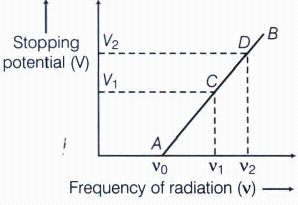
Take two point C and D on the graph.
The corresponding frequency of radiation is v1, v2 and stopping potential is V1,V2.
Then, \(e{ V }_{ 1 }=h{ v }_{ 1 }-{ \phi }_{ 0 }\) and \(e{ V }_{ 2 }=h{ v }_{ 2 }-{ \phi }_{ 0 }\)
\(\therefore \quad e\left( { V }_{ 2 }-{ V }_{ 1 } \right) =h\left( { V }_{ 2 }-{ V }_{ 1 } \right) \) or \(h=\frac { e\left( { V }_{ 2 }-{ V }_{ 1 } \right) }{ { V }_{ 2 }-{ V }_{ 1 } } \)
Thus, Planck's constant can be determined.
4.
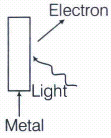
During photelectric emission, the momentum of incident photon is transferred to the metal. At microscopic level, atoms of a metal absorb the photon and its momentum is transferred mainly to the nucleus and electrons.
The excited electron is emitted. Therefore, the conservation of momentum is to be considerd as the momentum of incident photon transferred to the nucleus and electrons.
5.
(i) Here, it is given that, an electron absorbs 2 photons
each of frequency v, then v' = 2v
where, v' is the frequency of emitted electron
Given, \(E_{\max }=h v-\phi_{0}\)
Now, maximum energy for emitted electrons
\(E_{\max }^{\prime}=h(2 v)-\phi_{0}\)
\(=2 h v-\phi_{0}\)
(ii) The probability of absorbing two photons by the same electron is very low.
Hence, such emission will be negligible.

12th Standard CBSE Syllabus & Materials
12th Standard CBSE
CBSE 12th Computer Science Python Revision Tour I - New Previous year Question Papers Study Material - QB365 Set A
NEW12th Standard CBSE
CBSE 12th Business Studies Planning Important Questions And Answers Study Material - QB365 Set A
NEW12th Standard CBSE
CBSE 12th Business Studies Business Environment Important Questions And Answers Study Material - QB365 Set A
NEW12th Standard CBSE
CBSE 12th Business Studies Principles of Management Important Questions And Answers Study Material - QB365 Set A



NCERT Books

Syllabus

Exam Pattern

Sample Question Papers

Previous year Question Papers

Important Notes

MCQ Practice test

NCERT Exemplers

Case study Questions

Image Based Questions

Passage based Questions

HOT Questions

Value Based Questions

Model Questions Papers
NCERT ( Book Back ) Questions

Assertion and Reason
Important Questions And Answers

CBSE 12th Standard CBSE Subjects
CBSE Standards









