
 100% FREE ACCESS
12th Standard CBSE Syllabus & Materials
12th Standard CBSE
CBSE 12th Economics Government Budget and the Economy Previous year Question Papers Study Material - QB365 Set A
NEW12th Standard CBSE
CBSE 12th Computer Science Interface Python with MySQL - New Previous year Question Papers Study Material - QB365 Set A
NEW12th Standard CBSE
CBSE 12th Computer Science Database Concept - New Previous year Question Papers Study Material - QB365 Set A
NEW12th Standard CBSE
CBSE 12th Computer Science Data Communication - New Previous year Question Papers Study Material - QB365 Set A
NEW12th Standard CBSE
CBSE 12th Computer Science Data Structures - New Previous year Question Papers Study Material - QB365 Set A
NEW12th Standard CBSE
CBSE 12th Computer Science Functions - New Previous year Question Papers Study Material - QB365 Set A

Published on: 21/05/2021
QB365 Provides the updated CASE Study Questions for Class 12 , and also provide the detail solution for each and every case study questions . Case study questions are latest updated question pattern from NCERT, QB365 will helps to get more marks in Exams
Download CBSE Class 12th Standard CBSE Physics question papers, sample papers, important questions, and previous year solved papers in PDF format. Get free study materials, NCERT solutions, and exam preparation resources for Class 12th Standard CBSE Physics
Questions + Answers key
Take MCQ Physics Test
1.
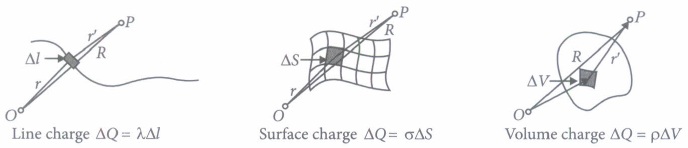
In practice, we deal with charges much greater in magnitude than the charge on an electron, so we can ignore the quantum nature of charges and imagine that the charge is spread in a region in a continuous manner. Such a charge distribution is known as continuous charge distribution. There are three types of continuous charge distribution : (i) Line charge distribution (ii) Surface charge distribution (iii) Volume charge distribution as shown in figure.
(I) Statement 1 : Gauss's law can't be used to calculate electric field near an electric dipole.
Statement 2 : Electric dipole don't have symmetrical charge distribution.
| (a) Statement 1 and statement 2 are true | (b) Statement 1 is false but statement 2 is true |
| (c) Statement 1 is true but statement 2 is false | (d) Both statements are false |
(ii) An electric charge of 8.85 X 10⁻¹³ C is placed at the centre of a sphere of radius 1 m. The electric flux through the sphere is
| (a) 0.2 N C-1 m2 | (b) 0.1 N C-1 m2 | (c) 0.3 N C-1 m2 | (d) 0.01 N C-1 m2 |
(iii) The electric field within the nucleus is generally observed to be linearly dependent on r. So,
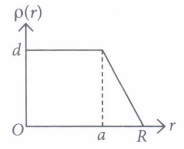
| (a) a=O | \(\text { (b) } a=\frac{R}{2}\) | (c) a=-R | \(\text { (d) } a=\frac{2 R}{3}\) |
(iv) What charge would be required to electrify a sphere of radius 25 cm so as to get a surface charge density of \(\frac{3}{\pi} \mathrm{C} \mathrm{m}^{-2} ?\)
| (a) 0.75 C | (b) 7.5 C | (c) 75 C | (d) zero |
(v) The SI unit of linear charge density is
| (a) Cm | (b) Cm-1 | (c) C m-2 | (d) C m-3 |
2.
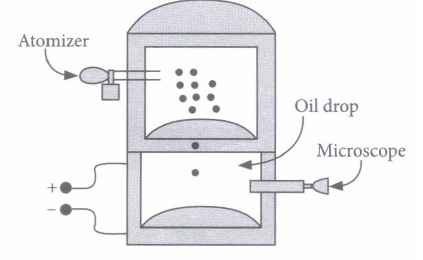
In 1909, Robert Millikan was the first to find the charge of an electron in his now-famous oil-drop experiment. In that experiment, tiny oil drops were sprayed into a uniform electric field between a horizontal pair of oppositely charged plates. The drops were observed with a magnifying eyepiece, and the electric field was adjusted so that the upward force on some negatively charged oil drops was just sufficient to balance the downward force of gravity. That is, when suspended, upward force qE just equaled Mg. Millikan accurately measured the charges on many oil drops and found the values to be whole number multiples of 1.6 x 10⁻¹⁹ C the charge of the electron. For this, he won the Nobel prize.
(i) If a drop of mass 1.08 x 10⁻¹⁴ kg remains stationary in an electric field of 1.68 x 10⁵ N C-I, then the charge of this drop is
| (a) 6.40 x 10⁻¹⁹ C | (b) 3.2 x 10⁻¹⁹ C |
| (c) 1.6 X 10⁻¹⁹ C | (d) 4.8 x 10⁻¹⁹ C |
(ii) Extra electrons on this particular oil drop (given the presently known charge of the electron) are
| (a) 4 | (b) 3 | (c) 5 | (d) 8 |
(iii) A negatively charged oil drop is prevented from falling under gravity by applying a vertical electric field 100 V m-1.If the mass of the drop is 1.6 X 10⁻³ g, the number of electrons carried by the drop is (g= 10 m s-2)
| (a) 1018 | (b) 1015 | (c) 1012 | (d) 109 |
(iv) The important conclusion given by Millikan's experiment about the charge is
| (a) charge is never quantized | (b) charge has no definite value |
| (c) charge is quantized | (d) charge on oil drop always increases. |
(v) If in Millikan's oil drop experiment, charges on drops are found to be \(8 \mu \mathrm{C}, 12 \mu \mathrm{C}, 20 \mu \mathrm{C}\) then quanta of charge is
| \(\text { (a) } 8 \mu \mathrm{C}\) | \(\text { (b) } 20 \mu \mathrm{C}\) | \(\text { (c) } 12 \mu \mathrm{C}\) | \(\text { (d) } 4 \mu \mathrm{C}\) |
1.
(i) (a): Gauss's law is applicable for any closed surface. Gauss's law is most useful in situation where the charge distribution has spherical or cylindrical symmetry or is distributed uniformly over the plane.
Whereas electric dipole is a system of two equal and opposite point charges separated by a very small and finite distance.
So both statements are correct.
(ii) (b): According to Gauss's law, the electric flux through the sphere is
\(\phi=\frac{q_{\mathrm{in}}}{\varepsilon_{0}}=\frac{8.85 \times 10^{-13} \mathrm{C}}{8.85 \times 10^{-12} \mathrm{C}^{2} \mathrm{~N}^{-1} \mathrm{~m}^{-2}}=0.1 \mathrm{~N} \mathrm{C}^{-1} \mathrm{~m}^{2}\)
(iii) (c) : For uniformly volume charge density,
\(E=\frac{\rho r}{3 \varepsilon_{0}}\)
\(E \propto r\)
(iv) (a): r = 25 ern = 0.25 m \(\sigma=\frac{3}{\pi} \mathrm{C} / \mathrm{m}^{2}\)
As, \(\sigma=\frac{q}{4 \pi r^{2}} \Rightarrow q=4 \pi \times(0.25)^{2} \times \frac{3}{\pi}=0.75 \mathrm{C}\)
(v) (b): The line charge density at a point on a line is the charge per unit length of the line at that point
\(\lambda=\frac{d q}{d L}\)
Thus, the SI unit for \(\lambda \text { is } \mathrm{Cm}^{-1} \text {. }\)
2.
(i) (a): As, \(q E=m g \Rightarrow q=\frac{1.08 \times 10^{-14} \times 9.8}{1.68 \times 10^{5}}\)
\(=6.4 \times 10^{-19} \mathrm{C}\)
(ii) (a): \(q=n e \text { or } \Rightarrow n=\frac{6.4 \times 10^{-19}}{1.6 \times 10^{-19}}=4\)
(iii) (c) : For the drop to be stationary,
Force on the drop due to electric field = Weight of the drop
qE=mg
\(q=\frac{m g}{E}=\frac{1.6 \times 10^{-6} \times 10}{100}=1.6 \times 10^{-7} \mathrm{C}\)
Number of electrons carried by the drop is
\(n=\frac{q}{e}=\frac{1.6 \times 10^{-7} \mathrm{C}}{1.6 \times 10^{-19} \mathrm{C}}=10^{12}\)
(iv) (c)
(v) (d): Millikan's experiment confirmed that the charges are quantized, i.e., charges are small integer multiples of the base value which is charge on electron. The charges on the drops are found to be multiple of 4. Hence, the quanta of charge is 4 \(\mu \)C.

12th Standard CBSE Syllabus & Materials
12th Standard CBSE
CBSE 12th Computer Science Python Revision Tour I - New Previous year Question Papers Study Material - QB365 Set A
NEW12th Standard CBSE
CBSE 12th Business Studies Planning Important Questions And Answers Study Material - QB365 Set A
NEW12th Standard CBSE
CBSE 12th Business Studies Business Environment Important Questions And Answers Study Material - QB365 Set A
NEW12th Standard CBSE
CBSE 12th Business Studies Principles of Management Important Questions And Answers Study Material - QB365 Set A



NCERT Books

Syllabus

Exam Pattern

Sample Question Papers

Previous year Question Papers

Important Notes

MCQ Practice test

NCERT Exemplers

Case study Questions

Image Based Questions

Passage based Questions

HOT Questions

Value Based Questions

Model Questions Papers
NCERT ( Book Back ) Questions

Assertion and Reason
Important Questions And Answers

CBSE 12th Standard CBSE Subjects
CBSE Standards








