
 100% FREE ACCESS
12th Standard CBSE Syllabus & Materials
12th Standard CBSE
CBSE 12th Economics Government Budget and the Economy Previous year Question Papers Study Material - QB365 Set A
NEW12th Standard CBSE
CBSE 12th Computer Science Interface Python with MySQL - New Previous year Question Papers Study Material - QB365 Set A
NEW12th Standard CBSE
CBSE 12th Computer Science Database Concept - New Previous year Question Papers Study Material - QB365 Set A
NEW12th Standard CBSE
CBSE 12th Computer Science Data Communication - New Previous year Question Papers Study Material - QB365 Set A
NEW12th Standard CBSE
CBSE 12th Computer Science Data Structures - New Previous year Question Papers Study Material - QB365 Set A
NEW12th Standard CBSE
CBSE 12th Computer Science Functions - New Previous year Question Papers Study Material - QB365 Set A

Published on: 21/05/2021
QB365 Provides the updated CASE Study Questions for Class 12 , and also provide the detail solution for each and every case study questions . Case study questions are latest updated question pattern from NCERT, QB365 will helps to get more marks in Exams
Download CBSE Class 12th Standard CBSE Physics question papers, sample papers, important questions, and previous year solved papers in PDF format. Get free study materials, NCERT solutions, and exam preparation resources for Class 12th Standard CBSE Physics
Questions + Answers key
Take MCQ Physics Test
1.
The electrical capacitance of a conductor is the measure of its ability to hold electric charge. An isolated spherical conductor of radius R. The charge Q is uniformly distributed over its entire surface. It can be assumed to be concentrated at the centre of the sphere. The potential atany point on the surface of the spherical conductor will be \(V=\frac{1}{4 \pi \varepsilon_{0}} \frac{Q}{R}\).
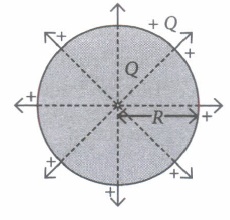
Capacitance of the spherical conductor situated in vacuum is \(C=\frac{Q}{V}=\frac{Q}{\frac{1}{4 \pi \varepsilon_{0}} \cdot \frac{Q}{R}} \text { or } C=4 \pi \varepsilon_{0} R\) Clearly, the capacitance of a spherical conductor is proportional to its radius.
The radius of the spherical conductor of 1F capacitance is R = \(\frac{1}{4 \pi \varepsilon_{0}}\). C and this radius is about 1500 times the radius of the earth \(\left(\sim 6 \times 10^{3} \mathrm{~km}\right)\).
(i) If an isolated sphere has a capacitance 50pF. Then radius is
| (a) 90 ern | (b) 45 cm | (c) 45 m | (d) 90 m |
(ii) How much charge should be placed on a capacitance of 25 pF to raise its potential to l05 V?
| \(\text { (a) } 1 \mu \mathrm{C}\) | \(\text { (b) } 1.5 \mu \mathrm{C}\) | \(\text { (c) } 2 \mu \mathrm{C}\) | \(\text { (d) } 2.5 \mu \mathrm{C}\) |
(iii) Dimensions of capacitance is
| \(\text { (a) }\left[M L^{-2} T^{4} A^{2}\right]\) | \(\text { (b) }\left[\mathrm{M}^{-1} \mathrm{~L}^{-1} \mathrm{~T}^{3} \mathrm{~A}^{1}\right]\) | \(\text { (c) }\left[\mathrm{M}^{-} \mathrm{L}^{-2} \mathrm{~T}^{4} \mathrm{~A}^{2}\right]\) | \(\text { (d) }\left[M^{0} L^{-2} T^{4} A^{1}\right]\) |
(iv) Metallic sphere of radius R is charged to potential V. Then charge q is proportional to
| (a) V | (b) R | (c) both V and R | (d) none of these. |
(v) If 64 identical spheres of charge q and capacitance C each are combined to form a large sphere. The charge and capacitance of the large sphere is
| (a) 64q, C | (b) 16q, 4C | (c) 64q, 4C | (d) 16q, 64C |
2.
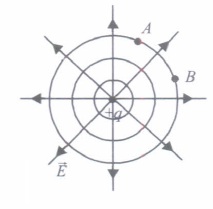
For the various charge systems, we represent equipotential surfaces by curves and line of force by full line curves. Between any two adjacent equipotential surfaces, we assume a constant potential difference the equipotential surfaces of a single point charge are concentric spherical shells with their centres at the point charge. As the lines of force point radially outwards, so they are perpendicular to the equipotential surfaces at all points.
(i) Identify the wrong statement.
| (a) Equipotential surface due to a single point charge is spherical. |
| (b) Equipotential surface can be constructed for dipoles too. |
| (c) The electric field is normal to the equipotential surface through the point. |
| (d) The work done to move a test charge on the equipotential surface is positive |
(ii) Nature of equipotential surface for a point charge is
| (a) Ellipsoid with charge at foci | (b) Sphere with charge at the centre of the sphere |
| (c) Sphere with charge on the surface of the sphere | (d) Plane with charge on the surface |
(iii) A spherical equipotential surface is not possible
| (a) inside a uniformly charged sphere | (b) for a dipole |
| (c) inside a spherical condenser | (d) for a point charge |
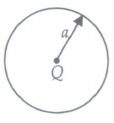
(iv) The work done in carrying a charge q once round a circle of radius a with a charge Q at its centre is
| \(\text { (a) } \frac{q Q}{4 \pi \varepsilon_{0} a}\) | \(\text { (b) } \frac{q Q}{4 \pi \varepsilon_{0} a^{2}}\) |
\(\text { (c) } \frac{q}{4 \pi \varepsilon_{0} a}\) |
(d) zero |
(v) The work done to move a unit charge along an equipotential surface from P to Q
| (a) must be defined as \(-\int_{P}^{Q} \vec{E} \cdot d \vec{l}\) | (b) is zero |
| (c) can have a non-zero value | (d) both (a) and (b) are correct |
3.
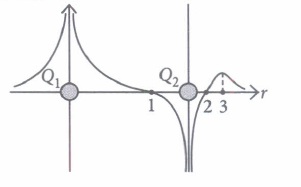
The potential at any observation point P of a static electric field is defined as the work done by the external agent (or negative of work done by electrostatic field) in slowly bringing a unit positive point charge from infinity to the observation point. Figure shows the potential variation along the line of charges. Two point charges Q1 and Q2 lie along a line at a distance from each other.
(i) At which of the points 1, 2 and 3 is the electric field is zero?
| (a) 1 | (b) 2 | (c) 3 | (d) Both (a) and (b) |
(ii) The signs of charges Q1 and Q2 respectively are
| (a) positive and negative | (b) negative and positive |
| (c) positive and positive | (d) negative and negative |
(iii) Which of the two charges Q1 and Q2 is greater in magnitude?
| (a) Q2 | (b) Q1 | (c) Same | (d) Can't determined |
(iv) Which of the following statement is not true?
| (a) Electrostatic force is a conservative force |
| (b) Potential energy of charge q at a point is the work done per unit charge in bringing a charge from any point to infinity |
| (c) When two like charges lie infinite distance apart, their potential energy is zero. |
| (d) Both (a) and (c). |
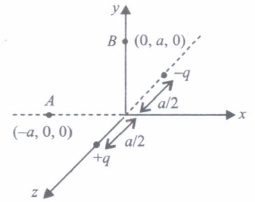
(v) Positive and negative point charges of equal magnitude are kept at \(\left(0,0, \frac{a}{2}\right)\) and \(\left(0,0, \frac{-a}{2}\right)\) respectively.
The work done by the electric field when another positive point charge is moved from (-a, 0, 0) to (0, a, 0) is
| (a) positive |
| (b) negative |
| (c) zero |
| (d) depends on the path connecting the initial and final positions |
1.
(i) (b): Here \(C-50 p F-50 \times 10^{-12} F, V=10^{4} V\)
\(R=\frac{1}{4 \pi \varepsilon_{0}} \cdot C=9 \times 10^{9} \mathrm{mF}^{-1} \times 50 \times 10^{-12} \mathrm{~F}\)
= 45 x 10-2 m = 45 cm
(ii) (d): As \(q=C V=25 \times 10^{-12} \times 10^{5}=2.5 \mu \mathrm{C}\)
(iii) (c)
(iv) (c): As charge \(q=C V=\left(4 \pi \varepsilon_{0} R\right) V\)
\(\therefore\) q depends on both V and R.
(v) (c): 64 drops have formed a single mop of radius R. Volume oflarge sphere = 64 x Volume of small sphere
\(\therefore \frac{4}{3} \pi R^{3}=64 \frac{4}{3} \pi r^{3} \Rightarrow R=4 r \text { and } Q_{\text {total }}=64 q\)
\(C^{\prime}=4 \pi \varepsilon_{0} R \Rightarrow C^{\prime}=\left(4 \pi \varepsilon_{0}\right) \cdot 4 r \Rightarrow C^{\prime}=4 C\)
2.
(i) (d)
(ii) (b)
(iii) (b)
(iv) (d): The electrical potential at any (J) point on circle of radius a due to charge Qa Q.at Its centre I.S V = \(V=\frac{1}{4 \pi \varepsilon_{0}} \frac{Q}{a}\)
It is an equipotential surface.
Hence, work done in carrying a charge q round the circle is zero.
(v) (d): Work done to move a unit charge along an equipotential surface from P to Q,
\(W=-\int_{P}^{Q} \vec{E} \cdot d \vec{l}\)
On equipotential surface \(\vec{E} \perp d \vec{l}\)
\(W=-\int_{P}^{Q} E(d l) \cos 90^{\circ}=0\)
3.
(I) (c) : As \(\frac{-d V}{d r}=E_{r}\) the negative of the slope of V versus r curve represents the component of electric field along r. Slope of curve is zero only at point 3. Therefore, the electric field vector is zero at point 3.
(ii) (a) : Near positive charge, net potential is positive and near a negative charge, net potential is negative. Thus, charge Q1 is positive and Q2 is negative.
(iii) (b) : From the figure, it can be seen that net potential due to two charges is positive everywhere in the region left to charge Q1. Therefore the magnitude of potential due to charge Q1 is greater than due to Q2.
(iv) (b)
(v) (c) : It can be seen that potential at the points both A and B are zero. When the charge is moved from A to B, work done by the electric field on the charge will be zero.

12th Standard CBSE Syllabus & Materials
12th Standard CBSE
CBSE 12th Computer Science Python Revision Tour I - New Previous year Question Papers Study Material - QB365 Set A
NEW12th Standard CBSE
CBSE 12th Business Studies Planning Important Questions And Answers Study Material - QB365 Set A
NEW12th Standard CBSE
CBSE 12th Business Studies Business Environment Important Questions And Answers Study Material - QB365 Set A
NEW12th Standard CBSE
CBSE 12th Business Studies Principles of Management Important Questions And Answers Study Material - QB365 Set A



NCERT Books

Syllabus

Exam Pattern

Sample Question Papers

Previous year Question Papers

Important Notes

MCQ Practice test

NCERT Exemplers

Case study Questions

Image Based Questions

Passage based Questions

HOT Questions

Value Based Questions

Model Questions Papers
NCERT ( Book Back ) Questions

Assertion and Reason
Important Questions And Answers

CBSE 12th Standard CBSE Subjects
CBSE Standards








