
 100% FREE ACCESS
12th Standard CBSE Syllabus & Materials
12th Standard CBSE
CBSE 12th Economics Government Budget and the Economy Previous year Question Papers Study Material - QB365 Set A
NEW12th Standard CBSE
CBSE 12th Computer Science Interface Python with MySQL - New Previous year Question Papers Study Material - QB365 Set A
NEW12th Standard CBSE
CBSE 12th Computer Science Database Concept - New Previous year Question Papers Study Material - QB365 Set A
NEW12th Standard CBSE
CBSE 12th Computer Science Data Communication - New Previous year Question Papers Study Material - QB365 Set A
NEW12th Standard CBSE
CBSE 12th Computer Science Data Structures - New Previous year Question Papers Study Material - QB365 Set A
NEW12th Standard CBSE
CBSE 12th Computer Science Functions - New Previous year Question Papers Study Material - QB365 Set A

Published on: 21/05/2021
QB365 Provides the updated CASE Study Questions for Class 12 , and also provide the detail solution for each and every case study questions . Case study questions are latest updated question pattern from NCERT, QB365 will helps to get more marks in Exams
Download CBSE Class 12th Standard CBSE Physics question papers, sample papers, important questions, and previous year solved papers in PDF format. Get free study materials, NCERT solutions, and exam preparation resources for Class 12th Standard CBSE Physics
Questions + Answers key
Take MCQ Physics Test
1.
A capacitor is a device to store energy. The process of charging up a capacitor involves the transferring of electric charges from its one place to another. This work done in charging the capacitor is stored as its electrical potential energy.
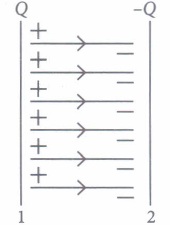
If q is the charge and V is the potential difference across a capacitor at any instant during its charging, then small work done in storing an additional small charge dq against the repulsion of charge q already stored on it is \(d W=V . d q=(q / C) d q\)
(i) A system of 2 capacitors of capacitance \(2 \mu \mathrm{F}\) and \(4 \mu \mathrm{F}\) is connected in series across a potential difference of 6 V. The energy stored in the system is
| \(\text { (a) } 3 \mu \mathrm{J}\) | \(\text { (b) } 24 \mu \mathrm{J}\) | \(\text { (c) } 30 \mu \mathrm{J}\) | \(\text { (d) } 108 \mu \mathrm{J}\) |
(ii) A capacitor of capacitance of \(10 \mu \mathrm{F}\) is charged to 10 V. The energy stored in it is
| \(\text { (a) } 100 \mu \mathrm{J}\) | \(\text { (b) } 500 \mu \mathrm{J}\) | \(\text { (c) } 1000 \mu \mathrm{J}\) | \(\text { (d) } 1 \mu \mathrm{J}\) |
(iii) A parallel plate air capacitor has capacity C farad, potential V volt and energy E joule. When the gap between the plates is completely filled with dielectric
| (a) both V and E increase | (b) both V and E decrease |
| (c) V decreases, E increases | (d) V increases, E decreases |
(iv) A capacitor with capacitance \(5 \mu \mathrm{F}\) is charged to \(5 \mu \mathrm{C}\). If the plates are pulled apart to reduce the capacitance to \(2 \mu \mathrm{F}\),how much work is done?
| \(\text { (a) } 6.25 \times 10^{-6} \mathrm{~J}\) | \(\text { (b) } 3.75 \times 10^{-6} \mathrm{~J}\) | \(\text { (c) } 2.16 \times 10^{-6} \mathrm{~J}\) | \(\text { (d) } 2.55 \times 10^{-6} \mathrm{~J}\) |
(v) A metallic sphere of radius 18 cm has been given a charge of 5 x 10⁻⁶ C. The energy of the charged conductor is
| (a) 0.2 J | (b) 0.6 J | (c) 1.2 J | (d) 2.4 J |
2.
The simplest and the most widely used capacitor is the parallel plate capacitor. It consists of two large plane parallel conducting plates, separated by a small distance.
In the outer regions above the upper plate and below the lower plate, the electric fields due to the two charged plates cancel out. The net field is zero.
In the inner region between the two capacitor plates, the electric fields due to the two charged plates add up. The net field is \(\frac{\sigma}{\varepsilon_{0}}\).
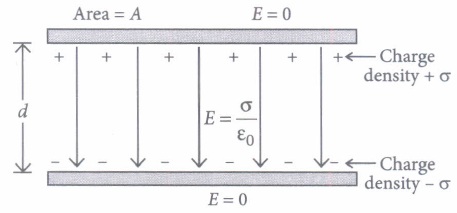
For a uniform electric field, potential difference between the plates = Electric field x distance between the plates. Capacitance of the parallel plate capacitor is, the charge required to supplied to either of the conductors of the capacitor so as to increase the potential difference between then by unit amount.
(i) A parallel plate capacitor is charged and then isolated. The effect of increasing the plate separation on charge, potential and capacitance respectively are
| (a) increases, decreases, decreases | (b) constant, increases, decreases |
| (c) constant, decreases, decreases | (d) constant, decreases, increases |
(ii) In a parallel plate capacitor, the capacity increases if
| (a) area of the plate is decreases | (b) distance between the plates increases |
| (c) area of the plate is increases | (d) dielectric constant decreases |
(iii) A parallel plate capacitor has two square plates with equal and opposite charges. The surface charge densities on the plates are \(+\sigma\) and \(-\sigma\) respectively. In the region between the plates the magnitude of the electric field is
| \(\text { (a) } \frac{\sigma}{2 \varepsilon_{0}}\) | \(\text { (b) } \frac{\sigma}{\varepsilon_{0}}\) | (c) 0 | (d) none of these. |
(iv) If a parallel plate air capacitor consists of two circular plates of diameter 8 cm. At what distance should the plates be held so as to have the same capacitance as that of sphere of diameter 20 cm?
| (a) 9mm | (b) 4mm | (c) 8mm | (d) 2mm |
(v) If a charge of + 2.0 x 10⁻⁸ C is placed on the positive plate and a charge of -1.0 x 10⁻⁸ C on the negative plate of a parallel plate capacitor of capacitance 1.2 x 10⁻³ \(\mu \mathrm{F}\) then the potential difference developed between the plates is
| (a) 6.25 V | (b) 3.0 V | (c) 12.5 V | (d) 25 V |
3.
This energy possessed by a system of charges by virtue of their positions. When two like charges lie infinite distance apart, their potential energy is zero because no work has to be done in moving one charge at infinite distance from the other.
In carrying a charge q from point A to point B, work done \(W=q\left(V_{A}-V_{B}\right)\). This work may appear as change in KE/PE of the charge. The potential energy of two charges q1 and q2 at a distance r in air is \(\frac{q_{1} q_{2}}{4 \pi \varepsilon_{0} r}\). It is measured in joule. It may be positive, negative or zero depending on the signs of ql and q2.
(i) Calculate work done in separating two electrons form a distance of 1m to 2m in air, where e is electric charge and k is electrostatic force constant.
| (a) ke2 | (b) e2/2 | (c) -ke2/2 | (d) zero |
(ii) Four equal charges q each are placed at four corners of a square of side a each. Work done in carrying a charge -q from its centre to infinity is
| (a) zero | \(\text { (b) } \frac{\sqrt{2} q^{2}}{\pi \varepsilon_{0} a}\) | \(\text { (c) } \frac{\sqrt{2} q}{\pi \varepsilon_{0} a}\) | \(\text { (d) } \frac{q^{2}}{\pi \varepsilon_{0} a}\) |
(iii) Two points A and B are located in diametrically opposite directions of a point charge of +2 \(\mu \mathrm{C}\) at distances 2 m and 1 m respectively from it. The potential difference between A and B is
| (a) 3 x 10³ V | (b) 6 x 10⁴ V | (c) -9 X 10³ V | (d) -3 x 10³ V |
(iv) Two point charges A = +3 nC and B = +1 nC are placed 5 ern apart in air. The work done to move charge B towards A by 1 cm is
| (a) 2.0 x 10⁻⁷ J | (b) 1.35 x 10⁻⁷ J | (c) 2.7 X 10⁻⁷ J | (d) 12.1 x 10⁻⁷ J |
(v) A charge Q is placed at the origin. The electric potential due to this charge at a given point in space is V. The work done by an external force in bringing another charge q from infinity up to the point is
| \(\text { (a) } \frac{V}{q}\) | (b) Vq | (c) V + q | (d) V |
4.
For the various charge systems, we represent equipotential surfaces by curves and line of force by full line curves. Between any two adjacent equipotential surfaces, we assume a constant potential difference the equipotential surfaces of a single point charge are concentric spherical shells with their centres at the point charge. As the lines of force point radially outwards, so they are perpendicular to the equipotential surfaces at all points.
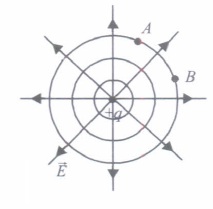
(i) Identify the wrong statement.
| (a) Equipotential surface due to a single point charge is spherical. |
| (b) Equipotential surface can be constructed for dipoles too. |
| (c) The electric field is normal to the equipotential surface through the point. |
| (d) The work done to move a test charge on the equipotential surface is positive |
(ii) Nature of equipotential surface for a point charge is
| (a) Ellipsoid with charge at foci | (b) Sphere with charge at the centre of the sphere |
| (c) Sphere with charge on the surface of the sphere | (d) Plane with charge on the surface |
(iii) A spherical equipotential surface is not possible
| (a) inside a uniformly charged sphere | (b) for a dipole |
| (c) inside a spherical condenser | (d) for a point charge |
(iv) The work done in carrying a charge q once round a circle of radius a with a charge Q at its centre is
| \(\text { (a) } \frac{q Q}{4 \pi \varepsilon_{0} a}\) | \(\text { (b) } \frac{q Q}{4 \pi \varepsilon_{0} a^{2}}\) |
\(\text { (c) } \frac{q}{4 \pi \varepsilon_{0} a}\) |
(d) zero |
(v) The work done to move a unit charge along an equipotential surface from P to Q
| (a) must be defined as \(-\int_{P}^{Q} \vec{E} \cdot d \vec{l}\) | (b) is zero |
| (c) can have a non-zero value | (d) both (a) and (b) are correct |
1.
(i) (b): As, \(C_{1}=2 \mu F, C_{2}=4 \mu F\)
In series combination, the equivalent capacitance will be, \(C=\frac{C_{1} C_{2}}{C_{1}+C_{2}}=\left(\frac{2 \times 4}{2+4}\right) \mu \mathrm{F}=\frac{4}{3} \mu \mathrm{F}\)
Potential difference applied, V = 6 V
Energy stored in the system \(U=\frac{1}{2} C V^{2}\)
\(=\frac{1}{2} \times \frac{4}{3} \times 10^{-6} \times(6)^{2} \mathrm{~J}=24 \mu \mathrm{J}\)
(ii) (b): The energy stored in a capacitor is \(U=\frac{1}{2} C V^{2}=\frac{1}{2} \times\left(10 \times 10^{-6}\right)(10)^{2}=500 \mu \mathrm{J}\)
(iii) (b): When the gap between the plates is completely filled with dielectric of dielectric constant K, then potential is
\(V=\frac{Q d}{A \varepsilon_{0} K}\) ... (i)
and electric field is
\(E=\frac{Q}{A \varepsilon_{0} K}\) ...(ii)
From equations (i) and (ii), both electric field and potential decrease.
(iv) (b): Work done = \(U_{f}-U_{i}=\frac{1}{2} \frac{q^{2}}{C_{f}}-\frac{1}{2} \frac{q^{2}}{C_{i}}\)
\(=\frac{q^{2}}{2}\left[\frac{1}{C_{f}}-\frac{1}{C_{i}}\right]=\frac{\left(5 \times 10^{-6}\right)^{2}}{2}\left[\frac{1}{2 \times 10^{-6}}-\frac{1}{5 \times 10^{-6}}\right]\)
\(=3.75 \times 10^{-6} \mathrm{~J}\)
(v) (b) : Here \(r=18 \mathrm{~cm}=18 \times 10^{-2} \mathrm{~m}, q=5 \times 10^{-6} \mathrm{C}\)
As \(C=4 \pi \varepsilon_{0} r=\frac{18 \times 10^{-2}}{9 \times 10^{9}}=2 \times 10^{-11} \mathrm{~F}\)
Energy of charged conductor is
\(U=\frac{q^{2}}{2 C}=\frac{\left(5 \times 10^{-6}\right)^{2} \mathrm{C}}{2 \times 2 \times 10^{-11} \mathrm{~F} \mid}=0.625 \mathrm{~J}\)
2.
(i) (b): As the capacitor is isolated after charging, charge Q on it remains constant: Plate separation d Increases, capaci.tance decreases as \(C=\frac{\varepsilon_{0} A}{d}\) and hence, potential increases as \(V=\frac{Q}{C}\).
(ii) (c): In a parallel plate capacitor, the capacity of capacitor
\(C=\frac{K \varepsilon_{Q} A}{d} \quad \text { i.e., } C \propto A\)
The capacity of capacitor increases if area of the plate increases.
(iii) (b): The magnitude of the electric field between the plates is E = \(\frac{\sigma}{2 \varepsilon_{0}}-\left(-\frac{\sigma}{2 \varepsilon_{0}}\right)=\frac{\sigma}{\varepsilon_{0}}\)
(IV) (b): As \(\frac{\varepsilon_{0} A}{d}=4 \pi \varepsilon_{0} R \text { or } \frac{\varepsilon_{0} \pi D^{2}}{4 d}=4 \pi \varepsilon_{0} R\)
\(\text { or } \quad d=\frac{D^{2}}{16 R}=\frac{(0.08)^{2}}{16 \times 0.10}=4 \times 10^{-3} \mathrm{~m}=4 \mathrm{~mm}\)
(v) (c): Here \(V=\frac{q_{1}-q_{2}}{2 C}\)
\(=\frac{2.0 \times 10^{-8}+1.0 \times 10^{-8}}{2 \times 1.2 \times 10^{-9}}=12.5 \mathrm{~V}\)
3.
(i) (c): \(W=(\text { P.E. })_{\text {final }}-(\text { P.E. })_{\text {initial }}\)
\(=\frac{k e^{2}}{2}-\frac{k e^{2}}{1}=\frac{-k e^{2}}{2}\)
(ii) (b) : Potential at the centre of the square due to four equal charges q at four corners
\(V=\frac{4 q}{4 \pi \varepsilon_{0}(a \sqrt{2}) / 2}=\frac{\sqrt{2} q}{\pi \varepsilon_{0} a}\)
\(W_{0 \rightarrow \infty}=-W_{\infty \rightarrow 0}=-(-q) V=\frac{\sqrt{2} q^{2}}{\pi \varepsilon_{0} a}\)
(iii) (c): Here, \(q=2 \mu \mathrm{C}=2 \times 10^{-6} \mathrm{C}, r_{A}=2 \mathrm{~m}, r_{B}=1 \mathrm{~m}\)
\(\therefore \ V_{A}-V_{B}=\frac{q}{4 \pi \varepsilon_{0}}\left[\frac{1}{r_{A}}-\frac{1}{r_{B}}\right]\)
\(=2 \times 10^{-6} \times 9 \times 10^{9}\left[\frac{1}{2}-\frac{1}{1}\right] \mathrm{V}=-9 \times 10^{3} \mathrm{~V}\)
(iv)(b) : Required work done = Change in potential energy of the system
\(W=U_{f}-U_{i}=k \frac{q_{1} q_{2}}{r_{f}}-k \frac{q_{1} q_{2}}{r_{i}}=k q_{1} q_{2}\left[\frac{1}{r_{f}}-\frac{1}{r_{i}}\right]\)
\(\therefore \ W=\left(9 \times 10^{9}\right)\left(3 \times 10^{-9} \times 1 \times 10^{-9}\right)\) \(\times\left[\frac{1}{4 \times 10^{-2}}-\frac{1}{5 \times 10^{-2}}\right]\)
\(=27 \times 10^{-7} \times(0.05)=1.35 \times 10^{-7} \mathrm{~J}\)
(v) (b)
4.
(i) (d)
(ii) (b)
(iii) (b)
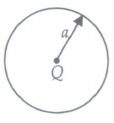
(iv) (d): The electrical potential at any (J) point on circle of radius a due to charge Qa Q.at Its centre I.S V = \(V=\frac{1}{4 \pi \varepsilon_{0}} \frac{Q}{a}\)
It is an equipotential surface.
Hence, work done in carrying a charge q round the circle is zero.
(v) (d): Work done to move a unit charge along an equipotential surface from P to Q,
\(W=-\int_{P}^{Q} \vec{E} \cdot d \vec{l}\)
On equipotential surface \(\vec{E} \perp d \vec{l}\)
\(W=-\int_{P}^{Q} E(d l) \cos 90^{\circ}=0\)

12th Standard CBSE Syllabus & Materials
12th Standard CBSE
CBSE 12th Computer Science Python Revision Tour I - New Previous year Question Papers Study Material - QB365 Set A
NEW12th Standard CBSE
CBSE 12th Business Studies Planning Important Questions And Answers Study Material - QB365 Set A
NEW12th Standard CBSE
CBSE 12th Business Studies Business Environment Important Questions And Answers Study Material - QB365 Set A
NEW12th Standard CBSE
CBSE 12th Business Studies Principles of Management Important Questions And Answers Study Material - QB365 Set A



NCERT Books

Syllabus

Exam Pattern

Sample Question Papers

Previous year Question Papers

Important Notes

MCQ Practice test

NCERT Exemplers

Case study Questions

Image Based Questions

Passage based Questions

HOT Questions

Value Based Questions

Model Questions Papers
NCERT ( Book Back ) Questions

Assertion and Reason
Important Questions And Answers

CBSE 12th Standard CBSE Subjects
CBSE Standards








