
 100% FREE ACCESS
12th Standard CBSE Syllabus & Materials
12th Standard CBSE
CBSE 12th Economics Government Budget and the Economy Previous year Question Papers Study Material - QB365 Set A
NEW12th Standard CBSE
CBSE 12th Computer Science Interface Python with MySQL - New Previous year Question Papers Study Material - QB365 Set A
NEW12th Standard CBSE
CBSE 12th Computer Science Database Concept - New Previous year Question Papers Study Material - QB365 Set A
NEW12th Standard CBSE
CBSE 12th Computer Science Data Communication - New Previous year Question Papers Study Material - QB365 Set A
NEW12th Standard CBSE
CBSE 12th Computer Science Data Structures - New Previous year Question Papers Study Material - QB365 Set A
NEW12th Standard CBSE
CBSE 12th Computer Science Functions - New Previous year Question Papers Study Material - QB365 Set A

Published on: 27/05/2021
CBSE 12th Standard Physics Subject Electrostatic Potential And Capacitance HOT Questions 2 Mark Questions With Solution 2021
Download CBSE Class 12th Standard CBSE Physics question papers, sample papers, important questions, and previous year solved papers in PDF format. Get free study materials, NCERT solutions, and exam preparation resources for Class 12th Standard CBSE Physics
Questions + Answers key
Take MCQ Physics Test
1.
An electric dipole is held in an uniform electric field. Using suitable diagram, show at it doesn't undergo any translatory motion, and (ii) derive an expression for torque acting on it and specify its direction.
2.
Two Capacitors of capacitace 6\(\mu \)F and 12\(\mu \)F ae connnected in series with tha battery the volatage across the 6\(\mu \)F capacitor is 2 volt, Compute the total battery voltage.
3.
A charged Particle q is shot towards another charged particle Q which is fixed , with a speed v. It approaches Q up to a closet distance r and then returns, If q were given a speed 2 v the n find the closet distance of approach.
4.
A thin fixed ring of radius 2 m has a positive charge of 10-6C uniformly distributed over it. A particle of mass 0.9 g and having a negative charge 10-7C is placed on the axis at a distance of 2cm from the center of the ring. Show that motion of the negatively charged particle is approximately SHM. Calculate the time period of oscillation.
5.
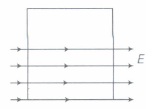
A square surface of side l metre is in the plane of paper. A uniform electric field E (volt/metre), also in the plane of the paper, is limited only to the lower half of the square surface, (see figure). What is the electric flux associated with this surface?
1.
(i) Dipole has two equal and opposite charges. In the uniform electric field they will experience equal and opposite force. Net force is zero, So there can't be any translatory motion
(ii) Torque \(\tau \)F = 21 sin \(\theta\) qE = p x E
2.
V = V1 + V2
Q = C1V = 6 x 10-6 x 2 = 12\(\mu \)C
As C2 is in series same amount of charge will also flow through it now V2 = Q/C2 = (12 x 10-6) /(12 x 10-6) = 1 volt
Total Battery voltage, V = 2 + 1 = 3 Volt
3.
q \(\rightarrow\)_______Q
1/2 mv2 = kQq/r
Or, v2 a1/r
Or, r a 1/v2
Or, r' = r/4
4.
\(Given,radius\ of\ ring,r=2m,{ q }_{ 1 }={ 10 }^{ -6 }C\)
\({ q }_{ 2 }={ 10 }^{ -7 }C,m=9\times { 10 }^{ -4 }kg\)
\(l=2cm=0.02m,T=?\)
\(Force\ on\ particle\ is\ given\ by\)
\(F=\frac { { q }_{ 1 }{ q }_{ 2 }l }{ 4\pi { \varepsilon }_{ 0 }{ ({ l }^{ 2 }+{ r }^{ 2 }) }^{ 2 } } =\frac { (9\times { 10 }^{ 9 })({ 10 }^{ -6 }){ 10 }^{ -7 })l }{ ({ 4+0.0004 })^{ 3/2 } } \)
\(=\frac { 9\times { 10 }^{ -4 }l }{ 8.001 } =1.125\times { 10 }^{ -4 }l\)
\(As,acceleration,a=\frac { F }{ m } =\frac { 1.125\times { 10 }^{ -4 }l }{ 9{ \times 10 }^{ -4 } } \)
\(Thus,the\ motion\ of\ particle\ is\ SHM.\)
\(Now,\ thime\ period\ of\ oscillation\ of\ particle\ is\quad given\ by\)
\(T=2\pi \sqrt { \frac { l }{ a } } =2\pi \sqrt { \frac { l }{ 0.125l } } \Rightarrow 17.7s\)
5.
Electric flux \(\phi\) is a measure of number of field lines crossing a surface. The number of field lines passing through unit area (N / S) will be proportional to the electric field, i.e. N / S \(\propto \) E \(\Rightarrow\) N \(\propto \) ES
The quantity ES is the electric flux through surface S. As in the given question, the field lines that enter the closed surface leave the surface immediately, so the net electric flux is bound to the system. Thus, electric flux is zero.

12th Standard CBSE Syllabus & Materials
12th Standard CBSE
CBSE 12th Computer Science Python Revision Tour I - New Previous year Question Papers Study Material - QB365 Set A
NEW12th Standard CBSE
CBSE 12th Business Studies Planning Important Questions And Answers Study Material - QB365 Set A
NEW12th Standard CBSE
CBSE 12th Business Studies Business Environment Important Questions And Answers Study Material - QB365 Set A
NEW12th Standard CBSE
CBSE 12th Business Studies Principles of Management Important Questions And Answers Study Material - QB365 Set A



CBSE 12th Standard CBSE Subjects
CBSE Standards










