
 100% FREE ACCESS
12th Standard CBSE Syllabus & Materials
12th Standard CBSE
CBSE 12th Economics Government Budget and the Economy Previous year Question Papers Study Material - QB365 Set A
NEW12th Standard CBSE
CBSE 12th Computer Science Interface Python with MySQL - New Previous year Question Papers Study Material - QB365 Set A
NEW12th Standard CBSE
CBSE 12th Computer Science Database Concept - New Previous year Question Papers Study Material - QB365 Set A
NEW12th Standard CBSE
CBSE 12th Computer Science Data Communication - New Previous year Question Papers Study Material - QB365 Set A
NEW12th Standard CBSE
CBSE 12th Computer Science Data Structures - New Previous year Question Papers Study Material - QB365 Set A
NEW12th Standard CBSE
CBSE 12th Computer Science Functions - New Previous year Question Papers Study Material - QB365 Set A

Published on: 27/05/2021
QB365 Provides the HOT Question Papers for Class 12 Physics, and also provide the detail solution for each and every HOT Questions. HOT Questions will help to get more idea about question pattern in every exams and also will help to get more marks in Exams
Download CBSE Class 12th Standard CBSE Physics question papers, sample papers, important questions, and previous year solved papers in PDF format. Get free study materials, NCERT solutions, and exam preparation resources for Class 12th Standard CBSE Physics
Questions + Answers key
Take MCQ Physics Test1.
(i) How is the electric field due to a charged parallel plate capacitor affected, when a dielectric slab is inserted between the plates fully occupying the intervening region?
(ii) A slab of material of dielectric constant K has the same area as the plates of a parallel plate capacitor but has thickness \(\frac{1}{2}\) d, where d is the separation between the plates. Find the expression for the capacitance when the slab is inserted between the plates.
2.
A charge Q is distributed over two concentric hollow shaperes of radii r and R( > r) such that their surface densities are equal. Find the potential at the common centre.
3.
An electricdipole consists of two opposite charges each of magnitude 1.0\(\times\)10-6C separated by 2cm. The dipole is placed in an external uniform field of 1\(\times\)105 N/C. Find
(i) the maximum torque exterted by the field on the dipole
(ii) the work which an external agent will have to do in turning the dipole through 1800 starting the position, \(\theta\) = 00.
4.
Two charges +Q and -Q are kept at points (-x2, 0) and (x1, 0) respectively, in the XY-plane. Find the magnitude and direction of the net electric field at the origin (0, 0).
5.
Three capacitors of 1\(\mu F\), 2\(\mu F\) and 3\(\mu F\) are joined in series.
(i) How many times will the capacity become when they are joined in parallel?
(ii) Determine the charge supplied by the battery of 100 V to the maximum resultant capacitor among both the arrangement.
1.
(i) The total charge of the capacitor remains conserved on introduction of dielectric slab. Also, the capacitance of capacitor increases to K times of original values.
\(\therefore \\ \) CV = C' V '= (KC) V' \(\Rightarrow V'=\frac { V }{ K } \)
\(\therefore \\ \) New electric field,
\(E'=\frac { V' }{ d } =\left( { \frac { { V }/{ K } }{ d } } \right) =\left( \frac { V }{ d } \right) \frac { 1 }{ k } =\frac { E }{ K } \)
\(\therefore \\ \) On introduction of dielectric medium, new electric field E' becomes \(\frac { 1 }{ K } \) times of its original value (decrease).
(ii) The thickness of dieletric slab is \(\frac{d}{2}, \text { i.e. } t=\frac{d}{2}\)
The capacitance of a capacitor due to dielectric slab,
\(\begin{aligned}
C & =\frac{\varepsilon_0 A}{d-t+\frac{t}{K}}
\end{aligned}\)
\(\begin{aligned}
=\frac{\varepsilon_0 A}{d-\frac{d}{2}+\frac{d}{2 K}}=\frac{2 \varepsilon_0 A}{d\left(1+\frac{1}{K}\right)}
\end{aligned}\)
2.
Let q1 and q2 be the charges on them
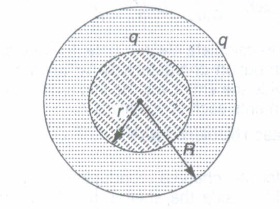
\(\sigma_1\) = \(\sigma_2\)
\(\therefore \ \frac{q_{1}}{4 \pi r^{2}}=\frac{q_{2}}{4 \pi R^{2}}\)
\(\therefore \ \frac{q_{1}}{q_{2}}=\frac{r^{2}}{R^{2}}\)
i.e. charge on them is distributed in above ratio or \(q_{1}=\frac{r^{2}}{r^{2}+R^{2}} Q \ \text { and } q_{2}=\frac{R^{2}}{r^{2}+R^{2}} Q\)
\(\therefore\) Potential at.centre
V = Potential due to q1 + Potential due to q 2
\(\therefore \ V=\frac{1}{4 \pi \varepsilon_{0}} \cdot \frac{q_{1}}{r}+\frac{1}{4 \pi \varepsilon_{0}} \cdot \frac{q_{2}}{R}=\frac{Q(R+r)}{4 \pi \varepsilon_{0}\left(r^{2}+R^{2}\right)}\)
3.
\(Here,q=1\times { 10 }^{ -6 }C,2a=2cm=0.02m\)
\(\therefore p=q\times 2a=(1\times { 10 }^{ -6 })\times 0.02=2\times { 10 }^{ -8 }cm\)
Intensity of the external electric field, E \(=1.0\times { 10 }^{ 5 }N/C\)
\((i){ \tau }_{ max }=pE=(2\times { 10 }^{ -8 })(1.0\times { 10 }^{ 5 })=2\times { 10 }^{ -3 }N-m\ (1)\)
(ii) Net work done in turning the dipole from \(\ 0^0\ to\ 180^0,\)
\( i.e \ W={ \int { _{ { 0 }^{ 0 } }^{ { 180 }^{ 0 } } } }\tau d\theta =\int { _{ { 0 }^{ 0 } }^{ { 180 }^{ 0 } } } pEsin\theta =pE{ [-cos\theta ] }_{ { 0 }^{ 0 } }^{ { 180 }^{ 0 } }\)
\(=-pE(cos{ 180 }^{ 0 }-cos{ 0 }^{ 0 })=2pE\)
\(=2\times (2\times { 10 }^{ -8 })(1\times { 10 }^{ 5 })J=4\times { 10 }^{ -3 }J\ (11/2)\)
4.
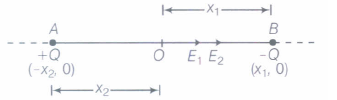
Electric field intensity at Point O due to + Q charge,
\({ E }_{ 1 }=\frac { 1 }{ 4\pi { \varepsilon }_{ o } } \times \frac { Q }{ { \left( { x }_{ 2 } \right) }^{ 2 } } (towards \ B) .....(i)\)
Electric field intensity at Point O due to - Q charge,
\({ E }_{ 2 }=\frac { 1 }{ 4\pi { \varepsilon }_{ o } } \times \frac { Q }{ { \left( { x }_{ 1 } \right) }^{ 2 } } (towards \ B).....(i)\)
\({ \because }\) E1 and E2 act along the same direction.
\({ \because }\) Net electric field intensity at point O,
\(E={ E }_{ 1 }+{ E }_{ 2 }=\frac { 1 }{ 4\pi { \varepsilon }_{ o } } \times \frac { Q }{ { \left( { x }_{ 2 } \right) }^{ 2 } } +\frac { 1 }{ 4\pi { \varepsilon }_{ o } } \times \frac { Q }{ { \left( { x }_{ 1 } \right) }^{ 2 } } (towards \ B)\)
\( E=\frac { Q }{ 4\pi { \varepsilon }_{ o } } \left[ \frac { 1 }{ { x }_{ 2 }^{ 2 } } +\frac { 1 }{ { x }_{ 1 }^{ 2 } } \right] \)
5.
(i) Given, C1 = 1\(\mu F\) C2 = 2\(\mu F\) C3 = 3\(\mu F\)
The combined capacity (Cs) in series combination is given by
\(\frac { 1 }{ { C }_{ s } } =\frac { 1 }{ { C }_{ 1 } } +\frac { 1 }{ { C }_{ 2 } } +\frac { 1 }{ { C }_{ 3 } } =\frac { 1 }{ 1 } +\frac { 1 }{ 2 } +\frac { 1 }{ 3 } =\frac { 11 }{ 6 } \)
\(\Rightarrow { C }_{ s }=\frac { 6 }{ 11 } \mu F\)
The combined capacity (Cp) in parallel combination is given by
Cp = C1 + C2 +C3 = 1 + 2 + 3 = 6\(\mu F\)
\(\Rightarrow { C }_{ p }=11{ C }_{ s }\)
(ii) As, \({ \ C }_{ p }>{ C }_{ s }\)
\(\therefore \) The charge supplied by 100 V battery
\({ q }_{ p }={ C }_{ p }V=6\mu F\times 100=6\times { 10 }^{ -6 }\times 100\)
\(\\ { q }_{ p }=6\times { 10 }^{ -4 }C\)= 600 \(\mu\)C

12th Standard CBSE Syllabus & Materials
12th Standard CBSE
CBSE 12th Computer Science Python Revision Tour I - New Previous year Question Papers Study Material - QB365 Set A
NEW12th Standard CBSE
CBSE 12th Business Studies Planning Important Questions And Answers Study Material - QB365 Set A
NEW12th Standard CBSE
CBSE 12th Business Studies Business Environment Important Questions And Answers Study Material - QB365 Set A
NEW12th Standard CBSE
CBSE 12th Business Studies Principles of Management Important Questions And Answers Study Material - QB365 Set A



NCERT Books

Syllabus

Exam Pattern

Sample Question Papers

Previous year Question Papers

Important Notes

MCQ Practice test

NCERT Exemplers

Case study Questions

Image Based Questions

Passage based Questions

HOT Questions

Value Based Questions

Model Questions Papers
NCERT ( Book Back ) Questions

Assertion and Reason
Important Questions And Answers

CBSE 12th Standard CBSE Subjects
CBSE Standards









