
 100% FREE ACCESS
12th Standard CBSE Syllabus & Materials
12th Standard CBSE
CBSE 12th Economics Government Budget and the Economy Previous year Question Papers Study Material - QB365 Set A
NEW12th Standard CBSE
CBSE 12th Computer Science Interface Python with MySQL - New Previous year Question Papers Study Material - QB365 Set A
NEW12th Standard CBSE
CBSE 12th Computer Science Database Concept - New Previous year Question Papers Study Material - QB365 Set A
NEW12th Standard CBSE
CBSE 12th Computer Science Data Communication - New Previous year Question Papers Study Material - QB365 Set A
NEW12th Standard CBSE
CBSE 12th Computer Science Data Structures - New Previous year Question Papers Study Material - QB365 Set A
NEW12th Standard CBSE
CBSE 12th Computer Science Functions - New Previous year Question Papers Study Material - QB365 Set A

Published on: 23/05/2021
QB365 Provides the updated NCERT Exemplar Questions for Class 12, and also provide the detail solution for each and every case study questions. NCERT Exemplar questions are latest updated question pattern from NCERT, QB365 will helps to get more marks in Exams
Download CBSE Class 12th Standard CBSE Physics question papers, sample papers, important questions, and previous year solved papers in PDF format. Get free study materials, NCERT solutions, and exam preparation resources for Class 12th Standard CBSE Physics
Questions + Answers key
Take MCQ Physics Test1.
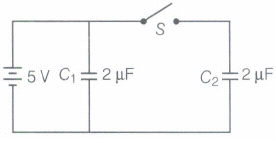
Figure shows two identical capacitors C1 and C2 ,each of 2\(\mu\) F capacitance, connected to a battery of 5 V. Initially switch S is closed. After sometimes, S is left open and dielectric slabs of dielectric constant K = 5 are inserted to fill completely the space between the plates of the two capacitors.How will the
(i) charge and
(ii) potential difference between the plates of the capacitors be affected after the slabs are inserted?
2.
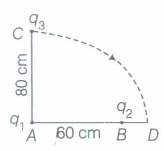
Two charges q1 = +2 x 10⁻⁸ C and q2 = -0.4 x 10⁻⁸ C are placed 60 cm about, as shown in the figure. A third charge q3 = 0.2 x 10⁻⁸ C is moved along the arc of a circle of radius 80 cm from C to D. Compute the percentage change in the energy of the system.
3.
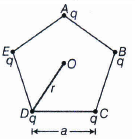
Five charges q each are placed at the corners of regular pentagon of side a as shown in the figure
(i) What wil be the electric field at O,the centre of the pentagon?
(b) what will be the electric field at O,if the charge from one of the corners(A) is removed?
(c) What will be electric field at O,if the charge q at A is replaced by -q?
(ii) How would your answer polygon with charge q at each of its corners?
4.
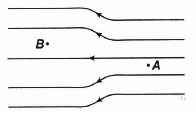
In the figure below the electric field lines on the left have twice the separation of those on the right.
(i) If the magnitude of the field of A is 40 N/C then what force acts on a proton at A?
(ii) What is the magnitude of the field at B?
5.
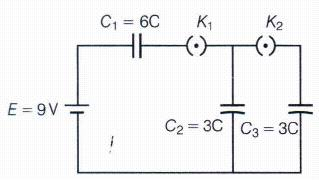
In the circuit shown in figure, initially K1 is closed and K2 is opened. What are the charges on each of the capacitors? If K1 was opened and K2 was closed (order is important), what will be the charge on each capacitor now?
[Given, C = 1\(\mu F\)]
1.
Two identical capacitors C1 and C2 get fully charged with 5 V battery initially.
So, the charge and potential difference on both capacitors becomes
q = CV
= 2 x 10-6 x 5 V = 10\(\mu \)C
and V = 5 V
On introduction of dielectric medium of K = 5.
For C1 (Continue to be connected with battery)
Potential difference of C1 , V' = 5 V
Capacitance C'1 = KC = 5 x 2 = 10\(\mu \)F
Charge q' = C1' V' = 10 x 5 = 50\(\mu \)C
For C2 (Disconnected with battery)
Charge, q' = q = 10\(\mu \)C
\(\therefore\) Potential difference, V' = \(\frac { V }{ K } =\frac{5}{5}=1 V\)
2.
Initially, the charge q3 is at C. Its distances from q1 and q2 are r13 = 80 cm = 0.80 m and r23 =\(\sqrt { { 80 }^{ 2 }+{ 60 }^{ 2 }=100\quad cm } \)
\(\\ =1.0m\)
Hence, the initial potential energy of the system is
\({ U }_{ i }=\frac { 1 }{ { 4\pi \varepsilon }_{ 0 } } \left[ \frac { { q }_{ 1 }{ q }_{ 2 } }{ { r }_{ 13 } } +\frac { { q }_{ 2 }{ q }_{ 3 } }{ { r }_{ 23 } } \right] =\frac { { q }_{ 3 } }{ { 4\pi \varepsilon }_{ 0 } } \left[ \frac { { q }_{ 1 } }{ { r }_{ 13 } } +{ \frac { { q }_{ 2 } }{ { r }_{ 23 } } } \right] \)
\(\\ =\frac { { q }_{ 3 } }{ { 4\pi \varepsilon }_{ 0 } } \left[ \frac { { 2x10 }^{ -8 } }{ 0.8 } -\frac { { 0.4x10 }^{ -8 } }{ 1.0 } \right]\)
\( \\ =\frac { { q }_{ 3 } }{ { 4\pi \varepsilon }_{ 0 } } x2.1x{ 10 }^{ -8 }\)
When the charge q3 is moved to D, its distances from q2 and q3 are
r13 = 80 cm = 0.8 m and r23 = 20 cm = 0.2 m
Thus, the final potential energy of the system is
\({ U }_{ f }=\frac { { q }_{ 3 } }{ { 4\pi \varepsilon }_{ 0 } } \left[ \frac { { 2x10 }^{ -8 } }{ 0.8 } -\frac { { 0.4x10 }^{ -8 } }{ 0.2 } \right]\)
\( \\ \therefore Decrease\ in\ energy\ of\ the\ system={ U }_{ i }-{ U }_{ f }\)
\(\\ =\frac { { q }_{ 3 } }{ { 4\pi \varepsilon }_{ 0 } } x(2.1x{ 10 }^{ -8 })-\frac { { q }_{ 3 } }{ { 4\pi \varepsilon }_{ 0 } } \left( \frac { { 2x10 }^{ -8 } }{ 0.8 } -\frac { { 0.4x10 }^{ -8 } }{ 0.2 } \right)\)
\( \\ =\frac { { q }_{ 3 } }{ { 4\pi \varepsilon }_{ 0 } } \left[ (2.1x{ 10 }^{ -8 })-\left( \frac { { 2x10 }^{ -8 } }{ 0.8 } -\frac { { 0.4x10 }^{ -8 } }{ 0.2 } \right) \right]\)
\( \\ =\frac { { q }_{ 3 } }{ { 4\pi \varepsilon }_{ 0 } } x1.6x{ 10 }^{ 18 }\)
\(\\ Percentage\ decrease=\frac { { 1.6x10 }^{ -8 } }{ { 2.1x10 }^{ -8 } } =100=76.2%\\ \)
3.
(a) The point O is equidistant from all the charges at the end points of pentagon.
(b) When charge q is removed from A electric field at O
E = \(\frac { q\times 1 }{ 4\pi \varepsilon _{ \circ }r^{ 2 } } \)
(c) If charge q at A is replaced by -q then it add chage -2q so electric field become E = \(\frac { 2q }{ 4\pi \varepsilon _{ \circ }r^{ 2 } } \)
(ii) when pentagon is replaced by n-side regular polygon with charge q at each of its corners, the electric field at O would continue to be zero as symmetricity of the charge.
4.
(i) Charge of proton q = 1.6 x 10⁻¹⁹C
Force on proton at A is F = qEA
= (1.6 x 10⁻¹⁹C) (40 N / C)
= 6.4 x 10⁻¹⁸N
(ii) Since, electric field,
E\(\propto \) Number of electric field lines/Area
Hence, EB = 1/2 EA
= 1/2(40 N / c)
= 20 N / C.
5.
In the circuit, when initially K 1 is closed and K2 is opened, the capacitors C1 and C2 acquire potential difference V1 and V2, respectively. So we have
V1 + V2 = E
and V1 + V2 = 9V
Also, in series combination,\(V \propto 1 / C\)
V1 : V2 = (1/6) : (1/3)
On solving,
\(\Rightarrow \) V1 = 3 V and V2 = 6V
\(\therefore \) Q1 = C1 V1 = 6\(\mu\) F x 3 V
= 18\(\mu\) C [\(\because\) C = 1 \(\mu\)F]
\(\Rightarrow\) Q2 = C2V2
= 3\(\mu\)F x 6V = 18\(\mu\)C
and Q3 = 0
When, K1 was opened and K2 was closed, the parallel combination of C2 and C3 is in series with C1 .
[Charge on C1 remains unchanged]
i.e. Q'1 = Q2= \(18\mu C\)
Charge on C2 is shared between C2 and C3 in parallel.
As, C2 = C3
\(\therefore\) \(Q_{2}^{\prime}=Q_{2}=\frac{Q_{2}}{2}=\frac{18}{2}=9 \mu \mathrm{C}\)
[\(\because\) Q2 = 18 \(\mu\)C]

12th Standard CBSE Syllabus & Materials
12th Standard CBSE
CBSE 12th Computer Science Python Revision Tour I - New Previous year Question Papers Study Material - QB365 Set A
NEW12th Standard CBSE
CBSE 12th Business Studies Planning Important Questions And Answers Study Material - QB365 Set A
NEW12th Standard CBSE
CBSE 12th Business Studies Business Environment Important Questions And Answers Study Material - QB365 Set A
NEW12th Standard CBSE
CBSE 12th Business Studies Principles of Management Important Questions And Answers Study Material - QB365 Set A



NCERT Books

Syllabus

Exam Pattern

Sample Question Papers

Previous year Question Papers

Important Notes

MCQ Practice test

NCERT Exemplers

Case study Questions

Image Based Questions

Passage based Questions

HOT Questions

Value Based Questions

Model Questions Papers
NCERT ( Book Back ) Questions

Assertion and Reason
Important Questions And Answers

CBSE 12th Standard CBSE Subjects
CBSE Standards









