
 100% FREE ACCESS
12th Standard CBSE Syllabus & Materials
12th Standard CBSE
CBSE 12th Economics Government Budget and the Economy Previous year Question Papers Study Material - QB365 Set A
NEW12th Standard CBSE
CBSE 12th Computer Science Interface Python with MySQL - New Previous year Question Papers Study Material - QB365 Set A
NEW12th Standard CBSE
CBSE 12th Computer Science Database Concept - New Previous year Question Papers Study Material - QB365 Set A
NEW12th Standard CBSE
CBSE 12th Computer Science Data Communication - New Previous year Question Papers Study Material - QB365 Set A
NEW12th Standard CBSE
CBSE 12th Computer Science Data Structures - New Previous year Question Papers Study Material - QB365 Set A
NEW12th Standard CBSE
CBSE 12th Computer Science Functions - New Previous year Question Papers Study Material - QB365 Set A

Published on: 23/05/2021
QB365 Provides the updated NCERT Exemplar Questions for Class 12, and also provide the detail solution for each and every case study questions. NCERT Exemplar questions are latest updated question pattern from NCERT, QB365 will helps to get more marks in Exams
Download CBSE Class 12th Standard CBSE Physics question papers, sample papers, important questions, and previous year solved papers in PDF format. Get free study materials, NCERT solutions, and exam preparation resources for Class 12th Standard CBSE Physics
Questions + Answers key
Take MCQ Physics Test1.
(a) A comb run through one’s dry hair attracts small bits of paper. Why?
What happens if the hair is wet or if it is a rainy day? (Remember, a paper does not conduct electricity.)
(b) Ordinary rubber is an insulator. But special rubber tyres of aircraft are made slightly conducting. Why is this necessary?
(c) Vehicles carrying inflammable materials usually have metallic ropes touching the ground during motion. Why?
(d) A bird perches on a bare high power line, and nothing happens to the bird. A man standing on the ground touches the same line and gets a fatal shock. Why?
2.
(a) Determine the electrostatic potential energy of a system consisting of two charges 7 μC and –2 μC (and with no external field) placed at (–9 cm, 0, 0) and (9 cm, 0, 0) respectively.
(b) How much work is required to separate the two charges infinitely away from each other?
(c) Suppose that the same system of charges is now placed in an external electric field E = A (1/r 2); A = 9 x 10⁵ NC-1 m2. What would the electrostatic energy of the configuration be?
3.
Figures (a) and (b) show the field lines of a positive and negative point charge respectively
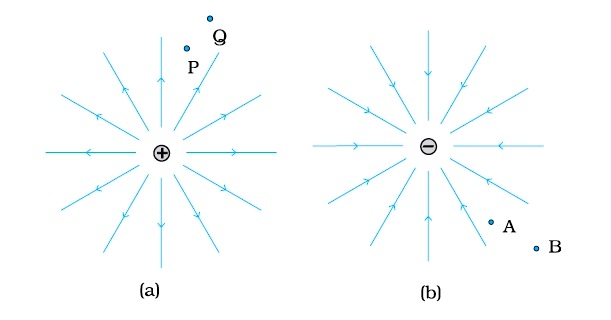
(a) Give the signs of the potential difference VP – VQ; VB – VA.
(b) Give the sign of the potential energy difference of a small negative charge between the points Q and P; A and B.
(c) Give the sign of the work done by the field in moving a small positive charge from Q to P.
(d) Give the sign of the work done by the external agency in moving a small negative charge from B to A.
(e) Does the kinetic energy of a small negative charge increase or decrease in going from B to A?
4.
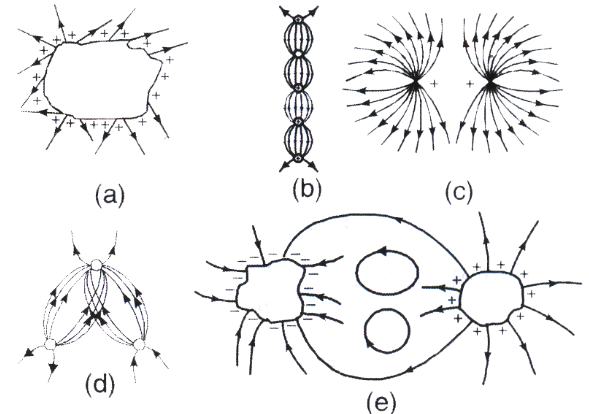
Which of the following figures cannot possibly represent electrostatic field lines?
5.
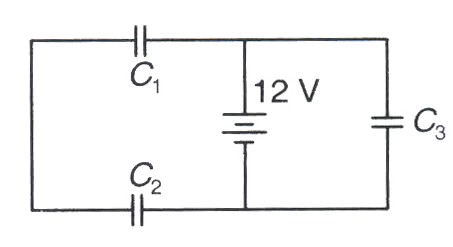
Three identical capacitors C1,C2 and C3 of capacitance \(6\mu F\) each are connected to a 12V battery as shown. Find charge on each capacitor
Find
(i) the charge on each capacitor
(ii) the equivalent capacitances of the network
(iii) the energy stored in the network of capacitors.
1.
(a) This is because the comb gets charged by friction. The molecules in the paper gets polarised by the charged comb, resulting in a net force of attraction. If the hair is wet, or if it is rainy day, friction between hair and the comb reduces. The comb does not get charged and thus it will not attract small bits of paper.
(b) To enable them to conduct charge (produced by friction) to the ground; as too much of static electricity accumulated may result in spark and result in fire.
(c) Reason similar to (b).
(d) Current passes only when there is difference in potential
2.
(a) \(U=\frac{1}{4 \pi \varepsilon_{0}} \frac{q_{1} q_{2}}{r}=9 \times 10^{9} \times \frac{7 \times(-2) \times 10^{-12}}{0.18}=-0.7 \mathrm{~J}\)
(b) W = U2 – U1 = 0 – U = 0 – (–0.7) = 0.7 J.
(c) The mutual interaction energy of the two charges remains unchanged. In addition, there is the energy of interaction of the two charges with the external electric field. We find
\(q_{1} V\left(\mathbf{r}_{1}\right)+q_{2} V\left(\mathbf{r}_{2}\right)=A \frac{7 \mu \mathrm{C}}{0.09 \mathrm{~m}}+A \frac{-2 \mu \mathrm{C}}{0.09 \mathrm{~m}}\)
and the net electrostatic energy is
\(q_{1} V\left(\mathbf{r}_{1}\right)+q_{2} V\left(\mathbf{r}_{2}\right)+\frac{q_{1} q_{2}}{4 \pi \varepsilon_{0} r_{12}}=A \frac{7 \mu C}{0.09 m}+A \frac{-2 \mu C}{0.09 m}-0.7 \mathrm{~J}\)
= 70 − 20 − 0.7 = 49.3 J
3.
(a) As \(V \propto \frac{1}{r}, V_{P}>V_{Q^{}}\) Thus, (VP – VQ) is positive. Also VB is less negative than VA . Thus, VB > VA or (VB – VA) is positive.
(b) A small negative charge will be attracted towards positive charge. The negative charge moves from higher potential energy to lower potential energy. Therefore the sign of potential energy difference of a small negative charge between Q and P is positive. Similarly, (P.E.)A > (P.E.)B and hence sign of potential energy differences is positive.
(c) In moving a small positive charge from Q to P, work has to be done by an external agency against the electric field. Therefore, work done by the field is negative.
(d) In moving a small negative charge from B to A work has to be done by the external agency. It is positive.
(e) Due to force of repulsion on the negative charge, velocity decreases and hence the kinetic energy decreases in going from B to A.
4.
Only (c) is right; the rest cannot represent electrostatic field lines.
(a) is wrong because field lines must be normal to a conductor.
(b) is wrong because lines of force cannot start from a negative charge.
(d) is wrong because lines of force cannot intersect each other.
(e) is wrong because electrostatic field lines cannot form closed loops.
5.
(i) The equivalent capacitance of C1 and C2 connected in series
\(\frac { 1 }{ C' } =\frac { 1 }{ { C }_{ 1 } } +\frac { 1 }{ { C }_{ 2 } } \)
\(\Rightarrow C'=\frac { 6 }{ 2n } =3\mu F\)
∴ Charge, q' = C'V = (3μF)12 = 36μF
∴ Charge on each capadtor of C1 and C2 is 36 μC
∴ Charge on C3,
q3 = C3V = (6μF) x 12 = 72μC
q3 = 72μC
(ii) Equivalent capacitance of network,
\({ C }_{ eq }=\frac { { C }_{ 1 }{ C }_{ 2 } }{ { C }_{ 1 }+{ C }_{ 2 } } +{ C }_{ 3 }\)
\(=\frac { 6\times 6 }{ 6+6 } +6\)
= 3 + 6 = 9μF
Ceq = 9μF
(iii) Energy stored in the network of capacitors
U = U1 + U2 + U3 = \(\frac { { q' }^{ 2 } }{ { 2C }_{ 1 } } +\frac { { q }'^{ 2 } }{ { 2C }_{ 2 } } +\frac { { q }^{ 2 } }{ { 2C }_{ 3 } } \)
∵ C1 = C2 = C3 = 6μF
\(\therefore U=\frac { 1 }{ (12\mu F) } [{ q' }^{ 2 }+{ q' }^{ 2 }+{ q }^{ 2 }]\)
\(=\frac { 1 }{ (12\mu F) } [({ 36\mu C) }^{ 2 }+({ 36\mu C) }^{ 2 }+({ 72\mu C) }^{ 2 }]\)
\(U=648\mu J\)

12th Standard CBSE Syllabus & Materials
12th Standard CBSE
CBSE 12th Computer Science Python Revision Tour I - New Previous year Question Papers Study Material - QB365 Set A
NEW12th Standard CBSE
CBSE 12th Business Studies Planning Important Questions And Answers Study Material - QB365 Set A
NEW12th Standard CBSE
CBSE 12th Business Studies Business Environment Important Questions And Answers Study Material - QB365 Set A
NEW12th Standard CBSE
CBSE 12th Business Studies Principles of Management Important Questions And Answers Study Material - QB365 Set A



NCERT Books

Syllabus

Exam Pattern

Sample Question Papers

Previous year Question Papers

Important Notes

MCQ Practice test

NCERT Exemplers

Case study Questions

Image Based Questions

Passage based Questions

HOT Questions

Value Based Questions

Model Questions Papers
NCERT ( Book Back ) Questions

Assertion and Reason
Important Questions And Answers

CBSE 12th Standard CBSE Subjects
CBSE Standards









