
 100% FREE ACCESS
12th Standard CBSE Syllabus & Materials
12th Standard CBSE
CBSE 12th Economics Government Budget and the Economy Previous year Question Papers Study Material - QB365 Set A
NEW12th Standard CBSE
CBSE 12th Computer Science Interface Python with MySQL - New Previous year Question Papers Study Material - QB365 Set A
NEW12th Standard CBSE
CBSE 12th Computer Science Database Concept - New Previous year Question Papers Study Material - QB365 Set A
NEW12th Standard CBSE
CBSE 12th Computer Science Data Communication - New Previous year Question Papers Study Material - QB365 Set A
NEW12th Standard CBSE
CBSE 12th Computer Science Data Structures - New Previous year Question Papers Study Material - QB365 Set A
NEW12th Standard CBSE
CBSE 12th Computer Science Functions - New Previous year Question Papers Study Material - QB365 Set A

Published on: 27/05/2021
QB365 Provides the HOT Question Papers for Class 12 Physics, and also provide the detail solution for each and every HOT Questions. HOT Questions will help to get more idea about question pattern in every exams and also will help to get more marks in Exams
Download CBSE Class 12th Standard CBSE Physics question papers, sample papers, important questions, and previous year solved papers in PDF format. Get free study materials, NCERT solutions, and exam preparation resources for Class 12th Standard CBSE Physics
Questions + Answers key
Take MCQ Physics Test1.
In a given diagram ,is the diode reverse (or) forward biased?
2.
Establish the relationship between half life of a radio- active substance and decay constant
3.
Does refraction in a water tank make apparent depth same throughout?
4.
If the area of the TV telecast is to be doubled then what will be the height of the transmitting antenna ?
5.
Define self-inductance in terms of work done against the induced emf.
6.
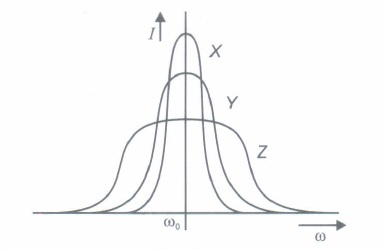
Three students X, Y, and Z performed an experiment for studying the variation of alternating current with angular frequency in a series LCR circuit and obtained the graphs as shown. They all used a.c sources of the same r.m.s. value and inductances of the same value. What can we (qualitatively) conclude about the
(i) capacitance value
(ii) resistance values Used by them? In which case will the quality factor be maximum? What can we conclude about nature of the impedance of the setup at frequency wo?
7.
A current carrying solenoid of 100 turns has an area of cross section 10-4 m2 .When suspended freely through its centre, it can turn in a horizontal plane .what is the magnetic moment of the solenoid for a current of 5A.Also calculate the net force and torque on solenoid if a uniform horizontal field of 10x10-2 T is set up at an angle of 30 degree with axis of solenoid when it is carrying the same current
8.
A bar magnet is cut into two pieces, along its length. How will its pole strength be affected?
9.
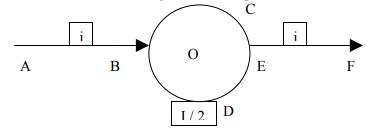
What will be the direction of magnetic field at point O
10.
You are given 8 \(\Omega \) resistor. What length of wire of resistance 120 Ωm-1 should be joined in parallel with it to get a value of 6 \(\Omega \) ?
11.
Charge of 2C is placed at the centre of a cube volume 8 cm3. What is the electric flux passiing through one face?
12.
Imagine removing one election from He4 and He3.Their energy levels, as worked out on the basis of Bohr's model will be very close. Explain why?
13.
A photon and an electron have been same de-Broglie wavelength which one has higher total energy?
14.
Two charges of -9C and +9C are palced at the points P(1, 0, 4) and Q(2,-1, 5) located in an electric field E = 0.20i V/cm. Calculate the torque acting on the dipole.
15.
Do electrons tend to go to regions of high potential or low potential?
1.
Reverse biased
2.
At t = T ½ N = No / 2 Using N = No e- λt
No / 2 = No e -λt ½
Solving we get, T1/2 = ln2/λ = 0.693/ λ
3.
No Apparent depth is maximum for that part of the bottom of the tank which is observed normally. Apparent depth decreases with increasing obliquity. Due to this unequal refraction, the flat bottom of the tank appears concave.
4.
doubled
5.
Self - inductance is defined as double the work done against the induced emf in producing unit current in the coil itself \(L=\frac{2 W}{I^2}\)
6.
(i) Decreases From X to Z
(ii) Decreases From X to Z
In case of X Quality factor Is More , Impedance, Decreases From X to Z.
7.
M = nIA = 100 x 5 x 10-4 = 500 x 10-4 J/T
Net force = 0
Torque = MB sin \(\theta\) = 5 x 102 x 0.1 x sin30 = 25 x 10-4 Nm
H = R cos \(\eth \) = 4 x 1/2 = 0.2 G
8.
M1 = M/2, M = M2
9.
The magnetic Field due to AB and EF is as the direction of length vector is along the radius vector. Also the magnetic field due to BCE and BDE are equal opposite and equal so they cancel the effect of each other. So the net magnetic field at O is 0.
10.
Now, 1/R = 1R1 + 1R2
Because 1 = 48/240 = 0.2 m
11.
\(\text { Toral } \phi=\mathrm{q} 0 / \varepsilon_0=2 / \varepsilon_0, \rightarrow \text { flux through one face }=\phi / 6=1 / 3 \varepsilon_0\)
12.
On removing one electron from He4 and He3, the energy levels, as worked out on the basis of Bohr's model will be very close as both the nuclei are very heavy as compared to electron mass. Also, after removing one electron, He4 and He3 atoms contain one electron and are hydrogen like atoms.
13.
Total energy of an electron Ee = mc2
Total energy of a photon, \(E_p=\frac{h c}{\lambda}\)
de-Broglie wavelength of electron of mass m moving with velocity V
\(
\lambda=\frac{h}{m v} \\
\Rightarrow m=\frac{h}{\lambda v}
\)
\(E_e=m c^2=\frac{h c^2}{\lambda v}\)
\(\therefore \frac{E_e}{E_p}=\frac{\frac{h_0^2}{\lambda v}}{\frac{h o}{\lambda}}=\frac{c}{v}\)
As c > > v, therefore the total energy of electron is more than the total energy of photon.
14.
As, P(1, 0, 4) and (2,-1, 5)
\(\therefore \ 2l=PQ=[(2-1)\hat { i } +(-1-0)\hat { j } +(5-4)\hat { k] }\\
=(\hat { i } -\hat { j } +\hat { k } )\)
and \(\ q=\pm 9\times { 10 }^{ -6 }C,E=0.20\hat { i } V/cm.\tau =?\)
Since, \(\tau =\rho \times E=q(2l)\times E\)
\(\therefore \ \tau =9\times { 10 }^{ -6 }(\hat { i } -\hat { j } +\hat { k } )\times 0.20=18\times { 10 }^{ -7 }(\hat { k } -\hat { j) }
\)
Magnitude of torque,
\(\tau =18\times { 10 }^{ -7 }[\sqrt { { (1) }^{ 2 }+{ (1) }^{ 2 } } ]=25.45\times { 10 }^{ -7 }N-m\)
15.
As electrons are negatively charged, they have tendency to go to regions of high potential.

12th Standard CBSE Syllabus & Materials
12th Standard CBSE
CBSE 12th Computer Science Python Revision Tour I - New Previous year Question Papers Study Material - QB365 Set A
NEW12th Standard CBSE
CBSE 12th Business Studies Planning Important Questions And Answers Study Material - QB365 Set A
NEW12th Standard CBSE
CBSE 12th Business Studies Business Environment Important Questions And Answers Study Material - QB365 Set A
NEW12th Standard CBSE
CBSE 12th Business Studies Principles of Management Important Questions And Answers Study Material - QB365 Set A



NCERT Books

Syllabus

Exam Pattern

Sample Question Papers

Previous year Question Papers

Important Notes

MCQ Practice test

NCERT Exemplers

Case study Questions

Image Based Questions

Passage based Questions

HOT Questions

Value Based Questions

Model Questions Papers
NCERT ( Book Back ) Questions

Assertion and Reason
Important Questions And Answers

CBSE 12th Standard CBSE Subjects
CBSE Standards









