
 100% FREE ACCESS
12th Standard CBSE Syllabus & Materials
12th Standard CBSE
CBSE 12th Economics Government Budget and the Economy Previous year Question Papers Study Material - QB365 Set A
NEW12th Standard CBSE
CBSE 12th Computer Science Interface Python with MySQL - New Previous year Question Papers Study Material - QB365 Set A
NEW12th Standard CBSE
CBSE 12th Computer Science Database Concept - New Previous year Question Papers Study Material - QB365 Set A
NEW12th Standard CBSE
CBSE 12th Computer Science Data Communication - New Previous year Question Papers Study Material - QB365 Set A
NEW12th Standard CBSE
CBSE 12th Computer Science Data Structures - New Previous year Question Papers Study Material - QB365 Set A
NEW12th Standard CBSE
CBSE 12th Computer Science Functions - New Previous year Question Papers Study Material - QB365 Set A

Published on: 27/05/2021
QB365 Provides the HOT Question Papers for Class 12 Physics, and also provide the detail solution for each and every HOT Questions. HOT Questions will help to get more idea about question pattern in every exams and also will help to get more marks in Exams
Download CBSE Class 12th Standard CBSE Physics question papers, sample papers, important questions, and previous year solved papers in PDF format. Get free study materials, NCERT solutions, and exam preparation resources for Class 12th Standard CBSE Physics
Questions + Answers key
Take MCQ Physics Test1.
In NPN transistor circuit, the collector current is 5mA. If 95% of the electrons emitted reach the collector region, what is the base current?
2.
For faster action which transistor is used and why?
3.
A neutron is absorbed by a 6Li3 nucleus with the subsequent emission of an alpha particle.
i) Write the corresponding nuclear reactions.
ii) Calculate the energy released in MeV, in this reaction.
Given mass 6Li3 = 6.0151264; mass (neutron) = 1.00966544
Mass (alpha particle) = 4.00260444 and mass(triton) = 3.01000004
4.
How is a wavefront different from a ray? Draw the geometrical shape of the wavefronts when (i) light diverges from a point source, and (ii) light emerges out of convex lens when a point source is placed at its focus
5.
Explain the twinkling of stars. Why do the planets not show twinkling effect?
6.
Three resistance 3Ω, 6Ω and 9Ω are connected to a battery. In which of them will the power dissipation be maximum if
a) They are all connected in parallel
b) They are all connected in series Give reason.
7.
A charged Particle q is shot towards another charged particle Q which is fixed , with a speed v. It approaches Q up to a closet distance r and then returns, If q were given a speed 2 v the n find the closet distance of approach.
8.
(a) Describe briefly the three factors which justify the need for translating a low frequency signal into high frequencies before transmission.
(b) Figure shows a block diagram of a detector for AM signal.
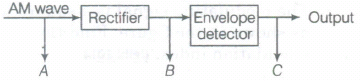
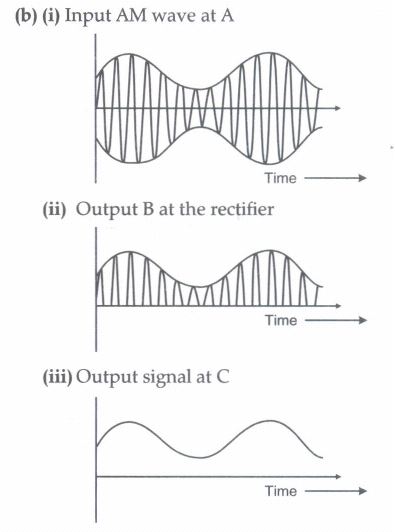
Draw the waveforms for the
(i) input AM wave at A,
(ii) output B at the rectifier, and (iii) output signal at C.
9.
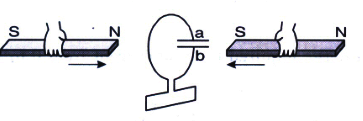
Equal currents I = 2A are flowing through the infinitely long wires parallel to Y-axis located at x = +1m, x = +2m, x = +4m and so on, but in opposite directions as shown in figure. Find the magnetic field at the origin O.
10.
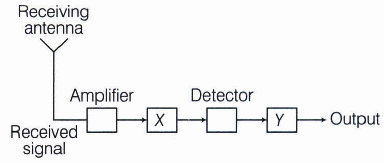
In the given block diagram of a receiver identify the boxes labelled as X and Y and write their functions.
11.
Find the ratio of the de-Broglie wavelength associated with protons accelerated through a potential of 128 V and a particles accelerated through a potential of 64 V.
To calculate the ratio of de-Baroglie wavelength of two particle find the ratio in terms of symbols and then put the given numerical values.
12.
Is Huygen's principle valid for longitundinal sound waves?
13.
Which of the following, If any, can act as a source of electromagnetic waves?
(i) A charge moving with a constant velocity
(ii) A charge moving with a circular orbit
(iii) A charge at rest
Give reason
14.
An electromagnet has stored 648 J of magnetic energy, when a current of 9 A exists in its coils. What average e.m.f. is induced if the current is reduced to zero in 0.45 s?
15.
A charged Particle is free to move in an electric field. Will it always move along an electric line of force ?
1.
Ic=95% of Ie = (95 / 100 ) Ie
Ie = (100 / 95) x 5 mA = 5.26mA
Ie= Ic+ Ib
Ib = 0.25 mA
2.
For faster action NPN Transistor is used. In an NPN transistor, current conduction is mainly by free electron, whereas in PNP type transistor. It is mainly holes Since electron are more mobile than holes we prefer NPN for faster action as well as high conduction current.
3.
(i) 6Li3 + 1no \(\rightarrow\)3H1 + 4He2 +Q (energy)
(ii) Q = \(\triangle\)mx931 MeV
Where \(\triangle\)m = 6.01512+1.0086654-4.0026044-3.0100000
4.
A wavefront is a surface obtained by joining all points vibrating in the same phase. A ray is a line drawn perpendicular to the wavefront in the direction of propagation of light wave.
The wavefronts of light emerging from a point source are spherical, as shown in figure. When a point source is placed at the focus of a convex lens, the emerging light has the plane wavefronts, as shown in figure
5.
Twinkling of stars. The light from stars undergoes refraction continuously before it reaches earth. So the apparent position of the stars is slightly different than its actual position. Due to variation in atmosphere conditions, like change in temperature, density etc., and this apparent position keeps on changing. The amount of light entering our eyes from a particular star increases and decreases randomly with time. Sometimes, the star appears brighter and other times, it appears fainter. This gives rise to the twinkling effect of stars
The planets do not show twinkling effect. As the planets are much closer to the earth, the greater and the fluctuations caused in the amount of light due to atmospheric refraction are negligible as compared to the amount of light received from them.
6.
a) in parallel, power dissipation \(\alpha\) 1/R
Therefore 3\(\Omega \) wire will dissipate more power
b) In series, power dissipation \(\alpha\) R
Therefore 9\(\Omega \) wire will dissipate more power
7.
q \(\rightarrow\)_______Q
1/2 mv2 = kQq/r
Or, v2 a1/r
Or, r a 1/v2
Or, r' = r/4
8.
(a) There are three factors:
(i) Wider Bandwidth: High frequency provide wider bandwidth.
(ii) Distance: High-frequency wave used to carry baseband signals (low-frequency signal) over a distance of several thousand kilometres.
(iii) Cost: High frequency transmits with low cost.
9.
Magnetic field at O due to current through one infinitely long wire is
\(B=\frac { \mu _{ 0 } }{ 4\pi } \times\frac { 2I }{ r } \hat{k}\)(i.e. along + Z-direction)
So, magnetic field at O due to all the wires is
\(B=\frac { \mu _{ 0 } }{ 4\pi } \times2\times2[\frac { 1 }{ 1 } -\frac { 1 }{ 2 } +\frac { 1 }{ 4 } -\frac { 1 }{ 8 } +\frac { 1 }{ 16 } +...] \hat{ k } \\ =\frac { { \mu }_{ 0 } }{ \pi } [(1+\frac { 1 }{ 4 } +\frac { 1 }{ 16 } +...)\hat{ k } -(\frac { 1 }{ 2 } +\frac { 1 }{ 8 } +...)\hat{ k } ]\\ =\frac { { \mu }_{ 0 } }{ \pi } [(\frac { 1 }{ 1-\frac { 1 }{ 4 } } )\hat{ k } \frac { 1 }{ 2 } (\frac { 1 }{ 1-\frac { 1 }{ 4 } } )\hat{ k } ]\\ \Rightarrow B=\frac { { \mu }_{ 0 } }{ \pi } \times\frac { 2 }{ 3 } \hat{ k } =\frac { { \mu }_{ 0 } }{ 4\pi } \times\frac { { { 8 }\hat{k} } }{ 3 } \)
10.
X \(\rightarrow\) Intermediate Frequency (IF) stage
Y \(\rightarrow\) Power amplifier
The IF stage change the high-frequency carrier wave into lower frequency wave and amplifier enhances the strength of the signals.
11.
de-Broglie wavelength is given by
\(\lambda =\frac { h }{ \sqrt { 2mK } } =\frac { h }{ \sqrt { 2mqV } }\)
\(\lambda \propto \frac { 1 }{ \sqrt { mqV } } \)
m = mass of charge particle, q = charge and V = potential difference
Raio of de-Broglie wavelengths of proton and a-particle is given by
\(\frac { \lambda _{ \alpha } }{ \lambda _{ p } } =\sqrt { \frac { m_{ \alpha }q_{ \alpha }V_{ \alpha } }{ m_{ p }q_{ p }V_{ p } } } =\sqrt { \left( \frac { m_{ \alpha } }{ m_{ p } } \right) \left( \frac { q_{ \alpha } }{ q_{ p } } \right) \left( \frac { V_{ \alpha } }{ V_{ p } } \right) } \)
\(\frac { m_{ \alpha } }{ m_{ p } } =4,\frac { q_{ \alpha } }{ q_{ p } } =2,\frac { V_{ \alpha } }{ V_{ p } } =\frac { 1 }{ 2 } \)
a-particle is 4 toimes heavier than proton and it has double the charge than that of proton
\(\frac { \lambda _{ p } }{ \lambda _{ \alpha } } =\sqrt { 4\times 2\times \frac { 1 }{ 2 } } =2\quad \Rightarrow \lambda _{ p }:\lambda _{ \alpha }=2:1\)
12.
When we are considering a point of sound wavw. The disturbance due to the source propagates in spherical symmetry, that is, in all directions.
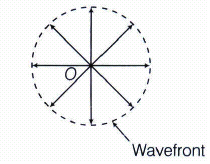
The formation of wavefront is in accordance with Huygen's principle. So, Huygen's principle is valid for longitudinal sound waves also.
13.
A charge moving with a circular orbit can produce electromagnetic waves because a circular motion is an accelerated motion and accelerated charges produce e.m.waves
14.
\(Here, \ E=648 \ J,I=9,e=?,\)
\(dI=9-0=9A,dt=0.45s\)
\(From \ E=\frac { 1 }{ 2 } { LI }^{ 2 }\)
\(648=\frac { 1 }{ 2 } { L(9) }^{ 2 }; \ L=\frac { 648\times2 }{ 9\times9 } =16H\)
\(As \ e=\frac { LdI }{ dt } \therefore e=\frac { 16(9) }{ 0.45 } =320V\)
15.
If Changed particle was Initially at rest, it will move along the direction of electric field. If initial velocity of the charged particle makes a certain angle with electric field, then the charged particle will no move along the line of force.

12th Standard CBSE Syllabus & Materials
12th Standard CBSE
CBSE 12th Computer Science Python Revision Tour I - New Previous year Question Papers Study Material - QB365 Set A
NEW12th Standard CBSE
CBSE 12th Business Studies Planning Important Questions And Answers Study Material - QB365 Set A
NEW12th Standard CBSE
CBSE 12th Business Studies Business Environment Important Questions And Answers Study Material - QB365 Set A
NEW12th Standard CBSE
CBSE 12th Business Studies Principles of Management Important Questions And Answers Study Material - QB365 Set A



NCERT Books

Syllabus

Exam Pattern

Sample Question Papers

Previous year Question Papers

Important Notes

MCQ Practice test

NCERT Exemplers

Case study Questions

Image Based Questions

Passage based Questions

HOT Questions

Value Based Questions

Model Questions Papers
NCERT ( Book Back ) Questions

Assertion and Reason
Important Questions And Answers

CBSE 12th Standard CBSE Subjects
CBSE Standards









