
 100% FREE ACCESS
12th Standard CBSE Syllabus & Materials
12th Standard CBSE
CBSE 12th Economics Government Budget and the Economy Previous year Question Papers Study Material - QB365 Set A
NEW12th Standard CBSE
CBSE 12th Computer Science Interface Python with MySQL - New Previous year Question Papers Study Material - QB365 Set A
NEW12th Standard CBSE
CBSE 12th Computer Science Database Concept - New Previous year Question Papers Study Material - QB365 Set A
NEW12th Standard CBSE
CBSE 12th Computer Science Data Communication - New Previous year Question Papers Study Material - QB365 Set A
NEW12th Standard CBSE
CBSE 12th Computer Science Data Structures - New Previous year Question Papers Study Material - QB365 Set A
NEW12th Standard CBSE
CBSE 12th Computer Science Functions - New Previous year Question Papers Study Material - QB365 Set A

Published on: 27/05/2021
QB365 Provides the HOT Question Papers for Class 12 Physics, and also provide the detail solution for each and every HOT Questions. HOT Questions will help to get more idea about question pattern in every exams and also will help to get more marks in Exams
Download CBSE Class 12th Standard CBSE Physics question papers, sample papers, important questions, and previous year solved papers in PDF format. Get free study materials, NCERT solutions, and exam preparation resources for Class 12th Standard CBSE Physics
Questions + Answers key
Take MCQ Physics Test1.
The base current is 100 µA and collector current is 3mA
Calculate the values of \(\beta\), Ie and α b) A change of 20\(\mu \)A in the base current produces a change of 0.5mAin the collector current. Calculate \(\beta\)a.c
2.
The antenna current of an AM transmitter is 8A when only carrier is sent but it increases to 8.93A when the carrier is sinusoidally modulated. Find the percent-age modulation index
3.
Why do semiconductors obey OHM’S law for only low fields?
4.
A neutron is absorbed by a 6Li3 nucleus with the subsequent emission of an alpha particle.
i) Write the corresponding nuclear reactions.
ii) Calculate the energy released in MeV, in this reaction.
Given mass 6Li3 = 6.0151264; mass (neutron) = 1.00966544
Mass (alpha particle) = 4.00260444 and mass(triton) = 3.01000004
5.
Two Sources of Intensity I and 4I are used in an interference experiment. Find the intensity at points where the waves from two sources superimpose with a phase difference (i) zero (ii) \(\pi\)/2 (iii) \(\pi\)
6.
How is a wavefront different from a ray? Draw the geometrical shape of the wavefronts when (i) light diverges from a point source, and (ii) light emerges out of convex lens when a point source is placed at its focus
7.
You are given a copper wire carrying current I of length L. Now the wire is turned into circular coil. Find the number of turns in the coil so that the torque at the centre of the coil is to maximum
8.
A charged Particle q is shot towards another charged particle Q which is fixed , with a speed v. It approaches Q up to a closet distance r and then returns, If q were given a speed 2 v the n find the closet distance of approach.
9.
Find the ratio of the de-Broglie wavelength associated with protons accelerated through a potential of 128 V and a particles accelerated through a potential of 64 V.
To calculate the ratio of de-Baroglie wavelength of two particle find the ratio in terms of symbols and then put the given numerical values.
10.
A magnetic needle free to rotate in a vertical plane parallel to the magnetic meridian has its North tip down at 600 with the horizontal. The horizontal component of the earth's magnetic field at the place is known to be 0.4 gauss. Determine the magnitude of the earth's magnetic field at the place.
11.
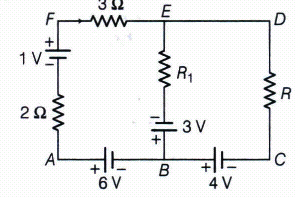
Use Kirchhoff's rules to determine the potential difference between the points A and D. When no current flows in the arm BE of the electric network shown in the figure below.
12.
A and B have identical size and same mass. A becomes A2+ and B become B2- . Will A2+ and B2- still have the same mass? Why?
13.
Which of the following, If any, can act as a source of electromagnetic waves?
(i) A charge moving with a constant velocity
(ii) A charge moving with a circular orbit
(iii) A charge at rest
Give reason
14.
A lens whose radii of curvature are different is forming the image of an object placed on its axis. If the lens is reversed, will the position of the image change?
1.
Here
Ib = 100\(\mu \)A = 0.1 mA
Ic = 3mA
a) \(\beta\) = Ic/Ib = 30
\(\beta\) = \(\alpha\) /(1-\(\alpha\))
\(\alpha\) = 0.97
\(\alpha\) = Ic/Ie
Ie = 3.1 mA
b) \(\triangle\)Ib = 20 \(\mu \)A 0.02 mA
\(\beta\)a.c = \(\triangle\) Ic/\(\triangle\) Ib
\(\beta\) a.c = 25
2.
Ps = 1/2 ma2 Pc
1.246 = 1 + \(\frac { ma^{ 2 } }{ 2 } \)
ma2/2 = 0.246
ma = (2 x 0.246)1/2 = 0.701 = 70.1%
3.
The drift velocity of a charge carrier is proportional to electric E. Therefore V = eET/m ie. V \(\alpha\) E. But V cannot be increased indefinitely by increasing E. At high-speed relaxation time (T) begins to decrease due to increase in collision frequency. S: so drift velocity saturates at thermal velocity (10 ms-1). An electric field of 106 V/m causes saturation of drift velocity. Hence semi- conduction obey ohm’s law for low electrical field and above this field ( E < 106 V/m ) current becomes independent of potential.
4.
(i) 6Li3 + 1no \(\rightarrow\)3H1 + 4He2 +Q (energy)
(ii) Q = \(\triangle\)mx931 MeV
Where \(\triangle\)m = 6.01512+1.0086654-4.0026044-3.0100000
5.
The resultant intensity at a point where phase difference is \(\Phi \)is
IR = I1 +I2 + 2\(\surd \)1112Cos \(\Phi \)
As I1 = I and I2 = 4I Therefore
IR = I + 4I + 2\(\surd \)1.41 Cos \(\Phi \) = 5I+4I cos \(\Phi \)
(i) when \(\Phi \) =0 , IR = 5I +4I cos 0 = 9 I
(ii) when \(\Phi \) =\(\pi \)/2 , IR = 5I +4I cos \(\pi \)/2 = 5 I
(iii) when \(\Phi \) =\(\pi \) , IR = 5I +4I cos \(\pi \) = I
6.
A wavefront is a surface obtained by joining all points vibrating in the same phase. A ray is a line drawn perpendicular to the wavefront in the direction of propagation of light wave.
The wavefronts of light emerging from a point source are spherical, as shown in figure. When a point source is placed at the focus of a convex lens, the emerging light has the plane wavefronts, as shown in figure
7.
Let the number of turns be = n
Radius = r
Length = l
Length of the wire = circumference of n turns of coil
L = n x 2\(\Pi \) r
r = L/2\(\Pi \) r
Maximum torque = nIBA = nIB \(\Pi \) r2
= nIB\(\Pi \) (2/2\(\Pi \) n)2
= 1/n
For maximum torque n should be minimum
i.e n = 1
8.
q \(\rightarrow\)_______Q
1/2 mv2 = kQq/r
Or, v2 a1/r
Or, r a 1/v2
Or, r' = r/4
9.
de-Broglie wavelength is given by
\(\lambda =\frac { h }{ \sqrt { 2mK } } =\frac { h }{ \sqrt { 2mqV } }\)
\(\lambda \propto \frac { 1 }{ \sqrt { mqV } } \)
m = mass of charge particle, q = charge and V = potential difference
Raio of de-Broglie wavelengths of proton and a-particle is given by
\(\frac { \lambda _{ \alpha } }{ \lambda _{ p } } =\sqrt { \frac { m_{ \alpha }q_{ \alpha }V_{ \alpha } }{ m_{ p }q_{ p }V_{ p } } } =\sqrt { \left( \frac { m_{ \alpha } }{ m_{ p } } \right) \left( \frac { q_{ \alpha } }{ q_{ p } } \right) \left( \frac { V_{ \alpha } }{ V_{ p } } \right) } \)
\(\frac { m_{ \alpha } }{ m_{ p } } =4,\frac { q_{ \alpha } }{ q_{ p } } =2,\frac { V_{ \alpha } }{ V_{ p } } =\frac { 1 }{ 2 } \)
a-particle is 4 toimes heavier than proton and it has double the charge than that of proton
\(\frac { \lambda _{ p } }{ \lambda _{ \alpha } } =\sqrt { 4\times 2\times \frac { 1 }{ 2 } } =2\quad \Rightarrow \lambda _{ p }:\lambda _{ \alpha }=2:1\)
10.
Angle of dip, \(\delta ={ 60 }^{ 0 }=\frac { \pi }{ 3 } \)
Horizontal component of the earth's magnetic field,
H = 0.4 gauss
Earth magnetic field, \({ B }_{ e }\)= ?
We know that,
\(\therefore \) Horizontal component of the earth's magnetic field,
\(\Rightarrow \quad { B }_{ e }=\frac { H }{ cos\delta } =\frac { 0.4 }{ cos{ 60 }^{ 0 } } =\frac { 0.4 }{ (\frac { 1 }{ 2 } ) } =0.8\)
\({ B }_{ e }=0.8\) gauss
11.
Applying Kirchhoff's loop rule for loop ABEFA
6 + 3 + R1 \(\times\) 0 - 3I1 + 1 - 2I1 = 0
or 10 - 5I1 = 0
or I1 = 2A
For loop BCDEB,
4 - I1 . R + R1 \(\times\) 0 - 3 = 0
or 1 - 2R = 0
\(\therefore \quad R=\frac{1}{2} \Omega\)
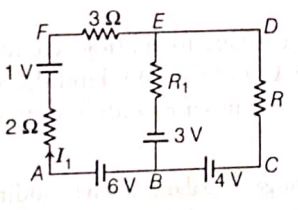
Potential difference between A and D through path
ABCD is 6 + 4 - I1 R = VAD \(\Rightarrow \quad 10-2 \times \frac{1}{2}=V_{A D}\)
\(\therefore\) VAD = 9 V
12.
No, they will not have the same mass. B2- has more mass as, it has gained two electrons, whereas A2+ has lost two electrons.
13.
A charge moving with a circular orbit can produce electromagnetic waves because a circular motion is an accelerated motion and accelerated charges produce e.m.waves
14.
No, image will be formed at the same position. This follows from lens maker's formula:
\(\frac { 1 }{ f } =(u-1)\left( \frac { 1 }{ { R }_{ 1 } } -\frac { 1 }{ { R }_{ 2 } } \right) \)
When we interchange R1 and R2, the value of f does not change except for the sign. Hence the image will be formed at the same position.

12th Standard CBSE Syllabus & Materials
12th Standard CBSE
CBSE 12th Computer Science Python Revision Tour I - New Previous year Question Papers Study Material - QB365 Set A
NEW12th Standard CBSE
CBSE 12th Business Studies Planning Important Questions And Answers Study Material - QB365 Set A
NEW12th Standard CBSE
CBSE 12th Business Studies Business Environment Important Questions And Answers Study Material - QB365 Set A
NEW12th Standard CBSE
CBSE 12th Business Studies Principles of Management Important Questions And Answers Study Material - QB365 Set A



NCERT Books

Syllabus

Exam Pattern

Sample Question Papers

Previous year Question Papers

Important Notes

MCQ Practice test

NCERT Exemplers

Case study Questions

Image Based Questions

Passage based Questions

HOT Questions

Value Based Questions

Model Questions Papers
NCERT ( Book Back ) Questions

Assertion and Reason
Important Questions And Answers

CBSE 12th Standard CBSE Subjects
CBSE Standards









