
 100% FREE ACCESS
12th Standard CBSE Syllabus & Materials
12th Standard CBSE
CBSE 12th Economics Government Budget and the Economy Previous year Question Papers Study Material - QB365 Set A
NEW12th Standard CBSE
CBSE 12th Computer Science Interface Python with MySQL - New Previous year Question Papers Study Material - QB365 Set A
NEW12th Standard CBSE
CBSE 12th Computer Science Database Concept - New Previous year Question Papers Study Material - QB365 Set A
NEW12th Standard CBSE
CBSE 12th Computer Science Data Communication - New Previous year Question Papers Study Material - QB365 Set A
NEW12th Standard CBSE
CBSE 12th Computer Science Data Structures - New Previous year Question Papers Study Material - QB365 Set A
NEW12th Standard CBSE
CBSE 12th Computer Science Functions - New Previous year Question Papers Study Material - QB365 Set A

Published on: 27/05/2021
QB365 Provides the HOT Question Papers for Class 12 Physics, and also provide the detail solution for each and every HOT Questions. HOT Questions will help to get more idea about question pattern in every exams and also will help to get more marks in Exams
Download CBSE Class 12th Standard CBSE Physics question papers, sample papers, important questions, and previous year solved papers in PDF format. Get free study materials, NCERT solutions, and exam preparation resources for Class 12th Standard CBSE Physics
Questions + Answers key
Take MCQ Physics Test1.
In half wave rectification , what is the output frequency if the input frequency is 50 Hz. What is the output frequency of a full wave rectification for the same input frequency.
2.
As we know that an n-type semiconductor has large number of electrons but it is still electrically neutral. Why?
3.
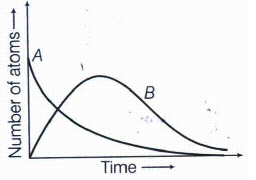
Consider a radioactive nucleus A which decays to a stable nucleus C through the following sequence:
A \(\longrightarrow \) B \(\longrightarrow \) C
where, B is an intermediate nuclei, which is also radioactive. Considering that there are N0 atoms of A initially, plot the graph showing the variation of number of atoms of A and B versus time.
4.
(i) Light passes through two polaroids \({ P }_{ 1 }and{ P }_{ 2 }\) with pass axis of \({ P }_{ 2 }\) with pass axis of \({ P }_{ 2 }\) making in angle \(\theta \) with the pass axis of \({ P }_{ 1 }\) . For what value of \(\theta \) is the intensity of emergent light zero?
(ii) A third polaroid is placed between \({ P }_{ 1 }and{ P }_{ 2 }\) with its pass axis making an angle \(\beta \) with the pass axis is \({ P }_{ 1 }\) . Find the value of \(\beta \) for which the intensity of light from \({ P }_{ 2 }\) is \(\frac { { I }_{ 0 } }{ 8 } \) , where \({ I }_{ 0 }\) is the intensity of light on the polaroid \({ P }_{ 1 }\) .
5.
An electron, \(\alpha \) -particle and a proton have the same de-Broglie wavelengths. Which of
theseparticle has
(i) minimum kinetic energy?
(ii) maximum kinetic energy and why?
In what way has the wave nature of electron beam exploited in an electron microscope?
6.
(i) How is the electric field due to a charged parallel plate capacitor affected, when a dielectric slab is inserted between the plates fully occupying the intervening region?
(ii) A slab of material of dielectric constant K has the same area as the plates of a parallel plate capacitor but has thickness \(\frac{1}{2}\) d, where d is the separation between the plates. Find the expression for the capacitance when the slab is inserted between the plates.
7.
Show that the force on each plate of a parallel plate capacitor has a magnitude equal to1/2 QE. where Q is the charge on the capacitor and E is the magnitude of electric field between the plates. Explain the origin of the factor 1/2.
Here, we can use the content that the work done in displacing the plates against the force is equal to the increase in energy of the capacitor.
8.
An electromagnetic wave is travelling in vacum with a speed 3 x 10⁸ m / s. Find its velocity in a medium having relative electric and magnetic permeability 2 and 1, respectively.
9.
What is a ground wave? Why short wave communication over long distance is not possible via ground waves?
10.
The fringe width in a young's doubt slit experiment is mm, distance between slit and screen is 1.2m and separation between the slits is 0.24mm. The radiation of same source is incident on a photo-cathode of work function 2.2 eV. Find the stopping potential.
11.
The isotopes of \({ U }^{ 238 }\ and\ { U }^{ 235 }\) occur in nature in the ratio 140 : 1. Assuming that at the time of earth's formation, they were present in equal ratio, make an estimate of the age of the earth. The half lives of \({ U }^{ 238 }\ and\ { U }^{ 235 }\) are \(4.5\times { 10 }^{ 9 }\) years and \(7.13\times { 10 }^{ 8 }\) years respectively.
Given : \(\log _{ 10 }{ 140 } =2.1461,\log _{ 10 }{ 2 } =0.3010\)
12.
An infinite number of charges each equal to q, are placed along X-axis at x = 1, x = 2, x = 4, x = 8, ............... and so on.
(i) Find the electric field at a point x = 0 due to this set up of charges.
(ii) What will be the electric field if in the above set up the consecutive charges have opposite signs.
13.
When a capacitor is connected in series LR circuit the alternating current flowing in the circuit increases. Explain why.
14.
A long horizontal rigidly supported wire carries \({ i }_{ a }\)of 100 A. Directed above it and parallels to it is a fine wire that carries a current \({ i }_{ a }\)of 20A and weighs 0.073N/m. How far above the lower wire should the second wire be kept if we wish to support it by magnetic repulsion?
Given permeability constant \({ \mu }_{ 0 }=4\pi \times { 10 }^{ -7 } \ Wb\ { A }^{ -1 }{ m }^{ -1 }\)
1.
Given, input frequency = 50 Hz
For a half-wave rectifier, the output frequency is equal to the input frequency.
\(\therefore\) Output frequency = 50 Hz
For a full-wave rectifier, the output frequency is twice the input frequency.
\(\therefore\) Output frequency = 2 x 50 = 100 Hz.
2.
n-type semiconductor is obtained when pentavalent impurity added to Si or Ge. All these materials are electrically neutral, so n-type semiconductor is also neutral.
3.
By considering the situation given in the question,
At t = 0, NA = N0 (maximum), while NB = 0. As time increases, NA decreases exponentially and the number of atoms of B increases. They become (NB) maximum and finally drop to zero exponentially by radioactive decay law. So, graph showing the variation of number of atoms of A and B will be shown as below:
4.
(i) By Malus law, intensity of emergent light from \({ P }_{ 2 }\) is \(I={ I }_{ \circ }cos^{ 2 }\theta \) , where \(\theta \) is the angle between \({ P }_{ 1 }and{ P }_{ 2 }\)|
When \(\theta ={ 90 }^{ \circ }\)
\(\\ I={ I }_{ \circ }\times 0\)
Intensity of emergent light, I = 0
(ii) Intensity of light from \({ P }_{ 3 }\)
\(=\left( \frac { { I }_{ \circ } }{ 2 } cos^{ 2 }\beta \right) \left[ cos^{ 2 }\left( { 90 }^{ \circ }-\beta \right) \right] \)
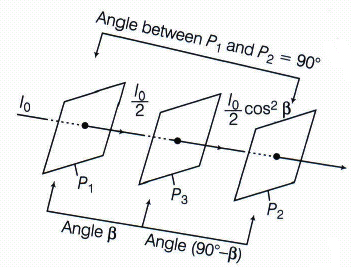
\(=\frac { { I }_{ \circ } }{ 2 } cos^{ 2 }\beta sin^{ 2 }\beta =\frac { { I }_{ \circ } }{ 8 } sin^{ 2 }2\beta \)
\(As,\ \frac { { I }_{ \circ } }{ 8 } sin^{ 2 }2\beta =\frac { { I }_{ \circ } }{ 8 } (given)\)
\(so, \ \left( sin2\beta \right) ^{ 2 }=1 \ \Rightarrow 2\beta ={ 90 }^{ \circ } \ \Rightarrow \beta ={ 45 }^{ \circ }\)
5.
de-Broglie matter wave equation,
\(\lambda =\frac { h }{ p } =\frac { h }{ \sqrt { 2mK } } \ \left[ \because K=\frac { { P }^{ 2 } }{ 2m } \right] \)
where K is kinetic energy and m is a mass of the particle.
\(K=\frac { { h }^{ 2 } }{ 2m{ \lambda }^{ 2 } } \) [ for same wavelength \( \lambda] \)
\(K\propto \frac { 1 }{ m }\)
\(\Rightarrow \ { K }_{ e }:{ K }_{ \alpha }:{ K }_{ p }=\frac { 1 }{ { m }_{ e } } :\frac { 1 }{ { m }_{ \alpha } } :\frac { 1 }{ { m }_{ p } } \)
where \({ m }_{ e },{ m }_{ p } \ and \ { m }_{ \alpha }\) are masses of electron, proton and \(\alpha \) -particle, respectively.
Also, \({ K }_{ e },k_{ p } \ and \ K_{ \alpha }\) are their respective kinetic energies.
\(\because \ m_{ \alpha }>m_{ p }>m_{ e }\)
\(\\ \Rightarrow m_{ \alpha }m_{ p }>m_{ e }m_{ \alpha }>m_{ e }m_{ p }\)
\(\\ { K }_{ e }>k_{ p }>K_{ \alpha }\)
(i) \(\alpha \) particle possess minimum kinetic energy
(ii) The electron has maximum kinetic energy. The magnifying power of an electron microscope is inversely related to the wavelength of radiation used. The Smaller wavelength of the electron beam in comparison to visible light increases the magnifying power of the microscope.
6.
(i) The total charge of the capacitor remains conserved on introduction of dielectric slab. Also, the capacitance of capacitor increases to K times of original values.
\(\therefore \\ \) CV = C' V '= (KC) V' \(\Rightarrow V'=\frac { V }{ K } \)
\(\therefore \\ \) New electric field,
\(E'=\frac { V' }{ d } =\left( { \frac { { V }/{ K } }{ d } } \right) =\left( \frac { V }{ d } \right) \frac { 1 }{ k } =\frac { E }{ K } \)
\(\therefore \\ \) On introduction of dielectric medium, new electric field E' becomes \(\frac { 1 }{ K } \) times of its original value (decrease).
(ii) The thickness of dieletric slab is \(\frac{d}{2}, \text { i.e. } t=\frac{d}{2}\)
The capacitance of a capacitor due to dielectric slab,
\(\begin{aligned}
C & =\frac{\varepsilon_0 A}{d-t+\frac{t}{K}}
\end{aligned}\)
\(\begin{aligned}
=\frac{\varepsilon_0 A}{d-\frac{d}{2}+\frac{d}{2 K}}=\frac{2 \varepsilon_0 A}{d\left(1+\frac{1}{K}\right)}
\end{aligned}\)
7.
Let the distance between the plates be increased by a very small distance\(\triangle x\) = Force x Increased distance
= F.\(\Delta x\) ...(i)
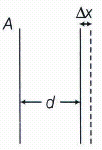
Increase in volume of capacitor
= Area of plates x Increased distance
= A.\(\Delta x\)
u = Energy density = \(\frac { Energy }{ Volume } \)
Increase in energy = u x voulme = u.A.\(\Delta x\) .....(ii)
As, Energy = Work done
F.\(\Delta x\) = u.A.\(\Delta x\) \([\because From \ Eqs.(i) \ and \ (ii)]\)
\(\Rightarrow\) F = u.A
\(=\frac { 1 }{ 2 } \varepsilon _{ 0 }{ E }^{ 2 }.A\quad [\because u=\frac { 1 }{ 2 } \varepsilon _{ 0 }{ E }^{ 2 } \ and \ E=\frac { V }{ d } ]\)
\(=\frac { 1 }{ 2 } \varepsilon _{ 0 }.\frac { { V }^{ 2 } }{ { d }^{ 2 } } .A=\left( \frac { { \varepsilon }_{ 0 }A }{ d } .A \right) \frac { V }{ d } \times \frac { 1 }{ 2 } \)
\(=\frac { 1 }{ 2 } .E.C.V=\frac { 1 }{ 2 } QE \ [\because C=\frac { { \varepsilon }_{ 0 }A }{ d } ,CV=Q]\)
8.
Given, velocity of electromagnetic wave in vacum, c = 3 X 10⁸ m / s
Relative electric permeability,\(\varepsilon _{ r }\) = 2
and magnetic permeability, \(\mu _{ r }\) = 1
Since, velocity of electromagnetic wave in a medium can be calculated by
v = \(\frac { 1 }{ \sqrt { \varepsilon _{ 0 }\varepsilon _{ r }\mu _{ 0 }\mu _{ r } } } =\frac { 1 }{ \sqrt { \varepsilon _{ 0 }\mu _{ 0 } } \quad x \quad \sqrt { \mu _{ r }\varepsilon _{ r } } } \)
Where,
\(\frac { 1 }{ \sqrt { \varepsilon _{ 0 }\mu _{ 0 } } } =c \ \Rightarrow \ v \ = \ \frac { c }{ \sqrt { \mu _{ r }\varepsilon _{ r } } } \) ...(i)
Therefore, v \(=\frac { 3x10^{ 8 } }{ \sqrt { 2x1 } } \Rightarrow \) \(v=\frac { 3 }{ \sqrt { 2 } } \times10^{ 8 }\) m/s.
9.
The amplitude modulated radiowaves having frequency 530 kHz to 1710 kHz (or wavelength between 175 m to 566 m) which are travelling directly following the surface of earth are known as ground waves. The short wave communication over long distance is only possible via sky waves. It is not possible via ground waves because the ground waves can bend round the corners of the objects on earth and hence, their intensity falls with distance. Moreover the ground wave transmission becomes weaker as frequency increases.
10.
\(Here,\beta =2mm=2\times { 10 }^{ -3 }m;D=1.2m \ and \ d=0.24\times { 10 }^{ -3 }m; \ { \phi }_{ 0 }=2.2eV,{ V }_{ 0 }=?\)
\(As \ \beta =\frac { D }{ d } \lambda \ or \ \lambda =\beta \frac { d }{ D } =\frac { \left( 2\times { 10 }^{ -3 } \right) \times \left( 0.24\times { 10 }^{ -3 } \right) }{ 1.2 } =4\times { 10 }^{ -7 }m\)
\({ eV }_{ 0 }=\frac { hc }{ \lambda } -{ \phi }_{ 0 } \ or \ { V }_{ 0 }=\frac { hc }{ e\lambda } -\frac { { \phi }_{ 0 } }{ e } =\frac { \left( 6.63\times { 10 }^{ -34 } \right) \times \left( 3\times { 10 }^{ 8 } \right) }{ 1.6\times { 10 }^{ -19 }\times \left( 4\times { 10 }^{ -7 } \right) } -\frac { 2.2eV }{ e } =3.1-2.2=0.9V\)
11.
\({ N }_{ 1 }={ N }_{ 0 }{ e }^{ -{ \lambda }_{ 1 }t },\quad { N }_{ 2 }={ N }_{ 0 }{ e }^{ -{ \lambda }_{ 2 }t }\)
\(\\ \frac { { N }_{ 1 } }{ { N }_{ 2 } } ={ e }^{ \left( { \lambda }_{ 2 }-{ \lambda }_{ 1 } \right) t }\quad or\quad t=\frac { \log _{ e }{ \left( { N }_{ 1 }{ /N }_{ 2 } \right) } }{ { \lambda }_{ 2 }-{ \lambda }_{ 1 } } =\frac { \log _{ e }{ 140/1 } }{ \log _{ 2 }{ 2\left[ \frac { 1 }{ { T }_{ 2 } } -\frac { 1 }{ { T }_{ 1 } } \right] } } =\frac { \log _{ e }{ 140 } }{ \log _{ 10 }{ 2 } } \left( \frac { { T }_{ 2 }{ T }_{ 1 } }{ { T }_{ 1 }-{ T }_{ 2 } } \right) \)
On putting the values, we get \(t=6\times { 10 }^{ 9 }\ years\)
12.
(i) Electric field at x = 0
\(E={1\over 4\pi \epsilon_o}[{q\over 1^2}+{q\over 2^2}+{q\over 4^2}+....]\)
\(={q\over 4\pi\epsilon_o}[{1\over 1-1/4}]={q\over 3\pi\epsilon_o}\)
(ii) If consecutive charges have opposite signs, then at x = 0,
Electric field, \(E'={q\over 4\pi\epsilon_o}[{1\over 1^2}-{1\over 4}+{1\over 16}-{1\over 64}+....]^\times\)
\(E'={q\over 4\pi\epsilon_o}[{1\over 1-(-1/4)}]={q\over 5\pi\epsilon_o}\)
13.
In LR circuit, the impedance is given by
\({ Z }_{ L }=\sqrt { { R }^{ 2 }+{ X }_{ L }^{ 2 } } \quad ...(i)\)
In LCR circuit, the impedance is given by
\(Z=\sqrt { { R }^{ 2 }+{ \left( { X }_{ L }-{ X }_{ C } \right) }^{ 2 } } \quad ...(ii)\)
From equations, (i) and (ii), we find that
\(Z<{ Z }_{ L }\)
\(since \ I=\frac { E }{ Z } \)
As Z decreases on connecting a capacitor in series with LR circuit, hence the current I in the circuit increases.
14.
If \({ i }_{ a }\)and \({ i }_{ b }\) are the 3 antiparallel currents flowing in two parallel wires separated by a distance R, then the repulsive force experienced by unit length (1m) of either wire is
\(F=\frac { { \mu }_{ 0 }{ i }_{ a }{ i }_{ b } }{ 2\pi R } \)
Weight per meter length of above wire
\(=0.073{ Nm }^{ -1 }\)
According to problem, the weight of lower wire is supported by upward magnetic repulsion, therefore
\(\frac { { \mu }_{ 0 }{ i }_{ a }{ i }_{ b } }{ 2\pi R } \)\(=0.073\)
\(R=\frac { { \mu }_{ 0 }{ i }_{ a }{ i }_{ b } }{ 2\pi \times 0.073 } \)
\(=\frac { 4\pi \times { 10 }^{ -7 }\times 100\times 20 }{ 2\pi \times 0.073 } \)
\(=4.4\times { 10 }^{ -3 }m = 4.48mm\)

12th Standard CBSE Syllabus & Materials
12th Standard CBSE
CBSE 12th Computer Science Python Revision Tour I - New Previous year Question Papers Study Material - QB365 Set A
NEW12th Standard CBSE
CBSE 12th Business Studies Planning Important Questions And Answers Study Material - QB365 Set A
NEW12th Standard CBSE
CBSE 12th Business Studies Business Environment Important Questions And Answers Study Material - QB365 Set A
NEW12th Standard CBSE
CBSE 12th Business Studies Principles of Management Important Questions And Answers Study Material - QB365 Set A



NCERT Books

Syllabus

Exam Pattern

Sample Question Papers

Previous year Question Papers

Important Notes

MCQ Practice test

NCERT Exemplers

Case study Questions

Image Based Questions

Passage based Questions

HOT Questions

Value Based Questions

Model Questions Papers
NCERT ( Book Back ) Questions

Assertion and Reason
Important Questions And Answers

CBSE 12th Standard CBSE Subjects
CBSE Standards









