
 100% FREE ACCESS
12th Standard CBSE Syllabus & Materials
12th Standard CBSE
CBSE 12th Economics Government Budget and the Economy Previous year Question Papers Study Material - QB365 Set A
NEW12th Standard CBSE
CBSE 12th Computer Science Interface Python with MySQL - New Previous year Question Papers Study Material - QB365 Set A
NEW12th Standard CBSE
CBSE 12th Computer Science Database Concept - New Previous year Question Papers Study Material - QB365 Set A
NEW12th Standard CBSE
CBSE 12th Computer Science Data Communication - New Previous year Question Papers Study Material - QB365 Set A
NEW12th Standard CBSE
CBSE 12th Computer Science Data Structures - New Previous year Question Papers Study Material - QB365 Set A
NEW12th Standard CBSE
CBSE 12th Computer Science Functions - New Previous year Question Papers Study Material - QB365 Set A

Published on: 27/05/2021
QB365 Provides the HOT Question Papers for Class 12 Physics, and also provide the detail solution for each and every HOT Questions. HOT Questions will help to get more idea about question pattern in every exams and also will help to get more marks in Exams
Download CBSE Class 12th Standard CBSE Physics question papers, sample papers, important questions, and previous year solved papers in PDF format. Get free study materials, NCERT solutions, and exam preparation resources for Class 12th Standard CBSE Physics
Questions + Answers key
Take MCQ Physics Test1.
An audio signal is modulated by a carrier wave of 20 MHz such that the bandwidth required for modulation is 3kHz.Could this wave be demodulated by a diode detector which has the values of R and C as
(i) R=\(1k\Omega ,C=0.01\mu F\)
(ii) R=\(10k\Omega ,C=0.01\mu F\)
(iii) R=\(10k\Omega ,C=1\mu F\)
2.
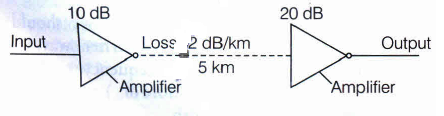
Figure shows a communication system. Which is the output power when input signal is 1.01 mW? (Gain in dB=\(10\log { _{ 10 }\frac { { P }_{ 0 } }{ { P }_{ 1 } } } \))
3.
Explain with the help of ray diagram, the working of an astronomical telescope. The magnifying power of a telescope in its normal adjustment is 20. If the length of the telescope is 105 cm in this adjustment, find the focal length of the two lenses.
4.
The electric field intensity produced by the radiations coming from 100 W bulb at a 3m distance is E.What will be the electric field produced by the radiations coming from 50 W bulb at the same distance?
5.
Two charges +Q and -Q are kept at points (-x2, 0) and (x1, 0) respectively, in the XY-plane. Find the magnitude and direction of the net electric field at the origin (0, 0).
6.
In a potentiometer arrangement, a cell of emf 2.25 V gives a balance point at 30 cm length of the wire.If the cell is replaced by another cell and the balance point shifts to 60 cm, what is the emf of the second cell?
7.
What is a ground wave? Why short wave communication over long distance is not possible via ground waves?
8.
Explain why the saturation current in photoelectric effect experiment with a light of one frequency and intensity is independent of the anode potential.
9.
(a) If \(\alpha \)-decay of \(_{ 92 }{ { U }^{ 238 } }\) is energetically allowed (i.e. the decay products have a total mass less than the mass of \(_{ 92 }{ { U }^{ 238 } }\)), what prevents \(_{ 92 }{ { U }^{ 238 } }\) from decaying all at once? Why is its half life so large?
(b) The \(\alpha \)-particle faces a Coulomb barrier. A neutron being uncharged faces no such barrier. Why does the nucleus \(_{ 92 }{ { U }^{ 238 } }\) not decay spontaneously, by emitting a neutron?
10.
Show that the instantaneous rate of change of activity of a radioactive substance is inversely proportional to the square of its half life.
11.
A charge is situated outside an uncharged hollow conductor experiences a force if another charge B is placed inside the conductor, but B does not experience any force. Why? Does it not violate the third law of motion ?
12.
When a capacitor is connected in series LR circuit the alternating current flowing in the circuit increases. Explain why.
13.
A circular coil of 20 turns and radius 10 cm is placed in a uniform magnetic field of 0.10 T normal to the plane of the coil. If the current in the coil is 5.0 A, what is the
(a) total torque on the coil,
(b) total force on the coil,
(c) average force on each electron in the coil due to the magnetic field?
(The coil is made of copper wire of cross-sectional area 10-5 m2, and the free electron density in copper is given to be about 1029 m-3)
1.
Give ,carrier wave frequency
\({ f }_{ c }=20MHz=20\times { 10 }^{ 6 }Hz\)
Bandwidth required for modulation is
\({ 2f }_{ m }=3kHz=3\times { 10 }^{ 3 }Hz\)
\(\Rightarrow \ \ { f }_{ m }=\frac { 3\times { 10 }^{ 3 } }{ 2 } =1.5\times { 10 }^{ 3 }Hz\) s
Demodulation by a diode is possible,if the condition
Thus,\(\frac { 1 }{ { f }_{ c } } =\frac { 1 }{ 20\times { 10 }^{ 6 }Hz } =0.5\times { 10 }^{ -7 }s\) .....(i)
and \(\frac { 1 }{ { f }_{ m } } =\frac { 1 }{ 1.5\times { 10 }^{ 3 }Hz } =0.7\times { 10 }^{ -3 }s\) ......(ii)
Now,gain through all the option of R and C one by one,we get
(i) \(RC=1k\Omega \times 0.01\mu F\)
\(\\ ={ 10 }^{ 3 }\Omega \times ({ 0.01 }\times { 10 }^{ -6 }F)={ 10 }^{ -5 }s\)
Here, condition \(\frac { 1 }{ { f }_{ c } } <\) is satisfied
Hence, it can be demodulated.
(ii) \((RC=1k\Omega \times 0.01\mu F={ 10 }^{ 4 }\Omega \times { 10 }^{ -8 }F={ 10 }^{ -4 }s)\)
Here, condition\(\frac { 1 }{ { f }_{ c } }\) <
Hence, it can be demodulated
(iii) \(RC=10k\Omega \times 1\mu F={ 10 }^{ 4 }\Omega \times { 10 }^{ -6 }F={ 10 }^{ -2 }s\)
Here, condition\(\frac { 1 }{ { f }_{ c } } >RC,\) so this cannot be demodulated.
2.
The distance travelled by the signal is 5km. Loss suffered in path of transmission = 2dB/km
So, total loss suffered in 5 km = \(-2\times 5=-10dB\)
Total amplifier gain = 10dB + 20dB = 30dB
Overall gain in signal = 30 - 10 = 30dB
According to the question, gain in dB = \(10{ log }_{ 10 }\frac { { P }_{ 0 } }{ { P }_{ 1 } } \)
\(\because \ 20=10{ log }_{ 10 }\frac { { P }_{ 0 } }{ P_{ i } } or\quad { log }_{ 10 }\frac { { P }_{ 0 } }{ P_{ i } } =2\)
Where\({ P }_{ i }=1.01mW\ and\ { P }_{ 0 }\) is the output power.
\(\because \ \frac { { P }_{ 0 } }{ { P }_{ i } } ={ 10 }^{ 2 }=100\)
\(\\ \Rightarrow { P }_{ 0 }={ p }_{ i }\times 100=1.01\times 100\ or\ { p }_{ 0 }=101mW\)
Thus the output is 101 mW.
3.
In normal adjustments, m = \(|\frac { { f }_{ 0 } }{ { f }_{ e } } |=20\\ \)
Also, length of telescope, f0 + fe = 105
20f0 + f e = 105
21f e = 105
f e = 5 cm
f0 = 20 fe = 20 x 5 = 100 cm
4.
As, we know that
Electric field intensity,
\( E= \ \sqrt { \frac { { Pc\mu }_{ 0 } }{ { 4\pi r }^{ 2 } } }\)
\( i.e.\ E\alpha \ \sqrt { \frac { P }{ { r }^{ 2 } } } \)
As, r is constant in this question.
So, \(E\alpha \sqrt { P } \)
For two different situations,
\({ \ E }_{ 1 }\alpha \sqrt { { P }_{ 1 } } and \ { E }_{ 2 } \ \alpha \sqrt { { P }_{ 2 } } \)
\(frac { { E }_{ 1 } }{ { E }_{ 2 } } =\left( \frac { { P }_{ 1 } }{ { P }_{ 2 } } \right) ^{ { 1 }/{ 2 } }\Rightarrow \frac { { E }_{ 1 } }{ { E }_{ 2 } } =\left( \frac { 100 }{ 50 } \right) ^{ { 1 }/{ 2 } }=\sqrt { 2 }\)
\(\Rightarrow \ { E }_{ 2 }=\frac { { E }_{ 1 } }{ \sqrt { 2 } }\)
\(As,d { E }_{ 1 }=E\Rightarrow { E }_{ 2 }=\frac { E }{ \sqrt { 2 } } \)
5.
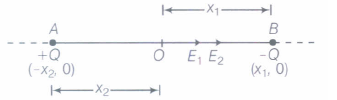
Electric field intensity at Point O due to + Q charge,
\({ E }_{ 1 }=\frac { 1 }{ 4\pi { \varepsilon }_{ o } } \times \frac { Q }{ { \left( { x }_{ 2 } \right) }^{ 2 } } (towards \ B) .....(i)\)
Electric field intensity at Point O due to - Q charge,
\({ E }_{ 2 }=\frac { 1 }{ 4\pi { \varepsilon }_{ o } } \times \frac { Q }{ { \left( { x }_{ 1 } \right) }^{ 2 } } (towards \ B).....(i)\)
\({ \because }\) E1 and E2 act along the same direction.
\({ \because }\) Net electric field intensity at point O,
\(E={ E }_{ 1 }+{ E }_{ 2 }=\frac { 1 }{ 4\pi { \varepsilon }_{ o } } \times \frac { Q }{ { \left( { x }_{ 2 } \right) }^{ 2 } } +\frac { 1 }{ 4\pi { \varepsilon }_{ o } } \times \frac { Q }{ { \left( { x }_{ 1 } \right) }^{ 2 } } (towards \ B)\)
\( E=\frac { Q }{ 4\pi { \varepsilon }_{ o } } \left[ \frac { 1 }{ { x }_{ 2 }^{ 2 } } +\frac { 1 }{ { x }_{ 1 }^{ 2 } } \right] \)
6.
Given, E1 = 2.25 V, l1 = 30 cm
l2 = 60 cm, E2 = ?
As, we know that in the case of the potentiometer, the potential gradient remains constant.
So, E ∝ l
\(\frac { E1 }{ E2 } =\frac { l1 }{ l2 } \) .....(i)
Substituting the given values in Eq.(i), we get
\(\frac { 2.24 }{ E2 } =\frac { 30 }{ 60 } \)
\(E2=\frac { 2.25X60 }{ 30 } =4.5\ V\)
7.
The amplitude modulated radiowaves having frequency 530 kHz to 1710 kHz (or wavelength between 175 m to 566 m) which are travelling directly following the surface of earth are known as ground waves. The short wave communication over long distance is only possible via sky waves. It is not possible via ground waves because the ground waves can bend round the corners of the objects on earth and hence, their intensity falls with distance. Moreover the ground wave transmission becomes weaker as frequency increases.
8.
The saturation current depends upon the maximum number of photoelectrons emitted per second from the photosensitive surface, which in turn dep[ends upon the intensity of incident light. The saturation current is independent of the anode potential as it cannot change the maximum number of electrons emitted from photo-cathode.
9.
(a) As explained in theory, \(\alpha \)-decay is caused by the quantum mechanical tunnelling of an alpha particle through a repulsive Coulomb barrier. The rate of tunnelling would depend upon the height and width of the barrier. The decay cannot be all at once. And that is the reason why half life of \(_{ 92 }{ { U }^{ 238 } }\) against \(\alpha \)-decay is large.
(b) The possible nuclear reaction is \(_{ 92 }{ { U }^{ 238 } }\rightarrow _{ 92 }{ { U }^{ 237 } }+_{ 0 }{ { n }^{ 1 } }\)
The data shows that \(m\left( _{ 92 }{ { U }^{ 237 } } \right) +m\left( n \right) \) is greater than \(m\left( _{ 92 }{ { U }^{ 238 } } \right) .\) Therefore, the decay is not allowed energetically. Rather, some external energy has to be supplied to separate a neutron from \(_{ 92 }{ { U }^{ 238 } }\).
10.
The instantaneous activity of a radioactive sample is given by \(A={ A }_{ 0 }{ e }^{ -\lambda t }\)
Differentiating both sides w.r.t. t, we get \(\frac { dA }{ dt } ={ A }_{ 0 }{ e }^{ -\lambda t }\left( -\lambda \right) =-\lambda { A }_{ 0 }{ e }^{ -\lambda t }=-\lambda A=-\lambda \left( \lambda N \right) =-{ \lambda }^{ 2 }N\)
Using \(\lambda =\frac { 0.693 }{ T } , \ we \ get \ \frac { dA }{ dt } =-{ \left( \frac { 0.693 }{ T } \right) }^{ 2 }N, \ i.e., \ \frac { dA }{ dt } \propto \frac { 1 }{ { T }^{ 2 } } ,\) which was to be proved.
11.
It happens because there 9 is an electric field over A but no electric field over B as it lies inside a hollow conductor. Third law of motion is not violated because force arises between A and the hollow sphere, the charge B is simply an internal part of the sphere.
12.
In LR circuit, the impedance is given by
\({ Z }_{ L }=\sqrt { { R }^{ 2 }+{ X }_{ L }^{ 2 } } \quad ...(i)\)
In LCR circuit, the impedance is given by
\(Z=\sqrt { { R }^{ 2 }+{ \left( { X }_{ L }-{ X }_{ C } \right) }^{ 2 } } \quad ...(ii)\)
From equations, (i) and (ii), we find that
\(Z<{ Z }_{ L }\)
\(since \ I=\frac { E }{ Z } \)
As Z decreases on connecting a capacitor in series with LR circuit, hence the current I in the circuit increases.
13.
Number of turns on the circular coil, n = 20
Radius of the coil,r = 10 cm = 0.1 m
Magnetic field strength, B = 0.10 T
Current in the coil, I = 5.0 A
(a) The total torque on the coil is zero because the field is uniform.
(b) The total force on the coil is zero because the field is uniform.
(c) Cross-sectional area of copper coil, A = 10-5 m2
Number of free electrons per cubic meter in copper, N = 1029 /m3
Charge on the electron, e = 1.6 x 10⁻¹⁹ C
Magnetic force, F = Bevd
Where,
vd = Drift velocity of electrons
\(=\frac{I}{N e A}\)
\(\therefore F=\frac{B e I}{N e A}\)
\(=\frac{0.10 \times 5.0}{10^{29} \times 10^{-5}}=5 \times 10^{-25} \mathrm{~N}\)
Hence, the average force on each electron is 5 x 10-25 N.

12th Standard CBSE Syllabus & Materials
12th Standard CBSE
CBSE 12th Computer Science Python Revision Tour I - New Previous year Question Papers Study Material - QB365 Set A
NEW12th Standard CBSE
CBSE 12th Business Studies Planning Important Questions And Answers Study Material - QB365 Set A
NEW12th Standard CBSE
CBSE 12th Business Studies Business Environment Important Questions And Answers Study Material - QB365 Set A
NEW12th Standard CBSE
CBSE 12th Business Studies Principles of Management Important Questions And Answers Study Material - QB365 Set A



NCERT Books

Syllabus

Exam Pattern

Sample Question Papers

Previous year Question Papers

Important Notes

MCQ Practice test

NCERT Exemplers

Case study Questions

Image Based Questions

Passage based Questions

HOT Questions

Value Based Questions

Model Questions Papers
NCERT ( Book Back ) Questions

Assertion and Reason
Important Questions And Answers

CBSE 12th Standard CBSE Subjects
CBSE Standards









