
 100% FREE ACCESS
12th Standard CBSE Syllabus & Materials
12th Standard CBSE
CBSE 12th Economics Government Budget and the Economy Previous year Question Papers Study Material - QB365 Set A
NEW12th Standard CBSE
CBSE 12th Computer Science Interface Python with MySQL - New Previous year Question Papers Study Material - QB365 Set A
NEW12th Standard CBSE
CBSE 12th Computer Science Database Concept - New Previous year Question Papers Study Material - QB365 Set A
NEW12th Standard CBSE
CBSE 12th Computer Science Data Communication - New Previous year Question Papers Study Material - QB365 Set A
NEW12th Standard CBSE
CBSE 12th Computer Science Data Structures - New Previous year Question Papers Study Material - QB365 Set A
NEW12th Standard CBSE
CBSE 12th Computer Science Functions - New Previous year Question Papers Study Material - QB365 Set A

Published on: 27/05/2021
QB365 Provides the HOT Question Papers for Class 12 Physics, and also provide the detail solution for each and every HOT Questions. HOT Questions will help to get more idea about question pattern in every exams and also will help to get more marks in Exams
Download CBSE Class 12th Standard CBSE Physics question papers, sample papers, important questions, and previous year solved papers in PDF format. Get free study materials, NCERT solutions, and exam preparation resources for Class 12th Standard CBSE Physics
Questions + Answers key
Take MCQ Physics Test1.
In a silicon transistor, a change of 7.89mA in the emitter current produces a change of 7.8 mA in the collector current. What change in the base current is necessary to produce an equivalent change in the collector current?
2.
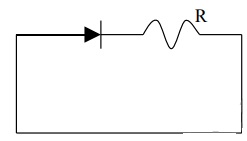
The diode shown in the figure has a constant voltage drop of 0.5V at all currents and a maximum power rating of 100mW. What should be the value of resistance R connected in series, for maximum current.?
3.
(a) Deduce the expression ,N = \({ N }_{ 0 }{ e }^{ -\lambda t }\), for the law of radioactive decay
(b) (i) Write symbolically the process expressing the \({ \beta }^{ + }\) decay of \(_{ 11 }^{ 22 }{ Na }\) . Also write the basic nuclear process underlying this decay.
(ii) Is the nucleus formed in the decay of the nucleus \(_{ 11 }^{ 22 }{ Na }\), an isotope or an isobar?
4.
An audio signal is modulated by a carrier wave of 20 MHz such that the bandwidth required for modulation is 3kHz.Could this wave be demodulated by a diode detector which has the values of R and C as
(i) R=\(1k\Omega ,C=0.01\mu F\)
(ii) R=\(10k\Omega ,C=0.01\mu F\)
(iii) R=\(10k\Omega ,C=1\mu F\)
5.
(i) Light passes through two polaroids \({ P }_{ 1 }and{ P }_{ 2 }\) with pass axis of \({ P }_{ 2 }\) with pass axis of \({ P }_{ 2 }\) making in angle \(\theta \) with the pass axis of \({ P }_{ 1 }\) . For what value of \(\theta \) is the intensity of emergent light zero?
(ii) A third polaroid is placed between \({ P }_{ 1 }and{ P }_{ 2 }\) with its pass axis making an angle \(\beta \) with the pass axis is \({ P }_{ 1 }\) . Find the value of \(\beta \) for which the intensity of light from \({ P }_{ 2 }\) is \(\frac { { I }_{ 0 } }{ 8 } \) , where \({ I }_{ 0 }\) is the intensity of light on the polaroid \({ P }_{ 1 }\) .
6.
An electron, \(\alpha \) -particle and a proton have the same de-Broglie wavelengths. Which of
theseparticle has
(i) minimum kinetic energy?
(ii) maximum kinetic energy and why?
In what way has the wave nature of electron beam exploited in an electron microscope?
7.
(i) How is the electric field due to a charged parallel plate capacitor affected, when a dielectric slab is inserted between the plates fully occupying the intervening region?
(ii) A slab of material of dielectric constant K has the same area as the plates of a parallel plate capacitor but has thickness \(\frac{1}{2}\) d, where d is the separation between the plates. Find the expression for the capacitance when the slab is inserted between the plates.
8.
Show that the force on each plate of a parallel plate capacitor has a magnitude equal to1/2 QE. where Q is the charge on the capacitor and E is the magnitude of electric field between the plates. Explain the origin of the factor 1/2.
Here, we can use the content that the work done in displacing the plates against the force is equal to the increase in energy of the capacitor.
9.
An electromagnetic wave is travelling in vacum with a speed 3 x 10⁸ m / s. Find its velocity in a medium having relative electric and magnetic permeability 2 and 1, respectively.
10.
Explain that microwaves are better carriers of signals than radio waves?
11.
A small metal plate of work function \(\phi \)is kept at a distance r from a singly ionised, fixed ion. A monochromit light beam is incident on the metal plate and photoelectrons are emitted. Find maximum wavelength of the light beam so that some of the electrons may go round the ion along a circle.
12.
A positronium atom is a bound state of an electron \(\left( { e }^{ - } \right) \) and its antiparticle, the positron \(\left( { e }^{ + } \right) \) revolving round their centre of mass. In which part of the em spectrum does the system radiate when it de-excites from its first excited state to the ground state?
13.
An infinite number of charges each equal to q, are placed along X-axis at x = 1, x = 2, x = 4, x = 8, ............... and so on.
(i) Find the electric field at a point x = 0 due to this set up of charges.
(ii) What will be the electric field if in the above set up the consecutive charges have opposite signs.
14.
A 12 V resistance and an inductance of \(\frac { 0.05 }{ \pi } H\) are connected in series.Across the end of this ciuit an alternating voltage of 130 V and frequency 50 Hz is connected. Calculate the current in the circuit and the potential difference across the inductance.
1.
\(\triangle\)Ie = 7.89 x 10⁻³ A
\(\triangle\)Ic = 7.8 x 10⁻³ A
Now \(\alpha\)a.c = \(\triangle\)Ic / \(\triangle\)Ie = 0.9886
We have,
\(\beta\)ac = \(\alpha\)ac / (1- \(\alpha\)ac) = 86.72
Also,
\(\beta\)ac = \(\triangle\)Ic/ \(\triangle\)Ib
\(\therefore\) \(\triangle\)Ib = Ic/\(\beta\)ac
\(\triangle\)Ib = (7.8 x 10⁻³)/(86.72)
\(\triangle\)Ib = 89.94 x 10⁻⁶A
2.
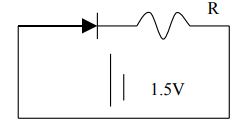
e.m.f of the source , E = 1.5
Voltage drop across the diode , Vd = 0.5 V
Maximum power rating of the diode
I = (P / Vd)
I = 0.2A
Potential drop across resistance R
V = E - Vd
= 1 V
R = V/1 = 1/0.2 = 5 \(\Omega \)
3.
(a) \(\frac { dN }{ dt } =-\lambda N\)
\(\int _{ { N }_{ 0 } }^{ N }{ \frac { dN }{ N } =\int _{ 0 }^{ t }{ -\lambda dt } } \)
\(\left[ { log }_{ e }^{ N } \right] _{ { N }_{ 0 } }^{ N }=-\lambda \left[ t \right] _{ 0 }^{ t }\)
\(loge\frac { N }{ { N }_{ 0 } } =-\lambda t\)
\(N={ N }_{ 0 }{ e }^{ -\lambda t }\)
(b) (i) \(_{ 11 }^{ 22 }{ Na }\rightarrow _{ 10 }^{ 22 }Ne+{ e }^{ x }+\upsilon \)
Also accept,if a student does not identify the product nucleus and writes as
\(_{ 11 }^{ 22 }{ Na }\rightarrow _{ 10 }^{ 22 }Xe+{ e }^{ x }+\upsilon \)
Basic process
\(p\rightarrow n+{ e }^{ + }+\upsilon \)
(ii) Isobar
4.
Give ,carrier wave frequency
\({ f }_{ c }=20MHz=20\times { 10 }^{ 6 }Hz\)
Bandwidth required for modulation is
\({ 2f }_{ m }=3kHz=3\times { 10 }^{ 3 }Hz\)
\(\Rightarrow \ \ { f }_{ m }=\frac { 3\times { 10 }^{ 3 } }{ 2 } =1.5\times { 10 }^{ 3 }Hz\) s
Demodulation by a diode is possible,if the condition
Thus,\(\frac { 1 }{ { f }_{ c } } =\frac { 1 }{ 20\times { 10 }^{ 6 }Hz } =0.5\times { 10 }^{ -7 }s\) .....(i)
and \(\frac { 1 }{ { f }_{ m } } =\frac { 1 }{ 1.5\times { 10 }^{ 3 }Hz } =0.7\times { 10 }^{ -3 }s\) ......(ii)
Now,gain through all the option of R and C one by one,we get
(i) \(RC=1k\Omega \times 0.01\mu F\)
\(\\ ={ 10 }^{ 3 }\Omega \times ({ 0.01 }\times { 10 }^{ -6 }F)={ 10 }^{ -5 }s\)
Here, condition \(\frac { 1 }{ { f }_{ c } } <\) is satisfied
Hence, it can be demodulated.
(ii) \((RC=1k\Omega \times 0.01\mu F={ 10 }^{ 4 }\Omega \times { 10 }^{ -8 }F={ 10 }^{ -4 }s)\)
Here, condition\(\frac { 1 }{ { f }_{ c } }\) <
Hence, it can be demodulated
(iii) \(RC=10k\Omega \times 1\mu F={ 10 }^{ 4 }\Omega \times { 10 }^{ -6 }F={ 10 }^{ -2 }s\)
Here, condition\(\frac { 1 }{ { f }_{ c } } >RC,\) so this cannot be demodulated.
5.
(i) By Malus law, intensity of emergent light from \({ P }_{ 2 }\) is \(I={ I }_{ \circ }cos^{ 2 }\theta \) , where \(\theta \) is the angle between \({ P }_{ 1 }and{ P }_{ 2 }\)|
When \(\theta ={ 90 }^{ \circ }\)
\(\\ I={ I }_{ \circ }\times 0\)
Intensity of emergent light, I = 0
(ii) Intensity of light from \({ P }_{ 3 }\)
\(=\left( \frac { { I }_{ \circ } }{ 2 } cos^{ 2 }\beta \right) \left[ cos^{ 2 }\left( { 90 }^{ \circ }-\beta \right) \right] \)
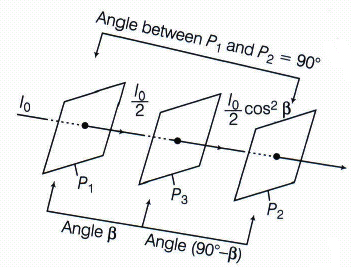
\(=\frac { { I }_{ \circ } }{ 2 } cos^{ 2 }\beta sin^{ 2 }\beta =\frac { { I }_{ \circ } }{ 8 } sin^{ 2 }2\beta \)
\(As,\ \frac { { I }_{ \circ } }{ 8 } sin^{ 2 }2\beta =\frac { { I }_{ \circ } }{ 8 } (given)\)
\(so, \ \left( sin2\beta \right) ^{ 2 }=1 \ \Rightarrow 2\beta ={ 90 }^{ \circ } \ \Rightarrow \beta ={ 45 }^{ \circ }\)
6.
de-Broglie matter wave equation,
\(\lambda =\frac { h }{ p } =\frac { h }{ \sqrt { 2mK } } \ \left[ \because K=\frac { { P }^{ 2 } }{ 2m } \right] \)
where K is kinetic energy and m is a mass of the particle.
\(K=\frac { { h }^{ 2 } }{ 2m{ \lambda }^{ 2 } } \) [ for same wavelength \( \lambda] \)
\(K\propto \frac { 1 }{ m }\)
\(\Rightarrow \ { K }_{ e }:{ K }_{ \alpha }:{ K }_{ p }=\frac { 1 }{ { m }_{ e } } :\frac { 1 }{ { m }_{ \alpha } } :\frac { 1 }{ { m }_{ p } } \)
where \({ m }_{ e },{ m }_{ p } \ and \ { m }_{ \alpha }\) are masses of electron, proton and \(\alpha \) -particle, respectively.
Also, \({ K }_{ e },k_{ p } \ and \ K_{ \alpha }\) are their respective kinetic energies.
\(\because \ m_{ \alpha }>m_{ p }>m_{ e }\)
\(\\ \Rightarrow m_{ \alpha }m_{ p }>m_{ e }m_{ \alpha }>m_{ e }m_{ p }\)
\(\\ { K }_{ e }>k_{ p }>K_{ \alpha }\)
(i) \(\alpha \) particle possess minimum kinetic energy
(ii) The electron has maximum kinetic energy. The magnifying power of an electron microscope is inversely related to the wavelength of radiation used. The Smaller wavelength of the electron beam in comparison to visible light increases the magnifying power of the microscope.
7.
(i) The total charge of the capacitor remains conserved on introduction of dielectric slab. Also, the capacitance of capacitor increases to K times of original values.
\(\therefore \\ \) CV = C' V '= (KC) V' \(\Rightarrow V'=\frac { V }{ K } \)
\(\therefore \\ \) New electric field,
\(E'=\frac { V' }{ d } =\left( { \frac { { V }/{ K } }{ d } } \right) =\left( \frac { V }{ d } \right) \frac { 1 }{ k } =\frac { E }{ K } \)
\(\therefore \\ \) On introduction of dielectric medium, new electric field E' becomes \(\frac { 1 }{ K } \) times of its original value (decrease).
(ii) The thickness of dieletric slab is \(\frac{d}{2}, \text { i.e. } t=\frac{d}{2}\)
The capacitance of a capacitor due to dielectric slab,
\(\begin{aligned}
C & =\frac{\varepsilon_0 A}{d-t+\frac{t}{K}}
\end{aligned}\)
\(\begin{aligned}
=\frac{\varepsilon_0 A}{d-\frac{d}{2}+\frac{d}{2 K}}=\frac{2 \varepsilon_0 A}{d\left(1+\frac{1}{K}\right)}
\end{aligned}\)
8.
Let the distance between the plates be increased by a very small distance\(\triangle x\) = Force x Increased distance
= F.\(\Delta x\) ...(i)
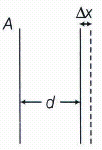
Increase in volume of capacitor
= Area of plates x Increased distance
= A.\(\Delta x\)
u = Energy density = \(\frac { Energy }{ Volume } \)
Increase in energy = u x voulme = u.A.\(\Delta x\) .....(ii)
As, Energy = Work done
F.\(\Delta x\) = u.A.\(\Delta x\) \([\because From \ Eqs.(i) \ and \ (ii)]\)
\(\Rightarrow\) F = u.A
\(=\frac { 1 }{ 2 } \varepsilon _{ 0 }{ E }^{ 2 }.A\quad [\because u=\frac { 1 }{ 2 } \varepsilon _{ 0 }{ E }^{ 2 } \ and \ E=\frac { V }{ d } ]\)
\(=\frac { 1 }{ 2 } \varepsilon _{ 0 }.\frac { { V }^{ 2 } }{ { d }^{ 2 } } .A=\left( \frac { { \varepsilon }_{ 0 }A }{ d } .A \right) \frac { V }{ d } \times \frac { 1 }{ 2 } \)
\(=\frac { 1 }{ 2 } .E.C.V=\frac { 1 }{ 2 } QE \ [\because C=\frac { { \varepsilon }_{ 0 }A }{ d } ,CV=Q]\)
9.
Given, velocity of electromagnetic wave in vacum, c = 3 X 10⁸ m / s
Relative electric permeability,\(\varepsilon _{ r }\) = 2
and magnetic permeability, \(\mu _{ r }\) = 1
Since, velocity of electromagnetic wave in a medium can be calculated by
v = \(\frac { 1 }{ \sqrt { \varepsilon _{ 0 }\varepsilon _{ r }\mu _{ 0 }\mu _{ r } } } =\frac { 1 }{ \sqrt { \varepsilon _{ 0 }\mu _{ 0 } } \quad x \quad \sqrt { \mu _{ r }\varepsilon _{ r } } } \)
Where,
\(\frac { 1 }{ \sqrt { \varepsilon _{ 0 }\mu _{ 0 } } } =c \ \Rightarrow \ v \ = \ \frac { c }{ \sqrt { \mu _{ r }\varepsilon _{ r } } } \) ...(i)
Therefore, v \(=\frac { 3x10^{ 8 } }{ \sqrt { 2x1 } } \Rightarrow \) \(v=\frac { 3 }{ \sqrt { 2 } } \times10^{ 8 }\) m/s.
10.
Microwaves are the electromagnetic waves of wavelength of the order of a few millimeters, which is less than those of T.V. signals. On account of smaller wavelength, the microwaves can be transmitted as beam signals in a particular direction, much better than radiowaves because microwaves do not spread or bend around the corners of any obstacle coming in their way. Therefore, microwaves are better carriers of signals than radio waves.
11.
If electron is to move around the ion in circular path of radius r, then
Kinetic energy of electron,
\(\frac { 1 }{ 2 } { mv }^{ 2 }=\frac { { e }^{ 2 } }{ 2\times 4\pi { \epsilon }_{ 0 }r } =\frac { { e }^{ 2 } }{ 8\pi { \epsilon }_{ 0 }r }\)
\(As \ \frac { 1 }{ 2 } { { mv }^{ 2 } }_{ max }=\frac { hc }{ \lambda } -\phi \ \therefore \ \frac { { e }^{ 2 } }{ 8\pi { \epsilon }_{ 0 }r } =\frac { hc }{ \lambda } -\phi \ or \ \frac { hc }{ \lambda } =\frac { { e }^{ 2 } }{ 8\pi { \epsilon }_{ 0 }r } +\phi =\frac { { e }^{ 2 }+8\pi { \epsilon }_{ 0 }r\phi }{ 8\pi { \epsilon }_{ 0 }r } \)
\( \lambda =\frac { 8\pi { \epsilon }_{ 0 }rhc }{ { e }^{ 2 }+8\pi { \epsilon }_{ 0 }r\phi } \)
12.
In an ordinary atom, as a first approximation, we ignore the motion of the nucleus, being too heavy. In a positronium atom, a positron replaces proton of hydrogen atom. As electron and positron masses are equal, the motion of the positron cannot be ignored. We consider motion of electron and positron about their centre of mass. A detailed analysis (beyond the scope of this book) shows that formulae of Bohr model apply to positronium atom provided that we replace \({ m }_{ e }\) by what is known as reduced mass of the electron. For positronium, the reduced mass is \({ m }_{ e }/2.\) In the transition n = 2 to n = 1, the wavelength of radiation emitted is double than that of the corresponding radiation emitted for a similar transition in hydrogen atom, which has a wavelength of \(1217\mathring { A } \) ; and hence is equal to \(2\times 1217=2434\mathring { A } .\) This radiation lies in the ultra-violet part of the electromagnetic spectrum.
13.
(i) Electric field at x = 0
\(E={1\over 4\pi \epsilon_o}[{q\over 1^2}+{q\over 2^2}+{q\over 4^2}+....]\)
\(={q\over 4\pi\epsilon_o}[{1\over 1-1/4}]={q\over 3\pi\epsilon_o}\)
(ii) If consecutive charges have opposite signs, then at x = 0,
Electric field, \(E'={q\over 4\pi\epsilon_o}[{1\over 1^2}-{1\over 4}+{1\over 16}-{1\over 64}+....]^\times\)
\(E'={q\over 4\pi\epsilon_o}[{1\over 1-(-1/4)}]={q\over 5\pi\epsilon_o}\)
14.
\( { I }_{ v }=\frac { { E }_{ v } }{ Z } =\frac { 130 }{ 2 } \ \ ...(i)\)
\(Since \ \ Z=\sqrt { { R }^{ 2 }+{ X }_{ L }^{ 2 } } =\sqrt { { \left( 12 \right) }^{ 2 }{ +\left( 2\pi vL \right) }^{ 2 } }\)
\(=\sqrt { { \left( 12 \right) }^{ 2 }+{ \left( 2\pi \times 50\times \frac { 0.05 }{ \pi } \right) }^{ 2 } } \)
\(or \ Z=\sqrt { 144+{ \left( 5 \right) }^{ 2 } } =13\Omega \)
\(So \ \ { I }_{ v } \ =\frac { 130 }{ 13 } =10 \ A\)
\(\\ And \ \ { E }_{ L }={ X }_{ L }I=5\times 10=50 \ V\)

12th Standard CBSE Syllabus & Materials
12th Standard CBSE
CBSE 12th Computer Science Python Revision Tour I - New Previous year Question Papers Study Material - QB365 Set A
NEW12th Standard CBSE
CBSE 12th Business Studies Planning Important Questions And Answers Study Material - QB365 Set A
NEW12th Standard CBSE
CBSE 12th Business Studies Business Environment Important Questions And Answers Study Material - QB365 Set A
NEW12th Standard CBSE
CBSE 12th Business Studies Principles of Management Important Questions And Answers Study Material - QB365 Set A



NCERT Books

Syllabus

Exam Pattern

Sample Question Papers

Previous year Question Papers

Important Notes

MCQ Practice test

NCERT Exemplers

Case study Questions

Image Based Questions

Passage based Questions

HOT Questions

Value Based Questions

Model Questions Papers
NCERT ( Book Back ) Questions

Assertion and Reason
Important Questions And Answers

CBSE 12th Standard CBSE Subjects
CBSE Standards









