
 100% FREE ACCESS
12th Standard CBSE Syllabus & Materials
12th Standard CBSE
CBSE 12th Economics Government Budget and the Economy Previous year Question Papers Study Material - QB365 Set A
NEW12th Standard CBSE
CBSE 12th Computer Science Interface Python with MySQL - New Previous year Question Papers Study Material - QB365 Set A
NEW12th Standard CBSE
CBSE 12th Computer Science Database Concept - New Previous year Question Papers Study Material - QB365 Set A
NEW12th Standard CBSE
CBSE 12th Computer Science Data Communication - New Previous year Question Papers Study Material - QB365 Set A
NEW12th Standard CBSE
CBSE 12th Computer Science Data Structures - New Previous year Question Papers Study Material - QB365 Set A
NEW12th Standard CBSE
CBSE 12th Computer Science Functions - New Previous year Question Papers Study Material - QB365 Set A

Published on: 21/05/2021
QB365 Provides the updated CASE Study Questions for Class 12 , and also provide the detail solution for each and every case study questions . Case study questions are latest updated question pattern from NCERT, QB365 will helps to get more marks in Exams
Download CBSE Class 12th Standard CBSE Physics question papers, sample papers, important questions, and previous year solved papers in PDF format. Get free study materials, NCERT solutions, and exam preparation resources for Class 12th Standard CBSE Physics
Questions + Answers key
Take MCQ Physics Test
1.
The field of a hollow wire with constant current is homageneous
Curves in the graph shown give, as functions of radius distance r, the magnitude B of the magnetic field inside and outside four long wires a, b, c and d, carrying currents that are uniformly distributed across the cross sections of the wires. Overlapping portions of the plots are indicated by double labels.
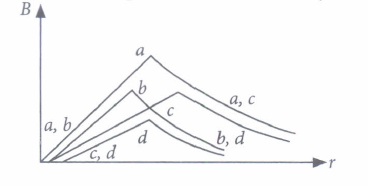
(i) Which wire has the greatest magnitude of the magnetic field on the surface?
| (a) a | (b) b | (c) c | (d) d |
(ii) The current density in a wire a is
| (a) greater than in wire c |
| (b) less than in wire |
| (c) equal to that in wire c |
| (d) not comparable to that of in wire c due to lack of information |
(iii) Which wire has the greatest radius?
| (a) a | (b) b | (c) c | (d) d |
(iv) A direct current I flows along the length of an infinitely long straight thin walled pipe, then the magnetic field is
| (a) uniform throughout the pipe but not zero |
| (b) zero only along the axis of the pipe |
| (c) zero at any point inside the pipe |
| (d) maximum at the centre and minimum at the edges |
(v) In a coaxial, straight cable, the central conductor and the outer conductor carry equal currents in opposite direction. The magnetic field is zero
| (a) outside the cable | (b) inside the inner conductor |
| (c) inside the outer conductor | (d) in between the two conductor. |
2.
The magnetic field lines of the earth resemble that of a hypothetical magnetic dipole located at the centre of the earth. The axis of the dipole is presently tilted by approximately 11.3o with respect to the axis of rotation of the earth.
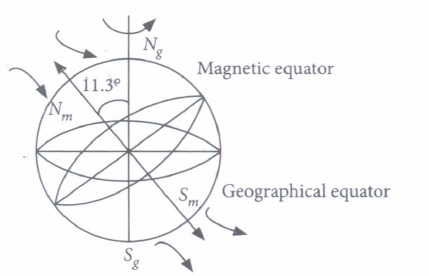
The pole near the geographic North pole of the earth is called the North magnetic pole and the pole near the geographic South pole is called South magnetic pole.
(i) The strength of the earth's magnetic field varies from place to place on the earth's surface, its value being of the order of
| (a) 105 T | (b) 10-6T | (c) 10-5 T | (d) 108 T |
(ii) A bar magnet is placed North-South with its North-pole due North. The points of zero magnetic field will be in which direction from centre of magnet?
| (a) North-South | (b) East-West |
| (c) North-East and South-West | (d) None of these. |
(iii) The value of angle of dip is zero at the magnetic equator because on it
| (a) V and H are equal | (b) the values of Vand H zero |
| (c) the value of V is zero | (d) the value of H is zero . |
(iv) The angle of dip at a certain place, where the horizontal and vertical components of the earth's magnetic field are equal, is
| (a) 30° | (b) 90° | (c) 60° | (d) 45° |
(v) At a place, angle of dip is 30°. If horizontal component of earth's magnetic field is H, then the total intensity of magnetic field will be
| (a) \(\frac{H}{2}\) | \(\text { (b) } \frac{2 H}{\sqrt{3}}\) | \(\text { (c) } H \sqrt{\frac{3}{2}}\) | (d) 2H |
3.
When the atomic dipoles are aligned partially or fully, there is a net magnetic moment in the direction of the field in any small volume of the material. The actual magnetic field inside material placed in magnetic field is the sum of the applied magnetic field and the magnetic field due to magnetisation. This field is called magnetic intensity (H).
\(H=\frac{B}{\mu_{0}}-M\)
where M is the magnetisation of the material, llo is the permittivity of vacuum and B is the total magnetic field. The measure that tells us how a magnetic material responds to an external field is given by a dimensionless quantity is appropriately called the magnetic susceptibility: for a certain class of magnetic materials, intensity of magnetisation is directly proportional to the magnetic intensity.
(i) Magnetization of a sample is
| (a) volume of sample per unit magnetic moment | (b) net magnetic moment per unit volume |
| (c) ratio of magnetic moment and pole strength | (d) ratio of pole strength to magnetic moment |
(ii) Identify the wrongly matched quantity and unit pair.
| (a) Pole strength | Am |
| (b) Magnetic susceptibility | dimensionless number |
| (c) Intensity of magnetisation | A m-1 |
| (d) Magnetic permeability | Henry m |
(iii) A bar magnet has length- 3 cm, cross-sectional area 2 cm2 and magnetic moment 3 A m2. The intensity of magnetisation of bar magnet is
| \(\text { (a) } 2 \times 10^{5} \mathrm{~A} / \mathrm{m}\) | \(\text { (b) } 3 \times 10^{5} \mathrm{~A} / \mathrm{m}\) |
| \(\text { (c) } 4 \times 10^{5} \mathrm{~A} / \mathrm{m}\) | \(\text { (d) } 5 \times 10^{5} \mathrm{~A} / \mathrm{m}\) |
(iv) A solenoid has core of a material with relative permeability 500 and its windings carry a current of 1 A. The number of turns of the solenoid is 500 per metre. The magnetization of the material is nearly
| \(\text { (a) } 2.5 \times 10^{3} \mathrm{Am}^{-1}\) | \(\text { (b) } 2.5 \times 10^{5} \mathrm{~A} \mathrm{~m}^{-1}\) |
| \(\text { (c) } 2.0 \times 10^{3} \mathrm{~A} \mathrm{~m}^{-1}\) | \(\text { (d) } 2.0 \times 10^{5} \mathrm{~A} \mathrm{~m}^{-1}\) |
(v) The relative permeability of iron is 6000. Its magnetic susceptibility is
| (a) 5999 | (b) 6001 |
| (c) 6000 x 10-7 | (d) 6000 x 107 |
4.
By analogy to Gauss's law of electrostatics, we can write Gauss's law of magnetism as \(\oint \vec{B} \cdot d \vec{s}=\mu_{0} m_{\text {inside }}\) where \(\oint \vec{B} \cdot d \vec{s}\) is the magnetic flux and \(m_{\text {inside }}\) is the net pole strength inside the closed surface.
We do not have an isolated magnetic pole in nature. At least none has been found to exist till date. The smallest unit of the source of magnetic field is a magnetic dipole where the net magnetic pole is zero. Hence, the net magnetic pole enclosed by any closed surface is always zero. Correspondingly, the flux of the magnetic field through any closed surface is zero.
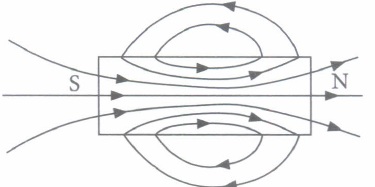
(I) Consider the two idealised systems
(i) a parallel plate capacitor with large plates and small separation and
(ii) a long solenoid oflength L >> R, radius of cross-section.
In (i) \(\vec{E}\) is ideally treated as a constant between plates and zero outside. In (ii) magnetic field is constant inside the solenoid and zerq outside. These idealised assumptions, however, contradict fundamental laws as below
| (a) case (i) contradicts Gauss's law for electrostatic fields |
| (b)case (ii) contradicts Gauss's aw for magnetic fields |
| \(\text { (c) case (i) agrees with } \oint \vec{E} \cdot \overrightarrow{d l}=0 \text { . }\) |
| \(\text { (d) case (ii) contradicts } \oint \vec{H} \cdot \overrightarrow{d l}=I_{e n}\) |
(ii) The net magnetic flux through any closed surface, kept in a magnetic field is
| (a) zero | \(\text { (b) } \frac{\mu_{0}}{4 \pi}\) | \(\text { (c) } 4 \pi \mu_{0}\) | \(\text { (d) } \frac{4 \mu_{0}}{\pi}\) |
(iii) A closed surface S encloses a magnetic dipole of magnetic moment 2ml. The magnetic flux emerging from the surface is
| \(\text { (a) } \mu_{0} m\) | (b) zero | \(\text { (c) } 2 \mu_{0} m\) | \(\text { (d) } \frac{2 m}{\mu_{0}}\) |
(iv) Which of the following is not a consequence of Gauss's law?
| (a) The magnetic poles always exist as unlike pairs of equal strength. |
| (b) If several magnetic lines of force enter in a closed surface, then an equal number of lines of force must leave that surface |
| (c) There are abundant sources or sinks of the magnetic field inside a closed surface |
| (d) Isolated magnetic poles do not exist |
(v) The surface integral of a magnetic field over a surface
| (a) is proportional to mass enclosed | (b) is proportional to charge enclosed |
| (c) is zero | (d) equal to its magnetic flux through that surface. |
5.
The earth's magnetic field at a point on its surface is usually characterised by three quantities: (a) declination (b) inclination or dip and (c) horizontal component of the field. These are known as the elements of the earth's magnetic field. At a place, angle between geographic meridian and magnetic meridian is defined as magnetic declination, whereas angle made by the earth's magnetic field with the horizontal in magnetic meridian is known as magnetic dip.
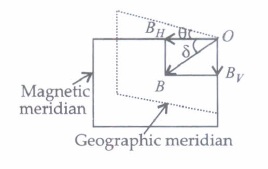
(i) In a certain place, the horizontal component of magnetic field is \(\frac{1}{\sqrt{3}}\) times the vertical component. The angle of dip at this place is
| (a) zero | \(\text { (b) } \pi / 3\) | \(\text { (c) } \pi / 2\) | \(\text { (d) } \pi / 6\) |
(ii) The angle between the true geographic north and the north shown by a compass needle is called as
| (a) inclination | (b) magnetic declination |
| (c) angle of meridian | (d) magnetic pole |
(iii) The angles of dip at the poles and the equator respectively are
| (a) 30°,60° | (b) 0°,90° | (c) 45°,90° | (d) 90°,0° |
(iv) A compass needle which is allowed to move in a horizontal plane is taken to a geomagnetic pole. It
| (a) will become rigid showing no movement |
| (b) will stay in any position |
| (c) will stay in north-south direction only |
| (d) will stay in east-west direction only. |
(v) Select the correct statement from the following
| (a) The magnetic dip is zero at the centre of the earth |
| (b) Magnetic dip decreases as we move away from the equator towards the magnetic pole |
| (c) Magnetic dip increases as we move away from the equator towards the magnetic pole |
| (d) Magnetic dip does not vary-from place to place. |
1.
(i) (a): It can be seen that slop of curve for wire a is greater than wire c.
(ii) (b): Inside the wire
The field of a hollow wire with constant current is homageneous
\(\text { i.e., slope } \propto \frac{I}{\pi R^{2}} \text { , }\) Current density
(iii) (c) : Wire c has the greatest radius.
(iv) (c)
(v) (a)
2.
(i) (c)
(ii) (b)
(iii) (c) : At equator vertical component of magnetic fields is zero.
(iv) (d): Given: V = H
\(\therefore \tan \delta=\frac{V}{H}=1 \text { or } \delta=45^{\circ}\)
(v) (b): Given : Biot-Savart law can be expressed alternatively as Ampere circuital law
3.
(i) (b)
(ii) (d): Magnetic permeability - Henry m-1
(iii) (d): Given, L= 3 cm, A = 2 cm2, M = 3 A m2
.Intensity of magnetisation \(=\frac{M}{l A}=\frac{3}{3 \times 10^{-2} \times 2 \times 10^{-4}}\)
\(=\frac{1}{2 \times 10^{-6}}=0.5 \times 10^{6}=5 \times 10^{5} \mathrm{~A} / \mathrm{m}\)
(iv) (b): Here, n = 500 turns/m
\(I=1 \mathrm{~A}, \mu_{-}=500\)
Magnetic intensity \(H=n I=500 \mathrm{~m}^{-1} \times 1 \mathrm{~A}=500 \mathrm{~A} \mathrm{~m}^{-1}\)
As \(\mu_{r}=1+\chi \quad \text { or } \chi=\left(\mu_{r}-1\right)\)
Magnetisation, M = XH
\(=\left(\mu_{r}-1\right) H=(500-1) \times 500 \mathrm{~A} \mathrm{~m}^{-1}\)
\(=2.495 \times 10^{5} \mathrm{~A} \mathrm{~m}^{-1} \approx 2.5 \times 10^{5} \mathrm{~A} \mathrm{~m}^{-1}\)
(v) (a): Relative permeability of iron \(\mu_{r}=6000\)
Magnetic susceptibility \(\chi_{m}=\mu_{r}-1=5999\)
4.
(i) (b): According to Gauss's law in magnetism \(\oint \vec{B} \cdot \overrightarrow{d S}=0\) which implies that number of magnetic field lines entering the Gaussian surface is equal to the number of magnetic field lines leaving it. Therefore, case (ii) is not possible.
(ii) (a): The net magnetic flux through a closed surface will be zero, i.e. \(\oint \vec{B} \cdot d \vec{s}=0\) because there are no magnetic monopoles.
(iii) (b)
(iv) (c): Gauss's law indicates that there are no sources or sinks of the magnetic field inside a closed surface. In other words, there a~e no free magnetic charges.
(v) (d): The surface integral of a magnetic field over a surface gives magnetic flux through that surface.
5.
(i) (b): \(\tan \theta=\frac{B_{V}}{B_{H}} \text { and } B_{H}=\frac{B_{V}}{\sqrt{3}}\)
\(\therefore \tan \theta=\sqrt{3} \quad \text { i.e. } \quad \theta=\frac{\pi}{3}\)
(ii) (b): The angle between the true geographic north and the north shown by a compass needle is called as magnetic declination or simply declination.
(iii) (d): Since angle of dip at a place is defined as the angle \(\delta\) which is the direction of total intensity of earth's magnetic field 13 makes with a horizontal line in magnetic meridian
At poles \(B=B_{V} \text { and } B_{V}=B \sin \delta \therefore \sin \delta=1 \Rightarrow \delta=90^{\circ}\)
At equator \(B=B_{H} \text { and } B_{H}=B \cos \delta\)
\(\therefore \cos \delta=1 \Rightarrow \delta=0^{\circ}\)
(iv) (a): A compass needle which is allowed to move in a horizontal plane is taken to a geomagnetic pole. It will stay in any position as the horizontal component of earth's magnetic field becomes zero at the geomagnetic pole.
(v) (c): At equator \(\delta=0^{\circ}\)
At poles \(\delta=90^{\circ}\)
\(\therefore \delta\) Sincreases as we move from equator towards poles.

12th Standard CBSE Syllabus & Materials
12th Standard CBSE
CBSE 12th Computer Science Python Revision Tour I - New Previous year Question Papers Study Material - QB365 Set A
NEW12th Standard CBSE
CBSE 12th Business Studies Planning Important Questions And Answers Study Material - QB365 Set A
NEW12th Standard CBSE
CBSE 12th Business Studies Business Environment Important Questions And Answers Study Material - QB365 Set A
NEW12th Standard CBSE
CBSE 12th Business Studies Principles of Management Important Questions And Answers Study Material - QB365 Set A



CBSE 12th Standard CBSE Subjects
CBSE Standards










