
 100% FREE ACCESS
12th Standard CBSE Syllabus & Materials
12th Standard CBSE
CBSE 12th Economics Government Budget and the Economy Previous year Question Papers Study Material - QB365 Set A
NEW12th Standard CBSE
CBSE 12th Computer Science Interface Python with MySQL - New Previous year Question Papers Study Material - QB365 Set A
NEW12th Standard CBSE
CBSE 12th Computer Science Database Concept - New Previous year Question Papers Study Material - QB365 Set A
NEW12th Standard CBSE
CBSE 12th Computer Science Data Communication - New Previous year Question Papers Study Material - QB365 Set A
NEW12th Standard CBSE
CBSE 12th Computer Science Data Structures - New Previous year Question Papers Study Material - QB365 Set A
NEW12th Standard CBSE
CBSE 12th Computer Science Functions - New Previous year Question Papers Study Material - QB365 Set A

Published on: 23/05/2021
QB365 Provides the updated NCERT Exemplar Questions for Class 12, and also provide the detail solution for each and every case study questions. NCERT Exemplar questions are latest updated question pattern from NCERT, QB365 will helps to get more marks in Exams
Download CBSE Class 12th Standard CBSE Physics question papers, sample papers, important questions, and previous year solved papers in PDF format. Get free study materials, NCERT solutions, and exam preparation resources for Class 12th Standard CBSE Physics
Questions + Answers key
Take MCQ Physics Test1.
A proton has spin and magnetic moment just like an electron. Why then its effect is neglected in magnetism of materials?
2.
A ball of superconducting matesial is dipped in liquid nitrogen and placed near a bar magnet.
(i) In which direction will it move?
(ii) What will be the direction of its magnetic moment?
3.
From molecular view point, discuss the temperature dependence of susceptibility for diamagnetism, paramagnetism and ferromagnetism.
4.
Consider the plane S formed by the dipole axis and the axis of the earth. Let P be point on the magnetic equator in S. Let Q be the point of intersection of the geographical and magnetic equators. Obtain the declination and dip angles at P and Q.
1.
As we know that, the magnetic moment of electron or proton is inversely proportional to the mass of electron or proton, respectively.
Magnetic. moment of electron, \(\mu_{e} \text { oc } \frac{1}{m_{e}}\)
where, me = mass of electron
Magnetic moment of proton, \(\mu_{p} \propto \frac{1}{m_{p}}\)
where, mp = mass of proton
\(\frac{\mu_{e}}{\mu_{p}}=\frac{m_{p}}{m_{e}}\) .......(i)
As, we know that, me < < mp
So, \(\frac{m_{p}}{m_{e}}>>1 \Rightarrow \frac{\mu_{e}}{\mu_{p}}>>1\)
\(\Rightarrow\) \(\mu_{e}>>\mu_{p}\)
Thus, as the value of magnetic moment of electron is much more as compared to magnetic moment of proton, so the effect of proton is neglected.
2.
Both a superconducting material and nitrogen are diamagnetic in nature. When a ball of superconducting material is dipped in liquid nitrogen, it behaves as a diamagnetic material. When placed near a bar magnet, it will be feebly magnetised opposite to the direction of magnetising field.
Because of this,
(i) it will be repelled (i.e. move away from magnet)
(ii) the direction of magnetic moment will be opposite to the direction of magnetic field of bar magnet.
3.
Susceptibility of magnetic material \(\chi=\frac{I}{H}\) where I is the intensity of magnetisation induced in the material and H is the magnetising force.
Diamagnetism is due to orbital motion of electrons in an atom developing magnetic moments opposite to applied field. Thus, the resultant magnetic moment of the diamagnetic material is zero and hence, the susceptibility X of diamagnetic material is not much affected by temperature.
Paramagnetism and ferromagnetism is due to alignment of atomic magnetic moments in the direction of the applied field. As temperature is raised, the alignment is disturbed, resulting decrease in susceptibility of both with increase in temperature.
4.
P is in the plane of S, needle is in North, so the declination is zero.
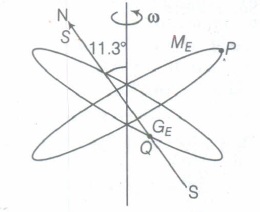
P is also on the magnetic equator, so the angle of dip is zero, because the value of angle of dip at equator is zero. Q is also on the magnetic equator, so the angle of dip is zero.
As, the earth is tilted on its axis by 113°, thus the declination at Q is 113°.

12th Standard CBSE Syllabus & Materials
12th Standard CBSE
CBSE 12th Computer Science Python Revision Tour I - New Previous year Question Papers Study Material - QB365 Set A
NEW12th Standard CBSE
CBSE 12th Business Studies Planning Important Questions And Answers Study Material - QB365 Set A
NEW12th Standard CBSE
CBSE 12th Business Studies Business Environment Important Questions And Answers Study Material - QB365 Set A
NEW12th Standard CBSE
CBSE 12th Business Studies Principles of Management Important Questions And Answers Study Material - QB365 Set A



NCERT Books

Syllabus

Exam Pattern

Sample Question Papers

Previous year Question Papers

Important Notes

MCQ Practice test

NCERT Exemplers

Case study Questions

Image Based Questions

Passage based Questions

HOT Questions

Value Based Questions

Model Questions Papers
NCERT ( Book Back ) Questions

Assertion and Reason
Important Questions And Answers

CBSE 12th Standard CBSE Subjects
CBSE Standards









