
 100% FREE ACCESS
12th Standard CBSE Syllabus & Materials
12th Standard CBSE
CBSE 12th Economics Government Budget and the Economy Previous year Question Papers Study Material - QB365 Set A
NEW12th Standard CBSE
CBSE 12th Computer Science Interface Python with MySQL - New Previous year Question Papers Study Material - QB365 Set A
NEW12th Standard CBSE
CBSE 12th Computer Science Database Concept - New Previous year Question Papers Study Material - QB365 Set A
NEW12th Standard CBSE
CBSE 12th Computer Science Data Communication - New Previous year Question Papers Study Material - QB365 Set A
NEW12th Standard CBSE
CBSE 12th Computer Science Data Structures - New Previous year Question Papers Study Material - QB365 Set A
NEW12th Standard CBSE
CBSE 12th Computer Science Functions - New Previous year Question Papers Study Material - QB365 Set A

Published on: 21/05/2021
QB365 Provides the updated CASE Study Questions for Class 12 , and also provide the detail solution for each and every case study questions . Case study questions are latest updated question pattern from NCERT, QB365 will helps to get more marks in Exams
Download CBSE Class 12th Standard CBSE Physics question papers, sample papers, important questions, and previous year solved papers in PDF format. Get free study materials, NCERT solutions, and exam preparation resources for Class 12th Standard CBSE Physics
Questions + Answers key
Take MCQ Physics Test
1.
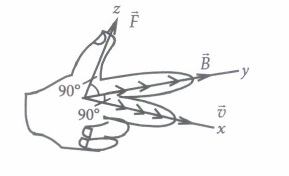
A charged particle moving in a magnetic field experiences a force that is proportional to the strength of the magnetic field, the component of the velocity that is perpendicular to the magnetic field and the charge of the particle.
This force is given by \(\vec{F}=q(\vec{v} \times \vec{B})\) where q is the electric charge of the particle, v is the instantaneous velocity of the particle, and B is the magnetic field (in tesla).
The direction of force is determined by the rules of cross product of two vectors
Force is perpendicular to both velocity and magnetic field. Its direction is same as \(\vec{v} \times \vec{B}\) if q is positive and opposite of \(\vec{v} \times \vec{B}\) if q is negative
The force is always perpendicular to both the velocity of the particle and the magnetic field that created it. Because the magnetic force is always perpendicular to the motion, the magnetic field can do no work on an isolated charge. It can only do work indirectly, via the electric field generated by a changing magnetic field.
(I) When a magnetic field is applied on a stationary electron, it
| (a) remains stationary |
| (b) spins about its own axis |
| (c) moves in the direction of the field |
| (d) moves perpendicular to the direction of the field. |
(ii) A proton is projected with a uniform velocity v along the axis of a current carrying solenoid, then
| (a) the proton will be accelerated along the axis |
| (b) the proton path will be circular about the axis |
| (c) the proton moves along helical path |
| (d) the proton will continue to move with velocity v along the axis. |
(iii) A charged particle experiences magnetic force in the presence of magnetic field. Which of the following statement is correct?
| (a) The particle is stationary and magnetic field is perpendicular. |
| (b) The particle is moving and magnetic field is perpendicular to the velocity |
| (c) The particle is stationary and magnetic field is parallel |
| (d) The particle is moving and magnetic field is parallel to velocity |
(iv) A charge q moves with a velocity 2 ms-1 along x-axis in a uniform magnetic field \(\vec{B}=(\hat{i}+2 \hat{j}+3 \hat{k}) \mathrm{T}\) then charge will experience a force
| (a) in z-y plane | (b) along -yaxis | (c) along +z axis | (d) along -z axis |
(v) Moving charge will produce
| (a) electric field only | (b) magnetic field only |
| (c) both electric and magnetic field | (d) none ofthese. |
2.
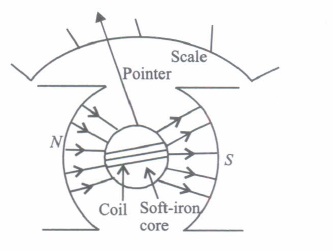
Moving coil galvanometer operates on Permanent Magnet Moving Coil (PMMC) mechanism and was designed by the scientist D'arsonval.
Moving coil galvanometers are of two types
(i) Suspended coil
(ii) Pivoted coil type or tangent galvanometer.
Its working is based on the fact that when a current carrying coil is placed in a magnetic field, it experiences a torque. This torque tends to rotate the coil about its axis of suspension in such a way that the magnetic flux passing through the coil is maximum.
(i) A moving coil galvanometer is an instrument which
| (a) is used to measure emf |
| (b) is used to measure potential difference |
| (c) is used to measure resistance |
| (d) is a deflection instrument which gives a deflection when a current flows through its coil |
(ii) To make the field radial in a moving coil galvanometer
| (a) number of turns of coil is kept small | (b) magnet is taken in the form of horse-shoe |
| (c) poles are of very strong magnets | (d) poles are cylindrically cut |
(iii) The deflection in a moving coil galvanometer is
| (a) directly proportional to torsional constant of spring |
| (b) directly proportional to the number of turns in the coil |
| (c) inversely proportional to the area of the coil |
| (d) inversely proportional to the current in the coil |
(iv) In a moving coil galvanometer, having a coil of N-turns of area A and carrying current I is placed in a radial field of strength B.
The torque acting on the coil is
| \(\text { (a) } N A^{2} B^{2} I\) | \(\text { (b) } N A B I^{2}\) | \(\text { (c) } N^{2} A B I\) | (d) NABI |
(v) To increase the current sensitivity of a moving coil galvanometer, we should decrease
| (a) strength of magnet | (b) torsional constant of spring |
| (c) number ofturns in coil | (d) area of coil |
3.
A magnetic field can be produced by moving, charges or electric currents. The basic equation governing the magnetic field due to a current distribution is the Biot-Savart law.
Finding the magnetic field resulting from a current distribution involves the vector product, and is inherently a calculas problem when the distance from the current to the field point is continuously changing.
According to this law, the magnetic field at a point due to a current element oflength \(d \vec{l}\) carrying current I, at a distance r from the element is \(d B=\frac{\mu_{0}}{4 \pi} \frac{I(d \vec{l} \times \vec{r})}{r^{3}}\)
Biot -Savart law has certain similarities as well as difference with Coloumbs law for electrostatic field e.g., there is an angle dependence in Biot-Savart law which is not present in electrostatic case.
(i) The direction of magnetic field \(d \vec{B}\) due to a current element \(I d \vec{l}\) at a point of distance \(\vec{r}\) from it, when a current I passes through a long conductor is in the direction
| \(\text { (a) of position vector } \vec{r} \text { of the point }\) | \(\text { (b) of current element } d \vec{l}\) |
| \(\text { (c) perpendicular to both } d \vec{l} \text { and } \vec{r}\) | \(\text { (d) perpendicular to } d \vec{l} \text { only }\) |
(ii) The magnetic field due to a current in a straight wire segment of length L at a point on its perpendicular bisector at a distance r (r >> L)
| \(\text { (a) decreases as } \frac{1}{r} \text { . }\) | \(\text { (b) decreases as } \frac{1}{r^{2}} \text { . }\) |
| \(\text { (c) decreases as } \frac{1}{r^{3}} \text { . }\) | \(\text { (d) approaches a finite limit as } r \rightarrow \infty\) |
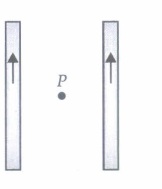
(iii) Two long straight wires are set parallel to each other. Each carries a current i in the same direction and the separation between them is 2r. The intensity of the magnetic field midway t between them is
| \(\text { (a) } \mu_{0} i / r\) | \(\text { (b) } 4 \mu_{0} i / r\) |
| (c) zero | \(\text { (d) } \mu_{0} i / 4 r\) |
(iv) A long straight wire carries a current along the z-axis for any two points in the x - y plane. Which of the following is always false?
| (a) The magnetic fields are equal |
| (b) The directions of the magnetic fields are the same |
| (c) The magnitudes ofthe magnetic fields are equal |
| (d) The field at one point is opposite to that at the other point |
(v) Biot-Savart law can be expressed alternatively as
| (a) Coulomb's Law | (b) Ampere's circuital law |
| (c) Ohm's Law | (d) Gauss's Law |
4.
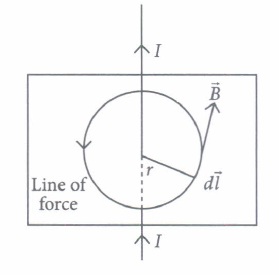
Ampere's law gives a method to calculate the magnetic field due to given current distribution. According to it, the circulation \(\oint \vec{B} \cdot d \vec{l}\) of the resultant magnetic field along a closed plane curve is equal to \(\mu_{0}\) times the total current crossing the area bounded by the closed curve provided the electric field inside the loop remains constant. Ampere's law is more useful under certain symmetrical conditions. Consider one such case of a long Straight wire with circular cross-section (radius R) carrying current I uniformly distributed across this cross-section.
(i) The magnetic field at a radial distance r from the centre of the wire in the region r > R, is
| \(\text { (a) } \frac{\mu_{0} I}{2 \pi r}\) | \(\text { (b) } \frac{\mu_{0} I}{2 \pi R}\) | \(\text { (c) } \frac{\mu_{0} I R^{2}}{2 \pi r}\) | \(\text { (d) } \frac{\mu_{0} I r^{2}}{2 \pi R}\) |
(ii) The magnetic field at a distance r in the region r < R is
| \(\text { (a) } \frac{\mu_{0} I}{2 r}\) | \(\text { (b) } \frac{\mu_{0} I r^{2}}{2 \pi R^{2}}\) | \(\text { (c) } \frac{\mu_{0} I}{2 \pi r}\) | \(\text { (d) } \frac{\mu_{0} I r}{2 \pi R^{2}}\) |
(iii) A long straight wire of a circular cross section (radius a) carries a steady current I and the current I is uniformly distributed across this cross-section. Which of the following plots represents the variation of magnitude of magnetic field B with distance r from the centre of the wire?

(iv) A long straight wire of radius R carries a steady current I. The current is uniformly distributed across its cross-section. The ratio of magnetic field at R/2 and 2R is
| \(\text { (a) } \frac{1}{2}\) | (b) 2 | \(\text { (c) } \frac{1}{4}\) | (d) 1 |
(v) A direct current I flows along the length of an infinitely long straight thin walled pipe, then the magnetic field is
| (a) uniform throughout the pipe but not zero | (b) zero only along the axis of the pipe |
| (c) zero at any point inside the pipe | (d) maximum at the centre and minimum at the edges. |
1.
(i) (a): For stationary electron, \(\vec{v}=0\)
\(\therefore\) Force on the electron is \(\vec{F}_{m}=-e(\vec{v} \times \vec{B})=0\)
(ii) (d): Force on the proton \(\vec{F}_{B}=e(\vec{v} \times \vec{B})\)
Since, \(\vec{v}\) is parallel to \(\vec{B}\)
\(\therefore \quad \vec{F}_{B} \doteq 0\)
Hence proton will continue to move with velocity v along the axis of solenoid.
(iii) (b): Magnetic force on the charged particle q is
\(\vec{F}_{m}=q(\vec{v} \times \vec{B}) \text { or } F_{m}=q v B \sin \theta\)
where \(\theta\) is the angle between \(\vec{v} \text { and } \vec{B}\)
Out of the given cases, only in case (b) it will experience the force while in other cases it will experience no force
(iv) (a) : \(\vec{F}=q(\vec{v} \times \vec{B})\)
\(=q[(2 \hat{i} \times(\hat{i}+2 \hat{j}+3 \hat{k})]=(4 q) \hat{k}-(6 q) \hat{j}\)
(v) (c): When an electric charge is moving both electric and magnetic fields are produced, whereas a static charge produces only electric field.
2.
(I) (d): A moving coil galvanometer is a sensitive instrument which is used to measure a deflection when a current flows through its coil.
(ii) (d): Uniform field is made radial by cutting pole pieces cylindrically.
(iii) (b): The deflection in a moving coil galvanometer \(\phi=\frac{N A B}{k} \cdot I \text { or } \phi \propto N\) where Nis number of turns in a coil, B is magnetic field and A is area of cross-section.
(iv) (d): The deflecting torque acting on the coil
\(\tau_{\text {deflection }}=N I A B\)
(v) (b): Current sensitivity of galvanometer
\(\frac{\phi}{I}=S_{i}=\frac{N B A}{k}\)
Hence, to increase (current sensitivity) Si (torsional constant of spring) k must be decrease.
3.
(i) (c): According to Biot -Savart's law, the magnetic induction due to a current element is given by
\(d \vec{B}=\frac{\mu_{0}}{4 \pi} \frac{I d \vec{l} \times \vec{r}}{r^{3}}\)
This is perpendicular to both \(d \vec{l} \text { and } \vec{r}\)
(ii) (b): From Biot-savart's law,\(d B=\frac{\mu_{0}}{4 \pi} \frac{I d l}{r^{2}} \text { i.e. } d B \propto \frac{1}{r^{2}}\)
(iii) (c): \(B=\frac{\mu_{0}}{2 \pi} \cdot \frac{i}{r}-\frac{\mu_{0}}{2 \pi} \cdot \frac{i}{r}=0\)
(iv) (a)
(v) (b): Biot-Savart law can be expressed alternatively as Ampere circuital law.
4.
(i) (a) :Magnetic field due to a long current carrying wire at r
\(B=\frac{\mu_{0}}{2 \pi} \frac{I}{r}\)
(ii) (d): Let I' be the current in region r < R
Then, \(I^{\prime}=\frac{I}{\pi R^{2}} \pi\left(r^{2}\right) \text { or } I^{\prime}=\frac{I r^{2}}{R^{2}}\)
So, magnetic. field \(B=\frac{\mu_{0} I^{\prime}}{2 \pi r}=\frac{\mu_{0} I r^{2}}{2 \pi R^{2} r}=\frac{\mu_{0} I r}{2 \pi R^{2}}\)
(iii) (a): Magnetic field due to a long straight wire of radius a carrying current I at a point distant r from the centre of the wire is given as follows
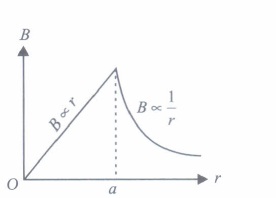
\(B=\frac{\mu_{0} I r}{2 \pi a^{2}} \quad \text { for } \quad r<a\)
\(B=\frac{\mu_{0} I}{2 \pi a} \quad \text { for } r=a\)
\(B=\frac{\mu_{0} I}{2 \pi r} \quad \text { for } r>a\)
The variation of magnetic field B with distance r from the centre of wire is shown in the figure.
(iv) (d): Let the magnetic fields due to a long straight wire of radius R carrying a steady current I at a distance r from the centre of the wire are
\(B_{1}=\frac{\mu_{0} I r}{2 \pi R^{2}} \quad(\text { For } r<R)\)
and \(B_{2}=\frac{\mu_{0} I}{2 \pi R} \quad(\text { For } r>R)\)
So, the magnetic field at \(r=\frac{R}{2} \text { is } B_{1}=\frac{\mu_{0} I}{2 \pi R^{2}}\left(\frac{R}{2}\right)=\frac{\mu_{0} I}{4 \pi R}\)
and at \(r=2 R \text { is } B_{2}=\frac{\mu_{0} I}{2 \pi(2 R)}=\frac{\mu_{0} I}{4 \pi R}\)
\(\therefore\) Their corresponding ratio is \(\frac{B_{1}}{B_{2}}=\frac{\left(\mu_{0} I / 4 \pi R\right)}{\left(\mu_{0} I / 4 \pi R\right)}=1\)
(v) (c)

12th Standard CBSE Syllabus & Materials
12th Standard CBSE
CBSE 12th Computer Science Python Revision Tour I - New Previous year Question Papers Study Material - QB365 Set A
NEW12th Standard CBSE
CBSE 12th Business Studies Planning Important Questions And Answers Study Material - QB365 Set A
NEW12th Standard CBSE
CBSE 12th Business Studies Business Environment Important Questions And Answers Study Material - QB365 Set A
NEW12th Standard CBSE
CBSE 12th Business Studies Principles of Management Important Questions And Answers Study Material - QB365 Set A



CBSE 12th Standard CBSE Subjects
CBSE Standards










