
 100% FREE ACCESS
12th Standard CBSE Syllabus & Materials
12th Standard CBSE
CBSE 12th Economics Government Budget and the Economy Previous year Question Papers Study Material - QB365 Set A
NEW12th Standard CBSE
CBSE 12th Computer Science Interface Python with MySQL - New Previous year Question Papers Study Material - QB365 Set A
NEW12th Standard CBSE
CBSE 12th Computer Science Database Concept - New Previous year Question Papers Study Material - QB365 Set A
NEW12th Standard CBSE
CBSE 12th Computer Science Data Communication - New Previous year Question Papers Study Material - QB365 Set A
NEW12th Standard CBSE
CBSE 12th Computer Science Data Structures - New Previous year Question Papers Study Material - QB365 Set A
NEW12th Standard CBSE
CBSE 12th Computer Science Functions - New Previous year Question Papers Study Material - QB365 Set A

Published on: 22/05/2021
QB365 Provides the updated NCERT Exemplar Questions for Class 12, and also provide the detail solution for each and every case study questions. NCERT Exemplar questions are latest updated question pattern from NCERT, QB365 will helps to get more marks in Exams
Download CBSE Class 12th Standard CBSE Physics question papers, sample papers, important questions, and previous year solved papers in PDF format. Get free study materials, NCERT solutions, and exam preparation resources for Class 12th Standard CBSE Physics
Questions + Answers key
Take MCQ Physics Test1.
First a set of n equal resistors of R each are connected in series to a battery of emf E and internal resistance R and current I is observed to flow. Then, the resistors are connected in parallel to the same battery. It is observed that the current is increased 10 times. What is n?
2.
Consider the plane S formed by the dipole axis and the axis of the earth. Let P be point on the magnetic equator in S. Let Q be the point of intersection of the geographical and magnetic equators. Obtain the declination and dip angles at P and Q.
3.
A paisa coin is made up of AI-Mg alloys and weighs 0.75 g. It has a square shape and its diagonal measures 17 mm. It is electrically neutral and contains equal amount of positive and negative charges. Treating the paisa coins made up of only AI, find the magnitude of equal number of positive and negative charges. What conclusion do you draw from this magnitude?
4.
In normal case, emitter-base junction is the forward bias and collector-base junction is reverse biased. What will happen if emitter is reverse biased and collector is forward biased?
5.
Why is the coil of dead beat galvanometer wound on a metal frame?
6.
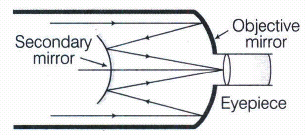
A Cassegrain telescope uses two mirrors as shown in the figure. Such a telescope is built with the mirrors 20mm apart. If the radius of curvature of large mirror is 220mm and the small mirror is 140 mm, where will the final image of an object at infinity be?
7.
A short bar magnet has a magnetic moment of 0.48 J/T. Give the direction and magnitude of the magnetic field produced by the magnet at a distance of 10cm from the centre of the magnet on
(i) the axis,
(ii) the equatorial lines (normal bisector) of the magnet.
8.
Two charges 2 \(\mu \)C and -2\(\mu \) C are placed at points A and B, 6 cm apart. What is the direction of the electric field at every point on this surface?
9.
A and B have identical size and same mass. A becomes A2+ and B become B2- . Will A2+ and B2- still have the same mass? Why?
10.
What happens to the intensity of light from a bulb if the distance from the bulb is doubled? As a laser beam travels across the length of a room, its intensity essentially remains constant. What geometrical characteristic of LASER beam is responsible for the constant intensity which is missing in the case of light from the bulb?
1.
In series combination of resistors, current I is given by
\(I=\frac{E}{R+n R}\)
whereas, in parallel combination current 10 I is given by
\(\frac{E}{R+\frac{R}{n}}=10 I \Rightarrow \frac{E}{R+\frac{R}{n}}=10\left(\frac{E}{R+n R}\right)\)
Now, according to problem,
\(\frac{1+n}{1+\frac{1}{n}}=10 \Rightarrow 10=\left(\frac{1+n}{n+1}\right) n \Rightarrow n=10\)
2.
P is in the plane of S, needle is in North, so the declination is zero.
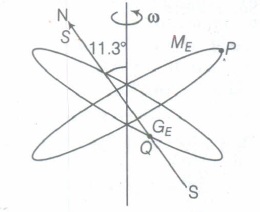
P is also on the magnetic equator, so the angle of dip is zero, because the value of angle of dip at equator is zero. Q is also on the magnetic equator, so the angle of dip is zero.
As, the earth is tilted on its axis by 113°, thus the declination at Q is 113°.
3.
Given, mass of a paisa coin, m = 0.75 g
Atomic mass of aluminium, M = 26.9815 g
Length of the diagonal of square shaped paisa coin= 17 mm
Avogadro's number, NA = 6.023 x 10²³
\(\Rightarrow \quad n=\frac{N_A}{M} \times m=\frac{6.023 \times 10^{23}}{26.9815 \mathrm{~g}} \times 0.75 \mathrm{~g}\)
\(=1.6742 \times 10^{22}\)
Since, atomic number (Z) of AI is 13, therefore each atom of AI contains 13 protons and 13 electrons. Now, find out the magnitude of positive and negative charges present in one paisa coin.
nZe = 1.6742 x 1022 x 13 x 1.6 x 10-19 C
= 34.8 kC
Now, write the conclusion drawn from this magnitude of charge.
34.8 kC is a very large amount of charge. This concludes that ordinary neutral matter contains an enormously large amount ot positive and negative charges.
4.
If emitter is reverse biased and collector is forward biased, then emitter works as collector and collector is work as emitter. In such situation, transistor works but has lower amplification because the size of emitter is smaller than collector and doping of emitter is more than collector.
5.
On switching on the current in a galvanometer, the coil of the galvanometer does not come to rest immediately. It oscillates about its equilibrium position but the coil of a dead beat galvanometer comes to rest immediately. It is due to the reason that the eddy currents are set up in the metallic frame, over which the coil is wound and the eddy currents oppose the oscillatory motion of the coil.
6.
Radius of curvature of objectrive mirror,
R1 = 220 mm
\({ f }_{ 1 }=\frac { { R }_{ 1 } }{ 2 } =\frac { 220 }{ 2 } =110 \ mm\)
Radius of curvature of secondary mirrors, R2 = 140 mm
\({ f }_{ 2 }=\frac { { R }_{ 2 } }{ 2 } =\frac { 140 }{ 2 } =70 \ mm\)
Distance between two mirrors, d = 20 mm from objective mirror.
Now, for secondary mirror, u = f1 - d = 110 - 20
= 90 mm
From mirror formula,
\(\frac { 1 }{ v } +\frac { 1 }{ u } =\frac { 1 }{ { f }_{ 2 } } \Longrightarrow \frac { 1 }{ v } =\frac { 1 }{ { f }_{ 2 } } -\frac { 1 }{ u } \)
\( =\frac { 1 }{ 70 } -\frac { 1 }{ 90 } \Longrightarrow v=\frac { 630 }{ 2 } =315\ mm\)
i.i., final image will be at 31.5 cm to the right of secondary mirror.
7.
(i)

The direction of magnetic field is from S to N-pole of magnet.
(ii)

The direction of magnetic field is from N to S-pole of magnet.
8.
According to the formula, E.dr = dV, the value of dV = 0 at each point of equipotential surface.
\(\therefore \) E.dr = 0
so, the angle between electric field vector and distance vector will be 90o . Thus, the electric field is always normal to the plane passing through AB.
9.
No, they will not have the same mass. B2- has more mass as, it has gained two electrons, whereas A2+ has lost two electrons.
10.
Intensity of light is reduced to one fourth because the light beam spreads as it approaches into a spherical region of area \(4\pi { r }^{ 2 },i.e.,I\infty 1/{ r }^{ 2 }\) But laser beam does not spread, hence its intensity remains constant. Laser beam is unidirectional, monochromatic and coherent light, whereas the light from a bulb does not posses the above properties.

12th Standard CBSE Syllabus & Materials
12th Standard CBSE
CBSE 12th Computer Science Python Revision Tour I - New Previous year Question Papers Study Material - QB365 Set A
NEW12th Standard CBSE
CBSE 12th Business Studies Planning Important Questions And Answers Study Material - QB365 Set A
NEW12th Standard CBSE
CBSE 12th Business Studies Business Environment Important Questions And Answers Study Material - QB365 Set A
NEW12th Standard CBSE
CBSE 12th Business Studies Principles of Management Important Questions And Answers Study Material - QB365 Set A



NCERT Books

Syllabus

Exam Pattern

Sample Question Papers

Previous year Question Papers

Important Notes

MCQ Practice test

NCERT Exemplers

Case study Questions

Image Based Questions

Passage based Questions

HOT Questions

Value Based Questions

Model Questions Papers
NCERT ( Book Back ) Questions

Assertion and Reason
Important Questions And Answers

CBSE 12th Standard CBSE Subjects
CBSE Standards









