
 100% FREE ACCESS
12th Standard CBSE Syllabus & Materials
12th Standard CBSE
CBSE 12th Economics Government Budget and the Economy Previous year Question Papers Study Material - QB365 Set A
NEW12th Standard CBSE
CBSE 12th Computer Science Interface Python with MySQL - New Previous year Question Papers Study Material - QB365 Set A
NEW12th Standard CBSE
CBSE 12th Computer Science Database Concept - New Previous year Question Papers Study Material - QB365 Set A
NEW12th Standard CBSE
CBSE 12th Computer Science Data Communication - New Previous year Question Papers Study Material - QB365 Set A
NEW12th Standard CBSE
CBSE 12th Computer Science Data Structures - New Previous year Question Papers Study Material - QB365 Set A
NEW12th Standard CBSE
CBSE 12th Computer Science Functions - New Previous year Question Papers Study Material - QB365 Set A

Published on: 22/05/2021
QB365 Provides the updated NCERT Exemplar Questions for Class 12, and also provide the detail solution for each and every case study questions. NCERT Exemplar questions are latest updated question pattern from NCERT, QB365 will helps to get more marks in Exams
Download CBSE Class 12th Standard CBSE Physics question papers, sample papers, important questions, and previous year solved papers in PDF format. Get free study materials, NCERT solutions, and exam preparation resources for Class 12th Standard CBSE Physics
Questions + Answers key
Take MCQ Physics Test1.
A ball of superconducting matesial is dipped in liquid nitrogen and placed near a bar magnet.
(i) In which direction will it move?
(ii) What will be the direction of its magnetic moment?
2.
The near vision of an average person is 25 cm. To view an object with an angular magnification of 10. what should be the power of the microscope?
3.
Is Huygen's principle valid for longitundinal sound waves?
4.
When an ideal capacitor is charged by a DC battery, no current flows. However, when an AC source is used, the current flows continously. How does one explain this, based on the concept of displacement current?
5.
(i) A metal ring is held horizontally and a bar magnet is dropped through the ring with its length along the axis of the ring. What will be the acceleration of a falling magnet?
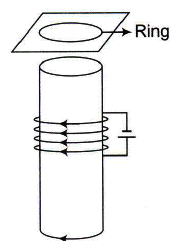
(ii) Consider a metal ring kept on top of a fixed solenoid (say on cardboard) (see figure). The center of the ring coincides with the axis of the solenoid. If the current is suddenly switched ON, the metal ring jumps up. Explain.
6.
In series L-C-R circuit, the plot of Imax\(\omega \) versus is shown in the figure. Find the bandwidth and mark in the figure.

7.
Suppose we want to verify the analogy between electrostatic and magnetic by an explicit experiment. Consider the motion of
(i) electric dipole p in an electrostatic field E and
(ii) magnetic dipole M in a magnetic field B. Write down a set of conditions on E,B,p,M so that the two motions are verified to be identical.(assume idential initial conditions)
E(r) = cB(r), suppose the angle between p and E is \(\theta \) . Torque on electric dipole moment M in magnetic field E, \(\tau =pEsin\theta \)
8.
AB is a potentiometer wire as shown in figure. If the value of R is increased, in which direction will the balance point J shift?

9.
A bird perches on a bare high power line and nothing happens to the bird. A man standing on the ground touches the same line and gets a fatal shock why?
1.
Both a superconducting material and nitrogen are diamagnetic in nature. When a ball of superconducting material is dipped in liquid nitrogen, it behaves as a diamagnetic material. When placed near a bar magnet, it will be feebly magnetised opposite to the direction of magnetising field.
Because of this,
(i) it will be repelled (i.e. move away from magnet)
(ii) the direction of magnetic moment will be opposite to the direction of magnetic field of bar magnet.
2.
The least distance of discint vision of an average person. (i.e, D) is 25 cm, in order to view an object with magnificaton of 10.
Here, v = D = 25 cm and u = f
But thr magnification, m = v/u = D/f
\(m=\frac { D }{ f } \Rightarrow f=\frac { D }{ m } =\frac { 25 }{ 10 } =2.5=0.025m\)
\( P=\frac { 1 }{ 0.025 } =40D \ [\therefore \ P=\frac { 1 }{ f } ]\)
This is the required power of lens.
3.
When we are considering a point of sound wavw. The disturbance due to the source propagates in spherical symmetry, that is, in all directions.
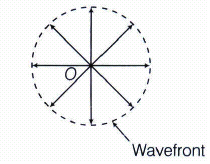
The formation of wavefront is in accordance with Huygen's principle. So, Huygen's principle is valid for longitudinal sound waves also.
4.
If an ideal capacitor is charged by DC battery, current flows momentarily till capacitor gets fully charged after that no current flows. however, when an AC source is connected, the conduction current, \(I_c=\frac{d q}{d t}\) starts flowing in the connecting wire. As charging polarity of AC current changes, the capacitor is alternatively charged and discharged with time. this causes change in electric field between plates of the capacitor which causes change in electric flux and gives rise to displacement current in the region between plates of cpacitor, as displacement current, \(I_d=\varepsilon_0 \frac{d {\phi}_E}{d t}\) and Id = Ie at all instants.
5.
(i) As the magnet falls, the magnetic flux linked with the ring increases. This induces emf in the ring which opposes the motion of the falling magnet, hence a < g.
6.
Consider the diagram.
Bandwidth = \(\omega _{ 2 }-{ \omega }_{ 1 }\),

Where , \(\omega_1\) and \(\omega_2\) correspond to frequencies at which magnitude of current is \(\frac { 1 }{ \sqrt { 2 } } \) times of maximum value.
\({ I }_{ rms }=\frac { { I }_{ max } }{ \sqrt { 2 } } =\frac { 1 }{ \sqrt { 2 } } \approx 0.7A\)
Clearly, from the diagram, the corresponding frequencies are 0.8 rad/s and rad/s.
\(\triangle \omega \) = B and width = 1.2 - 0.8 = 0.4 rad/s
7.
Now, suppose that the angle between M and B is \(\theta \) .
Troque on magnetic dipole moment M in magnetic field B,
\({ \tau }^{ ' }=MBsin\theta \)
Two motions will be identical, if
\(pEsin\theta =MBsin\theta \\ pE=MB\\ E=cB\)
Putting this value in Eq.(i), we get
\(pcB=MB\quad \Rightarrow p=\frac { M }{ c } \)
8.
As, the value of R is increased, the current flowing in the circuit will decrease. And the potential gradient, i.e. potential drop per unit length also decreases, so that the balance length will increase. Thus, J will shift towards B.
9.
When a bird is perched on a bare high power line, the circuit does not get complete between the bird and the earth, therefore, nothing happens to the bird.
When a man standing on ground touches the same line, the circuit between the man and the earth gets completed. As a result, he gets a fatal shock.

12th Standard CBSE Syllabus & Materials
12th Standard CBSE
CBSE 12th Computer Science Python Revision Tour I - New Previous year Question Papers Study Material - QB365 Set A
NEW12th Standard CBSE
CBSE 12th Business Studies Planning Important Questions And Answers Study Material - QB365 Set A
NEW12th Standard CBSE
CBSE 12th Business Studies Business Environment Important Questions And Answers Study Material - QB365 Set A
NEW12th Standard CBSE
CBSE 12th Business Studies Principles of Management Important Questions And Answers Study Material - QB365 Set A



NCERT Books

Syllabus

Exam Pattern

Sample Question Papers

Previous year Question Papers

Important Notes

MCQ Practice test

NCERT Exemplers

Case study Questions

Image Based Questions

Passage based Questions

HOT Questions

Value Based Questions

Model Questions Papers
NCERT ( Book Back ) Questions

Assertion and Reason
Important Questions And Answers

CBSE 12th Standard CBSE Subjects
CBSE Standards









