
 100% FREE ACCESS
12th Standard CBSE Syllabus & Materials
12th Standard CBSE
CBSE 12th Economics Government Budget and the Economy Previous year Question Papers Study Material - QB365 Set A
NEW12th Standard CBSE
CBSE 12th Computer Science Interface Python with MySQL - New Previous year Question Papers Study Material - QB365 Set A
NEW12th Standard CBSE
CBSE 12th Computer Science Database Concept - New Previous year Question Papers Study Material - QB365 Set A
NEW12th Standard CBSE
CBSE 12th Computer Science Data Communication - New Previous year Question Papers Study Material - QB365 Set A
NEW12th Standard CBSE
CBSE 12th Computer Science Data Structures - New Previous year Question Papers Study Material - QB365 Set A
NEW12th Standard CBSE
CBSE 12th Computer Science Functions - New Previous year Question Papers Study Material - QB365 Set A

Published on: 22/05/2021
QB365 Provides the updated NCERT Exemplar Questions for Class 12, and also provide the detail solution for each and every case study questions. NCERT Exemplar questions are latest updated question pattern from NCERT, QB365 will helps to get more marks in Exams
Download CBSE Class 12th Standard CBSE Physics question papers, sample papers, important questions, and previous year solved papers in PDF format. Get free study materials, NCERT solutions, and exam preparation resources for Class 12th Standard CBSE Physics
Questions + Answers key
Take MCQ Physics Test1.
Figure shows the electric field lines around three point charges A, B and C
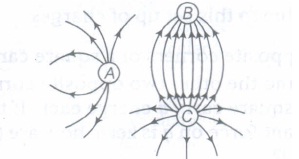
(i) Which charges are positive?
(ii) Which charge has the largest magnitude? Why?
(iii) In which region or regions of the picture could the electric field be zero? Justify your answer.
(a) Near A
(b) Near B
(c) Near C
(d) Nowhere
2.
Use Lenz’s law to determine the direction of induced current in the situations described by Fig.
(a) A wire of irregular shape turning into a circular shape;
(b) A circular loop being deformed into a narrow straight wire

3.
Show that the force on each plate of a parallel plate capacitor has a magnitude equal to1/2 QE. where Q is the charge on the capacitor and E is the magnitude of electric field between the plates. Explain the origin of the factor 1/2.
Here, we can use the content that the work done in displacing the plates against the force is equal to the increase in energy of the capacitor.
4.
Five charges q each are placed at the corners of regular pentagon of side a as shown in the figure
(i) What wil be the electric field at O,the centre of the pentagon?
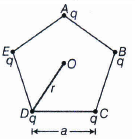
(b) what will be the electric field at O,if the charge from one of the corners(A) is removed?
(c) What will be electric field at O,if the charge q at A is replaced by -q?
(ii) How would your answer polygon with charge q at each of its corners?
5.
Figure represents a crystal unit of caesium chloride,CsCl. The caesium automs,represented by open circles are situated at the corners of a cube of side 0.40 nm, whereas a CI atom is situated at the centre of the cube. The Cs atoms are deficient in one electron while the CI atom carrieres an excess electron.

(i) What is the net electric field on the CI atom dur to eight Cs atoms?
(ii) Suppose that the Cs atom at the corner A is missing.What is the net force now on the CI atom due to seven remaining Cs atoms?
(i) Net force on a charge due to two equal and opposite charges will be zero.Also electric field on a charge is given by
E = F / Q
where E=electric field, F = force on change q due to electric field and q = magnitude of charge.
(ii) If a Cs atom is removed from the corner A, then a singly charged Cs ion at A will appear.
6.
Two long coaxial insulated solenoids, S1 and S2 of equal lengths are wound one over the other as shown in the figure. A steady current I flows through the inner solenoid S1 to the other end B, which is connected to the outer solenoid S2 through which the same current I flows in the opposite direction, so as to come out at end A. If n1and n2 are the number of turns per unit length, find the magnitude and direction of the net magnetic field at s point (a) inside on the axis and (b) outside the combined system.

7.
Figure shows the electric field lines around three point charges A, B and C.

(i) Which charges are positive?
(ii) Which charge has the largest magnitude?
(iii) In which region or regions of the picture could the electric field be zero? Justify your answer.
(a) Near A
(b) Near B
(c) Near C
(d) Near D
(i) Electric field lines always start from a positive charge and end at a negative charge. In case of a single charge, electric lines of force start from positive charge and end at infinity.
(ii) The magnitude of a charge depends on the number of lines of force emanating from a charge, i.e higher the number of lines of force, higher the magnitude of charge and vice-versa.
8.
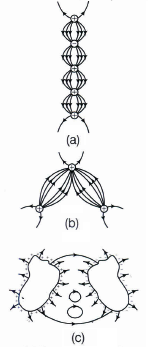
Explain why the following curves cannot possibly represent electrostatic field lines?
9.
An electron enters electric field of 104 V/m perpendicular to the field with a velocity of 106 m/s . Find the vertical displacement of electron after 3 milliseconds. Mass of electron = 9.1 x 10⁻³¹ kg ; charge on electron = 1.6 x 10⁻¹⁹ C
10.
An electric dipole of length 2 cm, when placed with its axis making an angle of 60o with a uniform electric field, experiences a torque of \(8\sqrt { 3 } \)N-m. Calculate the potential energy of the dipole, if it has a charge of \(\pm \)4nC.
1.
Electric field lines always start from a positive charge and end at a negative charge. In case of a single charge, electric lines of force start from positive charge and end at infinity.
The magnitude of a charge depends on the number of lines of force emanating from a charge, i.e. higher the number of lines of force, higher the magnitude of charge and vice-versa.
(i) In the given figure, the electric lines of force emanate from A and C. Therefore, charges A and C must be positive.
(ii) The number of electric lines of force emanating is maximum from charge C here, so C must have the largest magnitude.
(iii) Point between two like charges, where electrostatic force is zero, is called neutral point. So, the neutral point lies between A and C only.
Now, the position of neutral point depends on the strength of the forces of charges. Here, more number of electric lines of force show higher strength of charge C than A. So, neutral point lies near A.
2.
(i) Here, the direction of magnetic field is perpendicularly inwards to the plane of paper. If a wire of irregular shape turns into a circular shape, then its area increases (\(\because \) the circular loop has greater area than the loop of irregular shape) so that, the magnetic flux linked also increases. Now, the induced current is produced in a direction such that it decreases the magnetic field [i.e. the current will flow in such a direction, so that the wire forming the loop is pulled inward in all directions (to decrease the area)], i.e current is in anti-clockwise direction, ie. along adcba.
(ii) When a circular loop deforms into a narrow straight wire, the magnetic flux linked with it also decreases. The current induced due to change in flux will flow in such a direction that it will oppose the decrease in magnetic flux, so it will flow anti-clockwise, i.e along adcba due to which the magnetic field produced will be out of the plane of paper.
3.
Let the distance between the plates be increased by a very small distance\(\triangle x\) = Force x Increased distance
= F.\(\Delta x\) ...(i)
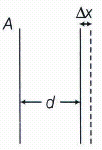
Increase in volume of capacitor
= Area of plates x Increased distance
= A.\(\Delta x\)
u = Energy density = \(\frac { Energy }{ Volume } \)
Increase in energy = u x voulme = u.A.\(\Delta x\) .....(ii)
As, Energy = Work done
F.\(\Delta x\) = u.A.\(\Delta x\) \([\because From \ Eqs.(i) \ and \ (ii)]\)
\(\Rightarrow\) F = u.A
\(=\frac { 1 }{ 2 } \varepsilon _{ 0 }{ E }^{ 2 }.A\quad [\because u=\frac { 1 }{ 2 } \varepsilon _{ 0 }{ E }^{ 2 } \ and \ E=\frac { V }{ d } ]\)
\(=\frac { 1 }{ 2 } \varepsilon _{ 0 }.\frac { { V }^{ 2 } }{ { d }^{ 2 } } .A=\left( \frac { { \varepsilon }_{ 0 }A }{ d } .A \right) \frac { V }{ d } \times \frac { 1 }{ 2 } \)
\(=\frac { 1 }{ 2 } .E.C.V=\frac { 1 }{ 2 } QE \ [\because C=\frac { { \varepsilon }_{ 0 }A }{ d } ,CV=Q]\)
4.
(a) The point O is equidistant from all the charges at the end points of pentagon.
(b) When charge q is removed from A electric field at O
E = \(\frac { q\times 1 }{ 4\pi \varepsilon _{ \circ }r^{ 2 } } \)
(c) If charge q at A is replaced by -q then it add chage -2q so electric field become E = \(\frac { 2q }{ 4\pi \varepsilon _{ \circ }r^{ 2 } } \)
(ii) when pentagon is replaced by n-side regular polygon with charge q at each of its corners, the electric field at O would continue to be zero as symmetricity of the charge.
5.
(From the given figure we can analyse that the chrolorine atom is at the centre of the cube. Thus due to symmetry the force due to all Cs atoms on CI atom will cancel out.)
E = F/q'
F = 0
E = 0
(ii) net force on CI atom at A would be given by
F = \(\frac { e^{ 2 } }{ 4\pi \varepsilon _{ \circ }r^{ 2 } } \)
\(\\ r=\sqrt { (0.20)^{ 2 }+(0.20)^{ 2 }+(0.20)^{ 2 }\times 10^{ -9 } } m\)
\( =0.346\times 10^{ -9 }\ m\)
\(\\ F=\frac { e^{ 2 } }{ 4\pi \varepsilon _{ \circ }r^{ 2 } } \)
\( =1.92\times 10^{ -9 }\ N\)
6.
According to Ampere's circuital law, the net field is given by \(B={ \mu }_{ 0 }nI\)
(a) The net magnetic field is given by
\({ B }_{ net }={ B }_{ 2 }-{ B }_{ 1 }-{ \mu }_{ 0{ n }_{ 2 } }I-{ \mu }_{ 0 }{ n }_{ 1 }\quad [\because { I }_{ 2 }={ I }_{ 1 }=I]\)
\(={ \mu }_{ 0 }I({ n }_{ 2 }-{ n }_{ 1 })\)
The direction is from B to A.
(b) As the magnetic fields due to S1 is confined solely inside S1 as the solenoids are assumed to be very long. So, there is no magnetic field outside S1 due to current in S1, similarly, there is no field outside S2 .
Bnet = 0
7.
(i) Here, in the figure, the electric lines of force emanate from A and C. Therefore, charges A and C must be positive.
(ii) The number of electric lines of force emanating is maximum from charge C here, so C must have the largest magnitude.
(iii) Point between two like charges where electrostatic force is called neutral point. So, the neutral point lies between A and C only.
Now, the position of neutral point depends on the strength of the forces of charges. Here more number of electric lines of force show higher strength of charge C than A. So, neutral point lies near A.
8.
(a)Electrostatic field lines cannot start from a negative charge.
(b)Electrostatic field lines cannot end at positive charge
(c)Electrostatic field lines cannot form closed loops.
9.
Given, m = 9.1 x 10⁻³¹ kg, q = 1.6 x 10⁻¹⁹ C
\(E={ 10 }^{ 4 }{ V\diagup m,v={ 10 }^{ 6 } }m\diagup s,t=3ms=0.003s\)
As, \(y=\frac { qE }{ 2m{ v }^{ 2 } } { x }^{ 2 }\)
\(y=\frac { qE }{ 2m } \left( \frac { x }{ v } \right) ^{ 2 }=\frac { qE }{ 2m } { t }^{ 2 }\left[ \therefore time(t)=\frac { distance(x) }{ speed(v) } \right] \)
\(y=\frac { \left( 1.6\times { 10 }^{ -19 } \right) \times \left( { 10 }^{ 4 } \right) \times \left( 0.003 \right) ^{ 2 } }{ 2\times \left( 9.1\times { 10 }^{ -31 } \right) } =7.9\times { 10 }^{ 9 }m\)
10.
\(Here,length,2a=2cm=2\times { 10 }^{ -2 }m.\)
\(\theta ={ 60 }^{ 0 },\tau =8\sqrt { 3 } N-m\)
Charges, Q = 4\(\times\) 10-9 C, U = ?
As we know that, \(\tau =Q(2a) E\sin { \theta } \)
\(\Longrightarrow \)Electric field,
\(e=\frac { \tau }{ Q(2a)\sin { \theta } } =\frac { 8\sqrt { 3 } }{ 4\times { 10 }^{ -9 }\times 2\times { 10 }^{ -2 }\times \sin { { 60 }^{ 0 } } } N/C\)
\(\\ \therefore Potential\quad energy, U=-\rho E\cos { \theta } =-Q(2a)E\cos { \theta }\)
\( \\ =-4\times { 10 }^{ -9 }+2\times { 10 }^{ -2 }\times \frac { 8\sqrt { 3 } \times \cos { { 60 }^{ 0 } } }{ 4\times { 10 }^{ -9 }\times 2\times { 10 }^{ -2 }\times \sin { { 60 }^{ 0 } } }\)
\( \\ \Longrightarrow U=-\frac { 8\sqrt { 3 } }{ \sqrt { 3 } } =-8J\)

12th Standard CBSE Syllabus & Materials
12th Standard CBSE
CBSE 12th Computer Science Python Revision Tour I - New Previous year Question Papers Study Material - QB365 Set A
NEW12th Standard CBSE
CBSE 12th Business Studies Planning Important Questions And Answers Study Material - QB365 Set A
NEW12th Standard CBSE
CBSE 12th Business Studies Business Environment Important Questions And Answers Study Material - QB365 Set A
NEW12th Standard CBSE
CBSE 12th Business Studies Principles of Management Important Questions And Answers Study Material - QB365 Set A



NCERT Books

Syllabus

Exam Pattern

Sample Question Papers

Previous year Question Papers

Important Notes

MCQ Practice test

NCERT Exemplers

Case study Questions

Image Based Questions

Passage based Questions

HOT Questions

Value Based Questions

Model Questions Papers
NCERT ( Book Back ) Questions

Assertion and Reason
Important Questions And Answers

CBSE 12th Standard CBSE Subjects
CBSE Standards









