
 100% FREE ACCESS
12th Standard CBSE Syllabus & Materials
12th Standard CBSE
CBSE 12th Economics Government Budget and the Economy Previous year Question Papers Study Material - QB365 Set A
NEW12th Standard CBSE
CBSE 12th Computer Science Interface Python with MySQL - New Previous year Question Papers Study Material - QB365 Set A
NEW12th Standard CBSE
CBSE 12th Computer Science Database Concept - New Previous year Question Papers Study Material - QB365 Set A
NEW12th Standard CBSE
CBSE 12th Computer Science Data Communication - New Previous year Question Papers Study Material - QB365 Set A
NEW12th Standard CBSE
CBSE 12th Computer Science Data Structures - New Previous year Question Papers Study Material - QB365 Set A
NEW12th Standard CBSE
CBSE 12th Computer Science Functions - New Previous year Question Papers Study Material - QB365 Set A

Published on: 22/05/2021
QB365 Provides the updated NCERT Exemplar Questions for Class 12, and also provide the detail solution for each and every case study questions. NCERT Exemplar questions are latest updated question pattern from NCERT, QB365 will helps to get more marks in Exams
Download CBSE Class 12th Standard CBSE Physics question papers, sample papers, important questions, and previous year solved papers in PDF format. Get free study materials, NCERT solutions, and exam preparation resources for Class 12th Standard CBSE Physics
Questions + Answers key
Take MCQ Physics Test1.
Explain with reason
(i) In amplitude modulation, the modulation index μ is kept less than or equal to 1.
(ii) The maximum amplitude of an amplitude modulated wave is found to be 15V while its minimum amplitude is found to be 3 V. What is the modulation index?
(iii) Why amplitude modulated signal be noisier than a frequency modulated signal upon transmission through a channel?
2.
A student has to use an appropriate number of
(i) NAND gates (only) to get the output Y1
(ii) NOR gates (only) to get the output Y2
From two given inputs A and B as shown in the diagram.
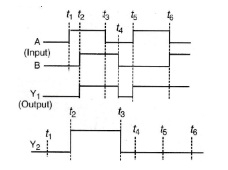
Identify the 'equivalent gate' needed in each case.Show how one can connect an appropriate number of (i) NAND (ii) NOR gates respectively in the two cases to get these' equivalent gates'.
3.
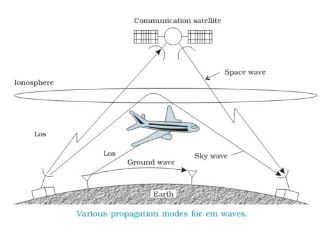
Draw schematic diagram showing the (i) ground wave (ii) sky wave and (iii) space wave propagation modes for em waves.
Write the frequency range for each of the following:
(i) Standard AM broadcast
(ii) Television
(iii) Satellite communication
4.
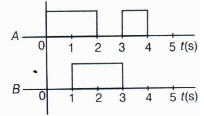
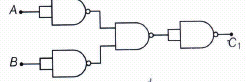
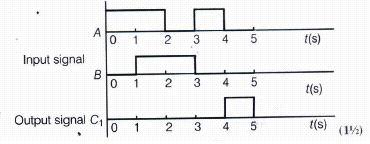
Draw the output signals C1 in the given combination of gates.
5.
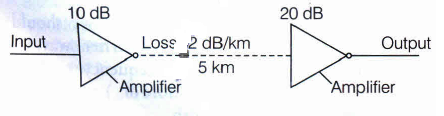
Figure shows a communication system. Which is the output power when input signal is 1.01 mW? (Gain in dB=\(10\log { _{ 10 }\frac { { P }_{ 0 } }{ { P }_{ 1 } } } \))
6.
For an optical communication system, operating at \(\lambda =800\ nm\), only 1% of the optical source frequency is the available channel bandwidth. How many channels can be accomdated for transmitting video T.V. signal requiring an approximate bandwidth of 4.5 MHz?
7.
Name the three different modes of propagation of electromagnetic waves.Explain using a proper diagram the made of propagation used in the frequency range from a few MHz to 40 MHz.
8.
Calculate the length of quarter wave antenna for transmission frequency of 20 MHz
1.
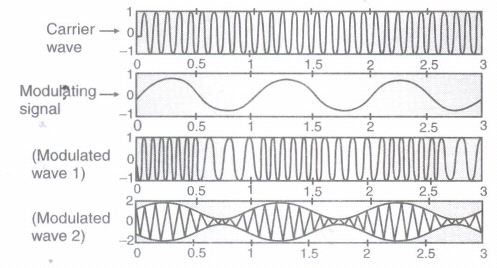
Modulation is a process in which one of the characteristics (amplitude, frequency, phase) of a high frequency carrier wave is made to change in accordance with a give low frequency message signal.
Modulated wave 1 : Frequency Modulation
Modulated wave 2 : Amplitude Modulation
Two advantages of FM over AM :
(i) Lower noise, better power efficiency
(ii) Higher operating range
(iii) Higher fidelity reception.
[Alternatively, Two advantages of AMover FM]
(i) Simple circuits are required.
(ii) Lower frequency space for transmission
2.
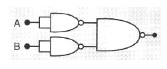
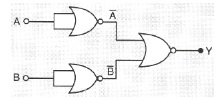
The equivalent gates in the two cases are the OR gate and the AND gate respectively.
(i)A combination of three NAND gates, connected in the manner shown, would be equivalent to an OR gate.
(ii) A combination of three NOR gates connected in the manner shown would be equivalent to an AND gate.
3.
(i) Standard AM broadcast 540-1600kHz
(ii) Television 54-890MHz
(iii) Satellite communication 5.925-6.425GHz uplink 3.7-4.2GHz Downlink
4.
First draw the truth table of C 1.
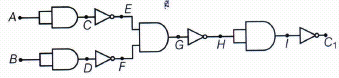
| A B | C D | E | F | G | H | I | C1 |
| 0 0 | 0 0 | 1 | 1 | 1 | 0 | 0 | 1 |
| 0 1 | 0 1 | 1 | 0 | 0 | 1 | 1 | 0 |
| 1 0 | 1 0 | 0 | 1 | 0 | 1 | 1 | 0 |
| 1 1 | 1 1 | 0 | 0 | 0 | 1 | 1 | 0 |
Therefore, the output signal C1 is shown as:
5.
The distance travelled by the signal is 5km. Loss suffered in path of transmission = 2dB/km
So, total loss suffered in 5 km = \(-2\times 5=-10dB\)
Total amplifier gain = 10dB + 20dB = 30dB
Overall gain in signal = 30 - 10 = 30dB
According to the question, gain in dB = \(10{ log }_{ 10 }\frac { { P }_{ 0 } }{ { P }_{ 1 } } \)
\(\because \ 20=10{ log }_{ 10 }\frac { { P }_{ 0 } }{ P_{ i } } or\quad { log }_{ 10 }\frac { { P }_{ 0 } }{ P_{ i } } =2\)
Where\({ P }_{ i }=1.01mW\ and\ { P }_{ 0 }\) is the output power.
\(\because \ \frac { { P }_{ 0 } }{ { P }_{ i } } ={ 10 }^{ 2 }=100\)
\(\\ \Rightarrow { P }_{ 0 }={ p }_{ i }\times 100=1.01\times 100\ or\ { p }_{ 0 }=101mW\)
Thus the output is 101 mW.
6.
Optical source frequency, \(v=\frac { c }{ \lambda } =\frac { 3\times { 10 }^{ 8 } }{ 800\times { 10 }^{ -9 } } =3.75\times { 10 }^{ 14 }Hz\)
Bandwidth of channel = 1% of source frequency = \(\frac { 1 }{ 100 } \times 3.75\times { 10 }^{ 14 }=3.75\times { 10 }^{ 12 }Hz\)
Number of channels for video T.V. signal = \(\frac { 3.75\times { 10 }^{ 12 } }{ 4.5\times { 10 }^{ 6 } } =8.3\times { 10 }^{ 5 }\)
7.
Three modes of propagation of electromagnetic waves are
(i) Ground wave propagation
(ii) Space wave propagation
(ii) Sky wave propagation
The mode of propagation used in the frequency range from a few 40 MHz is sky wave propagation.
8.
3.75 m
\(l=\frac { \lambda }{ 4 } =\frac { 1 }{ 4 } \left( \frac { c }{ v } \right) =\frac { 1 }{ 4 } \times \left( \frac { 3\times{ 10 }^{ 8 } }{ 20\times{ 10 }^{ 6 } } \right) =3.75\ m\)

12th Standard CBSE Syllabus & Materials
12th Standard CBSE
CBSE 12th Computer Science Python Revision Tour I - New Previous year Question Papers Study Material - QB365 Set A
NEW12th Standard CBSE
CBSE 12th Business Studies Planning Important Questions And Answers Study Material - QB365 Set A
NEW12th Standard CBSE
CBSE 12th Business Studies Business Environment Important Questions And Answers Study Material - QB365 Set A
NEW12th Standard CBSE
CBSE 12th Business Studies Principles of Management Important Questions And Answers Study Material - QB365 Set A



NCERT Books

Syllabus

Exam Pattern

Sample Question Papers

Previous year Question Papers

Important Notes

MCQ Practice test

NCERT Exemplers

Case study Questions

Image Based Questions

Passage based Questions

HOT Questions

Value Based Questions

Model Questions Papers
NCERT ( Book Back ) Questions

Assertion and Reason
Important Questions And Answers

CBSE 12th Standard CBSE Subjects
CBSE Standards









