
 100% FREE ACCESS
12th Standard CBSE Syllabus & Materials
12th Standard CBSE
CBSE 12th Economics Government Budget and the Economy Previous year Question Papers Study Material - QB365 Set A
NEW12th Standard CBSE
CBSE 12th Computer Science Interface Python with MySQL - New Previous year Question Papers Study Material - QB365 Set A
NEW12th Standard CBSE
CBSE 12th Computer Science Database Concept - New Previous year Question Papers Study Material - QB365 Set A
NEW12th Standard CBSE
CBSE 12th Computer Science Data Communication - New Previous year Question Papers Study Material - QB365 Set A
NEW12th Standard CBSE
CBSE 12th Computer Science Data Structures - New Previous year Question Papers Study Material - QB365 Set A
NEW12th Standard CBSE
CBSE 12th Computer Science Functions - New Previous year Question Papers Study Material - QB365 Set A

Published on: 22/05/2021
QB365 Provides the updated NCERT Exemplar Questions for Class 12, and also provide the detail solution for each and every case study questions. NCERT Exemplar questions are latest updated question pattern from NCERT, QB365 will helps to get more marks in Exams
Download CBSE Class 12th Standard CBSE Physics question papers, sample papers, important questions, and previous year solved papers in PDF format. Get free study materials, NCERT solutions, and exam preparation resources for Class 12th Standard CBSE Physics
Questions + Answers key
Take MCQ Physics Test1.
Shyam's sister was watching coloured soap bubbles and was excited to know, why it happens? She asked her elder brother Shyam, who is preparing for engineering entrance examination. Shyam explained everything to his sister, why soap bubbles appear to be of different colour patterns.
Read the above passage and answer the following questions:
(i) What are the values displayed by the Shyam?
(ii) What do you mean by interference.
(iii) Give the condition for bright fringe in Young's double slit experiment.
2.
(i) A monoenergetic electron beam with electron speed of \(5.20\times { 10 }^{ 6 }m/s\) is subject to a magnetic field of \(1.30\times { 10 }^{ -4 }m/s\) T normal to the beam velocity. What is the radius of the circle traced by the beam, given e/m for electron equals \(1.76\times { 10 }^{ 11 }c/kg\) ?
(ii) Is the formula you employ in (i) valid for calculating the radius of the path of a 20 MeV electron beam? if not, in what way is it modified?
3.
In Young's double slit experiment, the slits are separated by 0.28 mm and the screen is placed 1.4 m away. The distance between the central bright fringe and the fourth bright fringe is measured to be 1.2 cm, determine the wavelength of light used in the experiment.
4.
(i) A voltage V = V0 \(sin\ \omega t\) applied to a series L-C-R circuit derives a current I = I0 \(sin\ \omega t\) in the circuit. Deduce the expression for the average power dissipated in the circuit.
(ii) For circuits used for transporting electric power, a low power factor implies large power loss in transmission. Explain.
(iii) Define the term wattless current.
5.
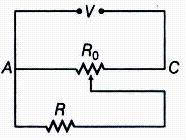
A resistance of R \(\Omega \) draws current from a potentiometer as shown in the figure. The potentiometer has a total resistance R0 \(\Omega\). A voltage V is supplied to the potentiometer. Derive an expression for the voltage across R, when the sliding contact is in the middle of the potentiometer.
6.
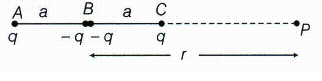
Given figure shows a charge array known as an electric quadrupole. For a point on the axis of the quadrupole, obtain the dependence of potential on r for r/a>>1 and contrast your results with that due to an electric dipole and an electric monopole(i.e. a single charge).
7.
In the birthday party of Kamal, his parents gave big slinkies to all his friends as a return gift. The very next day, during the physics class Mr. Mohan, the teacher explained them about the production of magnetic field using current carrying coil and also said that they can make permanent magnet, using such coils by passing high currents through them. That night Priyanshu, a friend of Kamal, asked his father about the coils, and their shape. His father asked him to bring the slinky, that his friend gave and explained the use of toroid and solenoid.
Read the above passage and answer the following questions:
(i) What value did Priyanshu's father have?
(ii) What is the difference between solenoid and toroid?
(iii) Give the value or magnitude of magnetic field in solenoid.
8.
The unknown resistance of a conductor can be determined by Wheatstone bridge. The standard form of Wheatstone bridge is shown in the figure. It can be shown when the bridge is balanced.
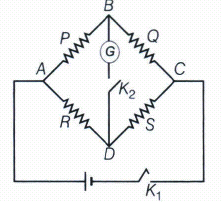
\(\frac { P }{ Q } =\frac { R }{ S } \quad or\quad S=\frac { Q }{ P } R\)
Knowing P,Q and R, unknown resistance S can be calculated.
Read the above passage and answer the following questions.
(i) Name any two applications of Wheatstone bridge.
(ii) What is the practical utility of the post office box in day to day life?
9.
The electric field at a point on the axial line at a distance of 10 cm from the center of an electric dipole is 3.75\(\times\) N/C. Calculate the length of an electric dipole.
10.
If one of the electrons of H2 molecules is removed, we get a hydrogen molecular ion H+2 . In the ground state of an H+2, the two protons are separated by roughly 1.5 \(\overset { o }{ A } \) and the electron is roughly 1\(\overset { o }{ A } \) from each proton. Determine the potential energy of the system. Specify your choice of the zero of potential energy.
1.
(i) Shyam is responsible, caring and intelligent.
(ii) It is the phenomena of redistribution of light energy in a medium due to the superposition of two coherent light waves.
(iii) For constructive interference or bright fringe, the phase difference between the two coherent light waves should be \(2n\pi \)
i.e \(\phi =2n\pi (n=0,1,2,3)\)
2.
(a) Speed of an electron, v = 5.20 x 10⁶ m/s
Magnetic field experienced by the electron, B = 1.30 x 10⁻⁴ T
Specific charge of an electron, ec
e = Charge on the electron = 1.6 x 10⁻¹⁹ C
m = Mass of the electron = 9.1 x 10⁻³¹ kg−1
The force exerted on the electron is given as:
\(F=e|\vec{v} \times \vec{B}|\)
\(=e v B \sin \theta\)
θ = Angle between the magnetic field and the beam velocity
The magnetic field is normal to the direction of beam.
∴ θ = 90∘
F = eVB ...(1)
The beam traces a circular path of radius, r. It is the magnetic field, due to its bending nature, that provides the centripetal force \(\left(F=\frac{m v^{2}}{r}\right)\)for the beam.
Hence, equation (1) reduces to:
\(e v B=\frac{m v^{2}}{r}\)
\(\therefore r=m \frac{v}{e B}=\frac{v}{\left(\frac{e}{m}\right) B}\)
\(=\frac{5.20 \times 10^{6}}{1.76 \times 10^{11}} \times 1.30 \times 10^{-4}=0.227 m=22.7 \mathrm{~cm}\)
Therefore, the radius of the circular path is 22.7 cm.
Energy of the electron beam, E = 20 MeV = 20 x 106 x 1.6 x 10-19J
The energy of the electron is given as:
\(E=\frac{1}{2} m v^{2}\)
\(\therefore v=\left(2 \frac{E}{m}\right)^{\frac{1}{2}}\)
\(=\sqrt{\frac{2 \times 20 \times 10^{6} \times 1.6 \times 10^{-19}}{9.1 \times 10^{-31}}}=2.652 \times 10^{9} \mathrm{~m} / \mathrm{s}\)
This result is incorrect because nothing can move faster than light. In the above formula, the expression (mv2/2) for energy can only be used in the non-relativistic limit, i.e., for v << c
When very high speeds are concerned, the relativistic domain comes into consideration.
In the relativistic domain, mass is given as:
\(m=m_{0}\left[1-\frac{v^{2}}{c^{2}}\right]^{\frac{1}{2}}\)
Where,
m0 = Mass of the particle at rest
Hence, the radius of the circular path is given as:
\(r=m \frac{v}{e} B\)
\(=\frac{m_{0} v}{e B \sqrt{\frac{c^{2}-v^{2}}{c^{2}}}}\)
3.
Here, slit width,d = 0.28 mm = \(0.28\times { 10 }^{ -3 }m\)
Distance between slit and screen, D = 1.4m
\(y=1.2cm=1.2\times { 10 }^{ -2 }m,n=4,\lambda =?\)
For constructive interference,
\(y=\eta \lambda \frac { D }{ d } or\lambda =\frac { yd }{ nD }\)
\( \\ =\frac { 1.2\times { 10 }^{ -2 }\times 0.28\times { 10 }^{ -3 } }{ 4\times 1.4 } =6\times { 10 }^{ -7 }m\)
= 600 nm
Hence, the wavelength of the light is 600 nm.
4.
(i) Average power delivered by an AC circuit is
\({ P }_{ av }={ V }_{ rms }{ I }_{ rms }cos\phi \)
where is minimum, the power delivered is minimum and hence, power dissipated will be maximum for the circuit.
5.
While the slide is in the middle of the potentiometer only half of its resistance (R0/2) will be between the points A and B. Hence, the total resistance between A and B, say, R1, will be given by the following expression:
\(\frac{1}{R_{1}}=\frac{1}{R}+\frac{1}{\left(R_{0} / 2\right)}\)
\(R_{1}=\frac{R_{0} R}{R_{0}+2 R}\)
The total resistance between A and C will be sum of resistance between A and B and B and C, i.e., R1 + R0/2
∴ The current flowing through the potentiometer will be
\(I=\frac{V}{R_{1}+R_{0} / 2}=\frac{2 V}{2 R_{1}+R_{0}}\)
The voltage V1 taken from the potentiometer will be the product of current I and resistance R1,
\(V_{1}=I R_{1}=\left(\frac{2 V}{2 R_{1}+R_{0}}\right) \times R_{1}\)
Substituting for R1, we have a
\(V_{1}=\frac{2 V}{2\left(\frac{R_{0} \times R}{R_{0}+2 R}\right)+R_{0}} \times \frac{R_{0} \times R}{R_{0}+2 R}\)
\(V_{1}=\frac{2 V R}{2 R+R_{0}+2 R}\)
\(\text { or } V_{1}=\frac{2 V R}{R_{0}+4 R}\)
6.
Given, AC = 2a, BP = r
AP = r + a and PC = r-a
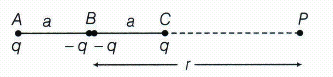
The potential at P is V.
\(\therefore\) V = Potential at P value due to A+ Potential at P due to B + Potential at P due to C
\(V=\frac { 1 }{ { 4\pi \varepsilon }_{ 0 } } \left[ \frac { q }{ AP } -\frac { 2q }{ BP } +\frac { q }{ CP } \right] \ \)
\(=\frac { 1 }{ { 4\pi \varepsilon }_{ 0 } } .q\left[ \frac { 1 }{ \left( r+a \right) } -\frac { 2 }{ r } +\frac { 1 }{ \left( r-a \right) } \right] \)
\(=\frac{q}{4 \pi \varepsilon_{0}}\left[\frac{r(r-a)-2(r+a)(r-a)+r(r+a)}{r(r+a)(r-a)}\right]\)
\(=\frac{q}{4 \pi \varepsilon_{0}}\left[\frac{r^{2}-r a-2 r^{2}+2 a^{2}+r^{2}+r a}{r\left(r^{2}-a^{2}\right)}\right]\)
\(=\frac{q \cdot 2 a^{2}}{4 \pi \varepsilon_{0} r\left(r^{2}-a^{2}\right)}=\frac{q \cdot 2 a^{2}}{4 \pi \varepsilon_{0} \cdot r \cdot r^{2}\left(1-\frac{a^{2}}{r^{2}}\right)}\)
According to the question,
If r/a>> 1 Therefore, V = \(\frac { q.2{ a }^{ 2 } }{ { 4\pi \varepsilon }_{ 0 }.{ r }^{ 3 } } \Rightarrow V\propto \frac { 1 }{ { r }^{ 3 } } \)
As, we know that electric potential at a point on axial line due to an electric dipole is
\(V\propto \frac { 1 }{ { r }^{ 2 } } \)
In case of electric monopole, \(V\propto \frac { 1 }{ { r } } \) .
Then, we conclude that for larger r, the electric potential due to quadrupole is inversely proportional to the cube of the distance r, while due to an electric dipole, it is inversely proportional to the square of r and inversely proportional to the distance r for a monopole.
7.
(i) Priyanshu's father is responsible, makes his child understood the concepts of solenoid and toroid.
(ii) A solenoid has magnetic field straight within the turns and in toroid, it is in form of concentric circles.
(iii) The magnitude of magnetic field in solenoid is given by \(B={ { \mu } }_{ \circ }nI\)
(where, n = number of turns/length, I = current in coil)
8.
(i) Post office box and meter bridge are two electrical appliances based on the principal of Wheatstone bridge.
(ii) The post office box is used practically in post and telegraph department to locate the snapping of telephone line.
The broken telephone line will touch the ground. Using post office box, resistance S of broken line is determined.
As resistance per unit length of line is known, the length of broken line can be calculated. Therefore, snapping of line is located.
9.
\(We \ know \ that,{ E }_{ axial }=\frac { 1 }{ 4\pi { \varepsilon }_{ 0 } } .\frac { 2\rho r }{ { ({ r }^{ 2 }-{ r }^{ 2 }) }^{ 2 } } \)
\(CaseI,\)
\( When \ r=10cm=0.1m\)
\(\\ { E }_{ axial }=3.75\times { 10 }^{ 5 }N/C\)
\(\\ 3.75\times { 10 }^{ 5 }=9\times { 10 }^{ 5 }\times \frac { 2\rho \times 0.1 }{ { { [(0.1) }^{ 2 }-{ a }^{ 2 }] }^{ 2 } } \ .....(i)\)
\(Case \ II,\)
\( When \ r=20cm=0.2m\)
\(\\ { E }_{ axial }=3\times { 10 }^{ 4 }\times \frac { 2\rho \times 0.2 }{ { { [(0.2) }^{ 2 }-{ a }^{ 2 }] }^{ 2 } } \ .......(ii)\)
Solving the Eqs. (i) and (ii), we get
a = 0.05 m
Therefore, lemgth of the dipole is 2z.
So, 2a = 2 x 0.05
or 2a = 0.1 m
10.
There are two protons p1 and p2 with an electron e.
Distance between two protons id given by
r1 = 1.5\(\overset { o }{ A } \) = 1.5 x 10⁻¹⁰ m

Distance between proton p1 and electron e is given by
r2 = 1 \(\overset { o }{ A } \)
= 1 x 10⁻¹⁰ m
Distance between proton p2 and electron e is given by
r3 = 1\(\overset { o }{ A } \)
=1 x10⁻¹⁰ m
The total potential energy of the system,
\(U=\frac { 1 }{ { 4\pi \varepsilon }_{ 0 } } .\left[ \frac { { q }_{ p1 }{ q }_{ p2 } }{ { r }_{ 1 } } +\frac { { q }_{ p1 }{ q }_{ e } }{ { r }_{ 2 } } +\frac { { q }_{ p2 }{ q }_{ e } }{ { r }_{ 13 } } \right] \)......(i)
Given qp1 = qp2
= 1.6 x10⁻¹⁹ C
and qe= -1.6 x10⁻¹⁹ C
Putting these values in Eq.(i), we get
\(U=9 \times 10^{9}\left[\frac{1.6 \times 10^{-19} \times 1.6 \times 10^{-19}}{1.5 \times 10^{-10} \cdots}\right.\) \(+\frac{\left(1.6 \times 10^{-19}\right) \times\left(-1.6 \times 10^{-19}\right)}{10^{-10}}\) \(\left.+\frac{1.6 \times 10^{-19} \times\left(-1.6 \times 10^{-19}\right)}{10^{-10}}\right]\)
\(=\frac{9 \times 10^{9} \times 1.6 \times 1.6 \times 10^{-38}}{10^{-10}}\left[\frac{1}{1.5}-1-1\right]\)
= -30.72 x 10⁻¹⁹ J
\(=\frac{-30.72 \times 10^{-19}}{1.6 \times 10^{-19}} \mathrm{eV}=-19.2 \mathrm{eV}\)
Here, we use that potential energy at infinity is zero.

12th Standard CBSE Syllabus & Materials
12th Standard CBSE
CBSE 12th Computer Science Python Revision Tour I - New Previous year Question Papers Study Material - QB365 Set A
NEW12th Standard CBSE
CBSE 12th Business Studies Planning Important Questions And Answers Study Material - QB365 Set A
NEW12th Standard CBSE
CBSE 12th Business Studies Business Environment Important Questions And Answers Study Material - QB365 Set A
NEW12th Standard CBSE
CBSE 12th Business Studies Principles of Management Important Questions And Answers Study Material - QB365 Set A



NCERT Books

Syllabus

Exam Pattern

Sample Question Papers

Previous year Question Papers

Important Notes

MCQ Practice test

NCERT Exemplers

Case study Questions

Image Based Questions

Passage based Questions

HOT Questions

Value Based Questions

Model Questions Papers
NCERT ( Book Back ) Questions

Assertion and Reason
Important Questions And Answers

CBSE 12th Standard CBSE Subjects
CBSE Standards









