
 100% FREE ACCESS
12th Standard CBSE Syllabus & Materials
12th Standard CBSE
CBSE 12th Economics Government Budget and the Economy Previous year Question Papers Study Material - QB365 Set A
NEW12th Standard CBSE
CBSE 12th Computer Science Interface Python with MySQL - New Previous year Question Papers Study Material - QB365 Set A
NEW12th Standard CBSE
CBSE 12th Computer Science Database Concept - New Previous year Question Papers Study Material - QB365 Set A
NEW12th Standard CBSE
CBSE 12th Computer Science Data Communication - New Previous year Question Papers Study Material - QB365 Set A
NEW12th Standard CBSE
CBSE 12th Computer Science Data Structures - New Previous year Question Papers Study Material - QB365 Set A
NEW12th Standard CBSE
CBSE 12th Computer Science Functions - New Previous year Question Papers Study Material - QB365 Set A

Published on: 22/05/2021
QB365 Provides the updated NCERT Exemplar Questions for Class 12, and also provide the detail solution for each and every case study questions. NCERT Exemplar questions are latest updated question pattern from NCERT, QB365 will helps to get more marks in Exams
Download CBSE Class 12th Standard CBSE Physics question papers, sample papers, important questions, and previous year solved papers in PDF format. Get free study materials, NCERT solutions, and exam preparation resources for Class 12th Standard CBSE Physics
Questions + Answers key
Take MCQ Physics Test1.
A modulating signal is a square wave as shown in the figure.
The carrier wave is given by c(T) = 2 sin (8\(\pi \) t) volt.
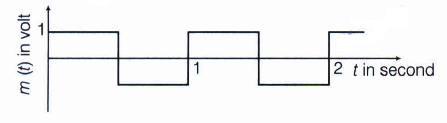
(i) Sketch the amplitude modulated waveform
(ii) What is the modulation index?
2.
(i) How does one demonstrate, using a suitable diagram, that unpolarised light when passed through a polaroid gets polarised?
(ii) A beam of unpolarised light is incident on a glass-air interface. Show, using a suitable ray diagram, that light reflected from the interface is totally polarised, when \(\mu =tan{ i }_{ B }\) where \(\mu \) is the refractive index of glass with respect to air and \({ i }_{ B }\) is the Brewster's angle.
3.
(i) A voltage V = V0 \(sin\ \omega t\) applied to a series L-C-R circuit derives a current I = I0 \(sin\ \omega t\) in the circuit. Deduce the expression for the average power dissipated in the circuit.
(ii) For circuits used for transporting electric power, a low power factor implies large power loss in transmission. Explain.
(iii) Define the term wattless current.
4.
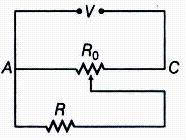
A resistance of R \(\Omega \) draws current from a potentiometer as shown in the figure. The potentiometer has a total resistance R0 \(\Omega\). A voltage V is supplied to the potentiometer. Derive an expression for the voltage across R, when the sliding contact is in the middle of the potentiometer.
5.
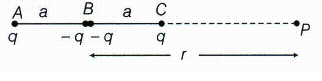
Given figure shows a charge array known as an electric quadrupole. For a point on the axis of the quadrupole, obtain the dependence of potential on r for r/a>>1 and contrast your results with that due to an electric dipole and an electric monopole(i.e. a single charge).
6.
(i) Derive the expression for the torque on a rectangular current carrying loop suspended in a uniform magnetic field
(ii) A proton and a deuteron having equal momentum enter in a region of a uniform magnetic field at right angle to the direction of the field.Depict their trajectories in the field
7.
The unknown resistance of a conductor can be determined by Wheatstone bridge. The standard form of Wheatstone bridge is shown in the figure. It can be shown when the bridge is balanced.
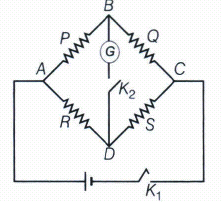
\(\frac { P }{ Q } =\frac { R }{ S } \quad or\quad S=\frac { Q }{ P } R\)
Knowing P,Q and R, unknown resistance S can be calculated.
Read the above passage and answer the following questions.
(i) Name any two applications of Wheatstone bridge.
(ii) What is the practical utility of the post office box in day to day life?
8.
Explain using a labelled diagram, the principle and working of a moving coil galvanometer. What is the function of
(i) uniform radial magnetic field
(ii) soft iron core?
Also, define the terms
(iii) current sensitivity and
(iv) voltage sensitivity of a galvanometer.
Why does increasing the current sensitivity not necessarily increase voltage sensitivity?
9.
Suppose a 'n'-type wafer is created by doping Si crystal having \(5\times10^{ 28 }\)atoms/\({ m }^{ 3 }\)with 1 ppm concentration of As.On the surface 200 ppm Boron is added to create \('p'\)region in this wafer. Considering \({ n }_{ i }=1.5\times10^{ 16 }m^{ -3 }\)
(i) Calculate the densities of the charge carriers in the \(n\& p\) regions.
(ii) Comment which carriers would contribute largely for the reverse saturation current when diode is reverse biased.
1.
Given, the equation of carrier wave,
c(t) = 1 sin (8\(\pi \) t) ..........(i)
(i) According to the figure,
Amplitude of modulating signal,
Am = 1 V
Amplitude of carrier wave,
AC =2
Tm = 1 s
From Eq.(i), we get
\({ \omega }_{ m }=\frac { 2\pi }{ { T }_{ m } } =\frac { 2\pi }{ 1 } =2\pi \ rad/s\) ....(ii)
c(t) = 2 sin (8 \(\pi \) t)
So, \({ \omega }_{ c }=4{ \omega }m_{ }\)
From Eq. (ii) , we get
So, \({ \omega }_{ c }=4{ \omega }_{ m }\)
Amplitude of modulated wave,
A = Am + Ac
= 1 + 2= 3 V
The sketch of the amplitude modulated waveform is shown below:
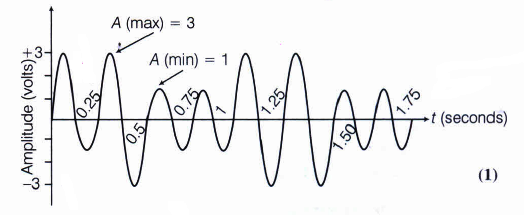
For carrier signal, \({ \omega }\) = 8 \(\pi \)
\(T=\frac { 2\pi }{ \omega } =\frac { 2\pi }{ 8\pi } =\frac { 1 }{ 4 } =0.25s\)
(ii) Modulation index, \(m=\frac{A_{m}}{A_{c}}=\frac{1}{2}=0.5\)
2.
The components of electric vector associated with light wave, along the direction of aligned molecules of a polaroid, get absorbed. As a result after passing through it, the components perpendicular to the direction of aligned molecules will be obtained in the form of plane polarised light.
(b) When unpolarised light is incident on the boundary between two transperent media, the reflected light is polarised, with electric vector perpendicular to the plane of incidence when the reflected and refracted light rays make a right angle, as shown in the figure below.
Since, \(\angle CBQ+\angle QBD={ 90 }^{ o }\)
(90 - iB) + (90 - r) = 90o
iB + r = 90
r = 90 - iB
Using Snell's law,
\(\mu =\frac { sin{ i }_{ B } }{ sinr } \)
\(=\frac { sin{ i }_{ B } }{ sin\left( 90-{ i }_{ B } \right) } \)
\(=\frac { sin{ i }_{ B } }{ { cosi }_{ B } } \)
\(\mu =tan{ i }_{ B }\).
3.
(i) Average power delivered by an AC circuit is
\({ P }_{ av }={ V }_{ rms }{ I }_{ rms }cos\phi \)
where is minimum, the power delivered is minimum and hence, power dissipated will be maximum for the circuit.
4.
While the slide is in the middle of the potentiometer only half of its resistance (R0/2) will be between the points A and B. Hence, the total resistance between A and B, say, R1, will be given by the following expression:
\(\frac{1}{R_{1}}=\frac{1}{R}+\frac{1}{\left(R_{0} / 2\right)}\)
\(R_{1}=\frac{R_{0} R}{R_{0}+2 R}\)
The total resistance between A and C will be sum of resistance between A and B and B and C, i.e., R1 + R0/2
∴ The current flowing through the potentiometer will be
\(I=\frac{V}{R_{1}+R_{0} / 2}=\frac{2 V}{2 R_{1}+R_{0}}\)
The voltage V1 taken from the potentiometer will be the product of current I and resistance R1,
\(V_{1}=I R_{1}=\left(\frac{2 V}{2 R_{1}+R_{0}}\right) \times R_{1}\)
Substituting for R1, we have a
\(V_{1}=\frac{2 V}{2\left(\frac{R_{0} \times R}{R_{0}+2 R}\right)+R_{0}} \times \frac{R_{0} \times R}{R_{0}+2 R}\)
\(V_{1}=\frac{2 V R}{2 R+R_{0}+2 R}\)
\(\text { or } V_{1}=\frac{2 V R}{R_{0}+4 R}\)
5.
Given, AC = 2a, BP = r
AP = r + a and PC = r-a
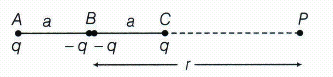
The potential at P is V.
\(\therefore\) V = Potential at P value due to A+ Potential at P due to B + Potential at P due to C
\(V=\frac { 1 }{ { 4\pi \varepsilon }_{ 0 } } \left[ \frac { q }{ AP } -\frac { 2q }{ BP } +\frac { q }{ CP } \right] \ \)
\(=\frac { 1 }{ { 4\pi \varepsilon }_{ 0 } } .q\left[ \frac { 1 }{ \left( r+a \right) } -\frac { 2 }{ r } +\frac { 1 }{ \left( r-a \right) } \right] \)
\(=\frac{q}{4 \pi \varepsilon_{0}}\left[\frac{r(r-a)-2(r+a)(r-a)+r(r+a)}{r(r+a)(r-a)}\right]\)
\(=\frac{q}{4 \pi \varepsilon_{0}}\left[\frac{r^{2}-r a-2 r^{2}+2 a^{2}+r^{2}+r a}{r\left(r^{2}-a^{2}\right)}\right]\)
\(=\frac{q \cdot 2 a^{2}}{4 \pi \varepsilon_{0} r\left(r^{2}-a^{2}\right)}=\frac{q \cdot 2 a^{2}}{4 \pi \varepsilon_{0} \cdot r \cdot r^{2}\left(1-\frac{a^{2}}{r^{2}}\right)}\)
According to the question,
If r/a>> 1 Therefore, V = \(\frac { q.2{ a }^{ 2 } }{ { 4\pi \varepsilon }_{ 0 }.{ r }^{ 3 } } \Rightarrow V\propto \frac { 1 }{ { r }^{ 3 } } \)
As, we know that electric potential at a point on axial line due to an electric dipole is
\(V\propto \frac { 1 }{ { r }^{ 2 } } \)
In case of electric monopole, \(V\propto \frac { 1 }{ { r } } \) .
Then, we conclude that for larger r, the electric potential due to quadrupole is inversely proportional to the cube of the distance r, while due to an electric dipole, it is inversely proportional to the square of r and inversely proportional to the distance r for a monopole.
6.
(ii) We know, Lorentz force, F = Bqv sin\(\theta \)
Where \(\theta \) = angle between velocity of particle and magnetic field=900
So,Lorentz force, F = Bqv [sin 900 = 1]
When a charged particle enters in a magnetic field in a direction normal to the field, then in this condition,
Lorentz force = Centripetal force
\(Bqv=\frac { mv^{ 2 } }{ r } \Rightarrow r=\frac { mv }{ Bq } \)
7.
(i) Post office box and meter bridge are two electrical appliances based on the principal of Wheatstone bridge.
(ii) The post office box is used practically in post and telegraph department to locate the snapping of telephone line.
The broken telephone line will touch the ground. Using post office box, resistance S of broken line is determined.
As resistance per unit length of line is known, the length of broken line can be calculated. Therefore, snapping of line is located.
8.
Current sensitivity, \({ I }_{ s }=\frac { NAB }{ k } \) and
Voltage sensitivity, \(V_{ s }=\frac { NAB }{ kR } \)
Since, the resistance of the coil may vary, it implies an increase in current sensitivity may not necessarily increase voltage sensitivity.
Thus, the trajectory of both the particles will be same.
9.
(i)When As is implanted in Si-crystal, n-type wafer is created. The no of majority carrier electrons due to doping of As is
\(n_{ e }={ N }_{ D }=\frac { 1 }{ 10^{ 6 } } \times5\times10^{ 28 }=5\times10^{ 22 }/m^{ -3 }\)
No of minority carriers (holes) in \(n-\)type wafer is
\({ n }_{ h }=\frac { { n }_{ 1 }^{ 2 } }{ n_{ e } } =\frac { (1.5\times10^{ 16 })^{ 2 } }{ 5\times10^{ 22 } } =0.45\times10^{ 10 }/m^{ 3 }\)
when B is implanted in Si-crystal p-type wafer is created with no of holes
\({ n }_{ h }=N_{ A }=\frac { 200 }{ 10^{ 6 } } \times(5\times10^{ 28 })=1\times10^{ 25 }/m^{ 3 }\)
Minority carriers (electrons) created in the p-type wafer is
\({ n }_{ e }=\frac { { n }_{ 1 }^{ 2 } }{ n_{ h } } =\frac { (1.5\times10^{ 16 })^{ 2 } }{ 1\times10^{ 25 } } =2.25\times10^{ 10 }/m^{ 3 }\)
When \(p-n\)a junction is reverse biased, the minority carrier holes of \(n-\)region wafer \((n_{ h }=0.45\times10^{ 10 }/m^{ 3 })\) would contributte more to the reverse saturation current than minority carrier than minority carrier electrons \((n_{ e }=2.25\times10^{ 7 }/m^{ 3 })\)

12th Standard CBSE Syllabus & Materials
12th Standard CBSE
CBSE 12th Computer Science Python Revision Tour I - New Previous year Question Papers Study Material - QB365 Set A
NEW12th Standard CBSE
CBSE 12th Business Studies Planning Important Questions And Answers Study Material - QB365 Set A
NEW12th Standard CBSE
CBSE 12th Business Studies Business Environment Important Questions And Answers Study Material - QB365 Set A
NEW12th Standard CBSE
CBSE 12th Business Studies Principles of Management Important Questions And Answers Study Material - QB365 Set A



NCERT Books

Syllabus

Exam Pattern

Sample Question Papers

Previous year Question Papers

Important Notes

MCQ Practice test

NCERT Exemplers

Case study Questions

Image Based Questions

Passage based Questions

HOT Questions

Value Based Questions

Model Questions Papers
NCERT ( Book Back ) Questions

Assertion and Reason
Important Questions And Answers

CBSE 12th Standard CBSE Subjects
CBSE Standards









