
 100% FREE ACCESS
12th Standard CBSE Syllabus & Materials
12th Standard CBSE
CBSE 12th Economics Government Budget and the Economy Previous year Question Papers Study Material - QB365 Set A
NEW12th Standard CBSE
CBSE 12th Computer Science Interface Python with MySQL - New Previous year Question Papers Study Material - QB365 Set A
NEW12th Standard CBSE
CBSE 12th Computer Science Database Concept - New Previous year Question Papers Study Material - QB365 Set A
NEW12th Standard CBSE
CBSE 12th Computer Science Data Communication - New Previous year Question Papers Study Material - QB365 Set A
NEW12th Standard CBSE
CBSE 12th Computer Science Data Structures - New Previous year Question Papers Study Material - QB365 Set A
NEW12th Standard CBSE
CBSE 12th Computer Science Functions - New Previous year Question Papers Study Material - QB365 Set A

Published on: 21/05/2021
QB365 Provides the updated CASE Study Questions for Class 12 , and also provide the detail solution for each and every case study questions . Case study questions are latest updated question pattern from NCERT, QB365 will helps to get more marks in Exams
Download CBSE Class 12th Standard CBSE Physics question papers, sample papers, important questions, and previous year solved papers in PDF format. Get free study materials, NCERT solutions, and exam preparation resources for Class 12th Standard CBSE Physics
Questions + Answers key
Take MCQ Physics Test
1.
Interference is based on the superposition principle. According to this principle, at a particular point in the medium, the resultant displacement produced by a number of waves is the vector sum of the displacements produced by each of the waves. If two sodium lamps illuminate two pinholes S1 and S2. The intensities will add up and no interference fringes will be observed on the screen. Here the source undergoes abrupt phase change in times of the order of 10-10 seconds.
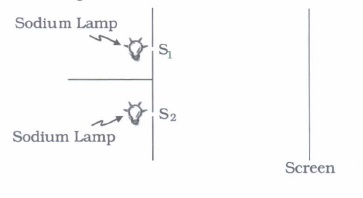
(i) Two coherent sources of intensity 10 W/m2 and 25 W/m2 interfere to form fringes. Find the ratio of maximum intensity to minimum intensity
| (a) 15.54 | (b) 16.78 | (c) 19.72 | (d) 18.39 |
(ii) Which of the following does not show interference?
| (a) Soap bubble | (b) Excessively thin film | (c) A thick film | (d) Wedge shaped film |
(iii) In a Young's double-slit experiment, the slit separation is doubled. To maintain the same fringe spacing on the screen, the screen-to-slit distance D must be changed to
| (a) 2D | (b) 4D | (c) D/2 | (d) D/4 |
(iv) The maximum number of possible interference maxima for slit separation equal to twice the wavelength in Young's double-slit experiment, is
| (a) infinite | (b) five | (c) three | (d) zero |
(v) The resultant amplitude of a vibrating particle by the superposition of the two waves \(y_{1}=a \sin \left[\omega t+\frac{\pi}{3}\right] \text { and } y_{2}=a \sin \omega t \text { is }\)
| (a) a | (b)\(\sqrt{2}\) a | (c) 2a | (d) \(\sqrt{3}\) a |
2.
Huygen's principle is the basis of wave theory of light. Each point on a wavefront acts as a fresh source of new disturbance, called secondary waves or wavelets. The secondary wavelets spread out in all directions with the speed light in the given medium.An initially parallel cylindrical beam travels in a medium of refractive index \(\mu(I)=\mu_{0}+\mu_{2} I\), where \(\mu_{0} \text { and } \mu_{2}\)are positive constants and I is the intensity of the light beam. The intensity of the beam is decreasing with increasing radius.
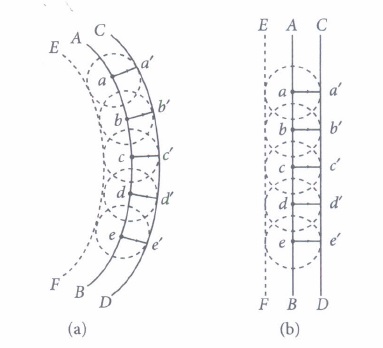
(i) The initial shape of the wavefront of the beam is
| (a) planar | (b) convex |
| (c) concave | (d) convex near the axis and concave near the periphery |
(ii) According to Huygens Principle, the surface of constant phase is
| (a) called an optical ray | (b) called a wave |
| (c) called a wavefront | (d) always linear in shape |
(iii) As the beam enters the medium, it will
| (a) travel as a cylindrical beam | (b) diverge |
| (c) converge | (d) diverge near tile axis and converge near the periphery. |
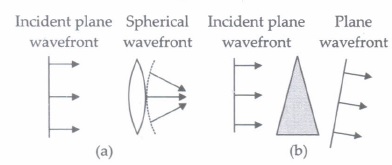
(iv) Two plane wavefronts of ligbt, one incident on a thin convex lens and another on the refracting face of a thin prism. After refraction at them, the emerging wavefronts respectively become
| (a) plane wavefront and plane wavefront | (b) plane wavefront and spherical wavefront |
| (c) spherical wavefront and plane wavefront | (d) spherical wavefront and spherical wavefront |
(v) Which of the following phenomena support the wave theory of light?
1. Scattering
2. Interference
3. Diffraction
4. Velocity of light in a denser medium is less than the velocity of light in the rarer medium
| (a) 1,2,3 | (b) 1,2,4 | (c) 2,3,4 | (d) 1,3,4 |
3.
Wavefront is a locus of points which vibratic in same phase. A ray of light is perpendicular to the wavefront. According to Huygens principle, each point of the wavefront is the source of a secondary disturbance and the wavelets connecting from these points spread out in all directions with the speed of wave. The figure shows a surface XY separating two transparent media, medium-1 and medium-2. The lines ab and cd represent wavefronts of a light wave travelling in medium- 1 and incident on XY. The lines ef and gh represent wavefronts of the light wave in medium -2 after refraction.
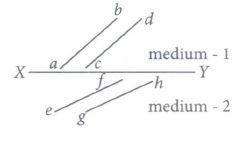
(i) Light travels as a
| (a) parallel beam in each medium | (b) convergent beam in each medium |
| (c) divergent beam in each medium | (d) divergent beam in one medium and convergent beam in the other medium. |
(ii) The phases of the light wave at c, d, e and f are \(\phi_{c}, \phi_{d}, \phi_{e}\) and \( \phi_{f}\) respectively. It is given that \(\phi_{c} \neq \phi_{f}\)
| \(\text { (a) } \phi_{c} \text { cannot be equal to } \phi_{d}\) | \(\text { (b) } \phi_{d} \text { can be equal to } \phi_{e}\) |
| \(\text { (c) }\left(\phi_{d}-\phi_{f}\right) \text { is equal to }\left(\phi_{c}-\phi_{e}\right)\) | \(\text { (d) }\left(\phi_{d}-\phi_{c}\right) \text { is not equal to }\left(\phi_{f}-\phi_{e}\right)\) |
(iii) Wavefront is the locus of all points, where the particles of the medium vibrate with the same
| (a) phase | (b) amplitude | (c) frequency | (d) period |
(iv) A point source that emits waves uniformly in all directions, produces wavefronts that are
| (a) spherical | (b) elliptical | (c) cylindrical | (d) planar |
(v) What are the types of wavefronts ?
| (a) Spherical | (b) Cylindrical | (c) Plane | (d) All of these |
4.
A narrow tube is bent in the form of a circle of radius R, as shown in figure. Two small holes S and D are made in the tube at the positions at right angle to each other. A source placed at S generates a wave of intensity Io which is equally divided into two parts: one part travels along the longer path, while the other travels along the shorter path. Both the waves meet at point D where a detector is placed.
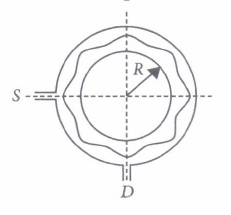
(i) If a maxima is formed at a detector, then the magnitude of wavelength \(\lambda\) of the wave produced is given by
| \((a) \pi R\) | \((b) \frac{\pi R}{2}\) | \((c) \frac{\pi R}{4}\) | (d) all of these |
(ii) If the intensity ratio of two coherent sources used in Young's double slit experiment is 49 : 1, then the ratio between the maximum and minimum intensities in the interference pattern is
| (a) 1: 9 | (b) 9: 16 | (c) 25: 16 | (d) 16: 9 |
(iii) The maximum intensity produced at D is given by
| (a) 4I0 | (b) 2I0 | (c) I0 | (d) 3I0 |
(iv) In a Young's double slit experiment, the intensity at a point where the path difference is \(\lambda\)/6 (\(\lambda\) - wavelength of the light) is I. If I0 denotes the maximum intensity, then I/I0 is equal to
| \((a) \frac{1}{2}\) | \((b) \frac{\sqrt{3}}{2}\) | \((c) \frac{1}{\sqrt{2}}\) | \((d) \frac{3}{4}\) |
(v) Two identical light waves, propagating in the same direction, have a phase difference d. After they superpose the intensity of the resulting wave will be proportional to
| \((a) \cos \delta\) | \((b) \cos (\delta / 2)\) | \((c) \cos ^{2}(\delta / 2)\) | \((d) \cos ^{2} \delta\) |
1.
(i) (c) : Given \(I_{1}=10 \mathrm{~W} / \mathrm{m}^{2} \text { and } I_{2}=25 \mathrm{~W} / \mathrm{m}^{2}\)
\(\frac{I_{1}}{I_{2}}=\frac{a_{1}^{2}}{a_{2}^{2}}=\frac{10}{25} \Rightarrow \frac{a_{1}}{a_{2}}=\frac{3.16}{5} \text { or } a_{1}=\frac{3.16}{5} a_{2}=0.6324 a_{2}\)
\(\frac{I_{\max }}{I_{\min }}=\frac{\left(a_{1}+a_{2}\right)^{2}}{\left(a_{1}-a_{2}\right)^{2}}=\frac{\left[0.6324 a_{2}+a_{2}\right]^{2}}{\left[0.6324 a_{2}-a_{2}\right]^{2}}=19.724\)
(ii) (b): In an excessively thin film, the thickness of the film is negligible. Thus the path difference between the reflected rays becomes \(\lambda\)/2 which produces a minima.
(iii) (a): Since, \(\beta=\frac{\lambda D}{d} \text { for } d=2 d\)
\(\beta^{\prime}=\frac{\lambda D^{\prime}}{2 d}=\beta(\text { Gives })\)
\(\therefore \quad D_{1}=2 D\)
(iv) (b): The condition for possible interference maxima on the screen is, dsin \(\theta\) = n\(\lambda\)
where d is slit separation and Ais the wavelength.
\(\text { As } d=2 \lambda \text { (given) } \quad \therefore 2 \lambda \sin \theta=n \lambda \text { or } 2 \sin \theta=n\)
For number of interference maxima to be maximum,sin\(\theta\) = 1 :. n = 2
The interference maxima will be formed when n = 0, ± 1, ± 2
Hence the maximum number of possible maxima is 5.
(v) (d): \(y_{1}=a \sin \left(\omega t+\frac{\pi}{3}\right) \text { and } y_{2}=a \sin \omega t\)
\(A=\sqrt{a_{1}^{2}+a_{2}^{2}+2 a_{1} a_{2} \cos \phi}, \text { where } \phi=\frac{\pi}{3}\)
\(=\sqrt{a^{2}+a^{2}+2 a a \cos \frac{\pi}{3}}=\sqrt{3} a\)
2.
(i) (a): As the beam is initially parallel, the shape of wavefront is planar.
(ii) (c): According to Huygens Principle, the surface of constant phase is called a wavefront.
(iii) (c)
(iv) (c): After refraction, the emerging wavefronts respectively become spherical. wavefront and plane wavefront as shown in figures (a) and (b).
(v) (c)
3.
(i) (a): Since the path difference between two waveform is equal, light traves as parallel beam in each medium.
(ii) (c): Since all points on the wavefront are in the same phase,
\(\phi_{d}=\phi_{c} \text { and } \phi_{f}=\phi_{e} \)
\(\therefore \phi_{d}-\phi_{f}=\phi_{c}-\phi_{e^{-}}\)
(iii) (a): Wavefront is the locus of all points, where the particles of the medium vibrate with the same phase
(iv) (a)
(v) (d)
4.
(i) (d): Path difference produced is
\(\Delta x=\frac{3}{2} \pi R-\frac{\pi}{2} R=\pi R\)
For maxima \(\Delta x=n \lambda\)
\(\begin{array}{l} \therefore \quad n \lambda=\pi R \\ \Rightarrow \lambda=\frac{\pi R}{n}, n=1,2,3, \ldots . \end{array}\)
Thus, the possible values of \(\lambda \text { are } \pi R, \frac{\pi R}{2}, \frac{\pi R}{3}, \ldots\)
(ii) (d)
(iii) (b): Maximum intensity \(I_{\max }=\left(\sqrt{I_{1}}+\sqrt{I_{2}}\right)^{2}\)
\(\text { Here, } I_{1}=I_{2}=\frac{I_{0}}{2} \text { (given) }\)
\(\therefore \quad I_{\max }=\left(\sqrt{\frac{I_{0}}{2}}+\sqrt{\frac{I_{0}}{2}}\right)^{2}=2 I_{0}\)
(iv) (d): Phase difference \(\phi=\frac{2 \pi}{\lambda}\) x path diffrerence
\(\phi=\frac{2 \pi}{\lambda} \times \frac{\lambda}{6}=\frac{\pi}{3}=60^{\circ} \text { As } I=I_{\max } \cos ^{2} \frac{\phi}{2}\)
\(\therefore \quad I=I_{0} \cos ^{2} \frac{60^{\circ}}{2}=I_{0} \times\left(\frac{\sqrt{3}}{2}\right)^{2}=\frac{3}{4} I_{0} \Rightarrow \frac{I}{I_{0}}=\frac{3}{4}\)
(v) (c): HereA2 = \(a_{1}^{2}+a_{2}^{2}+2 a_{1} a_{2} \cos \delta \because a_{1}=a_{2}=a\)
\(\therefore A^{2}=2 a^{2}(1+\cos \delta)=2 a^{2}\left(1+2 \cos ^{2} \frac{\delta}{2}-1\right)\)
\(\text { or } A^{2} \propto \cos ^{2} \frac{\delta}{2}\)
\(\text { Now } I \propto A^{2} \quad \therefore I \propto A^{2} \propto \cos ^{2} \frac{\delta}{2} \Rightarrow I \propto \cos ^{2} \frac{\delta}{2}\)

12th Standard CBSE Syllabus & Materials
12th Standard CBSE
CBSE 12th Computer Science Python Revision Tour I - New Previous year Question Papers Study Material - QB365 Set A
NEW12th Standard CBSE
CBSE 12th Business Studies Planning Important Questions And Answers Study Material - QB365 Set A
NEW12th Standard CBSE
CBSE 12th Business Studies Business Environment Important Questions And Answers Study Material - QB365 Set A
NEW12th Standard CBSE
CBSE 12th Business Studies Principles of Management Important Questions And Answers Study Material - QB365 Set A



NCERT Books

Syllabus

Exam Pattern

Sample Question Papers

Previous year Question Papers

Important Notes

MCQ Practice test

NCERT Exemplers

Case study Questions

Image Based Questions

Passage based Questions

HOT Questions

Value Based Questions

Model Questions Papers
NCERT ( Book Back ) Questions

Assertion and Reason
Important Questions And Answers

CBSE 12th Standard CBSE Subjects
CBSE Standards








