
 100% FREE ACCESS
12th Standard CBSE Syllabus & Materials
12th Standard CBSE
CBSE 12th Economics Government Budget and the Economy Previous year Question Papers Study Material - QB365 Set A
NEW12th Standard CBSE
CBSE 12th Computer Science Interface Python with MySQL - New Previous year Question Papers Study Material - QB365 Set A
NEW12th Standard CBSE
CBSE 12th Computer Science Database Concept - New Previous year Question Papers Study Material - QB365 Set A
NEW12th Standard CBSE
CBSE 12th Computer Science Data Communication - New Previous year Question Papers Study Material - QB365 Set A
NEW12th Standard CBSE
CBSE 12th Computer Science Data Structures - New Previous year Question Papers Study Material - QB365 Set A
NEW12th Standard CBSE
CBSE 12th Computer Science Functions - New Previous year Question Papers Study Material - QB365 Set A

Published on: 27/05/2021
QB365 Provides the HOT Question Papers for Class 12 Physics, and also provide the detail solution for each and every HOT Questions. HOT Questions will help to get more idea about question pattern in every exams and also will help to get more marks in Exams
Download CBSE Class 12th Standard CBSE Physics question papers, sample papers, important questions, and previous year solved papers in PDF format. Get free study materials, NCERT solutions, and exam preparation resources for Class 12th Standard CBSE Physics
Questions + Answers key
Take MCQ Physics Test1.
In an experiment with two coherent sources, the amplitude of the intensity variation is found to be 5% of the average intensity. What will be the relative intensities of the light waves of interfering source.
2.
Explain with the help of ray diagram, the working of an astronomical telescope. The magnifying power of a telescope in its normal adjustment is 20. If the length of the telescope is 105 cm in this adjustment, find the focal length of the two lenses.
3.
(i) Light passes through two polaroids \({ P }_{ 1 }and{ P }_{ 2 }\) with pass axis of \({ P }_{ 2 }\) with pass axis of \({ P }_{ 2 }\) making in angle \(\theta \) with the pass axis of \({ P }_{ 1 }\) . For what value of \(\theta \) is the intensity of emergent light zero?
(ii) A third polaroid is placed between \({ P }_{ 1 }and{ P }_{ 2 }\) with its pass axis making an angle \(\beta \) with the pass axis is \({ P }_{ 1 }\) . Find the value of \(\beta \) for which the intensity of light from \({ P }_{ 2 }\) is \(\frac { { I }_{ 0 } }{ 8 } \) , where \({ I }_{ 0 }\) is the intensity of light on the polaroid \({ P }_{ 1 }\) .
4.
Show that for a material with refractive index \(\mu \ge \sqrt { 2 } \), light incident at any angle shall be guided along a length perpendicular to the incident face.
5.
A jar of height is filled with a transparent liquid of refractive index \(\mu \)(figure). At the centre of the jar on the bottom surface is a dot. Find the minimum diameter of a disc, such that when placed on the top surface symmetrically about the centre, the dot is invisible.

The problem is based on the principle of total inter reflection and area of visibility.
1.
As we know that, \(I={ I }_{ av }\pm 0.05{ I }_{ av }\)
\(\Rightarrow \) \({ I }_{ max }={ I }_{ av }\left( 1+0.05 \right) =1.05{ I }_{ av }\)
\({ I }_{ min }={ I }_{ av }\left( 1-0.05 \right) =0.95{ I }_{ av }\)
Dividing Eqs. (i) and (ii), we get
\(\Rightarrow \) \(\frac { { I }_{ max } }{ { I }_{ min } } =\frac { 1.05 }{ 0.95 } \)
\(\Rightarrow \) \(\left( \frac { r+1 }{ r-1 } \right) ^{ 2 }=\frac { 105 }{ 95 } \)
\(\Rightarrow \) \({ r }^{ 2 }+1+2r)95=105({ r }^{ 2 }+1-2r)\)
\(\Rightarrow \) \({ 10r }^{ 2 }-400r+10=0\Rightarrow r=40\)
\(\frac { { I }_{ 1 } }{ { I }_{ 2 } } ={ r }^{ 2 }=({ 40) }^{ 2 }=1600:1\)
2.
In normal adjustments, m = \(|\frac { { f }_{ 0 } }{ { f }_{ e } } |=20\\ \)
Also, length of telescope, f0 + fe = 105
20f0 + f e = 105
21f e = 105
f e = 5 cm
f0 = 20 fe = 20 x 5 = 100 cm
3.
(i) By Malus law, intensity of emergent light from \({ P }_{ 2 }\) is \(I={ I }_{ \circ }cos^{ 2 }\theta \) , where \(\theta \) is the angle between \({ P }_{ 1 }and{ P }_{ 2 }\)|
When \(\theta ={ 90 }^{ \circ }\)
\(\\ I={ I }_{ \circ }\times 0\)
Intensity of emergent light, I = 0
(ii) Intensity of light from \({ P }_{ 3 }\)
\(=\left( \frac { { I }_{ \circ } }{ 2 } cos^{ 2 }\beta \right) \left[ cos^{ 2 }\left( { 90 }^{ \circ }-\beta \right) \right] \)
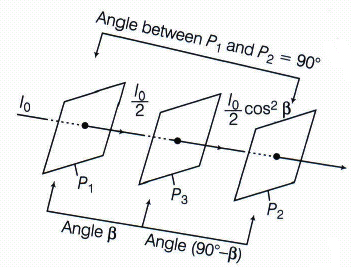
\(=\frac { { I }_{ \circ } }{ 2 } cos^{ 2 }\beta sin^{ 2 }\beta =\frac { { I }_{ \circ } }{ 8 } sin^{ 2 }2\beta \)
\(As,\ \frac { { I }_{ \circ } }{ 8 } sin^{ 2 }2\beta =\frac { { I }_{ \circ } }{ 8 } (given)\)
\(so, \ \left( sin2\beta \right) ^{ 2 }=1 \ \Rightarrow 2\beta ={ 90 }^{ \circ } \ \Rightarrow \beta ={ 45 }^{ \circ }\)
4.
Any ray entering at an angle i shall be guided along AC, if the ray makes an angle \(\phi \) with the face AC greater than the critical angle as the principle of total internal reflection,\(\phi \)+r = 90o, therefore, sin \(\phi \) = cos r.
\(\Rightarrow \ sin\phi \ge \frac { 1 }{ \mu } \ \Rightarrow \ cos\ r\ge \frac { 1 }{ \mu } \)
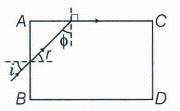
or \(1-{ cos }^{ 2 }r\le 1-\frac { 1 }{ { \mu }^{ 2 } } \Rightarrow { sin }^{ 2 }r\le 1-\frac { 1 }{ { \mu }^{ 2 } } \left[ \therefore 1-{ cos }^{ 2 }r={ sin }^{ 2 }r \right] \)
5.
Let d be the diameter of the disc. The sopt shall be invisible, if the incident rays OA and OB suffer total internal reflection.
Let i be the angle of incidence

Using relationship between refractive index and critical angle, then
\(\sin { i=\frac { 1 }{ \mu } }\)
Using geometry and trigonometry,
Now,
\(\frac { d/2 }{ h } =\tan { i } \Rightarrow \frac { d }{ 2 } =h\tan { i } =h[\sqrt { { \mu }^{ 2 }-1{ ] }^{ -1 } }\)
\( [\because \ From \ the \ figure,\ tani=\frac { 1 }{ \sqrt { { \mu }^{ 2 } } -1 } ]\)
\( d=\frac { 2h }{ \sqrt { { \mu }^{ 2 } } -1 } \)
This is required expression of d.

12th Standard CBSE Syllabus & Materials
12th Standard CBSE
CBSE 12th Computer Science Python Revision Tour I - New Previous year Question Papers Study Material - QB365 Set A
NEW12th Standard CBSE
CBSE 12th Business Studies Planning Important Questions And Answers Study Material - QB365 Set A
NEW12th Standard CBSE
CBSE 12th Business Studies Business Environment Important Questions And Answers Study Material - QB365 Set A
NEW12th Standard CBSE
CBSE 12th Business Studies Principles of Management Important Questions And Answers Study Material - QB365 Set A



NCERT Books

Syllabus

Exam Pattern

Sample Question Papers

Previous year Question Papers

Important Notes

MCQ Practice test

NCERT Exemplers

Case study Questions

Image Based Questions

Passage based Questions

HOT Questions

Value Based Questions

Model Questions Papers
NCERT ( Book Back ) Questions

Assertion and Reason
Important Questions And Answers

CBSE 12th Standard CBSE Subjects
CBSE Standards









