
 100% FREE ACCESS
12th Standard CBSE Syllabus & Materials
12th Standard CBSE
CBSE 12th Economics Government Budget and the Economy Previous year Question Papers Study Material - QB365 Set A
NEW12th Standard CBSE
CBSE 12th Computer Science Interface Python with MySQL - New Previous year Question Papers Study Material - QB365 Set A
NEW12th Standard CBSE
CBSE 12th Computer Science Database Concept - New Previous year Question Papers Study Material - QB365 Set A
NEW12th Standard CBSE
CBSE 12th Computer Science Data Communication - New Previous year Question Papers Study Material - QB365 Set A
NEW12th Standard CBSE
CBSE 12th Computer Science Data Structures - New Previous year Question Papers Study Material - QB365 Set A
NEW12th Standard CBSE
CBSE 12th Computer Science Functions - New Previous year Question Papers Study Material - QB365 Set A

Published on: 23/05/2021
QB365 Provides the updated NCERT Exemplar Questions for Class 12, and also provide the detail solution for each and every case study questions. NCERT Exemplar questions are latest updated question pattern from NCERT, QB365 will helps to get more marks in Exams
Download CBSE Class 12th Standard CBSE Physics question papers, sample papers, important questions, and previous year solved papers in PDF format. Get free study materials, NCERT solutions, and exam preparation resources for Class 12th Standard CBSE Physics
Questions + Answers key
Take MCQ Physics Test1.
A polaroid I is placed in front of a monochromatic source. Another polaroid II is placed in front of this polaroid II is now placed in between I and II. In this case, will light emerge from II. Explain
2.
Consider a two slit interference arrangement (shown in figure) such that the distance of the screen from the slits is half the distance between the slits. Obtain the value of D in terms of \(\lambda \) such that the first minima on the screen falls at a distance D from the centre O.
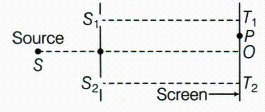
For nth minima to be formed on the screen path difference between the rays coming from S1 and S2 must be \(\left( 2n-1 \right) \frac { \lambda }{ 2 } .\)
3.
The near vision of an average person is 25 cm. To view an object with an angular magnification of 10. what should be the power of the microscope?
4.
A convex lens of focal length f1 is kept in contact with a concave lens of focal length f2 find the focal length of the combination
5.
A thin convex lens of focal length 25 cm is cut into two pieces 0.5 cm above the principal axis. The top part is placed at (0, 0) and an object placed at(-50 cm, 0)Find coordinates of the image.
There is no effect on the focal length of the lens if it cut as given in the question.
1.
In the diagram shown, a monochromatic light is placed in front of polaroid (I) as shown nelow.
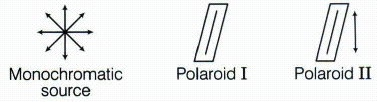
As, per the given question, monochromatic light emerging from polaroid I is plane polarised. When polaroid II is placed in front of this polaroid II, then I and II are set in crosses positions, i.e. pass axes of I and II are at \({ 90 }^{ \circ }\)
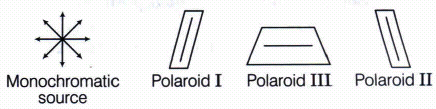
When a polaroid III is placed in between I and II, no light will emerge from II, if pass axis of III is parallel to that od I or II. In all the other case, light will emerge from II.
2.
From the given figure ,of two slit interference arrangement,we can write
\({ T }_{ 2 }P={ T }_{ 2 }O+OP=D+x\) and
\(\\ { T }_{ 1 }P={ T }_{ 1 }O-OP=D-x\)
\({ S }_{ 1 }P=\sqrt { \left( { S }_{ 1 }{ T }_{ 1 } \right) +\left( { PT }_{ 1 } \right) ^{ 2 } } =\sqrt { { D }^{ 2 }+\left( D-x \right) ^{ 2 } } \)
and \({ S }_{ 2 }P=\sqrt { \left( { S }_{ 2 }{ T }_{ 2 } \right) +\left( { T }_{ 2 }P \right) ^{ 2 } } =\sqrt { { D }^{ 2 }+\left( D-x \right) ^{ 2 } } \)
The minima will occur when \({ S }_{ 2 }P-{ S }_{ 1 }P=\left( 2n-1 \right) \frac { \lambda }{ 2 } \)
i.e.\(\left[ { D }^{ 2 }+\left( D+x \right) ^{ 2 } \right] ^{ 1/2 }-\left[ { D }^{ 2 }+0 \right] ^{ 1/2 }=\frac { \lambda }{ 2 } \)
[for first minima, n = 1]
if x = D, we can write, \(\left[ { D }^{ 2 }+4D^{ 2 } \right] ^{ 1/2 }-\left[ { D }^{ 2 }+0 \right] ^{ 1/2 }=\frac { \lambda }{ 2 } \)
\(\Rightarrow \left[ 5D^{ 2 } \right] ^{ 1/2 }-\left[ { D }^{ 2 } \right] ^{ 1/2 }=\frac { \lambda }{ 2 } \Rightarrow \sqrt { 5D-D } =\frac { \lambda }{ 2 } \)
\(\\ \Rightarrow D\left( \sqrt { 5-1 } \right) =\lambda /2orD=\frac { \lambda }{ 2\left( \sqrt { 5-1 } \right) } \)
putting \(\sqrt { 5 } =2.236\)
\(\\ \Rightarrow \sqrt { 5-1 } =2.236-1=1.236\)
\(\\ D=\frac { \lambda }{ 2\left( 1.236 \right) } =0.404\lambda \)
3.
The least distance of discint vision of an average person. (i.e, D) is 25 cm, in order to view an object with magnificaton of 10.
Here, v = D = 25 cm and u = f
But thr magnification, m = v/u = D/f
\(m=\frac { D }{ f } \Rightarrow f=\frac { D }{ m } =\frac { 25 }{ 10 } =2.5=0.025m\)
\( P=\frac { 1 }{ 0.025 } =40D \ [\therefore \ P=\frac { 1 }{ f } ]\)
This is the required power of lens.
4.
Focal length for convex lens = f1
Focal length for concave lens = -f2
The equivalent focal length
\(\frac { 1 }{ F } =\frac { 1 }{ f_{ 1 } } +\frac { 1 }{ f_{ 2 } } \Rightarrow F=\frac { f_{ 1 }f_{ 2 } }{ f_{ 1 }-f_{ 2 } } \)
5.
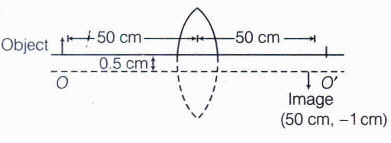
if there was no cut then object heigh 0.5 cm principal axis OO'
\(\frac { 1 }{ v } -\frac { 1 }{ u } =\frac { 1 }{ f }\)
\( \frac { 1 }{ v } =\frac { 1 }{ u } +\frac { 1 }{ f } \)
\(= \frac { 1 }{ -50 } +\frac { 1 }{ 25 } \)
\(= \frac { 1 }{ -50 } +\frac { 1 }{ 25 }\)
\( v=50 \ cm \ m=\frac { v }{ u } \ \Rightarrow \frac { -50 }{ 50 } =-1\)

12th Standard CBSE Syllabus & Materials
12th Standard CBSE
CBSE 12th Computer Science Python Revision Tour I - New Previous year Question Papers Study Material - QB365 Set A
NEW12th Standard CBSE
CBSE 12th Business Studies Planning Important Questions And Answers Study Material - QB365 Set A
NEW12th Standard CBSE
CBSE 12th Business Studies Business Environment Important Questions And Answers Study Material - QB365 Set A
NEW12th Standard CBSE
CBSE 12th Business Studies Principles of Management Important Questions And Answers Study Material - QB365 Set A



NCERT Books

Syllabus

Exam Pattern

Sample Question Papers

Previous year Question Papers

Important Notes

MCQ Practice test

NCERT Exemplers

Case study Questions

Image Based Questions

Passage based Questions

HOT Questions

Value Based Questions

Model Questions Papers
NCERT ( Book Back ) Questions

Assertion and Reason
Important Questions And Answers

CBSE 12th Standard CBSE Subjects
CBSE Standards









