
 100% FREE ACCESS
12th Standard CBSE Syllabus & Materials
12th Standard CBSE
CBSE 12th Economics Government Budget and the Economy Previous year Question Papers Study Material - QB365 Set A
NEW12th Standard CBSE
CBSE 12th Computer Science Interface Python with MySQL - New Previous year Question Papers Study Material - QB365 Set A
NEW12th Standard CBSE
CBSE 12th Computer Science Database Concept - New Previous year Question Papers Study Material - QB365 Set A
NEW12th Standard CBSE
CBSE 12th Computer Science Data Communication - New Previous year Question Papers Study Material - QB365 Set A
NEW12th Standard CBSE
CBSE 12th Computer Science Data Structures - New Previous year Question Papers Study Material - QB365 Set A
NEW12th Standard CBSE
CBSE 12th Computer Science Functions - New Previous year Question Papers Study Material - QB365 Set A

Published on: 23/05/2021
QB365 Provides the updated NCERT Exemplar Questions for Class 12, and also provide the detail solution for each and every case study questions. NCERT Exemplar questions are latest updated question pattern from NCERT, QB365 will helps to get more marks in Exams
Download CBSE Class 12th Standard CBSE Physics question papers, sample papers, important questions, and previous year solved papers in PDF format. Get free study materials, NCERT solutions, and exam preparation resources for Class 12th Standard CBSE Physics
Questions + Answers key
Take MCQ Physics Test1.
A short object of length L is placed along the principal axis of a concave mirror away from focus. The object distance is u. If the mirror has a focal length f, what will be the length of the image? You may take L <, |v - f|.
The length of image is the separation between the images formed by mirror of the extremities of object.
2.
An erect image 3 times the size of the object is obtained with a concave mirror of radius of curvature 36cm. What is the position of the object?
3.
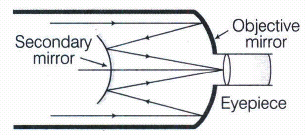
A Cassegrain telescope uses two mirrors as shown in the figure. Such a telescope is built with the mirrors 20mm apart. If the radius of curvature of large mirror is 220mm and the small mirror is 140 mm, where will the final image of an object at infinity be?
4.
Consider a point at the focal point of covergent lens. Another covergent lens of short focal length is placed on the other side. What is the nature of the wavefronts emerging from the final image?
5.
Is Huygen's principle valid for longitundinal sound waves?
1.
Since, the object distance is u. Let us consider the two ends of the object be at distance \({ u }_{ 1 }=u-L/2\) and \({ u }_{ 2 }=u+L/2\), respectively, so that \(|{ u }_{ 1 }-{ u }_{ 2 }|=L\). Let the image of the two ends be formed at \({ v }_{ 1 } \ and \ { v }_{ 2 }\), respectively so that the image length would be
\({ L }^{ ' }=|{ v }_{ 1 }-{ v }_{ 2 }|\)
Applying mirror formula, we have
\(\frac { 1 }{ u } +\frac { 1 }{ v } =\frac { 1 }{ f } \ or\ v=\frac { fu }{ u-f } \)
On shoving, the positions of two images are given by
\({ v }_{ 1 }=\frac { f\left( u-L/2 \right) }{ u-f-L/2 } ,{ v }_{ 2 }=\frac { f\left( u+L/2 \right) }{ u-f+L/2 } \)
For length, substituting these values in Eq. (i), we have
\({ L }^{ ' }=|{ v }_{ 1 }-{ v }_{ 2 }|=\frac { { f }^{ 2 }L }{ \left( u-f \right) ^{ 2 }-{ L }^{ 2 }/4 } \)
Since, the object is short and kept away from focus, we have \({ L }^{ 2 }/4<<\left( u-f \right) ^{ 2 }\)
Hence, finally, \({ L }^{ ' }=\frac { { f }^{ 2 } }{ \left( u-f \right) ^{ 2 } } L\)
This is the required expression of length of an image.
2.
Given, magnification, m = +3, R = -36cm
Object distance, u=?
Let u = -x
\(m=\frac { { h }_{ 2 } }{ { h }_{ 1 } } =\frac { +v }{ -u } =3 \ \Rightarrow v=-3u \ \Rightarrow v=3x\)
Applying mirror formula, we have
\(\frac { 1 }{ u } +\frac { 1 }{ v } =\frac { 1 }{ f } =\frac { 2 }{ R } \ \Rightarrow \frac { 1 }{ -x } +\frac { 1 }{ 3x } =\frac { 2 }{ -36 }\)
\( \Rightarrow \ \frac { -3+1 }{ 3x } =\frac { -1 }{ 18 } \ \Rightarrow 3x=36\ \Rightarrow x=12cm \ or \ u=-12cm\)
3.
Radius of curvature of objectrive mirror,
R1 = 220 mm
\({ f }_{ 1 }=\frac { { R }_{ 1 } }{ 2 } =\frac { 220 }{ 2 } =110 \ mm\)
Radius of curvature of secondary mirrors, R2 = 140 mm
\({ f }_{ 2 }=\frac { { R }_{ 2 } }{ 2 } =\frac { 140 }{ 2 } =70 \ mm\)
Distance between two mirrors, d = 20 mm from objective mirror.
Now, for secondary mirror, u = f1 - d = 110 - 20
= 90 mm
From mirror formula,
\(\frac { 1 }{ v } +\frac { 1 }{ u } =\frac { 1 }{ { f }_{ 2 } } \Longrightarrow \frac { 1 }{ v } =\frac { 1 }{ { f }_{ 2 } } -\frac { 1 }{ u } \)
\( =\frac { 1 }{ 70 } -\frac { 1 }{ 90 } \Longrightarrow v=\frac { 630 }{ 2 } =315\ mm\)
i.i., final image will be at 31.5 cm to the right of secondary mirror.
4.
Consider the ray diagram shown below.
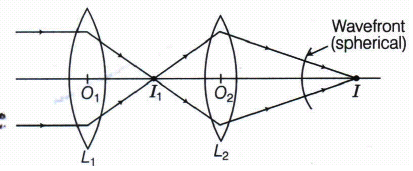
The point image I1 due to L1 is the focal point. Now. due to converging lens L2, let the final image formed be I which is a point image, hence the wavefront for this image will be of spherical symmetry.
5.
When we are considering a point of sound wavw. The disturbance due to the source propagates in spherical symmetry, that is, in all directions.
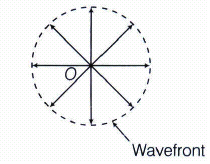
The formation of wavefront is in accordance with Huygen's principle. So, Huygen's principle is valid for longitudinal sound waves also.

12th Standard CBSE Syllabus & Materials
12th Standard CBSE
CBSE 12th Computer Science Python Revision Tour I - New Previous year Question Papers Study Material - QB365 Set A
NEW12th Standard CBSE
CBSE 12th Business Studies Planning Important Questions And Answers Study Material - QB365 Set A
NEW12th Standard CBSE
CBSE 12th Business Studies Business Environment Important Questions And Answers Study Material - QB365 Set A
NEW12th Standard CBSE
CBSE 12th Business Studies Principles of Management Important Questions And Answers Study Material - QB365 Set A



NCERT Books

Syllabus

Exam Pattern

Sample Question Papers

Previous year Question Papers

Important Notes

MCQ Practice test

NCERT Exemplers

Case study Questions

Image Based Questions

Passage based Questions

HOT Questions

Value Based Questions

Model Questions Papers
NCERT ( Book Back ) Questions

Assertion and Reason
Important Questions And Answers

CBSE 12th Standard CBSE Subjects
CBSE Standards









