
 100% FREE ACCESS
12th Standard CBSE Syllabus & Materials
12th Standard CBSE
CBSE 12th Economics Government Budget and the Economy Previous year Question Papers Study Material - QB365 Set A
NEW12th Standard CBSE
CBSE 12th Computer Science Interface Python with MySQL - New Previous year Question Papers Study Material - QB365 Set A
NEW12th Standard CBSE
CBSE 12th Computer Science Database Concept - New Previous year Question Papers Study Material - QB365 Set A
NEW12th Standard CBSE
CBSE 12th Computer Science Data Communication - New Previous year Question Papers Study Material - QB365 Set A
NEW12th Standard CBSE
CBSE 12th Computer Science Data Structures - New Previous year Question Papers Study Material - QB365 Set A
NEW12th Standard CBSE
CBSE 12th Computer Science Functions - New Previous year Question Papers Study Material - QB365 Set A

Published on: 24/05/2021
QB365 Provides the updated NCERT Exemplar Questions for Class 12, and also provide the detail solution for each and every case study questions. NCERT Exemplar questions are latest updated question pattern from NCERT, QB365 will helps to get more marks in Exams
Download CBSE Class 12th Standard CBSE Physics question papers, sample papers, important questions, and previous year solved papers in PDF format. Get free study materials, NCERT solutions, and exam preparation resources for Class 12th Standard CBSE Physics
Questions + Answers key
Take MCQ Physics Test1.
Use the mirror equation to show that,
(ii) a convex mirror always produces a virtual image independent of the location of the object.
(iii) an object placed between the pole and focus of a concave mirror produces a virtual and enlarged image.
2.
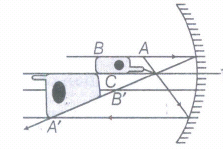
(i) A mobile phone lies along the principal axis of a concave mirror. Show with the help of a suitable diagram the formation of its image.Explain why magnification is not uniform.
(ii) Suppose the lower half of the concave mirror's reflecting surface is covered with an opaque material. What effect this will have on the image of the object? Explain.
3.
The radii of curvature of the surface of a double convex lens are 20 cm and 40 cm focus length 20 cm. What is refractive index of the material of the lens?
4.
An object is placed in front of a convex mirror of focal length 30cm. If the image is a quarter of the size of the object, find the position of the image.
5.
A candle flame is held 3 cm away from a concave mirror of radius of curvature 24 cm. Where is the image formed? What is the nature of the image?
1.
For convex mirror, f >
Also, u < 0
but from mirror equation,
\(\frac { 1 }{ f } =\frac { 1 }{ v } +\frac { 1 }{ u } =\frac { 1 }{ v } +\frac { 1 }{ \left| -u \right| } \ \left[ taking \ u \ with \ sign \right]\)
\( \frac { 1 }{ v } =\frac { 1 }{ f } +\frac { 1 }{ u } \)
\( \Rightarrow f \ and \ u \ to \ be \ positive, \ then\)
\(\frac { 1 }{ v } >0\Rightarrow \ v>0\)
Hence, virtual image is formed.
(iii) For concave mirror,
f < 0, u < 0, \(\left| f \right| >\left| u \right| >0\)
But from mirror equation,
\(\frac { 1 }{ f } =\frac { 1 }{ v } +\frac { 1 }{ u }\)
\( \Rightarrow \frac { -1 }{ \left| f \right| } =\frac { 1 }{ v } -\frac { 1 }{ \left| u \right| }\)
\( \frac { 1 }{ v } =\frac { 1 }{ \left| u \right| } -\frac { 1 }{ \left| f \right| }\)
\(\because \ \left| v \right| <\left| f \right|\)
\(\Rightarrow \frac { 1 }{ \left| u \right| } >\frac { 1 }{ \left| f \right| }\)
\(\Rightarrow \ \frac { 1 }{ v } >0 \ \Rightarrow \ v>0\)
Image is formed on RHS of mirror, i.e. virtual image.
Also, \(\frac { 1 }{ \left| f \right| } =\frac { 1 }{ v } -\frac { 1 }{ \left| u \right| } \)
For concave mirror, f is negative.
\(\Rightarrow \frac { 1 }{ \left| v \right| } <\frac { 1 }{ \left| u \right| } \Rightarrow \frac { \left| v \right| }{ \left| u \right| } >1\Rightarrow m>1\)
Enlarged virtual image formed on the other side of mirror.
2.
(i) The ray diagram for the formation of the image of the mobile phone is shown below. The image of the part which is on the plane perpendicular to principal axis will be on the same plane. It will be of the same size, i.e. \({ B }^{ \prime }C=BC\)
(ii) We may think that the image will now show only half of the object, but considering the laws of reflection to be true for all points of the remaining part of the mirror, the image will be that of the whole object.
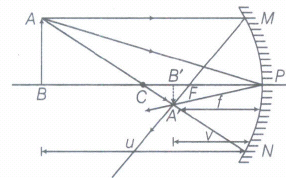
However, as the area of the reflecting surface has been reduced, the intensity of the image will be low, i.e. half.
3.
R1 = 20 cm
R2 = -40 cm
f = 20 cm, n = ?
\(\frac { 1 }{ f } =(n-1)\frac { 1 }{ R_{ 1 } } -\frac { 1 }{ R_{ 2 } }\)
\(\frac { 1 }{ 20 } =(n-1)\frac { 1 }{ 20 } +\frac { 1 }{ 40 } \Rightarrow \frac { 1 }{ n-1 } =20(\frac { 2+1 }{ 40 } )=\frac { 3 }{ 2 }\)
\( n-1=\frac { 2 }{ 3 } \Rightarrow 3n=5\Rightarrow n=\frac { 5 }{ 3 } \)
4.
Given, focal length, f = +30cm
Magnification, m \(=\frac { 1 }{ 4 } ,v=?\)
We know that,
\(m=\frac { f-v }{ f } \)
\(\Rightarrow \ \frac { 1 }{ 4 } =\frac { 30-v }{ 30 } \)
\( \Rightarrow 30=120-4v\)
\( \Rightarrow \ v=\frac { 90 }{ 4 } =+22.5cm\)
As, v is positive, therefore a virtual and erect image will be formed on other side of the object.
5.
Given, object distance,u = -3cm
Radius of curvature, R = -24cm
\(f=\frac { R }{ 2 } =-\frac { -24 }{ 2 } =-12cm\)
According to mirror formula,
\(\frac { 1 }{ f } =\frac { 1 }{ v } +\frac { 1 }{ u } \)
\(\Rightarrow \ \frac { 1 }{ v } =\frac { 1 }{ f } -\frac { 1 }{ u } =\frac { 1 }{ -12 } -\frac { 1 }{ -3 } \)
\(\Rightarrow \frac { 1 }{ v } =\frac { 1 }{ -12 } +\frac { 1 }{ 3 } \)
\( \Rightarrow \ \frac { 1 }{ v } =\frac { -1+4 }{ 12 }\)
\( \Rightarrow \ v=4cm\)
Magnification, \(m=-\frac { v }{ u } =\frac { -4 }{ -3 } =+1.33\)
i.e. the image formed is virtual, erect and magnified.

12th Standard CBSE Syllabus & Materials
12th Standard CBSE
CBSE 12th Computer Science Python Revision Tour I - New Previous year Question Papers Study Material - QB365 Set A
NEW12th Standard CBSE
CBSE 12th Business Studies Planning Important Questions And Answers Study Material - QB365 Set A
NEW12th Standard CBSE
CBSE 12th Business Studies Business Environment Important Questions And Answers Study Material - QB365 Set A
NEW12th Standard CBSE
CBSE 12th Business Studies Principles of Management Important Questions And Answers Study Material - QB365 Set A



NCERT Books

Syllabus

Exam Pattern

Sample Question Papers

Previous year Question Papers

Important Notes

MCQ Practice test

NCERT Exemplers

Case study Questions

Image Based Questions

Passage based Questions

HOT Questions

Value Based Questions

Model Questions Papers
NCERT ( Book Back ) Questions

Assertion and Reason
Important Questions And Answers

CBSE 12th Standard CBSE Subjects
CBSE Standards









