
 100% FREE ACCESS
12th Standard CBSE Syllabus & Materials
12th Standard CBSE
CBSE 12th Economics Government Budget and the Economy Previous year Question Papers Study Material - QB365 Set A
NEW12th Standard CBSE
CBSE 12th Computer Science Interface Python with MySQL - New Previous year Question Papers Study Material - QB365 Set A
NEW12th Standard CBSE
CBSE 12th Computer Science Database Concept - New Previous year Question Papers Study Material - QB365 Set A
NEW12th Standard CBSE
CBSE 12th Computer Science Data Communication - New Previous year Question Papers Study Material - QB365 Set A
NEW12th Standard CBSE
CBSE 12th Computer Science Data Structures - New Previous year Question Papers Study Material - QB365 Set A
NEW12th Standard CBSE
CBSE 12th Computer Science Functions - New Previous year Question Papers Study Material - QB365 Set A

Published on: 16/09/2019
Wave Optics
Download CBSE Class 12th Standard CBSE Physics question papers, sample papers, important questions, and previous year solved papers in PDF format. Get free study materials, NCERT solutions, and exam preparation resources for Class 12th Standard CBSE Physics
Questions + Answers key
Take MCQ Physics Test
1.
A narrow monochromatic beam of light of intensity I is incident a glass plate. Another identical glass plate is kept close to the first one and parallel to it. Each plate reflects 25% of the incident light and transmits the reaming. Calculate the ratio of minimum and maximum intensity in the interference pattern formed by the two beams obtained after reflection from each plate.
2.
In a two slit experiment with monochromatic light, fringes are obtained on a screen placed at some distance D from the slits. If the screen is moved 5 x 10⁻² m towards the slits, the charge in fringe width is 3 x 10 -5 m. If the distance between the slit is 10-3 m . calculate the wavelength of the light used.
3.
A ray of light passes through an equilateral glass prism, such that the angle of incidence is equal to the angle of emergence. If the angle of emergence is ¾ times the angle of the prism, Calculate the refractive index of the glass prism
4.
A lens forms a real image of an object. The distance of the object to the lens is 4 cm and the distance of the image from the lens is v cm. The given graph shows the variation of v with u.
(i) What is the nature of the lens?
(ii) Using this graph, find the focal length of this lens.
5.
The refractive index of water is 4/3. Obtain the value of the semivertical angle of the cone within which the entire outside view would be confined for a fish under water. Draw an appropriate ray diagram
6.
Only the stars near the horizon twinkle while those overhead do not twinkle. Why?
7.
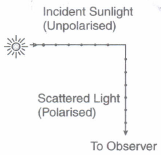
Distinguish between unpolarised and a linearly polarised light. Describe, with the help of a diagram, how unpolarised light gets linearly polarised by scattering
8.
Draw a ray diagram to show how a right angled isosceles prism may be used to bend the path of light rays by 90°.
9.
Draw a ray diagram of a reflecting type telescope. State two advantages of this telescope over a refracting telescope.
10.
In a single slit diffraction experiment, a monochromatic source of light of wavelength \(\lambda\) illuminates a narrow slit of width a. Show giving appropriate reasoning, that the half angular width of the central maximum in the observed pattern is (nearly) equal to \(\lambda\)/a.
11.
What is the relation between critical angle and refractive index of a material?
(ii) Does critical angle depend on the colour of light?
12.
(i) Draw a ray diagram for a convex mirror showing the image formation of an object placed anywhere in front of the mirror.
(ii) Use this ray diagram to obtain the expression for its linear magnification.
13.
Name the phenomenon which proves transerve wave nature of light.Gives two uses of the devices whose functioning is based on this phenomenon.
14.
A convex lens of local length 25 cm is placed coaxially in contact with a concave lens of focal length 20 cm. Determine the power of the combination. Will the system be converging or diverging in nature ?
1.
Let I be the intensity of beam I incident on first glass plate. Each plate reflects 25% of light incident on it and transmits 75%.
Therefore,
I1 = I and I2 = 25/100I = I/4
I3 = 75/100 I = 3/4I
I4 = 25/100 I3 = ¼ x ¾ I = 3/16 I
I5= 7/100 I4= ¾ x 3/16 I = 9/64 I
Amplitude ratio of beams 2 and 5 is
R = \(\surd \) I2/I5 = \(\surd \)I/4 x 64/91 = 4/3
Imin/ Imax = [r-1/r+1]2 = [4/3-1 / 4/3+1]2 = 1/49 = 1:49
2.
The fringe width in the two cases will be \(\beta\) = D\(\lambda \)/d
And \(\beta\)' = D' \(\lambda \)/d
\(\beta\) - \(\beta\) ' = (D - D' )\(\lambda \)/d
or wavelength \(\lambda \) = (\(\beta\) -\(\beta\)' )d /(D - D')
But D -D' = 5 x 10⁻² m
And \(\beta\) - \(\beta\)' = 3 x 10⁻⁵ m, d = 10-3 m
\(\lambda \) = 3 x 10-5 x 10-3 / 5 x 10-2 = 6 x 10⁻⁷ m = 6000A
3.
A = 600 , \(\delta \)m = 300
i = e = ¾ A = 450
as A + \(\delta \) = i + e
60 + \(\delta \) = 45 +45
or \(\delta \) = 300
Refractive index,
\(\mu \) = sin a + \(\delta \)m /2/sin A/2 = sin 600+300/2/sin 600/2
= sin 450/sin300 = 1\(\surd 2\) 1/2 = \(\surd 2\) = 1.414
4.
(i) As the lens forms a real iamge, it must be a convex lens.
(ii) From the graph, when u = 20 cm , we have v = 20 cm.
For the convex lens forming a real iamge, u is negative and v and f are positive.
U = -20 cm v = +20cm
Using this lens formula,
1/f = 1/v – 1/u = 1/20 – 1/-20 = 1/10 or f = + 10 cm
5.
Clearly , the fish can see the outside view of the cone with semi vertical angle
But \(\mu \) = 1.sin ic
or 1/3 = 1/ sin ic
or sin ic = 3/4 = 0.75
\(\theta\)/2 =ic = sin-1 (0.75 ) = 48.60
6.
Light from the stars near the horizon reaches the earth obliquely through the atmosphere. Its path changes due to refraction. Frequent atmospheric disturbances change the path of light and cause twinkling of stars. Light from the stars overhead reaches the earth normally. It does not suffer refraction. There is no change in its path. Hence there is no Twinkling effect
7.
For unpolarised light electric vector associated with light, is oscillating randomly in all directions in a plane perpendicular to the direction of propagation of light.
In linearly polarised light oscillating electric vector gets aligned along one direction perpendicular to the direction of propagation of light.
[Under the influence of the electric field of the incident wave, the electrons of the scattering molecules, accelerated parallel to the double arrows, do not radiate energy towards the observer. Hence, the scattered light gets polarized.]
8.
.png)
For total internal reflection
45° < ic
sin 45 > sin ic
5 > sin ic
> sin ic
\(\mu\)> sin ic
or
.png)
For convex lens u = - a, v = R + d
\({1\over f}={1\over v}-{1\over u}\)
\(={1\over (R+d)}-{1\over(-a)}={1\over (R+d)}+{1\over a}\)
\(\Rightarrow\ \ R=\left(af\over (a-f)\right)-d\)
9.
Ray diagram of a reflecting type telescope
Advantages :
(i) Reflecting telescopes have high resolving power due to a large aperture of mirrors.
(ii) Due to availability of paraboloidal mirror, the image is free from chromatic and spherical aberration.
10.
Here, intensity of central maxima will be maximum and that of other will gradually decrease, on this basis graph will be drawn
For central bright fringe, \(\theta ={ 0 }^{ 0 }\)
For first dark fringe, \(a\sin { \theta } =\pm \lambda \)
\(\Rightarrow\) \(\sin { \theta } =\pm \frac { \lambda }{ a } \)
If \(\theta\) is small, then \(\sin { \theta } \approx \theta \)
So, \(\theta =\pm \frac { \lambda }{ a } \)
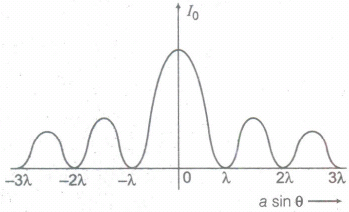
So, the half angular width of central maximum is
\(\theta \approx \sin { \theta } =\frac { \lambda }{ a } \)
11.
(i) Relation between critical angle and refractive index of a material is \(\mu =\frac { 1 }{ sini_{ e } } \)
where ie = critical angle
\(\mu =\) refractive index of denser medium W.r.t. rarer medium.
(ii) Yes, critical angle depends on colour of light is associated with wavelength .Smaller the wavelength, higher the refractive index and lower the critical angle and vice-versa Like \(\lambda _{ red }>\lambda _{ violet }\) hence \(\mu _{ red }>\mu _{ violet }\)
12.
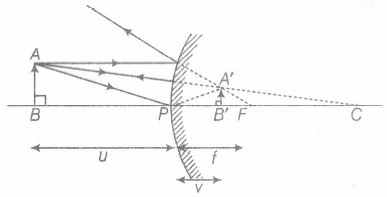
Figure shows the formation of image A' B' of a finite object AB by a convex mirror, virtual, erect and diminished,
Now \(\triangle ABP=\triangle A'BP\)
\(\therefore \frac { A^{ ' } }{ B^{ ' } } =\frac { PB^{ ' } }{ PB } \)
Applying the new cartesian sign convention,
\(A^{ ' }B^{ ' }=h_{ 2 },AB=h_{ 1 },PB^{ ' }=v,PB=-u\)
\(\therefore \frac { h_{ 2 } }{ h_{ 1 } } =\frac { v }{ -u } \)
Linear magnification m= \(\frac { h_{ 2 } }{ h_{ 2 } } =-\frac { v }{ u } \)
13.
Polarization.
Two Uses:
Polaroids can be used in sunglasses, window panes, photographic cameras, 3D movie cameras
14.
Power of convex lens = 1/0.25 = 4D
Power of concave lens = 1/0.20 = -5D
Power of the combination, P = P1+P2 = -1D
Nature : Diverging

12th Standard CBSE Syllabus & Materials
12th Standard CBSE
CBSE 12th Computer Science Python Revision Tour I - New Previous year Question Papers Study Material - QB365 Set A
NEW12th Standard CBSE
CBSE 12th Business Studies Planning Important Questions And Answers Study Material - QB365 Set A
NEW12th Standard CBSE
CBSE 12th Business Studies Business Environment Important Questions And Answers Study Material - QB365 Set A
NEW12th Standard CBSE
CBSE 12th Business Studies Principles of Management Important Questions And Answers Study Material - QB365 Set A



CBSE 12th Standard CBSE Subjects
CBSE Standards










