100% FREE ACCESS
9th Standard CBSE Syllabus & Materials
9th Standard CBSE
CBSE 9th Science Is matter around us pure? - New Model Questions Papers Study Material - QB365 Set A
NEW9th Standard CBSE
CBSE 9th Science Matter in our surroundings - New Model Questions Papers Study Material - QB365 Set A
NEW9th Standard CBSE
CBSE 9th Mathematics Heron's Formula Sample Question Papers Study Material - QB365 Set A
NEW9th Standard CBSE
CBSE 9th Mathematics Quadrilaterals Sample Question Papers Study Material - QB365 Set A
NEW9th Standard CBSE
CBSE 9th Mathematics Triangles Sample Question Papers Study Material - QB365 Set A
NEW9th Standard CBSE
CBSE 9th Mathematics Lines and Angles Sample Question Papers Study Material - QB365 Set A

Published on: 14/08/2026
Download CBSE Class 9th Standard CBSE Mathematics question papers, sample papers, important questions, and previous year solved papers in PDF format. Get free study materials, NCERT solutions, and exam preparation resources for Class 9th Standard CBSE Mathematics
Questions + Answers key
Take MCQ Mathematics Test
1.
100 surnames were randomly picked up from a local telephone and a frequency distribution of the number of letters in the English alphabet in the surnames was found as follows:
| Number of letters | Number of surnames |
| 1-4 | 6 |
| 4-6 | 30 |
| 6-8 | 44 |
| 8-12 | 16 |
| 12-20 | 4 |
(i) Draw a histogram to depict the given information.
(ii) Write the class interval in which the maximum number of surnames lie.
2.
The inner diameter of a circular well is 3.5 m. It is 10 m deep. Find
(i) its inner curved surface area,
(ii) the cost of plastering this curved surface at the rate of Rs 40 per m2.
3.
Find the area of a triangle two sides of which are 18cm and 10 cm and the perimeter is 42 cm.
4.
A circular park of radius 20 m is situated in a colony. Three boys Ankur, Syed and David are sitting at equal distance on its boundary each having a toy telephone in his hands to talk each other. Find the length of the string of each phone.
5.
Check which of the following are solutions of equation x-2y = 4 and which are not:
(2,0)
6.
Give possible expressions for the length and breadth of each of the following rectangles, in which their areas are given: Area: \(35y^2+13y-12\)
7.
Write three numbers whose decimal expansions are non-terminating non-recurring.
8.
Show that 1.272727... = \(1 . \overline{27}\) can be expressed in the form \(\frac{p}{q}\), where p and q are integers and \(q \neq 0\)
9.
The points scored by a Kabaddi team in a series of matches are as follows:
17,2,7,27,15,5,14,8,10,24,48,10,8,7,1,28
Find the median of the points scored by the team.
10.
Find the curved surface area of a right circular cone, whose slant height is 10 cm and base radius is 7 cm.
11.
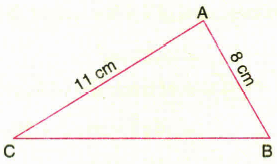
Find the area of a triangle two sides of which are 8 cm and 11 cm and the perimeter is 32 cm.
12.
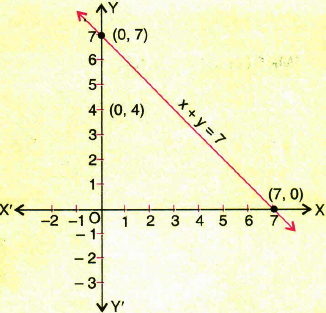
Draw the graph of x + y = 7.
13.
Evaluate each of the following using suitable identities:
(i) (104)3
(ii) (999)3
14.
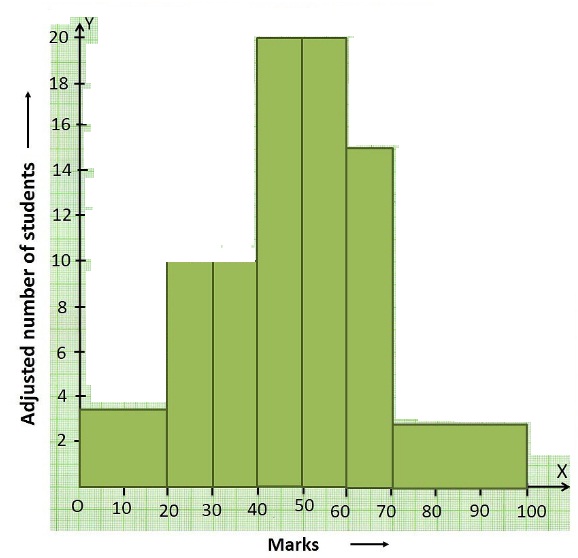
A teacher wanted to analyse the performance of two sections of students in a mathematics test of 100 marks. Looking at their performances, she found that a few students got under 20 marks and a few got 70 marks or above. So she decided to group them into intervals of varying sizes as follows: 0 - 20, 20 - 30, . . ., 60 - 70, 70 - 100. Then she formed the following table:
| Marks | Number of students |
| 0 - 20 | 7 |
| 20 - 30 | 10 |
| 30 - 40 | 10 |
| 40 - 50 | 20 |
| 50 - 60 | 20 |
| 60 - 70 | 15 |
| 70 - above | 8 |
| Total | 90 |
Make histogram of the data.
15.
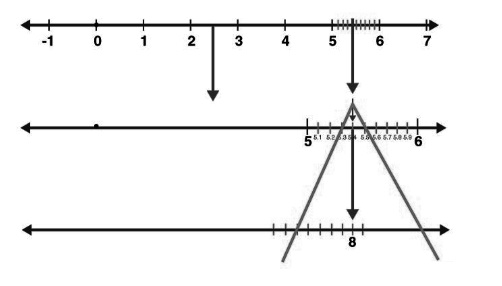
Visualize the representation of \(5.3 \overline{7}\) on the number line upto 5 decimal places, that is, up to 5.37777.
16.
Factorise x3 - 23x2 + 142x - 120
17.
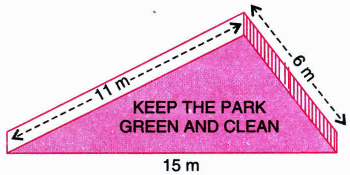
There is a slide in a park. One of its side walls has been painted in some colour with a message 'KEEP THE PARK GREEN AND CLEAN'. If the sides of the wall are 15 m, 11 m and 6 m, then find the area painted in colour.
1.
Modified Table
[Minumum class-]
| Number of letters | Number of surnames | Width of the class | Length of the rectangle |
| 1-4 | 6 | 3 | \(\frac {6}{3}\times 2 =4\) |
| 4-6 | 30 | 2 | \(\frac {30}{2}\times 2 =30\) |
| 6-8 | 44 | 2 | \(\frac {44}{2}\times 2 =44\) |
| 8-12 | 16 | 4 | \(\frac {16}{4}\times 2 =8\) |
| 12-20 | 4 | 8 | \(\frac {4}{8}\times 2 =1\) |
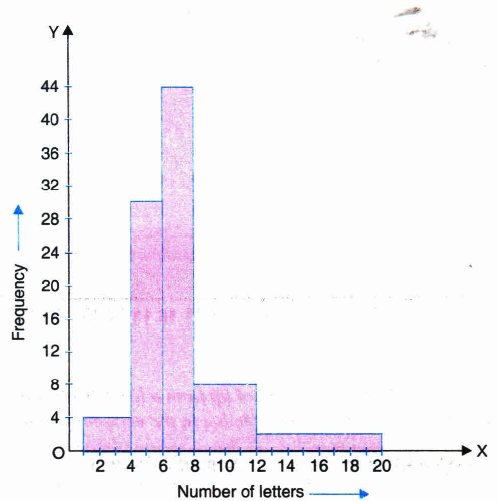
(ii) The class interval in which the maximum number of surname lie is 6-8.
2.
(i) 2r = 3.5 m
\(\Rightarrow\) \(r=\frac { 3.5 }{ 2 } m\)
\(\Rightarrow\) r = 1.75 m
h = 10 m
\(\therefore \) Inner curved surface area of the circular well = \(2\pi rh\)
\(=2\times \frac { 22 }{ 7 } \times 1.75\times 10=110{ m }^{ 2 }.\)
(ii) Cost of plastering the curved surface at the rate of Rs 40 per m2 = Rs 110 \(\times\) 40 = Rs 4400.
3.
a = 18 cm, b = 10 cm
Perimeter = 42 cm
\(\Rightarrow a+b+c=42\)
\(\\ \Rightarrow 18+10+c=42\)
\(\\ \Rightarrow 28+c=42\)
\(\\ \Rightarrow c=42-28\)
\(\Rightarrow \ c=14\quad \)cm
\(s=\frac { 42 }{ 2 } =21\)cm
\(\therefore \) Area of the triangle \(=\sqrt { s(s-a)(s-b)(s-c) } \quad \quad \)
\(=\sqrt { 21(21-18)(21-10)(21-14) } \)
\(\\ =\sqrt { 21(3)(11)(7) }\)
\( \\ =\sqrt { (7)(3)(3)(11)(7) } \)
\(=(7)(3)\sqrt { 11 } =21\sqrt { 11 } \)cm2
4.
Let BD = x m
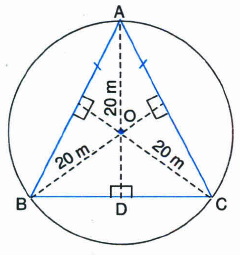
Then in right triangle ODB,
OB2 = OD2 + BD2
By Pythagoras Theorem
⇒ (20)2 = OD2 + x2
⇒ OD2= 400 - x2⇒ OD =\(\sqrt { 400-x^{ 2 } } \)
Again, area of equilateral triangle ABC
= Area of \(\Delta OBC\) + Area of \(\Delta OCA\) + Area of \(\Delta OAB\)
= 3 Area of \(\Delta OBC\)= 3\(\frac { \left( BC \right) \left( OD \right) }{ 2 } \)
\(=3x\sqrt { 400-x^{ 2 } } \) ....(2)
⇒ \(\sqrt { 3 } \sqrt { 400-x^{ 2 } } =x\)
Squaring both sides,
3(400 - x2) = x2
⇒ 1200 - 3x2 = x2
⇒ 4x2 = 1200 ⇒ x2 = 300
⇒ \(x=10\sqrt { 3 } \) ⇒ BD=\(10\sqrt { 3 } \)
⇒ \(2BD=20\sqrt { 3 } \) ⇒ \(BC=20\sqrt { 3 } \)
Hence, the length of string of each phone is \(20\sqrt { 3 } \) m.
5.
The given equation is x-2y = 4
(2,0)
Put x = 2 and y = 0 in (1), we get
x - 2y = 2 - 2(0) = 2 - 0 = 2, which is not 4.
(2,0) is not a solution of (1)
6.
\(35y^2+13y-12\)
\(=35y^2+28y-15y-12\)
\(=7y(5y+4)-3(5y+4)\)
\(=(5y+4)(7y-3)\)
\(\because\) The possible expressions for the length and breadth of the rectangle are 7y-3 and 5y+4
7.
0.01001 0001 00001...
0.20 2002 20002 200002...
0.003000300003...
8.
Let x = 1.272727... Since two digits are repeating, we multiply x by 100 to get
100 x = 127.2727
So, 100 x = 126 + 1.272727 = 126 + x
Therefore, 100 x – x = 126, i.e., 99 x = 126
\(x=\frac{126}{99}=\frac{14}{11}\)
You can check the reverse that \(\frac{14}{11}=1 . \overline{27}\)
9.
Arranging the points scored by the team in ascending order, we get
2, 5, 7, 7, 8, 8, 10, 10, 14, 15, 17, 18, 24, 27, 28, 48.
There are 16 terms. So there are two middle terms, i.e. the \(\frac{16}{2} \text { th and }\left(\frac{16}{2}+1\right) \text { th, i.e., }\) the 8th and 9th terms.
So, the median is the mean of the values of the 8th and 9th terms.
i.e, the median = \(\frac{10+14}{2}=12\)
So, the medial point scored by the Kabaddi team is 12.
10.
Curved surface area = \(\pi\)rl
\(=\frac{22}{7} \times 7 \times 10 \mathrm{~cm}^{2}\)
= 220 cm2
11.
Here we have perimeter of the triangle = 32 cm, a = 8 cm and b = 11 cm.
Third side c = 32 cm – (8 + 11) cm = 13 cm
So, 2s = 32, i.e., s = 16 cm,
s – a = (16 – 8) cm = 8 cm,
s – b = (16 – 11) cm = 5 cm,
s – c = (16 – 13) cm = 3 cm.
Therefore, area of the triangle = \(\sqrt{s(s-a)(s-b)(s-c)}\)
\(=\sqrt{16 \times 8 \times 5 \times 3} \mathrm{~cm}^{2}=8 \sqrt{30} \mathrm{~cm}^{2}\)
12.
13.
(i) We have
(104)3 = (100 + 4)3
= (100)3 + (4)3 + 3(100)(4)(100 + 4)
(Using Identity VI)
= 1000000 + 64 + 124800
= 1124864
(ii) We have
(999)3 = (1000 – 1)3
= (1000)3 – (1)3 – 3(1000)(1)(1000 – 1)
(Using Identity VII)
= 1000000000 – 1 – 2997000
= 997002999
14.
So, we need to make certain modifications in the lengths of the rectangles so that the areas are again proportional to the frequencies.
The steps to be followed are as given below:
1. Select a class interval with the minimum class size. In the example above, the minimum class-size is 10.
2. The lengths of the rectangles are then modified to be proportionate to the class-size 10.
For instance, when the class-size is 20, the length of the rectangle is 7. So when the class-size is 10, the length of the rectangle will be \(\frac{7}{20} \times 10=3.5\)
Similarly, proceeding in this manner, we get the following table:
| Marks | Frequency | Width of the class | Length of the rectangle |
| 0 - 20 | 7 | 20 | \(\frac{7}{20} \times 10=3.5\) |
| 20 - 30 | 10 | 10 | \(\frac{10}{10} \times 10=10\) |
| 30 - 40 | 10 | 10 | \(\frac{10}{10} \times 10=10\) |
| 40 - 50 | 20 | 10 | \(\frac{20}{10} \times 10=20\) |
| 50 - 60 | 20 | 10 | \(\frac{20}{10} \times 10=20\) |
| 60 - 70 | 15 | 10 | \(\frac{15}{10} \times 10=15\) |
| 70 - 100 | 8 | 30 | \(\frac{8}{30} \times 10=2.67\) |
Since we have calculated these lengths for an interval of 10 marks in each case, we may call these lengths as “proportion of students per 10 marks interval”.
So, the correct histogram with varying width is given in fig
15.
Once again we proceed by successive magnification, and successively decrease the lengths of the portions of the number line in which \(5.3 \overline{7}\) is located. First, we see that \(5.3 \overline{7}\) is located between 5 and 6. In the next step, we locate 5.37 between 5.3 and 5.4. To get a more accurate visualization of the representation, we divide this portion of the number line into 10 equal parts and use a magnifying glass to visualize that \(5.3 \overline{7}\) lies between 5.37 and 5.38. To visualize \(5.3 \overline{7}\) more accurately, we again divide the portion between \(5.3 \overline{7}\) and 5.38 into ten equal parts and use a magnifying glass to visualize that \(5.3 \overline{7}\) lies between 5.377 and 5.378. Now to visualize 5.37 still more accurately, we divide the portion between 5.377 an 5.378 into 10 equal parts, and visualize the representation of 5.37 as in Fig. 1.14 (iv). Notice that \(5.3 \overline{7}\) is located closer to 5.3778 than to 5.3777 [see Fig 1.14 (iv)].
16.
Let p(x) = x3 – 23x2 + 142x – 120
We shall now look for all the factors of –120. Some of these are ±1, ±2, ±3, ±4, ±5, ±6, ±8, ±10, ±12, ±15, ±20, ±24, ±30, ±60.
By trial, we find that p(1) = 0. So x – 1 is a factor of p(x).
Now we see that x3 – 23x2 + 142x – 120 = x3 – x2 – 22x2 + 22x + 120x – 120
= x2(x –1) – 22x(x – 1) + 120(x – 1)
= (x – 1) (x2 – 22x + 120) [Taking (x – 1) common]
We could have also got this by dividing p(x) by x – 1.
Now x2 – 22x + 120 can be factorised either by splitting the middle term or by using the Factor theorem. By splitting the middle term, we have:
x2 – 22x + 120 = x2 – 12x – 10x + 120
= x(x – 12) – 10(x – 12)
= (x – 12) (x – 10)
So, x3 – 23x2 – 142x – 120 = (x – 1)(x – 10)(x – 12)
17.
Let given sides of the wall be a = 15m, b = 11m and c = 6 m.
ஃ Semi-perimeter, \(s=\frac{a+b+c}{2}=\frac{15+11+6}{2}=\frac{32}{2}=16m\)
Now, area of the wall= \(=\sqrt{s(s-a)(s-b)(s-c)}\)
\(=\sqrt{16(16-15)(16-11)(16-6)}\)
\(=\sqrt{16\times1\times5\times10}=\sqrt{4\times4\times5\times5\times2}=5\times4\sqrt2\)
\(=20\sqrt{2}m^2\)
Hence, the area painted in colour is \(=20\sqrt{2}m^2\)

9th Standard CBSE Syllabus & Materials
9th Standard CBSE
CBSE 9th Mathematics Introduction to Euclid's Geometry Sample Question Papers Study Material - QB365 Set A
NEW9th Standard CBSE
CBSE 9th Mathematics Linear Equations in Two Variables Sample Question Papers Study Material - QB365 Set A
NEW9th Standard CBSE
CBSE 9th Mathematics Coordinate Geometry Sample Question Papers Study Material - QB365 Set A



NCERT Books

Syllabus

Exam Pattern

Sample Question Papers

Previous year Question Papers

Important Notes

MCQ Practice test

NCERT Exemplers

Case study Questions

Image Based Questions

Passage based Questions

HOT Questions

Value Based Questions

Model Questions Papers
NCERT ( Book Back ) Questions

Assertion and Reason
Important Questions And Answers

CBSE 9th Standard CBSE Subjects
CBSE Standards