100% FREE ACCESS
9th Standard CBSE Syllabus & Materials
9th Standard CBSE
CBSE 9th Science Is matter around us pure? - New Model Questions Papers Study Material - QB365 Set A
NEW9th Standard CBSE
CBSE 9th Science Matter in our surroundings - New Model Questions Papers Study Material - QB365 Set A
NEW9th Standard CBSE
CBSE 9th Mathematics Heron's Formula Sample Question Papers Study Material - QB365 Set A
NEW9th Standard CBSE
CBSE 9th Mathematics Circles Sample Question Papers Study Material - QB365 Set A
NEW9th Standard CBSE
CBSE 9th Mathematics Quadrilaterals Sample Question Papers Study Material - QB365 Set A
NEW9th Standard CBSE
CBSE 9th Mathematics Triangles Sample Question Papers Study Material - QB365 Set A

Published on: 14/08/2026
Download CBSE Class 9th Standard CBSE Mathematics question papers, sample papers, important questions, and previous year solved papers in PDF format. Get free study materials, NCERT solutions, and exam preparation resources for Class 9th Standard CBSE Mathematics
Questions + Answers key
Take MCQ Mathematics Test
1.
Which of the following is an irrational number?
\(\sqrt{16}\)
\(\sqrt{49}\)
\(\sqrt{11}\)
\(\sqrt{100}\)
2.
The rational number exactly midway between \(\frac{1}{4}\) and \(\frac{1}{3} \text { is: }\)
\(\frac{1}{6}\)
\(\frac{1}{6}\)
\(\frac{5}{12}\)
\(\frac{7}{24}\)
3.
Which of the following is not a rational number?
-9
0
\(\frac{7}{0}\)
\(\frac{-2}{5}\)
4.
In Brahmagupta's framework, a negative number is called:
Dhana (fortune)
Shunya (zero)
Ria (debt)
\({ Parārdha }\)
5.
The number 0 is called a
zero polynomial
binomial
trinomial
linear polynomial
6.
If a point is on negative side of y-axis at a distance of 3 units from origin then, the co-ordinates of the point are :
(0, 3)
(0, -3)
(3, 0)
(-3, 0)
7.
If two parallel lines are cut by a transversal then which of the following is not true?
Corresponding angles are equal
Alternate interior angles are equal
Interior angles of the same side of the transversal are supplementary
Interior angles on the same side of the transversal are complimentary
8.
In figure, the value of an angle q is
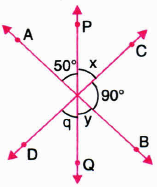
\(60^{ 0 }\)
\(90^{ 0 }\)
\(50^{ 0 }\)
\(40^{ 0 }\)
9.
In figure value of x is
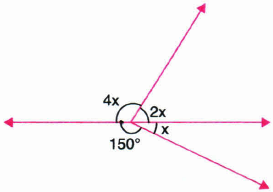
\(30^{ 0 }\)
\(40^{ 0 }\)
\(30^{ 0 }\)
\(50^{ 0 }\)
10.
Two angles measure \((30-a)^{ 0 }\) and \((125+2a)^{ 0 }\) If each one is the supplement of the other then the value of a is
\(45^{ 0 }\)
\(35^{ 0 }\)
\(25^{ 0 }\)
\(65^{ 0 }\)
11.
Which of the following is not a pair of complementary angles?
\(60^{ 0 },30^{ 0 }\)
\(56^{ 0 },34^{ 0 }\)
\(0^{ 0 },90^{ 0 }\)
\(150^{ 0 },30^{ 0 }\)
12.
If two lines intersect each other, then the vertically opposite angles are equal. prove it
13.
If the angles of a triangle are in the ratio 1 : 2 : 3. then find the angles.
14.
Prove that the sum of all the angles on the same side of a line at a given point is 180°
15.
In the given figure find x,if AB || CD
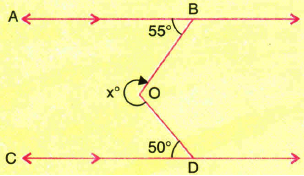
16.
In figures if AB || CD then find the value of x
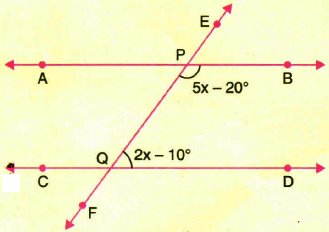
17.
In figure find the value of x.
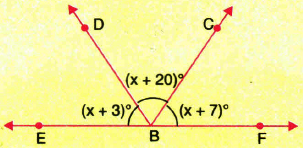
18.
If two parallel lines are intersected by a transversal then prove that the bisectors of any pair of corresponding angles are parallel.
19.
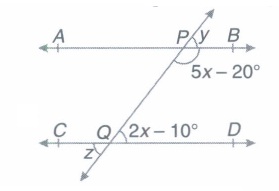
In the given figure, if AB||CD,\(\angle BPQ=(5x-20^o) and \angle PQD=(2x-10^o),\) Find the value of y and z.
20.
Given that \(\sqrt{3}\) is irrational, prove that \(5+2 \sqrt{3}\) is irrational
21.
Convert the following recurring decimals to \(\frac{p}{q}\) form:
\(\text { (A) } 3.0 \overline{52}\)
\(\text { (B) } 0 . \overline{23}\)
\(\text { (C) } 0.05\)
22.
If the coordinates of two points are P(-2, 3) and Q(-3, 5), then find (abscissa of P) - (abscissa of Q).
23.
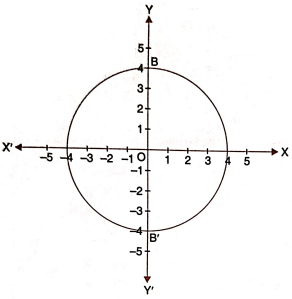
In the given figure of a circle, write the coordinates of the points where circle meets the axes.
24.
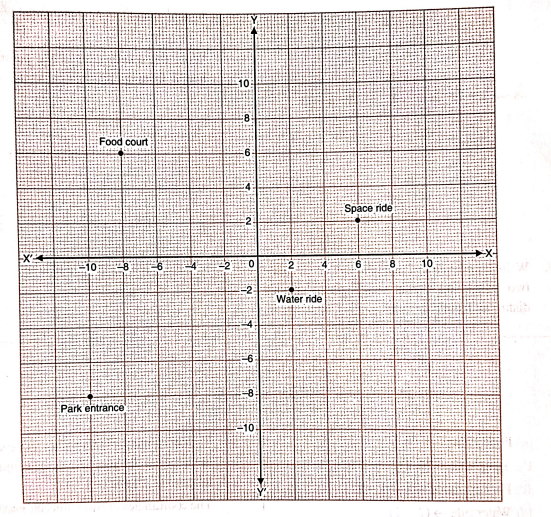
The locations of various activities at an amusement park are shown Write the coordinates of the points
(a) Food court
(b) Space ride
(c) Park entrance
(d) Water ride
25.
Evaluate the following using suitable identities:
(i) (99)3
(ii) (102)3
(iii) (998)3
26.
27.
Classify as rational or irrational with reasons:
(A) \(\sqrt{(169)}\)
(B) \(\sqrt{(75)}\)
(C) 0.12112111211112...
(D) \(3 . \overline{205}\)
28.
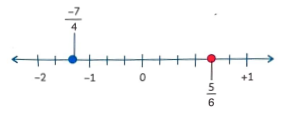
Locate \(\frac{-7}{4} \text { and } \frac{5}{6}\) on the number line with proper steps of construction
29.
Prove that \(\frac{2}{3} \text { and } \frac{4}{6}\) are equal. Also find \(\frac{2}{5}\) divided by \(\frac{-3}{10} .\)
30.
Calculate using Brahmagupta's laws and name the rule for each:
(A)(-12) x 5
(B) (-8) >x (-7)
(C) 0-(-14)
(D)(-20)+4
31.
If the abscissa of a point is x and ordinate is y, then what are the coordinates of the point ?
32.
What will be the general form of any point on the x-axis?
33.
Without actually calculating the cubes. find the value of each of the following:
(i) (-12)3 + (7)3 + (5)3
(ii) (28)3 + (-15)3 + (-13)3.
34.
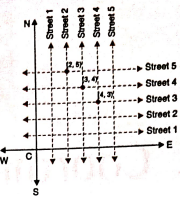
(Street Plan): A city has two main roads which cross each other at the centre of the city. These two roads are along the North-South direction and East-West direction. All the other streets of the city run parallel to these roads and are 200 m apart. There are 5 streets in each direction.
Using l cm = 200 m, draw a model of the city on your notebook. Represent the roads/streets by single line.
There are many cross-Streets in your model. A particular cross-street is made by two streets, one running in the North-South direction and another in the East-West direction. Each cross-street is referred to in the following manner: If the 2nd street running in the North-South direction and 5th in the East-West direction meet at some crossing, then we
will call this cross-street (2, 5). Using this convention, find:
(i) how many cross-streets can be referred to as (4, 3)?
(ii) how many cross-streets can be referred to as (3, 4)?
35.
Factorise the following using appropriate identities:
(i) 9x2 + 6xy + y2
(ii) 4y2 - 4y + 1
(iii) \(x^2-\frac{y^2}{100}\)
36.
37.
Assertion (A): Between any two rational numbers, an irrational number exists.
Reason (R): Rational numbers are dense but do not fill the entire number line; irrationals fill the remaining gaps.
Codes:
(a) Both Assertion and Reason are correct and Reason is the correct explanation of Assertion.
(b) Both Assertion and Reason are correct but Reason is not the correct explanation of Assertion.
(c) Assertion is correct but Reason is incorrect.
(d) Assertion is incorrect but Reason is correct.
38.
Assertion (A): \(\sqrt{5} \times \sqrt{5}=5,\) which is rational.
Reason (R): The product of two irrational numbers is always irrational.
Codes:
(a) Both Assertion and Reason are correct and Reason is the correct explanation of Assertion.
(b) Both Assertion and Reason are correct but Reason is not the correct explanation of Assertion.
(c) Assertion is correct but Reason is incorrect.
(d) Assertion is incorrect but Reason is correct.
39.
(A) Prove that \(\sqrt{10}\) is irrational.
(B) Explain the exact step where the proof method fails for \(\sqrt{4} \text { and } \sqrt{9} \text {. }\)Why does it fail?
1.
Since 11 is not a perfect square \(\sqrt{11}\)
Cannot be written as a rational number and is therefore irrational. In contrast, \(\sqrt{16}=4, \sqrt{49}=7 .\)and
\(\sqrt{100}=10\) are rational because 16, 49, and 100 are perfect squares
2.
The midpoint between \(\frac{1}{4} \text { and } \frac{1}{3}\) is found by taking their average:
\(\begin{aligned} & \text { Midpoint }=\frac{\frac{1}{4}+\frac{1}{3}}{2} \\ & \frac{1}{4}+\frac{1}{3}=\frac{3}{12}+\frac{4}{12}=\frac{7}{12} \\ & \frac{7}{12} \div 2=\frac{7}{12} \times \frac{1}{2}=\frac{7}{24} \end{aligned}\)
So, the midpoint is \(\frac{7}{24}\)
3.
\(\frac{7}{0}\) is undefined because division by zero is not possible in mathematics. In any rational number \(\frac{p}{q},\) the denominator must satisfy \(q \neq 0 .\)
If \(\frac{7}{0}=x, \text { then } x \times 0=7\)
But any number multiplied by zero equals zero, never 7. Therefore, no such number x exists. Hence, division by zero is undefined not a rational number.
4.
Brahmagupta explained negative numbers using everyday trade language. He called positive numbers Dhana (wealth) and negative numbers Rina (debts). For example, if you have ₹ 3 but owe ₹ 5, you are ₹ 2 in debt i.e., 3 -5=-2.
5.
(a)
zero polynomial
6.
(b)
(0, -3)
7.
The sum of consecutive interior angles on the same side of a transversal is \(180^{ 0 }\)
8.
\(x+50^{ 0 }\)
\(y+90^{ 0 }+x=180^{ 0 }\quad 50^{ 0 }+90^{ 0 }+x=180^{ 0 }\)
\(\Rightarrow x=40^{ 0 }\)
\(q=x=40^{ 0 }\)
9.
\(4x+2x=180^{ 0 }\)
10.
\((30-a)^{ 0 }+(125+2a)^{ 0 }=180^{ 0 }\)
11.
\(150^{ 0 },30^{ 0 }=180^{ 0 }\neq 90^{ 0 }\)
12.
Let AB and CD two lines intersecting at O
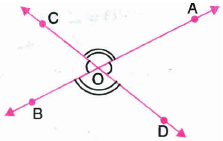
This leads to two pairs of vertically opposite angles,namely
(i) \(\angle \)AOC and \(\angle \)BOD
(II) \(\angle \)AOD and \(\angle \)BOC
We are to prove that
(i) \(\angle \)AOC and \(\angle \)BOD
(II) \(\angle \)AOD and \(\angle \)BOC
\(\therefore \) Ray OA stands on line CD
Therefore (i) \(\angle \)AOC and \(\angle \)AOD=\(180^{ 0 }\)
|Linear Pair Axiom
From (1) and (2)
\(\angle \)AOC and \(\angle \)AOD= \(\angle \)AOD and \(\angle \)BOD \(\angle \)AOC and \(\angle \)BOD
\(\Rightarrow \) Similarly we can prove that
\(\angle \)AOD and \(\angle \)BOC
13.
30°, 60°, 90°.
14.
Since ray OP stands on line AB.
∴\(\angle\)POA + \(\angle\)POB = 180° [by linear pair axiom]
\(\Rightarrow\) \(\angle\)POA + [\(\angle\)POQ + \(\angle\)QOR + \(\angle\)ROB] = 180°
[\(\because\) \(\angle\)POB = \(\angle\)POQ + \(\angle\)QOR + \(\angle\)ROB]
Hence, the sum of all the angles on the same side of a straight line at a given point is 180°.
Hence proved.
15.
\(255^{ 0 }\)
16.
30
17.
50
18.
∵ AB ॥ CD and EF is a transversal.
∴ ∠BEP = ∠EFD [corresponding angles]
⇒ \(\frac{1}{2}\) ∠BEP = \(\frac{1}{2}\) ∠EFD
⇒ ∠PEG = ∠EFH [∵ EG and FH are the angle bisectors of ∠BEP and ∠EFD respectively]
But they form pair of corresponding angles.
∴ EG॥ FH.
19.
5x-20o+2x-10o=180o (Corresponding interior angles)
\(\Rightarrow\)7x=180o+30o=210o
\(\Rightarrow\)x=30o
y=180o-(5x-20o)
=180o-(150o-20o)
\(\Rightarrow\)y=180o-130o=50o
z=2x-10o
=60o-10o=50o
20.
Let us assume \(5+2 \sqrt{3}\) is rational, then it must be in the form of
where p and q are co-prime integers and \(q \neq 0\)
i.e., \(5+2 \sqrt{3}=\frac{p}{q}\)
So
Since p,g, 5 and 2 are integers and \(q \neq 0,\)
RHS of equation (i) is rational. But LHS of (i) is \(\sqrt{3}\) which is irrational.
This is not possible. This contradiction has arisen due to our wrong assumption that \(5+2 \sqrt{3}\) is rational.
So, \(5+2 \sqrt{3}\) is irrational
21.
(A) x=3.0525252.., 10x =30.5252.
1000 x 3052.5252
990 x = 3022;
\(x=\frac{3022}{990}=\frac{1511}{495}\)
(B) X= 0.2323..
100x = 23.2323...
\(99 x=23 ; x=\frac{23}{99}\)
(C) X= 2.0555...
10x = 20.555...
100x =205.555...
\(90 x=185 ; x=\frac{185}{90}=\frac{37}{18}\)
22.
(abscissa of P) - (abscissa of Q)
= (-2) - (-3) =-2+3=1
23.
Let the circle meet OX at A and OX' at A'.
Then,
A→(4,0)
A'(-4,0)
Let the circle meet OY at B and OY' at B',
Then,
B→(0,4)
B'→ (0,-4)
24.
(a) Food court → (-8,6)
(b) Space ride → (6, 2)
(c) Park entrance → (-10,-8)
(d) Water ride → (2, -2)
25.
(i) (99)3 = (100 – 1)3 = (100)3 - (1)3 - 3(100)(1)(100 – 1) I Using Identity VII
= 1000 000 - 1 – 300(100 - 1) = 1000 000 - 1 - 30 000 + 300 = 970 299
(ii) (102)3 = (100 + 2)³ = (100)3 + (2) + 3(100)(2)(100 + 2) I Using Identity VI
= 1000000 + 8 + 600(100 + 2) = 1000000 + 8+ 60000 + 1200 = 1061208
(iii) (998)3 = (1000 - 2)3
= (1000)3 - (2)3 - 3(1000)(2)(1000 - 2) I Using Identity VII
= 100 00 00 000 - 8 - 6000(1000 - 2)
= 100 00 00 000 - 8 - 60 00 000 + 12000 = 99 40 11 992.
26.
27.
(A) \(\sqrt{169}=13\) ⇒ Rational (169 = 132, perfect square)
(B) \(\sqrt{75}=5 \sqrt{3}\) ⇒ Irrational (75 not a perfect square)
(C) 0.12112111211112... ⇒ Irrational (pattern grows no fixed block repeats)
(D) 3.205 ⇒ Rational (non-terminating recurring repeating block '05')
28.
Since.
(A) Representing \(\frac{-7}{4}\) on the number line
Converting to a mixed number:
\(-\frac{7}{4}=-1 \frac{3}{4}\)
Since \(\frac{-7}{4}=-1.75 \text {, it lies between }-2 \text { and }-1 \text {. }\)
Construction steps:
(1) Draw a number line and mark the integers -2 and-1 on it.
(2) Divide the segment between -2 and -1 into 4 equal parts (because the denominator is 4).
(3) Each small part represents \(\frac{1}{4} .\)
(4) Starting from -2, move 1 part to the right (since
\(\left.-2=\frac{-8}{4} \text { and } \frac{-7}{4}=\frac{-8}{4}+\frac{1}{4}\right)\)
(5) The 1st division point to the right of -2 represents \(\frac{-7}{4} .\)
(B) Representing \(\frac{5}{6}\) on the number line
Checking the value:
\(\frac{5}{6} \approx 0.833\)
Since \(0<\frac{5}{6}<1 \text {, it lies between } 0 \text { and } 1 .\)
Construction steps:
(1) Draw a number line and mark the integers 0 and 1 on it
(2)Divide the segment between 0 and 1 into 6 equal parts (because the denominator is 6).
(3) Each small part represents
(4) Starting from 0, move 5 equal parts to the right.
(5) The 5th division point to the right of O represents \(\frac{5}{6}\)
29.
Given fractions: \(\frac{2}{3} \text { and } \frac{4}{6}\)
Check cross multiplication:
2 x 6 = 12, 3 x 4 = 12
Since ad= bc, therefore:
Hence \(\frac{2}{3}=\frac{4}{6}\)
Also,
\(\begin{aligned} \frac{2}{5}+\left(-\frac{3}{10}\right) & =\frac{2}{5} \times\left(-\frac{10}{3}\right)=-\frac{20}{15}=-\frac{4}{3} \\ & =-\frac{20}{15}=-\frac{4}{3} \end{aligned}\)
30.
(A) (-12) x 5 = -60 ⇒ debt x fortune = debt
(B) (-8) x (-7) =56 debt x debt=fortune
(C) 0 - (-14) = 0 + 14 = 14 ⇒ subtracting a debt = adding a fortune
(D) (-20) ÷ 4 = -5 debt ÷ fortune = debt
31.
The coordinates of the point are (x,y).
32.
The general form of any point on the x-axis is (x,0).
33.
(i) (-12)3 + (7)3 + (5)3 = 3(- 12)(7)(5) =-1260 |∵ (-12) + (7) + (5) = 0
(ii) (28)3 + (-15)3 + (-13)3 = 3(28)(- 15)(- 13) = 16380. | ∵ (28) + (- 15) + (- 13) = 0
34.
Both the cross-streets are marked in the figure given. They are uniquely found because of the two reference lines we have used for locating them.
35.
(i) 9x2 + 6xy + y2 = (3x)2 + 2(3x)(y) + (y)2 = (3x+ y)2 = (3x + y)(3x + y) I Using Identity I
(ii) 4y2 - 4y + 1 = (2y)2 - 2(2y)(1) + (1)2 = (2y - 1)2 = (2y - 1)(2y - 1) I Using Identity II
(iii) \(x^2-\frac{y^2}{100}\)= \((x)^2-\left(\frac{y}{10}\right)^2=\left(x+\frac{y}{10}\right)\left(x-\frac{y}{10}\right) .\) | Using Identity III
36.
37.
(a) Both Assertion and Reason are correct and Reason is the correct explanation of Assertion.
Explanation:
Assertion (A) is true because an irrational number always exists between any two rational numbers. For example \(\sqrt{2}\) lies between 1 and 2 and is irrational. Reason (R) is also true because rational numbers are dense but do not cover the entire number line; irrational numbers occupy the remaining points. This explains why an irrational number can always be found between any two rational numbers.
38.
(c) Assertion is correct but Reason is incorrect.
Explanation:
Hence, the product is rational. However, the reason is incorrect because the product of two irrational numbers is not always irrational. This example itself is a counter example
39.
(A) Prove that \(\sqrt{10}\) is irrational.
Assume that \(\sqrt{10}=\frac{p}{q}\)
where p and q are co-prime integers and q ≠ 0.
Squaring both sides, p2 =10q2
Since 10 = 2 x 5, both 2 and 5 divide p2.
Therefore, 2 divides p and 5 also divides p. Hence, 10 divides p.
Let p = 10m
Substituting in the equation:
(10m)2 = 10q2
100m2 = 10q2
q2 = 10m2
Thus, 10 also divides q.
So both p and q are divisible by 10, which contradicts the assumption that p and q are co-prime.
Hence, \(\sqrt{10}\) is irrational.
(B) For \(\sqrt{4}: p^2=4 q^2\)
Taking p = 2k,
(2k)2 = 4q2
4K2 = 4q2
k = q
Therefore,
\(\sqrt{4}\) = 2 which is rational,
Similarly, for \(\sqrt{9}:\)
p2 = 9q2
Taking p = 3k,
9k² = 9q2
So k = q, giving
\(\sqrt{9}=3\)
which is also rational.
The proof by contradiction works only when the number is not a perfect square. For perfect squares such as and 9, the steps simplify to a rational number instead of producing a contradiction.

9th Standard CBSE Syllabus & Materials
9th Standard CBSE
CBSE 9th Mathematics Introduction to Euclid's Geometry Sample Question Papers Study Material - QB365 Set A
NEW9th Standard CBSE
CBSE 9th Mathematics Linear Equations in Two Variables Sample Question Papers Study Material - QB365 Set A
NEW9th Standard CBSE
CBSE 9th Mathematics Coordinate Geometry Sample Question Papers Study Material - QB365 Set A



NCERT Books

Syllabus

Exam Pattern

Sample Question Papers

Previous year Question Papers

Important Notes

MCQ Practice test

NCERT Exemplers

Case study Questions

Image Based Questions

Passage based Questions

HOT Questions

Value Based Questions

Model Questions Papers
NCERT ( Book Back ) Questions

Assertion and Reason
Important Questions And Answers

CBSE 9th Standard CBSE Subjects
CBSE Standards