100% FREE ACCESS
9th Standard CBSE Syllabus & Materials
9th Standard CBSE
CBSE 9th Science Is matter around us pure? - New Model Questions Papers Study Material - QB365 Set A
NEW9th Standard CBSE
CBSE 9th Science Matter in our surroundings - New Model Questions Papers Study Material - QB365 Set A
NEW9th Standard CBSE
CBSE 9th Mathematics Heron's Formula Sample Question Papers Study Material - QB365 Set A
NEW9th Standard CBSE
CBSE 9th Mathematics Circles Sample Question Papers Study Material - QB365 Set A
NEW9th Standard CBSE
CBSE 9th Mathematics Quadrilaterals Sample Question Papers Study Material - QB365 Set A
NEW9th Standard CBSE
CBSE 9th Mathematics Triangles Sample Question Papers Study Material - QB365 Set A

Published on: 14/08/2026
Download CBSE Class 9th Standard CBSE Mathematics question papers, sample papers, important questions, and previous year solved papers in PDF format. Get free study materials, NCERT solutions, and exam preparation resources for Class 9th Standard CBSE Mathematics
Questions + Answers key
Take MCQ Mathematics Test
1.
Convert the given frequency distribution into a continue-us grouped frequency distribution.
| Class interval | Frequency |
| 150-153 | 7 |
| 154-157 | 7 |
| 158-161 | 15 |
| 162-165 | 10 |
| 166-169 | 5 |
| 170-173 | 6 |
In which intervals would 153.5 and 157.5 be included?
2.
If the radius of a sphere is doubled, then find the percentage increase in its volume
3.
Given below are the seats won by different political parties in the polling outcome of a state assembly elections:
| Political Party | A | B | C | D | E | F |
| Seat won | 75 | 55 | 37 | 29 | 10 | 37 |
(i) Draw a bar graph to represent the polling results.
(ii) Which political party won the maximum number of seats?
4.
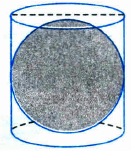
A right circular cylinder just encloses a sphere of radius r. Find
(i) surface area of the sphere,
(ii) curved surface area of the cylinder,
(iii) ratio of the areas obtained in (i) and (ii).
5.
The diameter of the moon is approximately one fourth of the diameter of the earth. Find the ratio of their surface area.
6.
Curved surface area of a cone is 308 cm2 and its slant height is 14 cm. Find (i) radius of the base and (ii) total surface area of the cone.
7.
Consider two 'postulates' given below:
(i) Given any two distinct points A and B, there exists a third point C which is in between A and B.
(ii) There exist at least three points that are not on the same line.
Do these postulates contain any undefined terms? Are these postulates consistent? Do they follow from Euclid's postulates? Explain.
8.
If the slant height and the base radius of a cone are 10 cm and 8 cm respectively, then find
(i) curved surface area and
(ii) total surface area. [Take π = 3.14]
9.
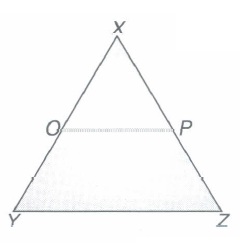
In the given figure, if \(OX=\frac{1}{2}XY, PX=\frac{1}{2}XZ\) and OX = PX, Show that XY = XZ.
10.
In the given figure, if A, Band Care three points on a line and B lies between A and C, then prove that AB + BC = AC.

11.
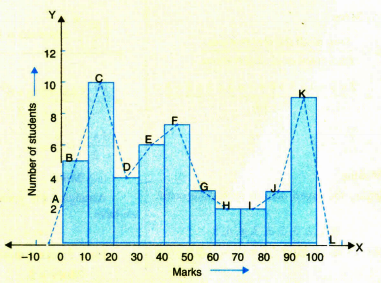
Consider the marks, out of 100, obtained by 51 students of a class in a test:
| Marks | Number of students |
|---|---|
| 0-10 | 5 |
| 10-20 | 10 |
| 20-30 | 4 |
| 30-40 | 6 |
| 40-50 | 7 |
| 50-60 | 3 |
| 60-70 | 2 |
| 70-80 | 2 |
| 80-90 | 3 |
| 90-100 | 9 |
| Total | 51 |
Draw a frequency polygon corresponding to this frequency distribution table.
12.
In a specific year, the distribution of the ages (in years) of primary teachers of a district is given:
| Age (in years) | Number of teachers |
| 15-20 | 10 |
| 20-25 | 30 |
| 25-30 | 50 |
| 30-35 | 50 |
| 35-40 | 30 |
| 40-45 | 6 |
| 45-50 | 4 |
(i) What is the lower limit of the first class interval?
(ii) What are the limits of the fourth class interval?
(iii) What is the class mark of the class 45-50?
13.
A hemispherical bowl has a radius of 3.5 cm. What would be the volume of water it would contain?
14.
The height and the slant height of a cone are 21 cm and 28 cm respectively. Find the volume of the cone.
15.
Let us now consider the following frequency distribution table which gives the weights of 38 students of a class:
| Weights (in kg) | Number of students |
| 31 - 35 | 9 |
| 36 - 40 | 5 |
| 41 - 45 | 14 |
| 46 - 50 | 3 |
| 51 - 55 | 1 |
| 56 - 60 | 2 |
| 61 - 65 | 2 |
| 66 - 70 | 1 |
| 71 - 75 | 1 |
| Total | 38 |
Now, if two new students of weights 35.5 kg and 40.5 kg are admitted in this class, then in which interval will we include them?
16.
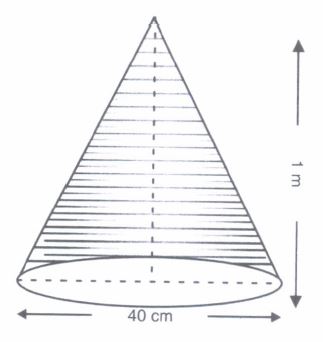
Students of class IX of the Sagar School plan to have their school bus stand barricaded from the remaining part of the road to avoid inconvenience of the people. For this purpose they use 50 hollow cones made of recycled cardboard. Each cone has a diameter of 40 cm and height 1 m.
They painted outer side of each of the cones. The cost of painting is 12 per m2.
[use π = 3.14 and \(\sqrt{1.04}\) = 1.02]
(a) Find the cost ofpainting ofall these cones.
(b) Which mathematical concept is used in the above problem?
(c) By barricading the school-bus stand using cones of recycled cardboard, which skills are depicted by the students of class IX of the Sagar School?
17.
Which of the following statements are true and which are false? Give reasons for your answers.
(i) Only one line can pass through a single point.
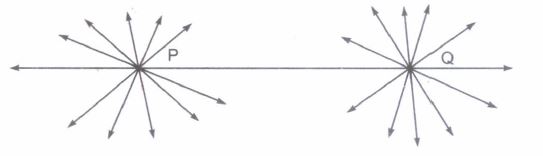
(ii) There are an infinite number of lines which pass through two distinct points.
(iii) A terminated line can be produced indefinitely on both the sides.
(iv) If two circles are equal, then their radii are equal.
(v) In the following figures. if AB = PQ and PQ = XY. then AB = XY.

18.
Two solid spheres made of the same metal have masses 5920 g of and 740 g respectively. Determine the radius of the larger sphere, if the diameter of the smaller sphere is 5 cm.
19.
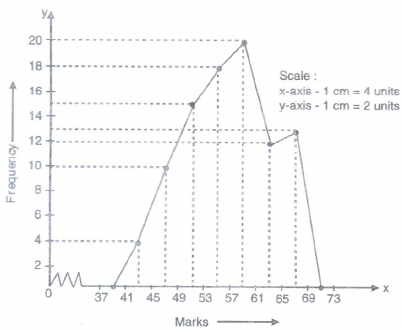
Represent the following data by means of a frequency polygon.
| Marks | Frequency |
|---|---|
| 41-45 | 4 |
| 45-49 | 10 |
| 49-53 | 15 |
| 53-57 | 18 |
| 57-61 | 20 |
| 61-65 | 12 |
| 65-69 | 13 |
1.
153.5-157.5 and 157.5-161.5
2.
800 %
3.
(i)
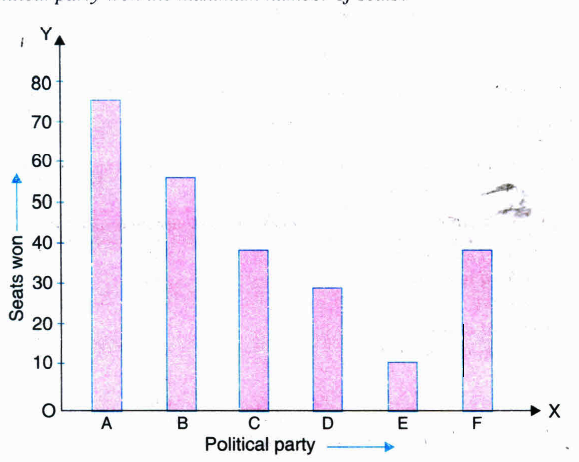
(ii) Political party A won the maximum number of seats.
4.
(i) Surface area of the sphere = \(4\pi { r }^{ 2 }\)
(ii) For cylinder
Radius of the base = r
Height = 2r
\(\therefore\) Curved surface area of the cylinder
\(=2\pi \left( r \right) \left( 2r \right) =4\pi { r }^{ 2 }\)
(iii) Ratio of the areas obtained in (i) and (ii)
\(=\frac { Surface\ area\ of\ the\ sphere }{ Curved\ surface\ area\ of\ the\ cylinder } \)
\(\\ =\frac { 4\pi { r }^{ 2 } }{ 4\pi { r }^{ 2 } } =\frac { 1 }{ 1 } =1:1.\)
5.
Let the diameter of the earth be 2r.
Then diameter of the moon \(=\frac { 1 }{ 4 } \left( 2r \right) =\frac { r }{ 2 } \)
\(\therefore\) Radius of the earth = \(\frac { 2r }{ 2 } =r\)
and, Radius of the moon \(=\frac { 1 }{ 2 } \left( \frac { r }{ 2 } \right) =\frac { r }{ 4 } \)
\(\therefore\) Surface area of the earth \(=4\pi { r }^{ 2 }\)
and, Surface area of the moon
\(=4\pi { \left( \frac { r }{ 4 } \right) }^{ 2 }=\frac { 1 }{ 4 } \pi { r }^{ 2 }\)
\(\therefore\) Ratio of their surface area
\(=\frac { Surface\ area\ of\ the\ moon }{ Surface\ area\ of\ the\ earth } \)
\(\\ =\frac { \frac { 1 }{ 4 } \pi { r }^{ 2 } }{ 4\pi { r }^{ 2 } } =\frac { 1 }{ 16 } =1:16.\)
6.
(i) Slant height (l) = 14 cm
Curved surface area = 308 cm2
\(\Rightarrow \pi rl=308\)
\(\\ \Rightarrow \frac { 22 }{ 7 } \times r\times 14=308\)
\(\\ \Rightarrow r=\frac { 308\times 7 }{ 22\times 14 } \)
\(\\ \Rightarrow r=7cm\)
Hence, the radius of the base is 7 cm.
(ii) Total surface area of the cone = \(\pi r\left( l+r \right) \)
\(=\frac { 22 }{ 7 } \times 7\times \left( 14+7 \right)\)
\( \\ =\frac { 22 }{ 7 } \times 7\times 21=462{ cm }^{ 2 }\)
Hence, the total surface area of the cone is 462 cm2.
7.
Yes! These postulates contain two undefined terms: Point and Line. Yes! These postulates are consistent because they deal with two different situations
(i) says that given two points A and B, there is a point C lying on the line in between them,
(ii) says that given A and B, we can take C not lying on the line through A and B. These 'postulates' do not follow from Euclid's postulates, however, they follow from Axiom 'Given two distinct lines, there is a unique line that passes through them.
8.
(i) 251.2 cm2
(ii) 452.16 cm2
9.
Here, \(OX=\frac{1}{2}XY, PX=\frac{1}{2}XZ\)
XY = 2(OX), XZ = 2(PX)
Also. OX = PX(Given)
XY = XZ
(because things which are double of the same things are equal to one another)
10.
In the given figure, AC coincides with AB + BC.
Also, Euclid's axiom 4 says that things which coincide with one another, are equal to one another. So, it can be deduced that
AB + BC = AC
11.
Let us first draw a histogram for this data and mark the mid-points of the tops of the rectangles as B, C, D, E, F, G, H, I, J, K, respectively. Here, the first class is 0-10. So, to find the class preceeding 0-10, we extend the horizontal axis in the negative direction and find the mid-point of the imaginary class-interval (–10) - 0. The first end point, i.e., B is joined to this mid-point with zero frequency on the negative direction of the horizontal axis. The point where this line segment meets the vertical axis is marked as A. Let L be the mid-point of the class succeeding the last class of the given data. Then OABCDEFGHIJKL is the frequency polygon, which is shown in Fig.
12.
(i) 15
(ii) 30-35
(iii) 47.5
13.
The volume of water the bowl can contain
\(=\frac{2}{3} \pi r^{3}\)
\(=\frac{2}{3} \times \frac{22}{7} \times 3.5 \times 3.5 \times 3.5 \mathrm{~cm}^{3}=89.8 \mathrm{~cm}^{3}\)
14.
From l2 = r2 + h2, we have
\(r=\sqrt{l^{2}-h^{2}}=\sqrt{28^{2}-21^{2}} \mathrm{~cm}=7 \sqrt{7} \mathrm{~cm}\)
So, volume of the cone \(=\frac{1}{3} \pi r^{2} h=\frac{1}{3} \times \frac{22}{7} \times 7 \sqrt{7} \times 7 \sqrt{7} \times 21 \mathrm{~cm}^{3}\)
= 7546 cm3
15.
consider the classes 31 - 35 and 36 - 40.
The lower limit of 36 - 40 = 36
The upper limit of 31 - 35 = 35
The difference = 36 – 35 = 1
So, half the difference = 1/2 = 0.5
So the new class interval formed from 31 - 35 is (31 – 0.5) - (35 + 0.5), i.e., 30.5 - 35.5.
Similarly, the new class formed from the class 36 - 40 is (36 – 0.5) - (40 + 0.5), i.e., 35.5 - 40.5.
Continuing in the same manner, the continuous classes formed are:
30.5-35.5, 35.5-40.5, 40.5-45.5, 45.5-50.5, 50.5-55.5, 55.5-60.5, 60.5 - 65.5, 65.5 - 70.5, 70.5 - 75.5.
Now it is possible for us to include the weights of the new students in these classes. But, another problem crops up because 35.5 appears in both the classes 30.5 - 35.5 and 35.5 - 40.5.
If it is considered in both classes, it will be counted twice.
By convention, we consider 35.5 in the class 35.5 - 40.5 and not in 30.5 - 35.5. Similarly, 40.5 is considered in 40.5 - 45.5 and not in 35.5 - 40.5.
So, the new weights 35.5 kg and 40.5 kg would be included in 35.5 - 40.5 and 40.5 - 45.5, respectively. Now, with these assumptions, the new frequency distribution table will be as shown below:
| Weights (in kg) | Number of students |
| 30.5-35.5 | 9 |
| 35.5-40.5 | 6 |
| 40.5-45.5 | 15 |
| 45.5-50.5 | 3 |
| 50.5-55.5 | 1 |
| 55.5-60.5 | 2 |
| 60.5-65.5 | 2 |
| 65.5-70.5 | 1 |
| 70.5-75.5 | 1 |
| Total | 40 |
16.
(a) Diameter of a cone = 40 cm
∴ Radius of a cone (r) = \(\frac{40}{2}\) cm = 20 cm = \(\frac{20}{100}\)m
= 0.2m
Height of a cone (h) = 1 m
⇒ Slant height of a cone (I) = \(\sqrt{r^{2}+h^{2}}\)
l = \(\sqrt{(0.2)^{2}+(1)^{2}}\)
\(=\sqrt{0.04+1} \mathrm{~m}\)
\(=\sqrt{1.04} \mathrm{~m}\)
= 1.02 m
[∵ It is given that \(\sqrt{1.04}\) = 1.02]
Now, curved surface area of a cone = πrl
[∵ Base of the cone is hollow]
⇒ Curved surface area of 1 cone = 3.14 x 0.2 x 1.02m2
\(=\frac{314}{100} \times \frac{2}{10} \times \frac{102}{100}\) m2
Cost of Painting :
∵ The rate of painting is 12 per m2
∴ Total cost of 50 cones = 12 x \(\left[\frac{314}{10} \times \frac{102}{100}\right]\)
= \( \frac{384336}{1000}\) = 384.34 (approx.)
(b) Surface Areas and Volumes [mensuration]
(c) (i) Care for the public convenience.
(ii) Betterment of environment.
17.
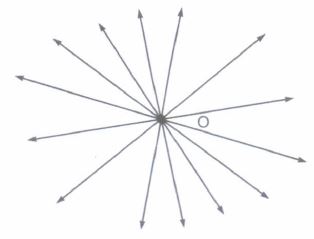
(i) False
[If we mark a point O on the surface of a paper and using pencil and ruler, we can draw indefinite number of straight lines passing through O.]
(ii) False
[∵ In the following figure, there are many straight lines passing through 'P'. There are many lines, passing through 'Q'. But there is one and only one line which is passing through 'P' as well as 'Q'.]
(iii) True
[∵ The postulate 2 says that "A terminated line can be produced indefinitely."]
(iv) True
[∵ Superimposing the region of one circle on the other, we find them coinciding. So, their centres and boundaries coincide. Thus, their radii will coincide.]
(v) True
[∵ According to Euclid's axiom, things which are equal to the same thing are equal to one another.]
18.
Let r and R be the radii of the smaller and larger spheres respectively, we have
\(r=\frac { 5 }{ 2 } cm\)
Volume of the smaller sphere \(=\frac { 4 }{ 3 } \pi { r }^{ 3 }=\frac { 4 }{ 3 } \pi { \left( \frac { 5 }{ 2 } \right) }^{ 3 }\)
\(=\frac { 4 }{ 3 } \times \pi \times \frac { 125 }{ 8 } { cm }^{ 3 }\)
Density of metal\(=\frac { mass }{ Valume } \)
\(=\frac { 740 }{ \frac { 4 }{ 3 } \pi \times \frac { 125 }{ 8 } } g\quad { cm }^{ 3 }\) ...........(i)
Volume of larger sphere = \(\frac { 4 }{ 3 } \pi { R }^{ 3 }\)
Density of metal=\(\frac { mass }{ Volume } =\frac { 5920 }{ \frac { 4 }{ 3 } \pi { R }^{ 3 } } \) ......(ii)
From (i) and (ii), we have
\(\frac { 740 }{ \frac { 4 }{ 3 } \pi \times \frac { 125 }{ 8 } } =\frac { 5920 }{ \frac { 4 }{ 3 } \pi { R }^{ 3 } } \)
\(\Rightarrow \quad { R }^{ 3 }=\frac { 5920\times 125 }{ 740\times 8 } \)
= 125
\(\Rightarrow\) R = 5 cm.
19.
| Marks | Frequency | Class Marks |
|---|---|---|
| 37-41 | 0 | 39 |
| 41-45 | 4 | 43 |
| 45-49 | 10 | 47 |
| 49-53 | 15 | 51 |
| 53-57 | 18 | 55 |
| 57-61 | 20 | 59 |
| 61-65 | 12 | 53 |
| 65-69 | 13 | 67 |
| 69-73 | 0 | 71 |

9th Standard CBSE Syllabus & Materials
9th Standard CBSE
CBSE 9th Mathematics Lines and Angles Sample Question Papers Study Material - QB365 Set A
NEW9th Standard CBSE
CBSE 9th Mathematics Linear Equations in Two Variables Sample Question Papers Study Material - QB365 Set A
NEW9th Standard CBSE
CBSE 9th Mathematics Coordinate Geometry Sample Question Papers Study Material - QB365 Set A



NCERT Books

Syllabus

Exam Pattern

Sample Question Papers

Previous year Question Papers

Important Notes

MCQ Practice test

NCERT Exemplers

Case study Questions

Image Based Questions

Passage based Questions

HOT Questions

Value Based Questions

Model Questions Papers
NCERT ( Book Back ) Questions

Assertion and Reason
Important Questions And Answers

CBSE 9th Standard CBSE Subjects
CBSE Standards