100% FREE ACCESS
9th Standard CBSE Syllabus & Materials
9th Standard CBSE
CBSE 9th Science Is matter around us pure? - New Model Questions Papers Study Material - QB365 Set A
NEW9th Standard CBSE
CBSE 9th Science Matter in our surroundings - New Model Questions Papers Study Material - QB365 Set A
NEW9th Standard CBSE
CBSE 9th Mathematics Heron's Formula Sample Question Papers Study Material - QB365 Set A
NEW9th Standard CBSE
CBSE 9th Mathematics Circles Sample Question Papers Study Material - QB365 Set A
NEW9th Standard CBSE
CBSE 9th Mathematics Triangles Sample Question Papers Study Material - QB365 Set A
NEW9th Standard CBSE
CBSE 9th Mathematics Lines and Angles Sample Question Papers Study Material - QB365 Set A

Published on: 14/08/2026
Download CBSE Class 9th Standard CBSE Mathematics question papers, sample papers, important questions, and previous year solved papers in PDF format. Get free study materials, NCERT solutions, and exam preparation resources for Class 9th Standard CBSE Mathematics
Questions + Answers key
Take MCQ Mathematics Test
1.
Show that the diagonals of a square are equal and bisect each other at right angles.
2.
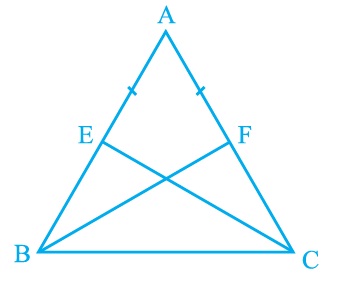
E and F are respectively the mid-points of equal sides AB and AC of D ABC (see Fig). Show that BF = CE.
3.
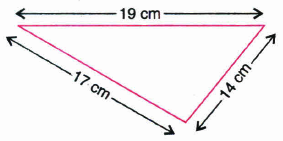
(a) Find the area of the triangle.
(b) Find the area of a triangle whose sides are 16 cm, 14 cm, nd 10 cm.
(c) The sides of a triangle are 7 cm, 12 cm, and 13 cm. Find its area.
d) Find the area of a triangle whose sides are 11 m, 60 m and 61 m.
4.
A traffic signal board, indicating 'SCHOOL AHEAD', is an equilateral triangle with side 'a'.Find the area of the signal board, using Heron's Formula.If its perimeter is 180 cm, what will be the area of the signal board?
5.
Write the following cubes in expanded from: \((2a-3b)^3\)
6.
Write the following in decimal form and say what kind of decimal expansion each has:
\(\frac { 3 }{ 13 } \)
7.
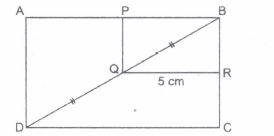
In the adjoining figure, ABCD and PQRB are rectangles where Q is the mid point of BD. If QR = 5 cm, then find the length of AB.
8.
The area of an equilateral triangle is 8\(\sqrt { 3 } \) cm2 Find its perimeter.
9.
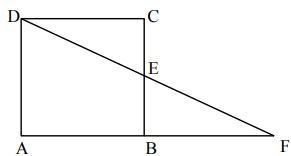
In the given figure, ABCD is a parallelogram and E is the mid-point of side BC. DE and AB, when produced meet at F. Prove that AF = 2 AB.
10.
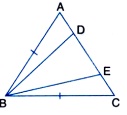
In the given figure, if AB = AC and DB = DC. then ΔABE≅ΔCBD
11.
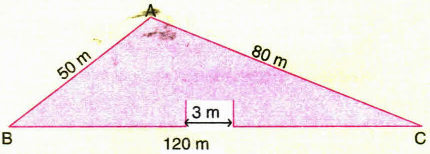
A triangular park ABC has sides 120 m, 80 m and 50 m. A gardener Dhania has to put a fence all around it and also plant grass inside. How much area does she need to plant? Find the cost of fencing it with barbed wire at the rate of Rs. 20 per metre leaving a space 3 m wide for a gate on one side.
12.
Show that 0.3333...=\(0.\overline { 3 } \) can be expressed in the form p/q, where p and q are integers and \(q\neq 0\)
13.
Two equal sides of an isosceles triangle are 13 cm each and its perimeter is 36 cm.Find the area of the triangle.
20 cm2
30 cm2
40 cm2
60 cm2
14.
Two sides of a triangle are 13 cm, and 14 cm and its semi-perimeter is 18 cm.Then third side of the triangle is
12 cm
11 cm
10 cm
9 cm
15.
The perimeter of a triangular plot is 16 m.If the measures of its two sides are 5 m, and 6m, then find the third side.
2 m
3 m
5 m
4 m
16.
Area of an isosceles right triangle is 8 cm2.Its hypotenuse is
\(\sqrt { 32 } \) cm
4 cm
\(4\sqrt { 3 } \) cm
\(2\sqrt { 6 } \) cm
17.
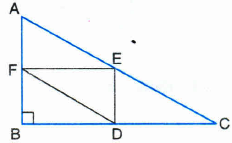
The triangle formed by joining the mid-points of the sides of a angled triangle is a
scalene
isosceles
equilateral
right
18.
In the following figure, ABCD is a parallelogram. The bisectors of angles A and B intersect at O. Then, the angle AGB is
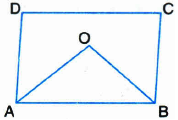
a right angle
an acute angle
an obtuse angle
a straight angle.a straight angle.
19.
Which of the following is true?
A diagonal of a parallelogram divides it into two congruent triangles
In a parallelogram, opposite angles may not be equal
In a parallelogram, opposite sides may be unequal
In a parallelogram, the diagonals do not bisect each other
20.
If ΔABC ≅ DEF by SSS congruence rule then:
AB = EF, BC = FD, CA = DE
AB = FD, BC = DE, CA = EF
AB = DE, BC = EF, CA = FD
AB = DE, BC = EF, ㄥC = ㄥF
21.
In ΔABC, ㄥC = ㄥA and BC = 6 ern and AC = 5 cm, then the length of AB is:
6 cm
5cm
3cm
2.5cm
22.
In the given figure, if AB = DC, ㄥABD = ㄥCDB, which congruence rule would you apply to prove ΔABD ≅ CDB?
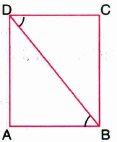
SAS
SSS
AAS
SAS
23.
(x+2) is a factor of \(2x^3+5x^2-x-k.\) The value of k is:
6
-24
-6
24
24.
If \(x^{11}+101 \) is divided by (x+1), the remainder is:
-1
102
0
100
25.
If a polynomial f(x) is divided by x-a, then remainder is:
f(0)
f(a)
f(-a)
f(a)-f(0)
26.
If p=17, the degree of the polynomial \(p(x)=(p-x)^3+14\) is:
17
14
0
3
27.
When \(15\sqrt { 5 } \) is divided by \(3\sqrt { 3 } \) , the quotient is:
\(5\sqrt { 3 } \)
\(3\sqrt { 5 } \)
\(5\sqrt { 5 } \)
\(3\sqrt { 3 } \)
28.
The sum of \(0.\overline { 3 } \) and \(0.\overline { 2 } \)
\(\frac { 5 }{ 99 } \)
\(\frac { 5 }{ 9 } \)
\(\frac { 5 }{ 10 } \)
\(\frac { 5 }{ 100 } \)
29.
A number is an irrational if and only if its decimal representation is:
non-terminating
non-terminating and repeating
non terminating and non repeating
terminating
30.
A rational number lying between \(\sqrt { 2 } \) and \(\sqrt { 3 } \) is:
\(\frac { \sqrt { 2 } +\sqrt { 3 } }{ 2 } \)
\(\sqrt { 6 } \)
1.6
1.9
31.
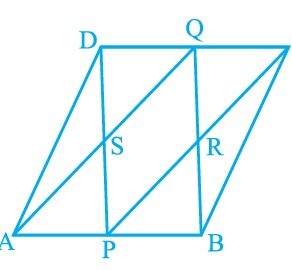
ABCD is a parallelogram in which P and Q are mid-points of opposite sides AB and CD (see Fig. 8.18). If AQ intersects DP at S and BQ intersects CP at R, show that:
(i) APCQ is a parallelogram.
(ii) DPBQ is a parallelogram.
(iii) PSQR is a parallelogram.
32.
Factorise x3 - 23x2 + 142x - 120
33.
Locate\(\sqrt{2}\) on the number line (or on the real line).
34.
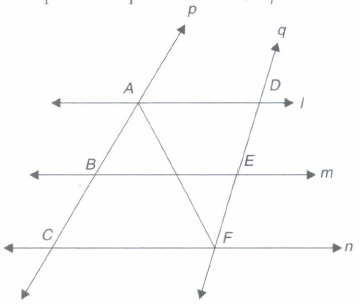
l, m and n are three parallel lines intersected by transversals p and q such that l, m and n cut off equal intercepts AB and BC on p (see Fig.). Show that l, m and n cut off equal intercepts DE and EF on q also.
35.
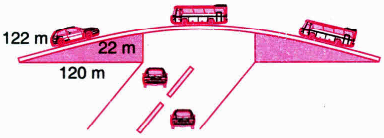
The triangular side walls of a flyover have been used for advertisements. The sides of the walls are 122 m, 22 m and 120 m (see figure). The advertisement yield an earning of Rs 5000 per m2 per year. A company hired one of its wall for 3 months. How much rent did it pay?
36.
In right angled MBC, right angled at C,M is the mid-point of hypotenuse AB. Cis joined to M and produced to a point D such that DM = CM. Point Dis joined to point B (see figure).
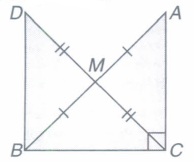
Show that
(i) \(\triangle AMC=\triangle BMD\)
(ii) \(\angle DBC\) is a right angle
(iii) \(\angle DBC=\cong \triangle ACB\)
(iv) CM = \(\frac { 1 }{ 2 } AB\)
37.
Assertion : In triangles ABC and PQR,∠A = ∠P, ∠C = ∠R and AC = PR. The two triangles are congruent by ASA congruence.
Reason : If two angles and the included side of one triangle are equal to two angles and the included side of the other triangle, then the two triangles are congruent.
38.
Assertion : In ∆ABC, D is the midpoint of BC. If DL ⊥ AB and DM ⊥ AC such that DL = DM, then BL = CM
Reason : If two angles and the included side of one triangle are equal to two angles and the included side of the other triangle, then the two triangles are congruent.
1.
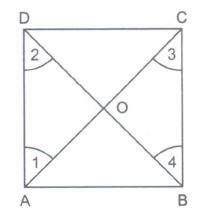
We have a square ABCD such that its diagonals AC and BD intersect at O.
(i) To prove that the diagonals are equal, i.e. AC = BD
In ΔABC and ΔBAD, we have
AB =BA
[Common]
BC = AD [Opposite sides oj the square ABCD]
∠ABC = ∠BAD [All angles of a square are equal to 90ο]
∴ ABC ≅ ΔBAD [SAS criteria]
⇒ Their corresponding parts are equal.
⇒ AC = BD ...(1)
(ii) To prove that '0' is the mid-point of AC and BD.
∵ AD II BC and AC is a transversal. [∵ Opposite sides of a square are parallel]
∴ ∠1 = ∠3 [Interior alternate angles]
Similarly, ∠2 = ∠4 [Interior alternate angles]
Now, in ΔOAD and ΔOCB, we have
AD = CB [Opposite sides oj the square ABCD]
∠1 = ∠3 [Proved]
∠2 = ∠4 [Proved]
∴ ΔOAD == ΔOCB [ASA criteria]
∴ Their corresponding parts are equal.
⇒ OA = OC and OD = OB
⇒ O is the mid-point of AC and BD, i.e. the diagonals AC and BD bisect each other at O. ...(2)
(iii) To prove that AC ⏊ BD.
In ΔOBA and ΔODA, we have
OB = OD [Proved]
BA = DA [Opposite sides of the square]
OA = OA [Common]
∴ ΔOBA ≅ ΔODA [SSS criteria]
⇒ Their corresponding parts are equal.
⇒ ∠AOB = ∠AOD
But ∠AOB and ∠AOD form a linear pair.
∴ ∠AOB + ∠AOD = 180ο
⇒ ∠AOB = ∠AOD = 90ο
⇒ AC ⏊ BD ... (3)
From (1), (2) and (3), we get AC and BD are equal and bisect each other at right angles.
2.
Proof: In \(\triangle\)ABF and \(\triangle\)ACE,
AB =AC
\(\angle\)A=\(\angle\)A
AF =AE
\(\therefore\) \(\triangle\)ABF = \(\triangle\)ACE (by SAS cong.)
\(\therefore\) By c.p.c.t BF = CE.
Alternative Method:
AB = AC\(\Rightarrow \frac { AB }{ 2 } =\frac { AC }{ 2 } \)
\(\Rightarrow \) AE=AF,
sice E and F are the mid-points of AB and AC
In \(\triangle\)ABF and \(\triangle\)ACE,
AB = AC (Given)
\(\angle\)A = \(\angle\)A (Common)
AF = AE (Proved)
\(\therefore \triangle ABF\cong \triangle ACE\) (By SAS cong.)
\(\therefore\) BF = CE. (By c.p.c.t)
3.
(a) 114.89 cm2
(b) \(40\sqrt { 3 } \)cm2
(c) \(24\sqrt { 3 } \)cm2
(d) 330 m2
4.
'a' = a, 'b' =a, 'c' =a
\(s=\frac { 'a'+'b'+'c' }{ 2 } =\frac { a+a+a }{ 2 } =\frac { 3a }{ 2 } \)
\(\therefore \) Area of the signal board
\(=\sqrt { s(s-'a')(s-'b')(s-'c') } \)
\(\\ =\sqrt { \frac { 3a }{ 2 } \left( \frac { 3a }{ 2 } -a \right) \left( \frac { 3a }{ 2 } -a \right) \left( \frac { 3a }{ 2 } -a \right) } \)
\(\\ =\sqrt { \frac { 3a }{ 2 } \left( \frac { a }{ 2 } \right) \left( \frac { a }{ 2 } \right) \left( \frac { a }{ 2 } \right) } =\sqrt { \frac { { 3a }^{ 4 } }{ 16 } } =\frac { \sqrt { 3 } }{ 4 } { a }^{ 2 }\)
Perimeter = 180 cm
\(\Rightarrow 'a'+'b'+'c'\ =\ 180\)
\(\\ \Rightarrow a+a+a=180\)
\(\\ \Rightarrow 3a=180\)
\(\\ \Rightarrow a=\frac { 180 }{ 3 } \)
\(\Rightarrow \) a = 60 cm
\(\therefore \) Area of the signal board
\(=\frac { \sqrt { 3 } }{ 4 } \) a2 =\( \frac { \sqrt { 3 } }{ 4 } \) (60)2 = \(900\sqrt { 3 } \) cm2
Alternatively,
\(s=\frac { 3a }{ 2 } =\frac { 3 }{ 2 } (60)=90\)cm
Area of the signal board
\(=\sqrt { s(s-'a')(s-'b')(s-'c') } \)
\(=\sqrt { 90(90-60)(90-60)(90-60) } \)
\(\\ =\sqrt { 90(30)(30)(30) } =900\sqrt { 3 } \) cm2.
5.
\((2a-3b)^3\)
\({ (2a-3b) }^{ 3 }={ (2a) }^{ 3 }-{ (3b) }^{ 3 }-2(2a)(3b)(2a-3b)\) | Using Identity VII
\(=8{ a }^{ 3 }-27{ b }^{ 3 }-18ab(2a-3b)\)
\(=8{ a }^{ 3 }-27{ b }^{ 3 }-36{ a }^{ 2 }b+54{ ab }^{ 2 }\)
6.
\(\frac { 3 }{ 13 } \)= 0.230769230769...=\(0.\overline { 230769 } \)
7.
AB = 10 cm
8.
54 cm
9.
Given ABCD is a parallelogram.
\(\therefore \) AB = CD and AD = BC
and E is the mid-point of side BC, i.e. BE = CE
To prove AF = 2 AB
Proof Now, in \(\triangle DEC\) and \(\triangle FEB\), we have
\(\angle DEC=\angle BEF\) [vertically opposite angles]
BE = CE [given]
and \(\angle DCE=\angle FBE\) [since, \(DC\parallel AF\) and BC is transversal, so alternate interior angles]
\(\therefore \triangle DEC\cong \triangle FEB\) [by ASA congruence rule]
So, DC = BF [by CPCT] .... (i)
Also, we have DC = AB [given] ... (ii)
From Eqs.(i) and (ii), we get
AB = BF
\(\therefore AF=2AB\)
10.
First prove that ΔADB ≅ ΔADC by SAS congruence rule. Then show that ㄥABD=ㄥACD by CPCT Ans: 1:1 Alternate MehodSince, AB=AC
∴ ㄥABC = ㄥACB
[-:angles opposite to equal sides are equal]
Similarly, ㄥDBC =ㄥDCB [∵ DB = DC]
Now, ㄥABC-ㄥDBC=ㄥACB-ㄥDCB
⇒ ㄥABD = ㄥACD
⇒ \(\frac { \angle ABD }{ \angle ACD } =1\Rightarrow \angle ABD:\angle ACD=1:\)
11.
For finding area of the park, we have
2s = 50 m + 80 m + 120 m = 250 m.
i.e., s = 125 m
Now, s – a = (125 – 120) m = 5 m,
s – b = (125 – 80) m = 45 m,
s – c = (125 – 50) m = 75 m.
Therefore, area of the park = \(\sqrt{s(s-a)(s-b)(s-c)}\)
\(=\sqrt{125 \times 5 \times 45 \times 75} \mathrm{~m}^{2}\)
\(=375 \sqrt{15} \mathrm{~m}^{2}\)
Also, perimeter of the park = AB + BC + CA = 250 m
Therefore, length of the wire needed for fencing = 250 m – 3 m (to be left for gate)
= 247 m
And so the cost of fencing = Rs.20 x 247 = RS. 4940
12.
Since we do not know what 0 3 . is , let us call it ‘x’ and so
x = 0.3333
Now here is where the trick comes in. Look at
10 x = 10 x (0.333...) = 3.333
Now, 3.3333 = 3 + x, since x = 0.3333
Therefore, 10 x = 3 + x
Solving for x, we get
\(9 x=3, \text { i.e., } x=\frac{1}{3}\)
13.
(d)
60 cm2
14.
(d)
9 cm
15.
(c)
5 m
16.
(a)
\(\sqrt { 32 } \) cm
17.
FE IIBC, ED II AB
\(\therefore\)BDEF is a parallelogram
19.
In a parallelogram, opposite sides and opposite angles are equal.
20.
(c)
AB = DE, BC = EF, CA = FD
21.
(a)
6 cm
22.
(a)
SAS
23.
Use factor theorem
24.
\(x+1=0\ \ Rightarrow \ x=-1\)
\(\therefore\) Remainder=\((-1)^11+101=-1+101\)
=100
25.
Remainder theorem
26.
\(p(x)=(p-x)^3+14=(17-x)^3+14\)
\(=(17)^3-x^3-3(17)^2(x)+3.17.x^2+14\)
\(\because\) Degree=3
27.
(c)
\(5\sqrt { 5 } \)
28.
(b)
\(\frac { 5 }{ 9 } \)
29.
(c)
non terminating and non repeating
30.
(c)
1.6
31.
(i) In quadrilateral APCQ,
AP || QC (Since AB || CD) .....................(1)
\(\mathrm{AP}=\frac{1}{2} \mathrm{AB}, \quad \mathrm{CQ}=\frac{1}{2} \mathrm{CD}\)
Also, AB = CD
So, AP = QC ...................(2)
Therefore, APCQ is a parallelogram [From (1) and (2)]
(ii) Similarly, quadrilateral DPBQ is a parallelogram, because
DQ || PB and DQ = PB
(iii) In quadrilateral PSQR,
SP || QR (SP is a part of DP and QR is a part of QB)
Similarly, SQ || PR
So, PSQR is a parallelogram.
32.
Let p(x) = x3 – 23x2 + 142x – 120
We shall now look for all the factors of –120. Some of these are ±1, ±2, ±3, ±4, ±5, ±6, ±8, ±10, ±12, ±15, ±20, ±24, ±30, ±60.
By trial, we find that p(1) = 0. So x – 1 is a factor of p(x).
Now we see that x3 – 23x2 + 142x – 120 = x3 – x2 – 22x2 + 22x + 120x – 120
= x2(x –1) – 22x(x – 1) + 120(x – 1)
= (x – 1) (x2 – 22x + 120) [Taking (x – 1) common]
We could have also got this by dividing p(x) by x – 1.
Now x2 – 22x + 120 can be factorised either by splitting the middle term or by using the Factor theorem. By splitting the middle term, we have:
x2 – 22x + 120 = x2 – 12x – 10x + 120
= x(x – 12) – 10(x – 12)
= (x – 12) (x – 10)
So, x3 – 23x2 – 142x – 120 = (x – 1)(x – 10)(x – 12)
33.
Draw XOX' and mark O as 0. Take OA = 1 unit.
Draw AB ⊥ OX and cut off AB = 1 unit.
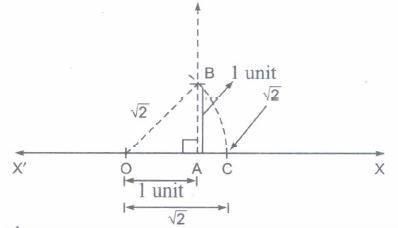
Now, OAB is a right triangle.
∴ OA2+ AB2 = OB2
or 12 + 12= OB2
or 2 = OB2
⇒ OB = \(\sqrt{2}\)
With centre O and OB as radius, draw an arc intersecting OX at C.
Thus, OC = \(\sqrt{2}\) on the real line XOX'.
34.
We are given that AB = BC and have to prove that
DE = EF.
Let us join A to E intersecting m at G.
Let trapezium ACFD is divided into two triangles, namely ΔACF and ΔAFD.
In ΔACF, it is given that B is the mid-point of AC(AB = BC) and BG II CF (Since m || n)
So, G is the mid-point of AF (By the converse of midpoint theorem)
Now in ΔAFD, we can apply the sam argument as G is the mid-point of AF, GE IIAD so E is the mid-point of DF
i.e., DE = EF
In otherwords l, m and n cut off equal intercepts on q also.
35.
Let the sides of wall are a=122m, b=22m and c=120 m.
Then, semi-perimeter, \(s=\frac{a+b+c}{2}=\frac{122+22+120}{2}=\frac{264}{2}=132m\)
Now , area of the wall=\(=\sqrt{s(s-a)(s-b)(s-c)}\)
\(=\sqrt{132(132-122)(132-22)(132-120)}\)
\(=\sqrt{132\times10\times110\times12}=\sqrt{11\times12\times10\times11\times10\times12}\)
\(=11\times 12\times10=1320m^2\)
Given, earning on 1 m2 per year=Rs5000
ஃ Earning on 1320m2 per year=1320 x 5000=Rs6600000
Now, earning in 12 months =Rs 6600000
ஃ Earning in months\(=\frac{6600000\times3}{12}=Rs1650000\)
Hence, the rent paid by the company for 3 months is Rs 1650000.
36.
Given In right angled \(\triangle ABC,\angle C=90^{ 0 }\) M is the mid-point of AB AM=MB and DM =CM
To Prove (i) \(\triangle AMC,\cong \triangle BMD\)
(ii) \(\angle DBC\) is a right angle
(iii) \(\triangle DBC=\triangle ACB\)
(iv) \(CM=\frac { 1 }{ 2 } AB\)
Proof (i) In \(\triangle AMC,\triangle BMD\)
AM=BM [given]
mc=dm [given]
and \(\angle AMC=\angle DMB\) [vertically opposite angles]
\(\therefore \triangle AMC=\triangle BMD\) [by SAS congruence rule]
(ii) From part (i)
\(\triangle AMC=\triangle BMD\)
Then AC=DB
and \(\triangle ACB=\triangle BDM\)
which are alternate angles.
\(\therefore BD||CA\) and BC is a transversal
Then \(\angle ACB+\angle DBC=180^{ 0 }\)
\(\Rightarrow 90^{ 0 }+\angle DBC=180^{ 0 }[\therefore \angle C=90^{ 0 }]\)
\(\Rightarrow \angle DBC=90^{ 0 }\)
Hence \(\angle DBC\) is a right angle
(iii) In \(\triangle DBC,\triangle ACB\)
DB=AC[Proved above]
BC=BC[common side]
and \(\angle DBC=\angle BCA\)[each 900.]
\(\therefore \angle DBC\equiv \angle BCA\) [by sas congruence rule]
(iv) From part (iii)
\(\triangle DBC\equiv ACB\) [by CPCT]
\(\Rightarrow CM+MD=AB[\therefore CD=CM+MD]\)
\(\Rightarrow CM+CM=AB[\therefore DM=CM]\)
\(\Rightarrow 2CM=AB\)
\(\therefore CM=\frac { 1 }{ 2 } AB\)
Hence proved
37.
We know that “If two angles and the included side of one triangle are equal to two angles and the included side of the other triangle, then the two triangles are congruent.” – This is ASA Congruence Rule
So, Reason is correct
Now, In triangles ABC and PQR,∠A = ∠P, ∠C = ∠R and AC = PR.
∴ By ASA congruence criteria, Δ ABC ≅ Δ PQR
So, Assertion is also correct.
Correct option is (a) Both assertion (A) and reason (R) are true and reason (R) is the correct explanation of assertion (A).
38.
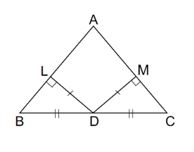
We know that “If two angles and the included side of one triangle are equal to two angles and the included side of the other triangle, then triangles are congruent.” - This is ASA Congruence Rule.
So, Reason is correct.
In △BDL and △CDM, we have
BD = CD (D is midpoint)
DL = DM (Given)
and ∠BLD = ∠CMD (90° each)
∴ △BDL ≅ △CDM (RHS criterion)
⇒ BL = CM (CPCT)
So, Assertion is also correct
Correct option is (b) Both assertion (A) and reason (R) are true and reason (R) is not the correct explanation of assertion (A).

9th Standard CBSE Syllabus & Materials
9th Standard CBSE
CBSE 9th Mathematics Introduction to Euclid's Geometry Sample Question Papers Study Material - QB365 Set A
NEW9th Standard CBSE
CBSE 9th Mathematics Linear Equations in Two Variables Sample Question Papers Study Material - QB365 Set A
NEW9th Standard CBSE
CBSE 9th Mathematics Coordinate Geometry Sample Question Papers Study Material - QB365 Set A



NCERT Books

Syllabus

Exam Pattern

Sample Question Papers

Previous year Question Papers

Important Notes

MCQ Practice test

NCERT Exemplers

Case study Questions

Image Based Questions

Passage based Questions

HOT Questions

Value Based Questions

Model Questions Papers
NCERT ( Book Back ) Questions

Assertion and Reason
Important Questions And Answers

CBSE 9th Standard CBSE Subjects
CBSE Standards