
 100% FREE ACCESS
12th Standard CBSE Syllabus & Materials
12th Standard CBSE
CBSE 12th Economics Government Budget and the Economy Previous year Question Papers Study Material - QB365 Set A
NEW12th Standard CBSE
CBSE 12th Computer Science Interface Python with MySQL - New Previous year Question Papers Study Material - QB365 Set A
NEW12th Standard CBSE
CBSE 12th Computer Science Database Concept - New Previous year Question Papers Study Material - QB365 Set A
NEW12th Standard CBSE
CBSE 12th Computer Science Data Communication - New Previous year Question Papers Study Material - QB365 Set A
NEW12th Standard CBSE
CBSE 12th Computer Science Data Structures - New Previous year Question Papers Study Material - QB365 Set A
NEW12th Standard CBSE
CBSE 12th Computer Science Functions - New Previous year Question Papers Study Material - QB365 Set A

Published on: 28/09/2019
General Principles and Processes of Isolation of Elements
Download CBSE Class 12th Standard CBSE Chemistry question papers, sample papers, important questions, and previous year solved papers in PDF format. Get free study materials, NCERT solutions, and exam preparation resources for Class 12th Standard CBSE Chemistry
Questions + Answers key
Take MCQ Chemistry Test
1.
Why is the reduction of a metal oxide easier if the metal formed is in liquid state at the temperature of reduction?
2.
Cinnabar and Galena on roasting often give their respective metals but Zincblende does not. Explain.
3.
Explain the role of
(i) cryolite in the electrolytic reduction of alumina.
(ii) carbon monoxide in the purification of nickel.
4.
Explain how the following changes are brought about:
(i) Pig iron into steel
(ii) Zinc oxide into metallic zinc
(iii) Impure titanium into pure titanium
5.
Discuss the electrolysis of fused alumina for obtaining aluminium.
6.
Which types of ores can be concentrated by magnetic separation method. Give two examples.
7.
Describe the role of the following:
(i) NaCN in the extraction of silver from a silver ore.
(ii) Iodine in the refining of titanium
(iii) Cryolite in the metallurgy of aluminium
8.
State the role of
(i) depressant in froth floatation process.
(ii) silica in the metallurgy of copper.
(iii) graphite rod in the electrolytic reduction of alumina.
9.
Write the reactions involved in the following processes:
(i) Leaching of bauxite ore to prepare pure alumina.
(ii) Refining of zirconium by van Arkel method.
(iii) Recovery of gold after gold ore has been leached with NaCN solution.
10.
How can you obtain pure alumina form a bauxite ore associated with silica? Write the reactions involved in this process.
11.
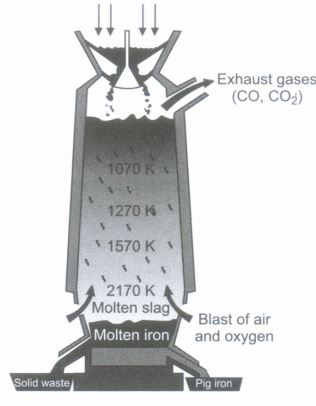
Write down the reactions taking place in different zones in the blast furnace during the extraction of iron.
12.
At a site, low grade copper ores are available and zinc and iron scraps are also available. Which of the two scraps would be more suitable for reducing the leached copper ore and why?
1.
The entropy is higher if the metal is in liquid state than when it is in solid state. The value of entropy change (DS) of the reduction process is more on positive side when the metal formed is in liquid state and the metal oxide being reduced is in solid state. Thus the value of DrG V becomes more on negative side and the reduction becomes easier.
2.
On roasting al these sulphide ores are partly converted into their respective oxides. Since the oxides of mercury and lead are unstable while that of zinc is stable., therefore, oxides of mercury and lead bring about the reduction of their respective sulphides to the corresponding metals but zinc oxides does not reduce ZnS to Zn metal\(\begin{aligned} &\mathrm{HgS}+2 \mathrm{HgO} \stackrel{\Delta}{\longrightarrow} 3 \mathrm{Hg}+\mathrm{SO}_{2} \end{aligned}\)
(unstable)
\(\mathrm{PbS}+2 \mathrm{P} \mathrm{bO} \stackrel{\Delta}{\longrightarrow} 3 \mathrm{~Pb}+\mathrm{SO}_{2}\)
(unstable)
\(\mathrm{ZnS}+\underset{(\text { stable })}{2 \mathrm{ZnO}} \stackrel{\Delta}{\longrightarrow} 3 \mathrm{Zn}+\mathrm{SO}_{2}\)
3.
(i) Cryolite reduces the melting point of Al2P3 and thus increases electrical conductivity.
(ii) Carbon monoxide reacts with crude nickel to form nickel tetracarbonyl Ni(CO)4 which on heating, gives pure nickel, whereas impurities do not react.
4.
(i) Pig iron is converted to steel by reducing its carbon content from about 5% to between 0.2 to 1.5% depending upon the quality of steel to be prepared. The basic principle of the method is to pass a blast of hot air or oxygen diluted with either steam or carbon monoxide through molten pig iron in a converter. The impurities react with oxygen and raise the temperature to above 2000K and these are completely burnt off. Since carbon is oxidised to CO it burns with a blue flame at the mouth of the converter. When the carbon is oxidised, calculated amount of other metals such as Mn, Cr, Ti, or W are added to get steel of desired quality.
(ii) Zinc oxide is reduced to zinc by heating with crushed coke at 673K in vertical fire clay retorts.
\(ZnO+\underset { Coke }{ C } \overset { 673\quad K }{ \longrightarrow } Zn+CO\)
The vapours of zinc formed are collected and condensed.
(iii) Impure titanium is converted to volatile unstable compound by heating with iodine at 523 K taking care that the impurities are not affected during compound formation. The compound thus formed is decomposed to get the pure metal.
\(\underset { Impure }{ Ti+2{ I }_{ 2 } } (g)\overset { 523\quad K }{ \longrightarrow } TiI_{ 4 }(g)\overset { 1700\quad K }{ \longrightarrow } Ti+\underset { Pure }{ 2{ I }_{ 2 } } (g)\)
5.
The alumina is dissolved in molten cryolite and is electrolysed in an iron tank lined inside with carbon. The molten cryolite (Na3AlF6) decreases the melting point to about 1173 K and also increases the electrical conductivity. The process of electrolysis is carried in an iron tank having a lining of carbon, which acts as the cathode. The anode consists of a number of carbon rods which dip in the fused electrolyte. The electrolyte is covered with a layer of powdered coke. The overall reaction is \(2{ Al }_{ 2 }{ O }_{ 3 }+3C\longrightarrow 4Al+{ 3CO }_{ 3 }\)
This process of electrolysis is called Hall Heroult process. During electrolysis the following reactions occur:
At cathode:
\({ Al }^{ 3+ }(melt)+{ 3e }^{ - }\longrightarrow Al(l)\)
At anode:
\({ O }^{ 2- }(melt)\longrightarrow O++{ 2e }^{ - }\)
\(\\ C(s)+O\longrightarrow CO(g)\)
\(\\ CO(g)+O\longrightarrow { CO }_{ 2 }(g)\)
Therefore, aluminium is liberated at the cathode and gets collected at the bottom of tank, from where it is removed periodically. The oxygen evolved at the anode combines with the carbon of the anode to produce carbon monoxide. CO either burns to CO2 or escapes out. In this method, for each kg of aluminium produced, about 0.5 kg of carbon anode is burnt
away. Because of the reaction of carbon anodes, these need to be replaced periodically.
6.
The ores in which one of the components (either the ore or the impurity) is magnetic in nature can be separated from the non-magnetic components by magnetic separation method.
For example,
(i) Haematite \(\left( { Fe }_{ 2 }{ O }_{ 3 } \right) \),
(ii) Magnetite \(\left( { Fe }_{ 3 }{ O }_{ 4 } \right) \)
7.
(i) Dil. NaCN forms a complex with Ag2S which on reduction with zinc gives silver metal. Impurities remain unaffected and can be filtered off.
\(Ag_{ 2 }S+4NaC{ N }\rightarrow 2Na[Ag(CN)_{ 2 }]+{ Na }_{ 2 }S\)
\(Na[Ag(CN)_{ 2 }]+Zn\overset { Zn }{ \rightarrow } Na_{ 2 }[Zn(CN)_{ 4 }]+2Ag\)
(ii) Iodine reacts with Titanium to form Titanium iodide which on heating strongly gives pure titanium and iodine back.
\(Ti(impure)+{ 2I }_{ 2 }\rightarrow { TiI }_{ 4 }\)
\({ TiI }_{ 4 }\overset { heat }{ \rightarrow } Ti(pure)+{ 2I }_{ 2 }\)
(iii) Cryolite lowers the melting point of alumina and increases electrical conductivity.
In other words, fused \(Al_{ 2 }{ O }_{ 3 }\) is bad conductor of electricity. Therefore, cryolite (Na3AlF6) is added to purified \(Al_{ 2 }{ O }_{ 3 }\) which reduces the melting point of \(Al_{ 2 }{ O }_{ 3 }\) mixture around 1140 K and also increases electrical conductance.
8.
(i) It prevents certain sulphides like ZnS to enter the froth in presence of PbS, therefore, helps in their separation. Sodium cyanide is used as depressant in the separation of ZnS from PbS.
(ii) It acts as flux.
(iii) Graphite rods act as anode in the extraction of aluminium.
9.
(i) The principle of the froth floatation process is that sulphide ores are preferentially wetted by pine oil, whereas the gangue particles are wetted by water.
(ii) van Arkel Method: It is used to get ultra-pure metals. Zirconium(Zr) is purified by this process. Zr is heated in iodine vapours at about 870 K to form volatile ZrI4 which is heated over tungsten filament at 2075 K to give pure Zr.
\(\underset { Impure }{ Zr(s) } +2{ I }_{ 2 }\overset { heat }{ \underset { 870 K }{ \rightarrow } } { ZrI }_{ 4 }(s)\)
\({ ZrI }_{ 4 }(s)\overset { 2075K }{ \underset { W }{ \rightarrow } } \underset { pure }{ Zr } +2{ I }_{ 2 }\)
(iii) Extraction of gold:
\(4Au(s)+8C{ N }^{ - }(aq)+{ 2H }_{ 2 }O+{ O }_{ 2 }\rightarrow 4[Au(CN)_{ 2 }]^{ - }(aq)+4OH^{ - }\)
\(2[Au(CN)_{ 2 }]^{ - }+Zn(s)\rightarrow [Zn(CN)_{ 4 }]^{ 2- }(aq)+2Au\)
In this reaction, zinc acts as a reducing agent.
10.
Digest the powered ore with conc. solution of NaOH at 473-523 K and 36-37 bar pressure. Al2O3 is leached out as sodium aluminate and SiO2 too as sodium silicate leaving the impurities.
\({ A1 }_{ 2 }{ O }_{ 3 }+2NaOH+{ 3H }_{ 2 }O(l)\rightarrow 2Na[Al(OH)_{ 4 }](aq)\)
The aluminate in solution is neutralised by CO2 gas and hydrated \({ A1 }_{ 2 }{ O }_{ 3 }\) is precipitated.
\(2Na[Al(OH)_{ 4 }]+{ CO }_{ 2 }\rightarrow { A1 }_{ 2 }{ O }_{ 3 }.x{ H }_{ 2 }O+2NaHC{ O }_{ 3 }\)
The sodium silicate remains in solution and hydrated alumina is filtered, dried and heated to get pure \({ A1 }_{ 2 }{ O }_{ 3 }\).
\({ A1 }_{ 2 }{ O }_{ 3 }.x{ H }_{ 2 }O\overset { 1470\quad K }{ \rightarrow } { A1 }_{ 2 }{ O }_{ 3 }(s)+x{ H }_{ 2 }O\)
11.
At 500-800 K
\(3Fe_{ 2 }{ O }_{ 3 }+CO\rightarrow 2Fe_{ 3 }{ O }_{ 4 }+CO_{ 2 }\)
\(Fe_{3 }{ O }_{ 4}+4CO\rightarrow 3Fe_+4CO_{ 2 }\)
\(Fe_{ 2 }{ O }_{ 3 }+CO\rightarrow 2Fe_{ }{ O }_{ }+CO_{ 2 }\)
At 900-1500 K
\(C+CO_{ 2 }\rightarrow 2CO\)
\(Fe_{} { O }_{ }+CO\rightarrow Fe_{ }{ }_{ }+CO_{ 2 }\)
\(C+O_{ 2}\rightarrow { }_{ }+CO_{ 2 }\)
At above 1570 K
\(Fe_{} { O }_{ }+C\rightarrow Fe_{ }{ }_{ }+CO_{ }\)
\(Ca{ CO }_{ 3 }\overset { \Delta }{ \rightarrow } Ca{ O }+CO_{ 2 }\)
\(Ca{ O }+SiO_{ 2 }\rightarrow CaSiO_{ 3 }(slag)\)
Ore, limestone, and coke
12.
Since zinc lies above iron in electrochemical series, it is more reactive than iron. As a result, if zinc scraps are used, the reduction will be fast. However, zinc is a costlier metal than iron. Therefore, it will be advisable and advantageous to use iron scraps.

12th Standard CBSE Syllabus & Materials
12th Standard CBSE
CBSE 12th Computer Science Python Revision Tour I - New Previous year Question Papers Study Material - QB365 Set A
NEW12th Standard CBSE
CBSE 12th Business Studies Planning Important Questions And Answers Study Material - QB365 Set A
NEW12th Standard CBSE
CBSE 12th Business Studies Business Environment Important Questions And Answers Study Material - QB365 Set A
NEW12th Standard CBSE
CBSE 12th Business Studies Principles of Management Important Questions And Answers Study Material - QB365 Set A



CBSE 12th Standard CBSE Subjects
CBSE Standards










